
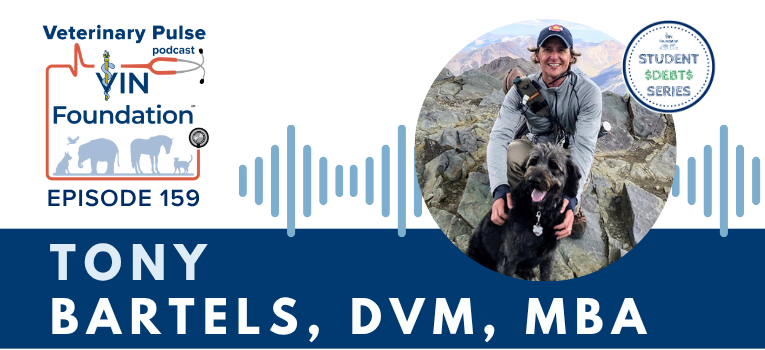
Listen in as student debt expert and Board Member Dr. Tony Bartels in this next installment of our Student Debt Series. This episode we’re going through the latest news from the Supreme Court, the Department of Education response, and what’s next for borrowers. Listen in to learn about the important dates coming up, and make sure to check out the links below to learn more.
As always, we want to hear from YOU. Please share your thoughts by sending an email or joining the conversation.
GUEST BIO:
Dr. Tony Bartels
Tony Bartels, DVM, MBA graduated in 2012 from the Colorado State University combined MBA/DVM program and is a VIN Foundation Board Member and Student Debt Expert, and an employee of the Veterinary Information Network (VIN). He and his wife, a small-animal internal medicine specialist practicing in Denver, have more than $400,000 in veterinary-school debt that they manage using federal income-driven repayment plans. By necessity (and now obsession), his professional activities include researching and speaking on veterinary-student debt, providing guidance to colleagues on loan-repayment strategies and contributing to VIN Foundation resources. Beyond debt, his professional interests include small- and exotic-animal practice. When he’s not staring holes into his colleagues’ student-loan data, Tony enjoys fly fishing, ice hockey, camping and exploring Colorado with his wife, Audra, daughter, Lucy, and their two rescued canines, Addi and Maggie.
LINKS AND INFORMATION:
VIN Foundation Student Debt Tools:
- VIN Foundation Student Debt Center
- Check your current student loan servicers and other loan details — VIN Foundation My Student Loans tool
- VIN Foundation Student Loan Repayment Simulator
- VIN Foundation WikiDebt
Additional links:
- Personalized student loan Help from VIN and VIN Foundation
- Repay Wiser
- Borrow Better
- New Grad Student Loan Repayment Playbook
- Climbing Mt. Debt for Veterinary Interns and Residents
- Federal Student Aid Data, Consolidation, and Repayment Application
- Saving on A Valuable Education (SAVE) replacing REPAYE
- Student Debt Relief Information
- One-time Forgiveness Count Adjustment
- Federal Student Loan Servicers
- Public Service Loan Forgiveness (PSLF)
- Stay up to date with VIN Foundation updates
- VIN Foundation GIVE page to support these programs & tools
- Email VIN Foundation
Join the conversation on Facebook, Instagram, LinkedIn, or Twitter.
If you like this podcast, we would appreciate it if you follow and share. As always, we welcome feedback. If you have an idea for a podcast episode, we’d love to hear it!
TRANSCRIPT
Intro
Tony Bartels, DVM, MBA: There’s so many changes that it’s worth taking a second look at your student loans. If you thought you had a good strategy in place 2 or 3 years ago or 5 years ago, you definitely need to take another look because so much has changed, and you really want to make sure that you’re not leaving any dollars on the table. The sooner that you get switched, the better that’s going to be.
Jordan Benshea: That is student debt expert and VIN Foundation Board Member, Dr. Tony Bartels, and this is the VIN Foundation’s Veterinary Pulse podcast, Special Student Debt series. I’m Jordan Benshea, Executive Director of the VIN Foundation. Join me as I talk with veterinary colleagues about critical topics and share stories, stories that connect us as humans, as animals, as a veterinary community. This podcast is made possible by individuals like you who donate to the VIN Foundation. Thank you. Please check the episode notes for bios, links, and information mentioned. Hey, Tony.
Tony Bartels, DVM, MBA: Hi, back again.
Jordan Benshea: Back again. We’re back with our VIN Foundation Board Member and student debt expert, Dr. Tony Bartels, and we are talking about the latest news in student loans. Man, that’s job security for you, it’s pretty severe.
Tony Bartels, DVM, MBA: Yeah, the head spinning that comes with it though, I mean lately, has been, it’s been a little bit tough to keep up with but.
Supreme Court Decision on Student Loan Forgiveness
Jordan Benshea: I know, and we’ve been waiting for the Supreme Court decision, and that’s what we’re going to kinda kick off this episode with today, is diving right in to the Supreme Court decision that came down on Friday, about student loan forgiveness and then the subsequent response from the Department of Education and all the other details that we have been learning about and Tony and team have been digging furiously into to try and pull out all of it and hopefully make sense of it. Alright, let’s dive right in, Tony. What was the decision from the Supreme Court on Friday in case people are not aware or at least, hopefully, you can give us your view on it.
Tony Bartels, DVM, MBA: Yeah. So they and we’ve been waiting for that for a while, and they waited till the absolute last possible day to release that decision. They ruled against the Biden Administration’s one time cancellation that would have offered up to $20,000 of student loan forgiveness. 20,000 for those people that received a Pell Grant and up to 10,000 for those who had not, as long as they met certain income thresholds. But all of that is kind of moot at this point. So there’s no, you know, the Supreme Court just said that that was too much to do through the executive rule making process and that they were going to have to, Congress was going to have to authorize that essentially. So, there will be no one time cancellation, at least as it was outlined previously.
Department of Education’s Response
Jordan Benshea: What was the Department of Education’s response?
Tony Bartels, DVM, MBA: Yes. I think, they claimed to have been shocked. I don’t know that they were terribly shocked because it looked like they had quite the backup plans ready to go. So they disagreed with the Supreme Court’s decision, that’s fine. But ultimately, that’s kind of the last say on that particular issue. But it did set in motion a whole host of plans going forward. So first they initiated a committee to see if there were some other ways that they can get through something that resembles that one time cancellation benefit. So that announcement will kind of set forth a new committee under the Higher Education Act and try to do some executive rulemaking around maybe a one time cancellation. But I wouldn’t hold out too much hope on that, we’ll see where that goes. But some of the other things that they set in motion were around proposed changes that have already gone through that process. So if you’ve been following along some of these podcasts and some of the information that the foundation puts out previously, we’ve been talking a lot about proposed changes, and after the Supreme Court ruled against the cancellation benefit, some of those proposed changes are going to take effect sooner rather than later. That was probably the biggest surprise that I saw. I wasn’t really anticipating that we would see some of those proposed changes take effect so quickly, but it sounds like we’re going to see the updates at least to the Revised Pay As You Earn plan take effect before student loan payments start back up later this fall. So that’s going to be super beneficial for anyone who can benefit from the Revised Pay As You Earn plan.
Jordan Benshea: Let’s pause it for a second, I want to jump back and say, if somebody did apply for forgiveness, obviously we know now they’re not getting it, but is there anything they should do?
Tony Bartels, DVM, MBA: No. There’s nothing they need to do. So that particular road is closed, if you will. So even if you applied or didn’t apply, it really doesn’t matter anymore because there’s no scenario where what had been proposed is going to be allowed to go through in that manner. So we’re now on to, like, plan B, C, D here.
Jordan Benshea: Okay. So if there does become a plan that somehow does pass for forgiveness, there’s going to be a whole new application process starting fresh.
Tony Bartels, DVM, MBA: Absolutely. Yeah. So whatever comes out of that committee to the extent that they decide they can go down a similar pathway, there’ll probably be a whole new application process, provided there’s something to apply for. So that whole thing is, the way that they had that structured just is kinda dead, if you will. Then we’ll see if they’re able to resurrect that particular kind of benefit in a different form in the not so distant future.
Jordan Benshea: Okay.
Revised Pay As You Earn (RePAYE) and SAVE Plan
Jordan Benshea: So now we’ve been hearing about these changes to RePAYE, and you sort of alluded to it. So let’s talk about this introduction of what we’re hearing the word SAVE. So help our audience understand what is SAVE. Is this replacing RePAYE? How does this work?
Tony Bartels, DVM, MBA: Exactly. So yes. So they gave it a new name, which is great because the name that we had been going with, we were calling it Revised Pay As You Earn, which was kinda silly. So, thankfully, we can give it its official name, which is called, it’s under the acronym SAVE, and I’m trying to find what that actually stands for here, the Saving on A Valuable Education, SAVE. So that’s going to be what RePAYE is known as going forward. So anybody who’s currently using RePAYE will automatically be enrolled in this SAVE program, and anybody who is interested or would benefit from it can apply separately. It’s an income driven repayment plan, so you would apply under the income driven repayment section on the studentaid.gov website, and you would apply for either RePAYE or SAVE. I looked today, I didn’t see that they had the SAVE language in the income driven repayment application just yet, but I imagine that’s probably coming soon. So you can think of RePAYE, Revised Pay As You Earn, and SAVE as pretty much the same plan.
Jordan Benshea: Okay, and we’ll put links to everything that we know now in the episode notes as always, so you guys can check it out. Alright, so we’ve got no forgiveness, we’ve got a new plan, SAVE, and we’re also hearing a lot of dates.
Important Dates for Borrowers
Jordan Benshea: So let’s go over the important dates that borrowers need to know now.
Tony Bartels, DVM, MBA: So the important dates on the horizon, September 1st, the interest will get turned back on. So we’ve all enjoyed more than 3 years of no interest and no payments on our federally held student loans, so the interest switch is going to get flipped on September 1st. So interest will start accruing as it did previously on all of our remaining federal student loan principal, and then payments will start up shortly thereafter. So October, you should receive a statement from your loan servicer in August or September that says what your first payment will be after the end of these pandemic forbearance benefits, that will be due sometime in October. So there’ll be, October will be your first minimum monthly payment that’s due. I would highly recommend that everybody log in to their loan servicer account and get familiar with, make sure all that information is correct, the repayment plan that you’re using, the minimum monthly payment, your address, phone number, email, turn on the autopay feature. So if you’ve been using autopay in the past, all of that got disconnected, so you’re going to have to reconnect the autopay feature, and I would recommend you do so because you’ll receive a 0.25% interest rate reduction, and you don’t have to worry about making your payments on time either. So it’ll automatically deduct that minimum monthly payment once that due date hits.
Jordan Benshea: Yeah. That’s a really good suggestion. It’s always making sure that your contact information is up to date, so if they are reaching out to you, then you’re hearing it, and the autopay is another huge benefit. Okay, there’s also another date that we’ve had in our emails and we’ve been talking about, but December 31st, so let’s talk about that.
Tony Bartels, DVM, MBA: December 31st, yeah.
One-Time Forgiveness Count Adjustment
Tony Bartels, DVM, MBA: So and probably the benefit that got the least press is the one time forgiveness count adjustment, and if you’ve, again, been following these along or you’ve read any of the information that we publish on the foundation site, this is the biggest benefit of all of them, and that’s still in place. It wasn’t impacted by the Supreme Court decision, this is an entirely different benefit that was put forth. Essentially, they’re going to go back in time and any amount of student loan time and even some deferment and forbearance time will be credited as if your loans were in repayment, and that time will be counted as forgiveness eligible time. So a lot of our colleagues have had some really interesting pathways to and through veterinary school where you’ve had some loans from undergrad, maybe a few years off before you went to veterinary school, and then been in repayment, maybe using a variety of different repayment plans after you graduated veterinary school. All of that time, at least the time that’s not spent in school, can be considered forgiveness eligible, and we’ll find out what that count adjustment number is sometime next year. Right now, some of you that have older loans, this is really beneficial for those of you that have older loans. So if you graduated veterinary school 2014 or earlier, you might have some older school loans that might not have benefited from a lot of the newer income driven repayment plans. If you consolidate those loans, you can still get the past repayment time credited as forgiveness eligible, it won’t reset the clock even if you include other loans that do have some forgiveness time. That consolidation will make your loans eligible not only for the one time count adjustment, but also for this new version of RePAYE, AKA SAVE, that’s going to be more beneficial going forward. So there’s a little bit of an intersection between some of these older and newer benefits, but if you want to have your loans considered in the one time count adjustment, you could possibly transfer some older repayment time onto your newer loans by consolidating them. You have to consolidate them before December 31st, or you have to apply for consolidation before December 31st. But I wouldn’t wait until the last possible day. It’s going to be better to consolidate your loan sooner rather than later, particularly after interest starts, because once interest starts accruing again, when you consolidate your loans, they’ll take whatever that interest is and it’ll add it to your principal. So if you do it now before interest starts back up, you’ll avoid some of that additional interest capitalization as part of the consolidation process.
Jordan Benshea: Okay, and then the next thing and that we’re going to, again we’ll put all these links, but another date that we keep hearing about is your IDR anniversary date.
Income-Driven Repayment Renewal
Jordan Benshea: So people might be wondering when is the income driven repayment renewal date going to happen?
Tony Bartels, DVM, MBA: Yeah, this is part of what I call the student loan physical exam. So if you want to know what’s going to happen come October or if you want a head start on knowing what your minimum monthly payment is, you can go get your student aid data file from studentaid.gov and then upload it into the VIN Foundation My Student Loans tool. If you’re using an income driven repayment plan, you’re going to have an anniversary date or an income driven repayment recertification date. Those dates have been pushed significantly forward because of all the extensions to the pandemic forbearance benefits. Nobody has been required to renew their IDR. information during the forbearance period, and nobody will be required to provide additional income information until at least after February of 2024. So if you have a very favorable minimum monthly payment under an income driven plan now, leave it. You want to keep that payment as low as possible for as long as possible, because that’s more favorable if you are on a track to reach forgiveness. So you want to see what that anniversary date is, if you see a date that’s in the past or one that’s between now and the end of the year, you can pretty much add a year to it until you get beyond February 2024, and that will be your next anniversary date, the next time you’re actually required to provide updated income information to have your payment adjusted. Now, a couple of caveats there.
Lowering Payments with Updated Income Information
Tony Bartels, DVM, MBA: If your income has decreased, so if your current income would produce a minimum monthly payment that’s lower than what you see in that file now, then you can provide or should provide updated income information so your payment is lower when payments resume and you have first payment is due in October. So if your payment would be lower because your income has decreased since the last time you renewed, then go ahead and update that before payments start back up again.
Automatic Enrollment in SAVE Plan
Tony Bartels, DVM, MBA: If you’re already using RePAYE when payments start back up in October, you won’t need to do anything and your payment will automatically be decreased because the way the new version of RePAYE, AKA SAVE, is going to work is that it’s going to subtract off a larger living expense allowance in the discretionary income formula. So you’ll have a lower monthly payment compared to what RePAYE generated previously. You don’t need to do anything for that if you’re already using RePAYE, the Department of Education is saying that you’re going to be rolled into this SAVE program and your payment will be automatically adjusted based on that new discretionary income formula, which means it will be lower than it was previously.
Jordan Benshea: So if you’re in RePAYE, you will be automatically enrolled and sort of rolled into SAVE, Saving on A Valuable Education plan, and there’s nothing anybody needs to do for that.
Tony Bartels, DVM, MBA: Correct.
Jordan Benshea: Okay, gosh. There’s so much to think about.
Requesting Refunds for Pandemic Payments
Jordan Benshea: Now one more thing that as we’re getting really close to payments starting again, we have been saying that, this is really the best time to not make payments and save your money. Now we’re about to start payments again, but if people have made payments, we want to remind them that they can request a refund.
Tony Bartels, DVM, MBA: That’s correct, and it’s a great reminder. So, yes, as part of the pandemic forbearance benefits, any payments that you’ve made to those federally held loans during that pandemic forbearance window, so any payment that you made on a federally held loan from March 13th of 2020, through the end of the forbearance benefit period, you can request a refund. So you do that through your loan servicer, I would recommend that you call them and ask for that refund to you. Actually, we saw, there’s some interesting language in the, I came across the other day on the buried in the morass of Department of Education words on all of this stuff, but even if you have an employer that’s been providing or somebody else has been paying towards your student loans, if you request a refund, they’re going to send you a check for that for those funds.
Jordan Benshea: That’s interesting.
Tony Bartels, DVM, MBA: So they don’t have a way of sending the money back to the official person who made it. It’s because the loans are in your name. Any payment that was made to those loans during that pandemic forbearance window will be refunded to you, they’ll cut a check to you. So, sometimes those employer provided benefits, those payments to your student loans are not the best use of funds, particularly if you’re on a pathway to reach forgiveness. So if you’re pretty confident you’re going to reach forgiveness, your debt to income ratio is greater than 2 and you’ve been in repayment for a while, that’s a pretty good indicator you could request a refund of those payments, even those employer payments, and they’ll cut you a check.
Jordan Benshea: Oh, that’s really interesting. That’s good to know.
Important Dates and Deadlines
Jordan Benshea: Okay, are there any dates that we’ve missed at this point? I mean, we’ve covered a lot of them.
Tony Bartels, DVM, MBA: Yeah. I just want to clarify, so the requesting a refund, I’m presuming that once the forbearance benefits end at the end of August, that you’re not going to be able to request a refund.
Jordan Benshea: That was going to be a question. Is there a deadline for that? Yeah.
Tony Bartels, DVM, MBA: I have not seen any language talking about that, but if you want to be safe, then request a refund before the end of August, because I think after that, my guess is they’re going to stop processing those refund requests. But I don’t know that for sure, but we’ll find that out. But, again, if you don’t want to gamble and you want to make sure that you get that refund, then I would get that request in before the end of August.
Jordan Benshea: Okay. What other, we’ve gone through a lot already, but what other important changes do borrowers and our audience need to know about?
Phasing Out Pay As You Earn
Tony Bartels, DVM, MBA: One to just kinda stick a pin in as part of the proposed changes, so not only were they going to update RePAYE, which is going to happen before payments resume, but they’re also going to phase out Pay As You Earn. Now we did get the date on that as well, which is July 1st of 2024. So it’s kind of nice that you actually have this staggering of we’re going to have the new version of RePAYE, what’s going to be known as SAVE, is going to take effect as payments start back up. But you’ve got another year to decide on whether or not you want to maybe stick with free pay or stick with Pay As You Earn before PAYE gets phased out. So Pay As You Earn is going to get phased out, if you’re using it when those changes take effect you can keep using it. But after July 1st of next year, if you’re not using Pay As You Earn and you’re eligible for it, you won’t be able to get back into it or to select it as a repayment plan. So it’s something to just kind of stick on the horizon for now. But for those of you that are either using Pay As You Earn and are like, ooo, maybe I want to try this new version of RePAYE. You could do that for a year because we also had another date for you, on July 1st the capitalization of unpaid interest has gone away, in most cases. So if you switch from a plan like Pay As You Earn to Revised Pay As You Earn, and then maybe back from Revised Pay As You Earn or SAVE to Pay As You Earn, there will be no unpaid interest capitalization, in that scenario.
Changes to Income-Based Repayment Plans
Tony Bartels, DVM, MBA: Now, if you are using the older version of IBR, which I know a lot of you are because that was a better plan for you than Revised Pay As You Earn was, some good news, bad news. The changes to Revised Pay As You Earn will allow you to separate your income from your spouse when you’re married, which is a huge improvement to RePAYE. So you can have a lower monthly payment, still have the payment calculated only on your income if you’re filing your taxes separately from your spouse. But unfortunately, when you switch from income based repayment to any other plan, if you have any unpaid interest it’s going to get capitalized. So they couldn’t make that capitalization event go away. They eliminated it in all other cases that they could, but leaving IBR is not a case that they can eliminate capitalization of interest, nor is leaving a deferment or most deferments, so you want to stay away from deferment. But some good news there for anybody who was using the old version of IBR because they were married and it produced the lowest monthly payment if they filed separately. This new version of RePAYE or SAVE is going to be a significant improvement for you, but it will come with that unpaid interest capitalization. Good news, you can simulate that using the VIN Foundation Student Loan Repayment Simulator, and you can see if that capitalization event still justifies you switching. In nearly every case, it will because that new version of RePAYE is that much better. So even if you have a lot of unpaid interest, it’s still going to be more beneficial to switch than to stick with that older version of IBR.
Benefits of the New SAVE Plan
Tony Bartels, DVM, MBA: The reason for that is because this new version of RePAYE, what’s going to be called SAVE, has a 100% unpaid interest subsidy. So we’ve been kinda chomping at the bit to know when this is going to go live, and it’s really exciting that it’s going to go live before payments start here because there will be no more unpaid interest. So one of the biggest knocks on income driven repayment was like, I hate making payments to my loans and watching the balance increase. Under this new version of RePAYE, that is gone, that’s no longer a thing. If your minimum monthly payment is below the monthly interest accrual, the government’s going to cover 100% of that unpaid interest that would normally accrue. So there will be no more growth to your balance, provided you’re using that new version of RePAYE or SAVE.
Jordan Benshea: Which I think psychologically is just a huge, huge shift.
Tony Bartels, DVM, MBA: Oh, huge. That’s yep, huge benefit.
Jordan Benshea: Yeah, that’s a huge benefit for people because I think that that’s, what is it that you call it? The statement syndrome?
Tony Bartels, DVM, MBA: Traumatic statement syndrome. Yeah, it was one of the worst parts of student, of income driven repayment is that you’d make payments and you’d watch your loan balance increase. And I was, there was always, and because of the way these plans have evolved and the timing and, a lot of it doesn’t necessarily make sense, but there was always a really large group of folks who were married. For them, that older version of IBR was their best repayment plan, it’s nice for them to have some relief through this new version of RePAYE. So that part is going to be huge, but it’s going to take a lot of communicating and trying to reach out to those folks, because for so long we had been telling them, look, you’re just kinda stuck here until there’s something better, and now there’s something better. So that’s good.
Staying Updated and Seeking Help
Jordan Benshea: Okay, I think we’ve covered a lot. What other information do you feel that colleagues need to know?
Tony Bartels, DVM, MBA: I would say it’s, you have to ask questions. You have to pay attention, do a good physical exam of your student loans. If you need some help, we can do that with you over on the VIN and VIN foundation Student Debt Message Board areas. We provide that kind of assistance for any veterinarian or veterinary student who’s looking for it. But there’s so many changes that it’s worth taking a second look at your student loans. If you thought you had a good strategy in place 2 or 3 years ago or 5 years ago, you definitely need to take another look because so much has changed, and you really want to make sure that you’re not leaving any dollars on the table. The sooner that you get switched, the better that’s going to be.
Jordan Benshea: Okay, and we, as always, colleagues can get updates on the VIN Foundation website, sign up for the emails. Highly encourage that, we’re sending out one today. In this podcast, we’ll put the episode notes and links as always.
Outro
Jordan Benshea: Tony, thank you for your tireless effort in keeping us updated and scouring the information, and hopefully helping our colleagues get some sort of understanding of the situation.
Tony Bartels, DVM, MBA: Great. Well, thank you, and please be patient with us as we try to keep updating all of the information we put out there with all the changes too. I mean, I know the simulator still has RePAYE in there, but we’re going to try to get switched over to SAVE. I’ve been trying to update a lot of the blog posts and content that we have to reflect all of the changes that have been made, but it’ll take a little bit of time to get through all that. So if you notice something that doesn’t maybe sound quite right, that’s what’s so great about these podcasts, so we can put this information out there as we know it right now. If you see something on the website that doesn’t quite jive, just please ask. That’ll help us to find that content that we need to update faster.
Jordan Benshea: Yeah. Please reach out. We’re always, of course, always ways that we can improve. You can email [email protected], or just reach out to us in the various ways that we give you links to, and let us know how we can improve that or what information needs to be updated. Thank you so much, Tony.
Tony Bartels, DVM, MBA: Yeah. Thank you. Thanks again for having me, and I’m sure we’ll be back in not too long. Well, thank you, Jordan.
Jordan Benshea: Thanks. Thank you for joining us for this episode of the Veterinary Pulse. Please check the episode notes for additional information referenced in the podcast. If you enjoyed this podcast, please follow, subscribe, and share a review. We welcome feedback and hope you will tune in again. You can find out more about the VIN Foundation through our website, VINFoundation.org, and our social media channels. Thank you for being here. Be well.