
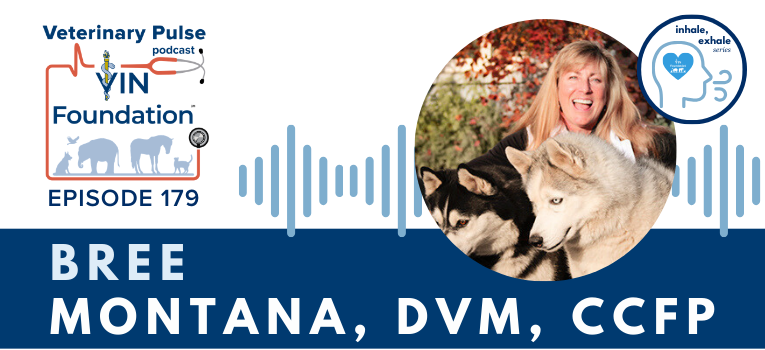
Listen in as we chat with VIN Foundation Vets4Vets® team lead Dr. Bree Montana as part of our Inhale, Exhale Series and this time were talking about preventing burnout and compassion fatigue
In this episode we have six major topics we’re addressing:
- Identifying burnout and compassion fatigue
- Understanding the cause
- Task switching
- How to handle feelings of losing the joy and fulfillment of vet med
- The importance of team culture
- How to get support
As always, we want to hear from YOU. Please share your thoughts by sending an email or joining the conversation.
GUEST BIO:
Dr. Bree Montana, DVM, CCFP
Bree Montana, DVM, CCFP, is a small animal practitioner and Founder of the Agate Bay Animal Hospital and Dog Gone Crazy boarding/training facilities in North Lake Tahoe California. Following the completion of a B.S. in Biology at the University of Cincinnati’s McMicken College, Dr. Montana graduated from the Ohio State University’s College of Veterinary Medicine with a Doctorate in Veterinary Medicine in 1992. A past member of the external advisory and admissions committees for UC Davis’ College of Veterinary Medicine, Dr. Montana also served as a working member of the VIN Foundation Board. In 2010, Dr. Montana helped to create the VIN Foundation’s innovative Vets4Vets® program, a confidential support group providing critical emotional care to veterinarians struggling with all forms of stress/addiction/mental health issues. The program is international and free for all veterinarians and veterinary students. Learning to balance the life of a rural solo practitioner, mom, wife, husky wrangler and aspiring dressage queen while coordinating the Vets4Vets® program has allowed Dr. Montana to become an expert at thinking outside of the box when advising veterinarians who feel stuck in their careers and personal lives. Dr. Montana enjoys lecturing on topics at the intersection of personal and professional life balance, including strategies for a healthy mentoring relationship, job seekers’ success techniques, effective communication in the workplace, as well as teaching the workplace ergonomics section of The Other Side of Veterinary Medicine: Healthy Clinicians Make Better Practitioners (a RACE approved course).
LINKS AND INFORMATION:
VIN Foundation Veterinary Pulse Podcast Future’s So Bright Series
VIN Foundation GIVE page to support these programs & tools
You may learn more about the VIN Foundation, on the website, or join the conversation on Facebook, Instagram, and LinkedIn.
If you like this podcast, we would appreciate it if you follow and share. As always, we welcome feedback. If you have an idea for a podcast episode, we’d love to hear it!
TRANSCRIPT
Intro
Bree Montana, DVM, CCFP: Burnout and compassion fatigue are the underlying cause of so many of us having this, like really scary feeling that we’ve spent all of this time and money and we’ve given our heart to becoming veterinarians, and then we get into our job and suddenly we start to have these feelings that maybe we don’t belong here. Sometimes folks might feel like they’re not getting the fulfillment that they need. People worry that they’re in the wrong hospital. And even scarier is when we worry that we’re in the wrong profession, that we spend all of our time and energy diving hard and swimming as hard as we can towards this goal, and we achieve the goal and then it’s not giving us the fulfillment or the joy that we had expected.
Jordan Benshea: That is VIN Foundation’s Vets4Vets® Team Lead, Dr. Bree Montana, and this is the VIN Foundation’s Veterinary Pulse podcast special Inhale, Exhale series. I’m Jordan Benshea, Executive Director of the VIN Foundation. Join me as I talk with veterinary colleagues about critical topics and share stories, stories that connect us as humans, as animals, as a veterinary community. This podcast is made possible by individuals like you who donate to the VIN Foundation. If you enjoy this podcast and want to hear more stories, you may support these efforts with a donation at VINFoundation.org/give. Thank you. Please check the episode notes for bios, links and information mentioned. Welcome back here to our listeners, and I’m really excited that today we have Dr. Bree Montana joining us. She is our VIN Foundation, Vets4Vets® Program Team Lead. You also might remember her from the Future So Bright podcast series. We have more episodes of that coming up to give you an update on where Dr. Montana is on her journey. It’s very exciting. And here we are back for the Inhale, Exhale series where we focus on mental health, and today we are specifically talking about preventing burnout and compassion fatigue. Welcome Bree.
Bree Montana, DVM, CCFP: Hey, I’m so happy to be here. Hi guys.
Jordan Benshea: We’re so happy to have you back.
Five Topics Today
Jordan Benshea: We all have this deep love for veterinary medicine, I am hoping that a majority of our audience does as well, and the animals that it helps. But we do know that it can be very tough on humans, so today we’re going to cover five topics. One is identifying burnout and compassion fatigue. Number two is understanding the cause. And number three is how to handle feelings of losing the joy and sometimes the fulfillment in vet med. Number four, the importance of team culture. And number five, how to get support if you feel like you might need a friend to talk to. So Bree, let’s start with understanding what is the issue.
Bree Montana, DVM, CCFP: Yeah, that’s a really, that’s the key point. Burnout and compassion fatigue are the underlying cause of so many of us having this, like really scary feeling that we’ve spent all of this time and money and we’ve given our heart to becoming veterinarians, and then we get into our job and suddenly we start to have these feelings that maybe we don’t belong here. Sometimes folks might feel like they’re not getting the fulfillment that they need. People worry that they’re in the wrong hospital. And even scarier is when we worry that we’re in the wrong profession, that we spend all of our time and energy diving hard and swimming as hard as we can towards this goal, and we achieve the goal and then it’s not giving us the fulfillment or the joy that we had expected. It’s a terrible feeling and I empathize. I’ve had some dark nights of the soul when I’m like, wow, am I cut out for this? And a lot of this comes from us not getting the fulfillment that we need, not having that right balance of emotional and physical and intellectual output compared to the emotional, physical, and intellectual rewards that we need from our work, because if we’re working really hard and we’re putting out a lot of energy but the energy that’s coming back to us, the feeling of fulfillment, the feeling of joy, the feelings of camaraderie that we have with our teams, I mean, that’s also a big part of it. If we have all of those rewards and that level is really high, it makes up for a high level of difficulty.
Jordan Benshea: Yeah.
Bree Montana, DVM, CCFP: And sometimes it’s a balance.
Jordan Benshea: And it’s definitely a lot of what we hear from colleagues reaching out to our Vets4Vets® program that are just not quite sure. It just seems like something’s a bit off and looking for a friend to talk to and someone that understands what they’re going through.
Defining Burnout vs Fatigue
Jordan Benshea: So let’s start with identifying burnout and compassion fatigue.
Bree Montana, DVM, CCFP: Yeah, good question. So I feel like many of us will, throughout our careers, experience episodic burnout. And if burnout’s handled well, and if it’s managed well, then it’s sort of like a blip on the screen. Burnout’s more difficult stepsister, compassion fatigue, results from the daily emotional strain of dealing with patients and clients without that opportunity to release the psychic trauma and to recover the physical wear that builds up through our busy days. So burnout, that’s something that probably the majority of us are going to experience throughout our careers. We’re trying to juggle busy and trying to have a rich personal life on the outside of the hospital and then we’re also trying to have a rich life that’s fulfilling and rewarding and challenging inside the hospital, and balancing those things we can sometimes get out of balance and not take enough care in our recovery stage and in our healing phase and our enrichment tasks. In our personal life, if we’re not focusing on bringing those two together, then we’re eventually going to burnout in one direction or the other, and that’s burnout. Compassion fatigue results from more trauma, more lack of recovery, more lack of care for ourselves, our inner selves, and we can definitely talk about some specific aspects of that too.
Jordan Benshea: We hear these words thrown around so often, and it’s just really good to be clear on what are those definitions, what does it mean? And so often we think to ourselves, is this something that we’re feeling or is that…I’m just not sure, and so to put some sort of parameters around it can be helpful. Obviously it can look like different things for different people, but some sort of framework is helpful.
Root Causes and Triggers
Jordan Benshea: So let’s now talk about understanding the cause of burnout and compassion fatigue.
Bree Montana, DVM, CCFP: Absolutely, and you just reminded me with that clarification, burnout can be really easily identified as opposed to compassionate fatigue in this way, if you can take a week off, maybe go to a CE or just go to Bimini for a week, and you feel better and you’re recharged and you’re ready to dive back into the hospital, that was burnout. If you took that week off, you have that week in Bimini, and you come back and you’re like, I can no way go to work tomorrow, that’s more likely to be compassion fatigue. And it’s a little bit simple and complex at the same time. For me, the way I like to put it in my brain is, burnout if managed just becomes burnout and you go back to work and you’re happy and everything’s rolling along smoothly. If you’re not recovering properly, then it’s more likely we have compassion fatigue that’s playing a role. And I kind of like to think of it in this way. You’re doing like, let’s pretend like we all are working out daily and we’re working out and our muscles are recovering, we were working out too much and we’re too tired to really have a good workout, that’s burnout. We’re working out, we’re not recovering properly, and all of a sudden we have a stress fracture, that’s compassion fatigue.
Jordan Benshea: That’s a good analogy.
Bree Montana, DVM, CCFP: Yeah, well I know that a lot of us use exercise as a way of managing our burnout and our compassion fatigue. And just like the causes, which I’m going to dive into in a second here, can create the problem, the recovery can also create the problem if we’re not doing it well, if we’re not really fully recovering. So to your question, Jordan, about the things that specifically can cause emotional strain and psychic trauma that lead to burnout and even worse compassion fatigue, let’s talk about those difficult cases, especially when you have case after case piling up upon you and we feel like we can’t properly address the case, especially when we’re pressed for time, we can’t research the cases the way we need to if we have the feeling that we’re not ethically showing up for our patients, that’s probably one of the hardest things for us as professionals and folks that deal with perfectionism or imposter syndrome. That’s the kind of thing that makes that stuff worse. So if we don’t have enough time to adequately address our cases, that really can build and that can pile on the compassion fatigue, that can pile on the burnout. Also, we’ve all had those difficult clients. We’ve had those clients who are too scared, are too worried to behave in a collaborative way, that are behaving really badly, we have clients that can’t afford diagnostics or treatments that their patient needs. This is a heartbreaker for us. We have a dog, a beautiful beloved dog who has something that could be fixed and all we need to do is be able to throw some money at it but there’s no money, that breaks our hearts. And sometimes we’ll have team members that are crispy and they’re not presenting their best selves to us. And of course for me, the worst thing is if I exhibit a behavior that I regret, if I don’t behave in a way that matches the way I see myself or I hope to see myself. And all of those things really can happen in our days. I know, Jordan, you are someone who loves your dog and you take wonderful care of your Zoe and I know that when you go to the doctor you’re compassionate towards the doctor in addition to presenting your cases, but you’ve probably heard of or met people that don’t behave that way when they’re having bad times.
Jordan Benshea: Absolutely, and I’m obviously going into it with a different view because I spend all day every day with amazing veterinarians, and so I have a much different view on it and an appreciation for the challenges and struggles. But I think that has got to be, veterinarians have these incredible talents to do incredible things and to really help animals at unbelievable levels with their knowledge, with all of your knowledge and expertise, and it must be so challenging to have an animal come in, and while we know it’s not enough to love animals for vet med, we also know that there is, at its base, there is, for all veterinarians, there’s this huge love for animals and to not be able to care for that animal that you know that you can care for because you have the expertise, you have the knowledge, you have the capability, and the client is either not willing to participate in the treatment plan that you’ve recommended or will not or cannot put in the funds to support that animal and here you are with your goal to make these animals better, that’s got to be such a challenging dichotomy.
Bree Montana, DVM, CCFP: It’s so painful. It really hurts us where we live. We go into this profession because we love animals, we love that love that people have for their animals, and we love science, and so that perfect intersection of art and science and heart, that’s where we live. And when anything happens to damage that relationship, it hurts us, and so we really need to take time to heal that.
Task Switching Stress
Bree Montana, DVM, CCFP: The good news is that we will talk about some steps to do that in a minute, but I want to also talk about another aspect of most veterinary hospitals that makes it almost impossible for us to avoid burnout, and that’s task switching. So we all have this, well, I used to have, I’ll speak for myself, I’ll out myself as somebody who thought I was really good at task switching and that’s task switching is what we’re doing when we’re multitasking. So I really felt like I was probably the hero of the multitasking world and then it became clear to me that I am in fact not
Jordan Benshea: What? This is news. This is worthy of a press release for sure.
Bree Montana, DVM, CCFP: I’m like, ADHD is my superpower, but apparently it’s not. And what I have learned is I shouldn’t be watching TV when I’m trying to learn something. I shouldn’t be task switching. There’s a ton of research about that because multitasking is sort of something that people are focusing on in the psych world and so they’ve done a lot of really cool deep dive studies into people that are really good at whatever their particular task is. They had them do that same task while they were multitasking or task switching and while they were focusing directly on the task, and they were significantly better at that same task when they were not task switching. We like to think that we’re really good at multitasking, but the reality is, scientifically, when we do that and we hook up all those cool little EEG electrodes to brains and we study what’s happening in the brain while people are trying to task switch versus going straight and solo tasking, we found that it creates and elevates anxiety. It also makes our thought processes really muddled so we’re not actually as good at doing our jobs. And they also have found with these studies that when folks are trying to task switch, in addition to it creating that kind of elevated anxiety, that anxiety that occurs while we’re in that process, it remains afterwards, so we have a heightened level of anxiety after we finish that early, super busy day. So go with me on this journey. You step into work, as soon as you arrive, you had a long drive so of course you need to pee, and before you can do that three people have asked you important questions about things that must be handled immediately. If that is anybody’s experience, raise your hand. It’s definitely always been mine. And that’s the very first step of the kind of multitasking we’re expected to do when we’re at work. We’re still arriving, we haven’t put our backpack down and put our snack in the fridge yet, and we’re already asked to start working. Then we start seeing our patients, and while we are seeing clients, when we come back to the treatment room to put things on the whiteboard or to get some blood drawn, we’re pulled away and asked about the pre-med for our anesthesia patient this afternoon. We’re really trying to figure out what’s going on with the patient in our hand and the client that’s waiting for us in our room. We haven’t finished writing up our chart yet, or even started writing the plans in the chart yet, and meanwhile, we’re being pulled away to do another complex intellectual study, a little exercise. We need to figure out how aggressive is that dog that’s going to have his neuter today, how painful will his procedure be, and figure out all those steps that go to creating an anesthesia protocol. So that’s task switching. That’s the negative aspect of multitasking, and that’s something that we experience on the daily. That increases our level of anxiety, increases our chances of burning out, and can lead to compassion fatigue.
Jordan Benshea: Gosh, and that’s just something that we’re all dealing with, especially in this world currently of just being bombarded with content and information at a speed and level that we’ve never experienced based on the channels that are available for that, and that didn’t used to be so you really have to protect yourself in a lot of those different ways.
Losing Joy Warning Signs
Jordan Benshea: If we have colleagues who are listening and like finding themselves, whoa, that’s totally me, I am absolutely doing this, how do they handle the initial feelings of potentially feeling like they might be losing joy or fulfillment in this job that they know they love?
Bree Montana, DVM, CCFP: Yeah, and that’s the most important part of recognizing burnout or compassion fatigue when we’re relating to our career that we’ve invested our whole selves in and the problem with that. But that task switching, that multitasking, those difficult clients, those difficult cases, all of that is that our joy can be diminished. We don’t have the joy that we wanted. We start to recognize, hey, I’m not really stoked about my job. When the positive experience of joy and reward are outbalanced by the negatives, we become burned out and we can begin to experience that compassion fatigue. And the thing is, Jordan, the burnout and the compassion fatigue, they don’t just live in our workspaces. They don’t just live in our work life. They live in our bodies. So that means that anyone we see and anywhere we go, we’ll carry that negative weight with us. So when we start to say, “Hey, it’s a Monday, it’s going to be Monday tomorrow and I just don’t feel like going to work,” that’s our first sign. If we go home, if we start to notice that, hey, like all the team, our associates or my friend from the other hospital, they’re all headed out to go bowling on Saturday and Saturday’s my day off, but I really want to go bowling, but screw them, man, they’re going bowling, I’m just not. Somebody will love to do that kind of social interaction. So when your social activities change, your energy for that changes when you no longer can get up to go and do the workout after work, and that used to be your happy space, that’s our sign. That’s a sign that we need to really pay attention to what’s happening in our world and start to put into effect some of the treatment plans that actually can work for this, because there are ways that it doesn’t have to be like this for us. It doesn’t have to be hard for us to go to work. It can be joyful always. It can be rewarding always, but we have to do some work to make that happen.
Jordan Benshea: Okay, so let’s start, now that we’ve very clearly identified the problem and
Bree Montana, DVM, CCFP: Yeah, I know it.
Jordan Benshea: Yeah, I know.
Bree Montana, DVM, CCFP: The hard parts over.
Jordan Benshea: So now let’s talk about some different ways to help support colleagues in this.
Team Culture Matters
Jordan Benshea: I’m hearing a lot about not only is it just this individual interaction between the doctor and the client and the patient, but also we go to work with people and people are all products of their own childhood and all come with their own things that they’re going through in every single day, so does team culture play a role in this as well?
Bree Montana, DVM, CCFP: Team culture is the bath that we’re swimming in, and if the bath water’s not comfortable, then we’re not enjoying the bath, and that’s every day. So every day we’re immersed in our team. We’re collaborating with our team. We’re learning with our team. We’re succeeding with our team. We’re failing with our team, and it’s just like if you’re in a team sport and you guys are all playing really well together, but maybe you don’t win the game. You still had a great experience and that’s the way it is for us here in vet med. We are very collaborative people. We rely on our support teams. We rely on the kennel person to tell us that dog looks like he’s in pain. We rely on our veterinary assistant to let us know that client is spicy. We rely on our technicians to help us make really great decisions and manage that pain and manage those procedures. We rely on our management, our upper management to make our schedule decent and help us do the things that we need to do to enjoy this profession, and that’s the thing. So there are solutions that really work to help with this buildup of pressure. There are solutions that can really help to reduce our anxiety and to let us rebalance our challenges and make our rewards a little bit higher and to return ourselves to our joy of practice, and the good news, the good and the bad news is that the solution’s super simple. But with all simple things, the solution requires dedication and commitment to the cause. And of course the cause is our own wellness, and when we focus on our wellness, we also focus on our team’s wellness. So I do want to talk about team culture a little bit because the way the culture is created and that organic, beast that is the team culture, it can be changed. It can be taught. It can be rewarding. The way we handle those things can be rewarding, and I’d love to, Jordan, dive a little bit into the specifics of the solutions.
Jordan Benshea: Yeah, let’s do it. Let’s go into the solutions.
Practical Fixes for Focus
Bree Montana, DVM, CCFP: Okay, so task switching. We need to avoid task switching or multitasking wherever possible. So here’s how we can avoid task switching, and it’s both easy and hard. So rather than allowing our team members to come to us whenever they have a question, somebody calls in and they want to get a refill on a prescription, they have a question about Dodi the dog that you saw last week, all of these things, rather than having them come to you and answering that question while you’re doing whatever you’re doing, encourage your team to create a message space, either in your practice software. I, until I sold my practice a minute ago, I used Avamark and they have a note feature, and so you just go in and you check your notes and you can get your phone calls and you can check all of that stuff so that nobody’s interrupting you. Teach the front desk staff to let clients know that they’ll get an answer to, they will email an answer to the client before the end of day. Or if it’s something more critical, they’ll get an answer to you as soon as you’re finished working with that patient. Whatever it is, teach people to get some delayed gratification, and a key way of doing that is letting them understand when you are doing something that is really task focused that you can’t be distracted from. For those of us like me who experience ADHD, I like to wear sound canceling headphones when I am doing something complicated. If I’m working on a really complex case and I’m writing my chart, so that I’m creating my plan of how I’m going to handle each of the diagnostics that I’ve pulled I’ll put on those sound canceling headphones so that everybody knows it’s a good time to put a note down in my computer instead of tapping me on the shoulder. I’ll also, if I’m having a hard time, if it’s really busy, then I’ll use either some pink noise or some brown noise in my headphones, which pink noise and pink sound and brown sound, you can find apps that are free on YouTube. You can find them online and it’s free, and you’ll just play that music into your head and it allows me to focus more clearly. It distracts the sounds and the activities that are happening outside, and that allows me to stay linearly focused rather than multitasking, and that’s a cultural change that you’ll have to teach your staff to respect. And you’ll also want to do that for them as well. When your technician is pulling up the drugs for that case, you want to not say “hey Sue, when you’re finished with that, will you…” because Sue’s going to be doing that in her head the minute you ask and that could mess up the way she’s doing her math, which is pretty important. So we’re going to try to change things in that way. We’re going to try to teach everyone that it’s okay to linear focus.
Jordan Benshea: Those are really good suggestions of how to help inside of a team.
Finding Support Vets4Vets
Jordan Benshea: Where if colleagues are listening and like, yeah, this is me, I am multitasking, I am task switching multitasking, I have this client and I just want to help, or I don’t know, I’m now questioning if this is the right career for me, is vet med right for me, or all these different questions that kind of come up, what’s the best way for a colleague to get support? Where is there a safe space for them or what does that look like?
Bree Montana, DVM, CCFP: Jordan, such an important question. Where can we go for help? What if we just aren’t sure if we made a mistake? What if we aren’t sure if this is the right particular hospital for us? What if we just need some career guidance? Hey, I’m ready to move on to my next amazing place or if we’re having some challenges of that nature, Vets4Vets® is here for us no matter where we are in our profession. Whether we’re just starting out and we need some guidance or we just need a buddy to listen, venting is hugely helpful and venting in a safe space where it’s not going to be reflected back to us in a negative way, that can be so healing. Having someone to just talk through something to make sure that you’re not crazy, this is something that needs to be changed and here are some tools. We can give you tools to move your career forward, and we’re all here for it, for you, for all of that. Go ahead and pop over to our website and you can walk through there. We have all kinds of support for you and we are here for you.
Jordan Benshea: Yeah. Vets4Vets® is VIN Foundation’s confidential wellness support group and program, and there are multiple groups.
Bree Montana, DVM, CCFP: And just to put a little bit of icing on top, everything that each of us does to allow us to be a stronger and healthier practitioner, that helps our entire team. And when we bring these concepts to our workspace, we are helping others. So not only are we making our own careers more resilient and joyful, we can bring more joy to our team by helping them and allowing them to do the same practices that we’re doing. We can share that and that’s a gift for everyone.
Jordan Benshea: Absolutely, and definitely a gift for ourselves, for our team, for our patients.
Bree Montana, DVM, CCFP: Yeah.
Jordan Benshea: Is there anything else you want our listeners to know, Bree? We have a lot of other episodes coming up, but I just,
Bree Montana, DVM, CCFP: Yeah.
Jordan Benshea: I want to give you a moment.
You Matter
Bree Montana, DVM, CCFP: I guess the thing that I always focus on when I’m speaking with one of our colleagues is that, you matter. The way you treat yourselves and the way you treat your love of medicine, that’s really important. If you’re recognizing something that’s just kinda uncomfortable, if you have a pebble in your shoe, let’s take a moment to take it out. It’s worth it. You don’t have to be at the end of your rope to reach out for a hand. You could just be a little uncomfortable. We’re happy to be here for you.
Jordan Benshea: And everything with Vets4Vets®, totally confidential. I think the important thing to know is that you are not alone.
Bree Montana, DVM, CCFP: Absolutely.
Jordan Benshea: No matter what, you’re not alone. Vets4Vets®, we started that in 2010. We’ve seen thousands. Thousands of colleagues have come in through support for support that Bree has helped and our team has helped, and you’re not alone however scary or not scary or just unsure, you might think there’s no way anyone’s been through this before. Trust me. They have.
Bree Montana, DVM, CCFP: I probably have. Very true.
Jordan Benshea: Yeah, and it could be very small. It could be small or it could be big. But you’re not alone, Vets4Vets® is here to help you. The VIN Foundation’s here to help you, and hopefully this episode just brings you some opportunity of, oh, this is a takeaway.
Bree Montana, DVM, CCFP: Yeah.
Jordan Benshea: And that’s really our goal.
Bree Montana, DVM, CCFP: And it can get better too. It can get better. It doesn’t have to be like that.
Jordan Benshea: Yeah.
Bree Montana, DVM, CCFP: It can get better. You can love veterinary medicine. Let’s love it together.
Jordan Benshea: Yeah, and maybe you do right now, you’re just like, I’m just not sure about this one little thing. Great.
Bree Montana, DVM, CCFP: Yeah. Yeah.
Jordan Benshea: It could be any realm of that. Hopefully this has helped you a little bit. We’ll have more Inhale, Exhale episodes coming. Dr. Bree Montana, as always, thank you. Thank you for all you are doing for our colleagues and animals. I’m very grateful.
Bree Montana, DVM, CCFP: Oh, Jordan Benshea thank you for having me. You’re so great. I love you. Love all the work you do for us. We appreciate you.
Jordan Benshea: We’re very grateful for you. Thanks everybody. I hope you have a great day, and hopefully this has helped a bit. Thank you.
Outro
Jordan Benshea: Thank you for joining us for this episode of the Veterinary Pulse. Please check the episode notes for additional information referenced in the podcast. If you enjoyed this podcast, please follow, subscribe, and share a review. We welcome feedback and hope you will tune in again. You can find out more about the VIN Foundation through our website, VINFoundation.org, and our social media channels. Thank you for being here. Be well.