
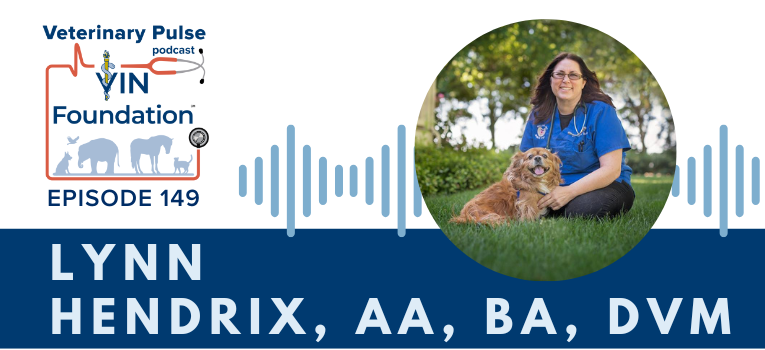
Dr. Lynn Hendrix shares her veterinary path, from an endearing childhood story with a horse, to practicing emergency medicine, and finding hope and passion for palliative care through complicated personal grief. This conversation offers insight and education around end of life care, and for all of us who love our animals, want the best for them, and are eager to learn how to be more observant of their needs.
*TRIGGER WARNING* Some of the content in this episode may include triggers for topics including pregnancy and person loss. As a reminder, if you are a veterinary student or veterinarian, the VIN Foundation’s confidential peer-to-peer support group vets4vets® is here for you, at no cost, please know, you are not alone. Call (530) 601-2133 or visit the website to schedule a confidential Vets4Vets® session.
GUEST BIO:
Dr. Lynn Hendrix
Dr Lynn Hendrix has worked and been on the cutting edge of the animal hospice and veterinary palliative medicine field. She is a certified Hospice and Palliative veterinarian, and Founder/owner of Beloved Pet Mobile Vet. She was a co-author on the 2013 IAAHPC guidelines for best practices in animal hospice and palliative care. She is founder of the Facebook group, the Veterinarian Palliative Medicine group, and the founding consultant for the Hospice and Palliative medicine folder on VIN. She has also founded the World Veterinary Palliative Medicine Organization in 2018, though it has been on hiatus since 2020 due to covid. Dr. Hendrix has an upcoming book, Animal Hospice and Palliative Medicine for the House Call Veterinarian. Just recently, she started giving End of Life rounds at UC Davis.
LINKS AND INFORMATION:
Animal Hospice and Palliative Medicine for the House Call Veterinarian:
SOCIAL LINKS:
Facebook group for veterinarians only
Facebook group for techs interested in palliative care
If you like this podcast, we would appreciate it if you follow and share. As always, we welcome feedback. If you have an idea for a podcast episode, we’d love to hear it!
TRANSCRIPT
Intro
Lynn Hendrix, AA, BA, DVM: When I was working as a veterinary assistant, I saw animals being dropped off at the office. I was the one holding them as they were getting an injection. They were scared. We weren’t doing a lot to help them through, help the clients through all of that end-of-life stuff and I thought “Why? Why are we having this experience with humans and not this experience in veterinary medicine?”
Guest Introduction: Lynn Hendrix, AA, BA, DVM
Jordan Benshea: That is Dr. Lynn Hendrix, a veterinarian specializing in palliative care. And this is the VIN Foundation’s Veterinary Pulse Podcast. I’m Jordan benShea, VIN Foundation’s Executive Director. Join me as we talk with veterinary colleagues about critical topics and share stories. Stories that connect us as humans, as animals, as a veterinary community. This podcast is made possible by individuals like you who donate to the VIN Foundation. Thank you. Please check the Episode Notes for bios, links, and information mentioned. Hey, all.
Trigger Warning and Support Resources
Jordan Benshea: A quick heads up that some of the content in today’s episode may include a trigger as it relates to personal loss and pregnancy. As a reminder, if you are a veterinary student or veterinarian, the VIN Foundation’s confidential support group, Vets4Vets, is here for you. And you can find information to reach out in the Episode Notes. Please know you are not alone. Hi Lynn, welcome. Thank you for joining us today.
Lynn Hendrix, AA, BA, DVM: Thank you for having me, Jordan. It’s great to be here.
Jordan Benshea: Well, I’m really excited to discuss this topic because I think it’s going to be something that we definitely haven’t covered yet in the podcast. And whether we like it or not, life and death are two certain aspects of everything that all of us deal with. Both humans and animals. I’m looking forward to having the conversation of how we help those that we love, the beings that we love and cherish as they get towards their elder years, shall we say?
Dr. Hendrix’s Journey to Veterinary Medicine
Jordan Benshea: Let’s start by kind of learning about your journey and your story to veterinary medicine. So were you one of those kids that from an early age thought “Yep. Always going to be a veterinarian. I love puppies and kittens and this is just for sure for me” or was there more of an “Aha!” moment for you?
Lynn Hendrix, AA, BA, DVM: Great question. I was the kid that was drawn more towards animals than I was people. People, I think early in my life, disappointed me a lot. I found the thing that a lot of people find with animals and that is that unconditional love. I was interested in being a veterinarian because those were the people that took care of animals. So helping animals live long and happy and healthy lives was something I was interested in. Of course, I was the kid that read James Herriot, thought it was all about being James Herriot, wanted to be James Herriot. And then as I got older and read more things, it was a book that I read later in life called If Wishes Were Horses by a veterinarian named Loretta Gage. It made me want to go even more. That particular book is about vet school. Mostly, it’s about getting into vet school and going into vet school. When I was trying to get into vet school, and failing miserably, that really was kind of my guiding light. If she can do it, I feel like I can do it and it just really drove me.
Jordan Benshea: That’s wonderful. That’s a story that we often hear from colleagues. That it started with either a pet that they really loved and wanted to care for or they just found this sort of true unconditional love in the being of an animal. That was really their heart animal to begin with.
Lynn Hendrix, AA, BA, DVM: All of my animals were like that. Whether it was a hamster, a dog, a cat. It didn’t matter. I just loved them all. My parents found me standing underneath a horse when I was two years old petting its belly. I had toddled down the street. Back in the days when people had horses down the street. They couldn’t find me and that’s where they found me. And of course, I don’t remember that. But that’s a story that gets told about me a lot.
Jordan Benshea: That’s very endearing.
Early Career in Emergency Medicine
Jordan Benshea: So what was your first job out of veterinary school? Obviously, you wanted to be a vet, your path was that. Where did it take you?
Lynn Hendrix, AA, BA, DVM: Because I am the person that I am, I jumped right into emergency medicine.
Jordan Benshea: All right, just go right in there.
Lynn Hendrix, AA, BA, DVM: I like to challenge myself. I had worked in emergency medicine prior to vet school. I had several GP jobs where I was a veterinary assistant. And then my last job before vet school was at an emergency clinic. I loved it so much, that that was my plan going into vet school and my plan coming out of vet school. Although part of my plan going into vet school was also about hospice. But there wasn’t really any organization set up at that time. My plan was always emergency medicine coming out. Because it was a challenge.
Jordan Benshea: Yeah. Did emergency medicine draw you in because of the challenge?
Lynn Hendrix, AA, BA, DVM: Yeah, yeah. And I will maintain this to this day, it fed my brain. But what I learned after about 10 years of doing it, is that it didn’t really feed my soul. That’s where I needed to shift in my way of thinking about veterinary medicine. I had a job that was so, so bad that I almost left veterinary medicine altogether. And that’s kind of how I got to where I’m at.
Jordan Benshea: Wow, okay.
Transition to Hospice and Palliative Care
Jordan Benshea: And you mentioned that you were interested in hospice going in. Where did that interest grow for you?
Lynn Hendrix, AA, BA, DVM: My mother who raised me. I’m adopted. I have to clarify that because then people meet my other mother, my biological mother, go “But she’s still alive”. But the mother that raised me died in 1993 of lung cancer. It was my first real experience with death and dying and hospice. Because it was my mother and she was my best friend my only friend at that point. Because I’m kind of an introvert. It was really hard. It was a really hard death and loss. And the hospice people made it worth living for me. They helped me in ways that they probably don’t even know to this day. They kept me from following her. I had a lot of complicated grief after her loss. Once I kind of came out the other side of all of that, I thought, I was working as a veterinary assistant. I saw animals being dropped off at the office. I was the one holding them as they were getting an injection. They were scared. We weren’t doing a lot to help them through, help the clients through all of that end-of-life stuff and I thought “Why are we having this experience with humans, and not this experience in vet med”? And even then, I was planning on going to vet school. I thought “Wow, we really need to change up what we do in veterinary medicine”. That’s kind of my journey there. I went to my vet school interview in 1998 talking about hospice for animals. And everybody there was intrigued. They were like “This is kind of mind-blowing stuff”. We’ve never heard of this before. After my mother died and after I got through my complicated grief, I started studying. Because that’s kind of my forte of being. I get interested in something, I just go research it like crazy and go to the library. Now we can do most of that stuff online. But at the time, I would go to the library and I’d look stuff up. I’d get on the internet, whatever it was in 1996.
Jordan Benshea: Right? AOL?
Lynn Hendrix, AA, BA, DVM: I think we were past AOL. I think we had Netscape and some other things. I started looking up animal hospice and there was really nothing out there. Nobody was really talking about it. Nobody was really doing anything in that realm. The first person I found that had any information on was Eric Clough in Pennsylvania. I think he gave the first lectures that I can find in 1998 at AVMA titled something about animal hospice. I don’t remember what the exact title was. That was the first internet information that I could find. There was nothing in writing. Nobody was writing about it. And of course, there were other people doing things. Alice Villalobos was down in Southern California starting her hospice experience. There was Amir Shanan in Chicago. Tami Shearer, I think she’s in Tennessee. So there were individuals. But nobody was really going into the national stage. There was no organization, nothing at that time. When I came into the vet school interview, talking about it, people were just blown away. Like “So tell me more about this”. And honestly, I didn’t really know what I know now. This was one of the myths that is still out there, that hospice and euthanasia are the same thing. And they’re not. That’s kind of where I stepped in. And then Nikki Hospice Foundation was founded in 1998 or 1999 by Kathryn Marocchino who’s a professor at a university in California. She’s not a veterinarian, she’s a layperson who had a traumatic end of life experience with her cat named Nikki. She wanted to start an organization that could develop education for veterinarians to better the experience for clients. She comes at it from the client perspective. I was a student member of their organization in 2000. I think it was my junior year that I did that. That was kind of an early experience with animal hospice.
Jordan Benshea: Wow, what a story. That must have been very rare for a veterinary school to have a student coming in saying they wanted to focus on end of life, right? It’s not the sense I get from a majority of veterinary students that they come into veterinary school saying, “I’d like to discuss end of life”. Kudos to you for exploring that and wanting to dive into it further. Where has that passion lead you to now and what is your current role in the veterinary profession?
Lynn Hendrix, AA, BA, DVM: As I said, I went in to my interview talking about animal hospice. I came out and became an emergency doctor. I was in emergency medicine for about 10 years.
Challenges and Personal Struggles
Lynn Hendrix, AA, BA, DVM: I got a bad, bad job. Really bad. Psychologically damaging bad. I thought about leaving the profession altogether because people threatened to kill you and all sorts of nastiness. Not only that, but the system at the place that I was working was broken. The management was bad. They were accusatory rather than team building. It was all around not a great place to work. They hired people to tattletale on other people. It was terrible. I had a miscarriage. That’s probably too much information for the audience. They talked with me on the phone about firing me because of staying home for a miscarriage. Then they were opening up to be 24 hours, and they asked me to come in and do an extra shift. I was working weekends, and I had a small child at the time. And they asked me to work an extra day. And I said, “Give me 24 hours, and I’ll let you know if I can make arrangements to do that”. And 24 hours later, it was February 28, at 2pm. Funny how I know that. In 2011. I called in to say, “Sure, I can do that”. And then they read me how I sucked as a human being. I go “What changed? What changed 24 hours ago?” That was weird. I went to work that weekend and started writing a business plan in my off time. That’s how I shifted my focus of emergency medicine to what is my passion. That is really kind of where I jumped on to this where I’m at.
Jordan Benshea: Wow, I mean, I can’t even. I know you said it might be too much to share with the audience, but I know that there are many people that have struggled with similar situations. I think that you sharing that and being willing to be vulnerable about that and have the courage to discuss it, I really applaud you. Because it’ll allow others to feel more connected and not as alone. I can only imagine how phenomenally challenging that must have been to be in that position and to have beyond no support. Just unkindness at that point from the employer who really legally definitely can’t say that. Wow, I don’t know what to say. I’m very, very sorry that you went through that experience.
Lynn Hendrix, AA, BA, DVM: Thank you, thank you. We all go through these kinds of experiences. It varies what kind of traumatizing things human beings do to one another. One of the things that I learned with my complicated grief and one of the reasons why I could go in after that conversation and still work was that we can move through it. We have to feel those feelings and be present and do that work. But life continues and grief continues. Grief doesn’t go away. There’s no end point to grief. It is with you, it changes you, it shifts your world. Every time that you experience a loss of any kind, you can have earth shattering shifting. Or time shifts. There are different tracks that you go on. Or maybe it’s a little thing. For me to lose a car used to be a shifting loss because I get attached to everything, including my cars. But some people can zoom out cars left and right. If I lose my phone, it would be life shifting. Because I’m married to it. Losing a baby is one of those life shifting events and people don’t realize how hard it is to have a miscarriage for women. We could we could go into what’s going on in the world right now, in the United States, but I think we’ll shift back to palliative medicine.
Jordan Benshea: Okay, maybe we’ll shift back to palliative care.
Understanding Euthanasia and Palliative Medicine
Jordan Benshea: For the audience members that might be new to this concept, can you help us understand, for our listeners and myself as well? What’s the difference between euthanasia and palliative medicine? What’s the difference between palliative medicine, palliative care, and hospice? How does this all parallel with human medicine? Because you mentioned hospice before, and I, for whatever reason, have a lot of experience being with people that I love going through hospice. I know that pretty well from that experience, but I haven’t experienced that from an animal perspective. I’d love if you can kind of share with us some insight into what those differences are and how they’re defined. think, us as humans, we understand hospice because we’re engaged with it. But if hospice is from an animal perspective, we might not know exactly what that means. We could presume, but I’d love to hear from you some more about the differences between those.
Lynn Hendrix, AA, BA, DVM: I’ll start with euthanasia, because that’s probably what most people in the audience is familiar with or have some experience with. Euthanasia is about the end of the life of the animal. And that’s it. Euthanasia is really just about how they leave this planet when they die. People tend to think of euthanasia in lots of different ways. It’s defined as good death. But there are a lot of ways for people and animals to leave the planet, as I like to call it. You can be eaten by a shark, you can be blown up by a terrorist event, we could die peacefully in our beds. Lots of different ways to leave this planet. Most people think of going into sleep, and not waking up, is the optimal way for human beings to die. Most people think that.
Jordan Benshea: They probably think that because they think that that’s the least painful, right?
Lynn Hendrix, AA, BA, DVM: It’s essentially a heart attack, but you’re just not conscious and aware of it. So your heart stops. And people find you passed away. There’s actually a study out there where they asked people “What’s the optimal way to die?” 90% of people said going to sleep in their beds. 10% said no. Not sure how else they want to go. Because they didn’t go into that detail in the study. But I’ve actually talked to clients about that. Most people who are in that 10% say they want to be awake and aware and surrounded by the people who they love. To me, euthanasia is about that. To be able to allow the animal to be surrounded by the people they love, be awake and aware. Then fall asleep on their bed or in a lap and just pass away there. That to me is a good death. And that’s what we try to accomplish. So that’s what euthanasia is. It’s just about the how of death. It’s nothing else. It’s about the how. Palliative medicine is the study of medical intervention that creates comfort and gives education and support to the family and caregivers. This creates comfort for the pet. And gives education and support to not only the pet but to the family that is taking care of those pets.
Understanding Palliative Medicine
Lynn Hendrix, AA, BA, DVM: Palliative medicine is mostly for chronic progressive and terminal chronic progressive disease and terminal illness. And palliative medicine is also about the education and practice for the medical provider. The veterinarian in this case, in human medicine that would be the medical doctor. Palliative care, on the other hand, is similar. But it’s more about the team effort that goes into the dying patient and caregivers. The nurses that are involved, the social workers, mental health providers, pharmacists, groomers in the case of a dog, or hairdressers, in the case of a person. Whoever can come into the person or the pets’ space that can help them and help the caregivers take care of that patient is what palliative care is about.
The Importance of Early Palliative Care
Lynn Hendrix, AA, BA, DVM: Both those things can be provided early in the disease. If your animal gets diagnosed with osteoarthritis, you can start palliative care then. And you should. There’s a study out there by Jennifer Temel. She’s an oncologist, who is also a palliative medicine specialist. They did a paper back in 2010 in the New England Journal of Medicine that showed that starting palliative care early in the disease process, not only made people live better, but they lived longer. That is certainly something that I have seen. I know other colleagues have also seen that with patients.
Case Study: Hemangiosarcoma
Lynn Hendrix, AA, BA, DVM: I’ll give you an example. I’ve had patients with hemangiosarcoma, which statistically speaking, whether you do surgery or not, has a lifespan of one to two, possibly four months with surgery. It’s not a long lived disease, statistically speaking. But I’ve had patients who have gotten ten to twelve months. And I had one that lived 20 months. The one that lived 20 months was diagnosed at the university and had tumors in the spleen and his liver and his lungs and his lymph nodes. At diagnosis, they got told one to two months. They opted not to pursue anything further. And they called me in and then he just kept going and going. He had 19 and a half really great months. Occasional day off and bleed then he would bounce right back and be going full steam ahead again. Those are outliers. Those are not the common ones, but we don’t know who’s going to be the outlier, who’s going to live longer. With palliative care, this dog lived a long, long time. He also lived really well for most of that time. He started to decline about 19 and a half months into that 20-month period.
Animal Hospice and Palliative Care Guidelines
Lynn Hendrix, AA, BA, DVM: Animal hospice which is the hot topic these days and there’s an organization that I used to be part of. The IAAHPC which stands for the International Association of Animal Hospice and Palliative Care. We wrote the first guidelines. AAHA picked up the guidelines and with the IAAHPC and wrote shorter guidelines. AVMA has guidelines so there’s some guidelines out there. But we were the first ones to really write about that. It was produced in 2013. And I think they’ve updated one or two times since then, We talked about what to call it because we were on the hospice focus. Animal hospice is really just the end stage of palliative care. They opted for animal hospice.
Veterinary Hospice vs. Animal Hospice
Lynn Hendrix, AA, BA, DVM: I’m an advocate for veterinary hospice, because then you’re going to have medical professionals involved. I see this these days. There are people who are getting certified who are lay people and have no medical experience whatsoever. They’re doing things for people that may or may not be useful at all. But people don’t know that there’s a difference between animal hospice, which is just about the animal, and veterinary based hospice. It should be veterinary based because you need to have medical professionals involved in the intervention of the animals so that they don’t have pain and suffering.
Jordan Benshea: When you say veterinary hospice, is that what you’re talking about when you talk about evidence-based medicine playing a role? Can you help untangle that for us?
Evidence-Based Medicine in Palliative Care
Lynn Hendrix, AA, BA, DVM: Evidence-based medicine is basically what science is based on and what medicine is based on which is science. So evidence-based means that studies have been done, they should be double blinded with controls and have peer reviews and things like that. To make sure that there’s not internal bias involved in the evidence and that the conclusion isn’t based on our own internal biases, and we all have them. I could create a study where I said, “the sky is blue” and then I would go out of my way to prove that. Or maybe I said, “the sky is green” and I would go out of my way to prove that. Rather than looking at what the wavelengths are and such. That’s what an internal bias would be. If I decided my perception of things was the only perception. I didn’t see blue, I saw green, I would see it as green. So internal biases are based on our personal perceptions. We really need to have evidence-based for any medication, any therapy that we’re giving. That way we make sure that they’re not harmful. We can all jump on the bandwagon about something and that’s where that internal bias belief system comes in. Or we try something out if there’s something that could be tried out and then the evidence shows that probably doesn’t work in the way that we thought that maybe it did work. COVID had a lot of that going on. The whole world got to see science in real time. We were all sort of the petri dish, so to speak, with COVID. The conversations around what works, what doesn’t work, the evidence of whether those things work or don’t work. Looking at the peer reviews and the evidence. I think that that should be the case for everything, right? I think where people get confused, and especially with COVID, is that if you’re looking at an experiment in real time, which essentially is what COVID has been, everybody is using their own biases and belief system. Rather than looking at the actual graph of “did this work or did this not work”. That is where it gets confusing. And science finds different conclusions. Part of the reason why science finds different conclusions is because our internal biases get involved in some of our findings. That just happens. Any therapy, anything that we do, especially for end-of-life patients should have an evidence base. That’s not to say, I don’t think outside the box. I have a book coming out where, in the medicine section, I looked at what did they do for human beings for this particular situation, etc.? How could I translate that into veterinary medicine? If I found that they used a particular drug, I look in the veterinary literature about whether or not we have ever used that drug before for that particular thing. If it was found to be or not be useful. And if it was found to not be useful, then I would drop it. If we’d never used it before or for that particular reason, then I would go on VIN and other places and ask internal medicine specialists or oncologist or whatever specialist, if they had ever used that particular thing. I would try to get some peer review even before I wrote about it. If I couldn’t find any reason why we could use a drug, I’d include it and say, “more studies absolutely need to be done”. But here’s something they do in human medicine, maybe we could consider doing it in veterinary medicine.
Jordan Benshea: It’s interesting.
Observing Pain in Animals
Jordan Benshea: It sounds like the real trick here is that us as humans, depending on what disease we might have, or we might be struggling with the end of life, we tend to have the free will and capability to express and communicate what we want, right? What’s working versus not. And obviously, animals don’t have that advantage. Hospice in humans versus hospice and palliative care in an animal is drastically different because of that. You’re left trying to assess based on really needing to be extremely observant of the animal.
Lynn Hendrix, AA, BA, DVM: Yes. It’s funny, because I just gave rounds at UC Davis on that very subject. The title of the rounds was “What is Suffering?” But we talked about observation and perception. Because how do you make these judgments? How do you determine pain? In human medicine, they have a saying “pain is what the patient says it is”. If I think pain is a ten and you think it’s a one? Who’s right? The person experiencing the pain.
Jordan Benshea: Exactly. Let’s go with the one experiencing it. And that’s tricky, because especially for small animal, cats and dogs are both really good at hiding that pain.
Lynn Hendrix, AA, BA, DVM: It’s not so much that they’re good at hiding it. It’s that they’re subtle about it. The observer is actually the issue here.
Jordan Benshea: Oh, obviously. Of course, us humans are the issue. Let’s be really, really clear.
Lynn Hendrix, AA, BA, DVM: I kind of find that to be a myth, that animals hide their pain. We need to observe better. I use this example when I talk to students a lot. I say “who in here has a headache?”, and a few people raise their hand. I go, “how many people knew they had a headache before they just raised their hand?” And maybe a hand or two would go up. It’s usually a person sitting next to him because they’ve said something to that person. And I then will say, “well, how many of you would have known they had a headache if they didn’t tell you?” No hands go up. Because observing the pain is different. Observing pain is different. One of the things with the students that I just talked about was, in human medicine, they’ve looked at mild, moderate, severe pain. What do people report. When I talk to clients, I’d say think about it in terms of a headache, because most people can understand having a headache. They might not be able to understand chronic pain in another way. Especially if they’re 20-something years old. But they’ve had a headache, probably at one point in their life. So mild headaches, what do they do, they continue to live their life. They still go to work and they still do things. It doesn’t really affect their life that much. When it gets to be moderate, there’s some mild changes in behavior. When it gets to severe, there’s severe changes in behavior. When we have a severe headache, we’re in bed and under the covers in a dark room. We’re doing some major changes to our behavior. We usually pull drugs when we’re in moderate pain. Understanding that everything that we’re talking about is coming from the perception of the human and not the perception of the animals. If we’re looking at animal behavior, are they changing their behavior? Could they still be in pain? Yes. If they’re changing their behavior, they’re at least in moderate pain, according to humans.
Jordan Benshea: And it’s hard to know. My dog happens to be struggling with this cyst on her paw and I can tell she’s struggling with it. I guess my question is really, how much is she struggling with it? And how can we really know that? I think that’s part of the trick is when you start to observe it, it’s severe? Let’s be really clear. There’s a squirrel, she’s still running.
Lynn Hendrix, AA, BA, DVM: I would say it’s between mild and moderate, because she’s still able to do things she would normally do. If it was severe, she would stop doing that.
Jordan Benshea: Right, even for bacon probably she wouldn’t run? Maybe, maybe.
Steps for Veterinarians and Clients
Jordan Benshea: Do you have steps or suggestions if there are veterinary colleagues that are looking to find more interest in palliative care and think this is something that they want to help their clients with? How do they help clients identify goals for caring for their pets around palliative care? Where, as a veterinarian, do they start?
Lynn Hendrix, AA, BA, DVM: Well, we could go on and on all day.
Jordan Benshea: Okay, let’s do the short version. We can definitely, as always, put links in the Episode Notes. We’ll have a lot more information available. But we don’t want to keep these too long because then nobody will ever listen.
Lynn Hendrix, AA, BA, DVM: In general, what I say is, if you’ve made a diagnosis that is chronic and progressive, or terminal, you should be starting palliative care. At that moment, if you’re not comfortable starting palliative care, you should refer to a palliative care veterinarian. There’s not a lot of us out there. Most of the people who are doing end-of-life care are doing euthanasia only or mostly. But there are a few people out there that are actually doing palliative care. That’s number one for veterinarians. They should start immediately. Two, I would say, getting more information. I have a book coming out that will help. I have a Nerd Book chapter coming out as well.
Jordan Benshea: The Nerd Book is part of the VIN Foundation. We have a lot of amazing, wonderful veterinarians working on updates all the time.
Lynn Hendrix, AA, BA, DVM: I haven’t heard in a while what the timeline is there.
Jordan Benshea: We’re working on it. I assure you, it’s being worked on. It is a weekly ongoing effort.
Lynn Hendrix, AA, BA, DVM: For client, if their pet has been diagnosed with a chronic, progressive or terminal illness, then they need to start looking into palliative care. There’s all sorts of things that you can do for palliative care and palliative medicine. But to know when they need it, it should be at the beginning. If you haven’t done it at the beginning, let’s say you just think, as a client, your dog is getting old and they’re slowing down. Not doing the things that they used to do. You just feel like they’re old. That would be a time to maybe consider talking to your veterinarian about some palliative care. Maybe they need additional support, maybe you need additional support. Hospice is just the end stage of palliative care. Maybe they’re at that point. If they’re at that point, maybe they need more information about disease trajectories, and what dying looks like and pain scales. That sort of thing. There are all sorts of things that they can specifically do, talking with a veterinarian. But I think the number one thing, if you have a dog or cat, or horse or goat or fish or tarantula. Mosquito if you have those as pets. A cockroach. Whenever I philosophize about whether there’s life after death, I always think but what about cockroaches? Do they have consciousness? What about ants? I have a lot of ants in my kitchen, sometimes.
Jordan Benshea: Is there palliative care that I can offer them?
Lynn Hendrix, AA, BA, DVM: I can offer them euthanasia. All right. I think that’s the number one step. If you’re at that point, start it now. So that’s where I would start.
Jordan Benshea: If colleagues are interested in learning more about palliative care, we’ll put some links in the Episode Notes so that people can learn more and read more.
Final Thoughts and Personal Insights
Jordan Benshea: I really appreciate first of all, your dedication to this area of the field. Thank you so much for trying to make our animals lives better throughout their life. I remember when I got my dog and I rescued her at three and a half months. People said to me, “Oh, you’re so lucky she’s a puppy. I wish mine was a puppy”. And I just thought, “Oh, I wish mine was a puppy every day”, because that way I get more time with her. But I also just want to appreciate her at every stage of her life. It’s so often that people tend to really want shiny new things. These animals are amazing creatures throughout their whole life. The more that we can do to help provide comfort and enjoyment for them, I think is so important. Especially when you see these numbers coming out of COVID of people that adopted animals and now are going back to work. The struggle animals are having because of that. I so appreciate that you’re taking the time and effort and have the passion for this so that we can all learn how we can better improve animals’ lives. That’s the motherlode, that’s what we’re all here for. To do everything we can to help these animals that we deeply, deeply, deeply love. We try to keep these not too long so that ideally people listen. But there is one question that I always like to ask people at the end. Do you have a secret talent or something that you enjoy doing that other people might not know about? Because I find that I ask these questions and, sometimes I think I know the person pretty well, so I think I know what they’re going to say. And it’s never the answer that I think.
Lynn Hendrix, AA, BA, DVM: I can say a lot of things. But I will say that I love Star Wars. I also love Star Trek. I do both. But I sew and I costume. I make noble outfits for renaissance fairs. I’ve made eighteen hundreds-type outfits for Dickens fair. I’ve made Jedi outfits for going to Disneyland. I’ve done a lot.
Jordan Benshea: Oh my gosh, that’s so cool. That is so cool. What a great talent to have. That’s very impressive. And again, if it was choose something that you think you might know about Lynn. We’ve just relatively met, but still I love hearing these things. Thank you so much, Lynn. Thank you for your time and effort. And again, really your dedication to helping the animals that we love. And it’s really an impressive and courageous path. And thank you for being willing to be brave and have the courage to share your story with us. There’s a lot of touching aspects there and ones that I know are not easy, and I really, really appreciate your time and effort. So thank you so much.
Lynn Hendrix, AA, BA, DVM: I appreciate you having me on. Thanks, Jordan.
Jordan Benshea: Thank you.
Outro
Jordan Benshea: Thank you for joining us for this episode of the Veterinary Pulse. Please check the Episode Notes for additional information referenced in the podcast. If you enjoyed this podcast, please follow, subscribe, and share a review. We welcome feedback and hope you will tune in again. You can find out more about the VIN Foundation through our website, VINFoundation.org, and our social media channels. Thank you for being here. Be well.