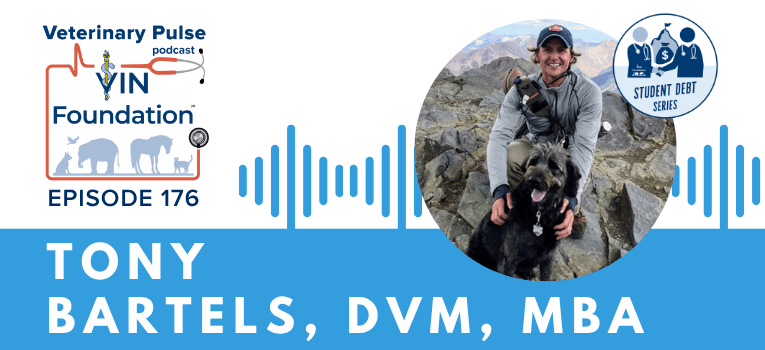
Listen in with student debt expert Dr. Tony Bartels in this next installment of our Student Debt Series covering the latest news and information on student loans.
In this episode we have six major topics we’re addressing:
- Quick review of student loan grace periods
- Consolidation Caution
- Application Ataxia
- Start with PAYE, when possible
- Important dates to add to your calendar
- How to get help
As always, we want to hear from YOU. Please share your thoughts by sending an email or joining the conversation.
GUEST BIO:
Dr. Tony Bartels
Tony Bartels, DVM, MBA graduated in 2012 from the Colorado State University combined MBA/DVM program and is a VIN Foundation Board Member and Student Debt Expert, and an employee of the Veterinary Information Network (VIN). He and his wife, a small-animal internal medicine specialist practicing in Denver, have more than $400,000 in veterinary-school debt that they manage using federal income-driven repayment plans. By necessity (and now obsession), his professional activities include researching and speaking on veterinary-student debt, providing guidance to colleagues on loan-repayment strategies and contributing to VIN Foundation resources. Beyond debt, his professional interests include small- and exotic-animal practice. When he’s not staring holes into his colleagues’ student-loan data, Tony enjoys fly fishing, ice hockey, camping and exploring Colorado with his wife, Audra, daughter, Lucy, and their two rescued canines, Addi and Maggie.
LINKS AND INFORMATION:
VIN Foundation GIVE page to support these programs & tools
VIN Foundation Blog, Related Student Debt Blog posts:
- Changes to federal student loans come into focus
- Student Loan Repayment: Trying to leave the SAVE forbearance? Choose PAYE
- Student Loans in SAVE Plan Will Start Accruing Interest August 1st
- Application for Federal Income-Driven Repayment Plans Reactivated
Personalized student loan Help from VIN and VIN Foundation
Income-Driven Repayment Plan Discretionary income calculations, WikiDebt
Federal Student Aid Data, Consolidation, and Repayment Applications
One-time Forgiveness Count Adjustment
Federal Student Loan Servicers
Public Service Loan Forgiveness (PSLF)
Have a veterinary story you want to share?
Stay up to date with VIN Foundation updates
Get updates to stay tuned for the VIN Foundation webinars on student debt.
You may learn more about the VIN Foundation, on the website, or join the conversation on Facebook, Instagram, and LinkedIn.
If you like this podcast, we would appreciate it if you follow and share. As always, we welcome feedback. If you have an idea for a podcast episode, we’d love to hear it!
TRANSCRIPT
Intro
Tony Bartels, DVM, MBA: This is a huge transition phase. We were operating under a certain set of rules for a long time and the loan servicers, the studentaid.gov had systems that were kind of designed to automate a lot of this communication and now we’ve radically changed the system so much that you will still get some of those old automated messages that really don’t make a lot of sense. Now it almost seems like, wait a minute, this doesn’t have anything to do with what I just submitted, and believe it or not, that’s kind of normal.
Jordan Benshea: That is student debt expert and VIN Foundation Board Member Dr. Tony Bartels, and this is the VIN Foundation’s Veterinary Pulse Podcast, Special Student Debt series. I’m Jordan Benshea, Executive Director of the VIN Foundation. Join me as I talk with veterinary colleagues about critical topics and share stories, stories that connect us as humans, as animals, as a veterinary community. This podcast is made possible by individuals like you who donate to the VIN Foundation. Thank you. Please check the episode notes for bios, links, and information mentioned. We are back with our VIN Foundation Board Member and student debt expert, Dr. Tony Bartels, and we thought, why not, let’s talk about some student debt news and how all the changes are impacting colleagues and what they need to know now. Welcome Tony.
Tony Bartels, DVM, MBA: Hi, Jordan. Thanks. Yeah, I mean, it’s been, what, a month or 2 maybe since we’ve…
Jordan Benshea: Yep.
Tony Bartels, DVM, MBA: We’ve done one of these, so it feels like forever.
Jordan Benshea: In student loan world it is forever.
Tony Bartels, DVM, MBA: Yeah.
Jordan Benshea: So we know that there’s a lot of changes on the horizon. The bill from last summer has made a lot of changes. It’s a good idea to kind of check in and see what we need to do to help. Specifically, we’re talking about the class of 2025 because there’s a lot of changes coming up. So we have six major topics we’re addressing in today’s episode. One is we’re going to do a quick review of student loan grace periods, because we’re getting a lot of those questions. Two, we’re going to, what we’re calling consolidation caution. Three, application ataxia. Four, we’re going to talk about starting with PAYE when possible. Five important dates to add to your calendar, and six, how you can get help. So as always, let’s dive right in.
Student Loan Grace Periods Explained
Jordan Benshea: Let’s start with that number one topic and a quick review of student loan grace periods. What do class of 2025 colleagues need to know about grace periods?
Tony Bartels, DVM, MBA: Yeah, so this is the time of year in particular where we start to get a lot of questions from the most recent graduating class about how to get started in student loan repayment, because the post-graduation 6 month grace period for your federal student loans, or the majority of your federal student loans, starts to wind down around this time. So, a typical veterinary student graduates April, May, June. 6 months from then, October, November, December, you start getting statements about student loan payments being due. So your federal direct loans have a 6 month grace period, so direct unsubsidized, direct grad plus loans have that 6 month grace period where no payment is due, but interest will still accrue. If you are lucky enough to have Health Profession Student Loans or Loans for Disadvantaged Students, those loans have a 12 month grace period, so they will not require a payment for another 6 months if you graduate kind of in that spring, early summer timeframe from veterinary school. But the direct loans are likely a bulk of your balance as we see for most graduating veterinarians, the federal direct loans represent the overwhelming majority of your student loan balance, and those are going to require you to make some decisions here shortly. So you may have already started receiving some notifications from your loan servicers about that. And of course we’ve got this always wonderfully timed government shutdown recent version where if you do have questions and complexities it’s hard to get someone on the phone to address those, particularly if it’s something that you need to do that doesn’t involve your loan servicers. So the loan servicers are not federal agencies, they’re paid by the Department of Education, but the loan servicers, so companies like NelNet, Mohela are the ones that are your primary contacts for your federal student loans, they should not be affected by the government shutdown. But, if there’s errors with your grace periods or loan statuses and things like that, that can be difficult to get addressed because you normally have to reach out to the Department of Education to get things like that, or studentaid.gov, addressed. And that’s more difficult since that’s part of the federal government that is currently shut down and a lot of those folks have been let go over the last year or so too. So, it’s a little bit more difficult to get answers to those federal student loan questions. So it really falls on you to understand what those options are for your student loans and how to navigate some of those complexities when they pop up.
Jordan Benshea: Alright, so a little more challenging because the federal shutdown, but it’s always challenging
Tony Bartels, DVM, MBA: indeed. I would say that there’s always kind of a base level challenge with your student loans.
Jordan Benshea: Base level frustration, base level challenge.
Tony Bartels, DVM, MBA: Exactly, but we also have this, let’s call them unforced errors here. I mean, things that make the system more complicated than it needs to be. And a lots going on, new graduates graduating, you’re all probably starting, you’re either knee deep in your internship experiences or you are knee deep in your private practice experiences by now, and throw in something like this that may require more time than you’re anticipating is not great. And the opportunities for mistakes and things that can end up costing you more are also higher when there’s more confusion and complexity in the system.
Consolidation Caution: What You Need to Know
Jordan Benshea: Okay, so let’s go on to our number two, consolidation caution.
Tony Bartels, DVM, MBA: Yeah, so normally what happens, we get questions pop up from new grads that, “hey, I’m getting a notification from my loan servicer that my payments are due,” and the default monthly payment on your direct loans are going to be tied to that standard 10 year plan, and that can be quite high. So you see that and you’re like, oh, I’m not ready for that, so the next questions that usually pop into your head are, do I need to consolidate my loans, or if I don’t, how do I apply for something that has a more reasonable payment? And at this point, consolidation is not going to be very helpful for you. Consolidation, while we have previously recommended consolidation as a easy way to get started in student loan repayment, this year, starting this year and beyond, consolidation is going to be much more complicated and much less helpful than it used to be. So, the system however, when you go to apply for a different repayment plan, will often encourage you to consolidate your loans, and this is not a great time to consolidate your loans. So at the end of your grace period, not a great time to consolidate your loans. You don’t have to consolidate your loans if you have all direct loans. So all direct loans means you are going to be eligible for a certain list of income driven repayment options, consolidation will not change that. Where consolidation can help is if you have loans like Health Profession Student Loans or Loans for Disadvantaged Students that are not direct loans, they don’t have direct in the name. Those non-direct loans are not eligible for income driven repayment plans or programs like Public Service Loan Forgiveness by themselves. You would have to consolidate those particular loans into a direct consolidation loan that would make that balance eligible for an income driven repayment plan or Public Service Loan Forgiveness. So for those folks who do have those Health Profession Student Loans, more commonly Health Profession Student Loans, less commonly Loans for Disadvantaged Students, if you would like them to be included in your income driven monthly payment or you’re working for a nonprofit, 501c3, you’re pretty confident that you are on a Public Service Loan Forgiveness pathway, then you’ll want to consolidate just those particular loans. So consolidate only the Health Profession Student Loans, consolidate only those Loans for Disadvantaged Students, leave the direct loans out of the consolidation, that’s not going to be helpful. So one of the side effects of consolidation is capitalization of your unpaid interest. So they’ll take any of the interest that accrued during school, they’ll add it to your principal, now you’re going to get charged a higher amount of interest than you would if you left the loans unconsolidated. We don’t have to worry about the capitalization part with Health Profession Student Loans or Loans for Disadvantaged Students because there is no unpaid interest. Those loans are what are called subsidized, meaning the interest is covered by the Department of Education until you officially enter repayment on those loans.
Jordan Benshea: Alright, that’s good because a lot of people, I think that word consolidation can seem like it’s friendly and happy and good, but consolidate, it’s small, keep it compressed.
Tony Bartels, DVM, MBA: It used to be very helpful and it’s just unfortunately, now it’s not. So, and that’s a tough, we’re kind of in this transition phase and things are just a little bit more complicated than they used to be.
Jordan Benshea: I mean, I feel like we’re constantly in a transition phase with student loans right now.
Tony Bartels, DVM, MBA: It does certainly feel that way.
Jordan Benshea: I mean, it’s felt that way since COVID, and I just feel like since the bill it’s even more so.
Tony Bartels, DVM, MBA: Yeah.
Application Ataxia: Navigating the Confusion
Jordan Benshea: Okay, number three, application ataxia.
Tony Bartels, DVM, MBA: Yeah, so I’m a big fan of alliteration and I try to tap into your medical brains as much as I can, but this is one of the best things I could come up with. Application right now, it’s just confusing, it’s clumsy, it’s a little bit like some of those animals that walk into our practices and are wobbling around, a little bit confused, a little bit wobbly, not quite sure what’s going on there, and that certainly applies to the studentaid.gov system. So normally, when you start to get those notices from your loan servicer it’s time to log in to studentaid.gov. So studentaid.gov is still up. You’re going to see a bunch of notifications about funding and things like that, but you can still log into studentaid.gov. You can still see a summary of your student loans and even get a student aid data file. You can apply for a consolidation, but as we talked about, it’s not that helpful unless you’re doing it only for a Health Profession Student Loan or Loan for Disadvantaged Student. The other application that’s in there is an application for an income driven repayment plan. So this is where you can start your application for a payment other than a fixed 10 year plan payment, and if you have a recent tax return on file, it will make this all so much easier. So hopefully, if you filed a tax return for 2024 before you graduated, that will allow you to pull that tax return data into that income driven application, and ideally that tax return value, that adjusted gross income from that tax return, is probably quite low or even negative from your last year of veterinary school. So that will assure that your minimum monthly payment will be $0 for the first 12 months. And that will all still work electronically. So studentaid.gov, even if you see that the system is recommending that you consolidate your loans, don’t believe it, choose not to consolidate, apply for an income driven plan. The most beneficial plan that you’re eligible for, and we’re looking particularly for Pay As You Earn in this context. So Pay As You Earn will have not only the lowest monthly payment, but will prevent your unpaid interest from capitalizing down the road. The side effect with Pay As You Earn is that you’re only allowed to use it until July 1st, 2028. So as part of the most recent Big Beautiful Bill that passed this past summer, we’re going to eliminate Pay As You Earn on July 1st, 2028, but you can use it as long as you’re eligible for it and it’s a great plan to get started with. If you can’t use the tax return or if you didn’t file a recent tax return and you currently have an income that’s greater than $0, it’s going to get complicated. The system will allow you to upload some documentation, alternative documentation of income, so maybe evidence of a recent tax sorry, pay stub. It can’t be more than 90 days old. If you’re going to or have to go that route, I would recommend that you open up a Google doc, Word doc, some kind of word processing document and do the math for them. Calculate out, here’s my recent pay stub, here’s how frequently I get paid, if I were to calculate out an annualized income given my recent pay stub, this is the number that it would be. Here’s my family size. If you’re single, your family size is one. If you’re married, your family size is two. You’re going to calculate out what your payment should be, ideally for that Pay As You Earn plan, and put that on your document, sign it, date it, provide a copy of a pay stub. With that, submit that information and see what comes back for your calculated monthly payment. This is where we can get into some of the errors that we see. Either they calculate the wrong payment or they calculate that you’re not eligible for a particular plan and the monthly payment calculation matches some other plan, so those are things that you’re going to want to look closely for. So, this is where, again, that system can get a little wobbly, and if it doesn’t spit out the number that you’re expecting, this is when it becomes very difficult to get answers due to all of the things that are going on around us that we’ve already just talked about. You’re welcome to post to the Student Debt Message Board area, and we can help do some math checking for you as a sanity check against some of that and we can give you some other tricks to try if you’re running up against some issues. But you definitely want to be an active participant in this process. Even after you submit that documentation, you’re going to want to make sure that what comes back next matches your expectations, and if it doesn’t, then seek out some assistance to figure out what you can do to make that go more smoothly.
Jordan Benshea: Yeah, I think we’ve learned that it’s really important to double, triple check. Make sure all the informations as you had it in there and you just don’t want to make any assumptions in this situation.
Tony Bartels, DVM, MBA: Indeed, and I think what some of the, we talked that, this is a huge transition phase. We were operating under a certain set of rules for a long time and the loan servicers, the studentaid.gov had systems that were kind of designed to automate a lot of this communication and now we’ve radically changed the system so much that you will still get some of those old automated messages that really don’t make a lot of sense. Now it almost seems like, wait a minute, this doesn’t have anything to do with what I just submitted, and believe it or not, that’s kind of normal. I mean, it’s not normal, but it’s normal because we had it.
Jordan Benshea: It is the normal.
Tony Bartels, DVM, MBA: It’s because the system has not yet caught up to all of the changes that are going on, so you’re going to see some of this confusing communication and, again, it’s going to be kind of up to you to look at it and be like, wait a minute, this doesn’t apply to me, or, oh, maybe this does, maybe I missed something that I do need to correct.
Jordan Benshea: Okay, so you started to talk a little bit about starting with PAYE when possible, do you feel like you’ve covered that or that’s number four, we can dive into that a bit more if you want.
Starting with PAYE: Best Practices
Tony Bartels, DVM, MBA: Yeah, so how do you know if you’re eligible for Pay As You Earn or not? I would suspect that most 2025 graduates are, unless you’re a bit of a career changer. Maybe you had a decent gap between when you finished your undergraduate degree or previous career and then went to vet school, you may not be eligible for Pay As You Earn. But one way to check and find out is to go to studentaid.gov, download your student aid data file, it’s this ugly looking TXT file that contains all of the history of your prior student loans and current student loans, and you can take that TXT file and upload it into the VIN Foundation My Student Loans tool. So we have a way for you to kind of check what the loan servicers and the studentaid.gov system is telling you if you have that student aid data file. You upload it to the VIN Foundation My Student Loans tool and check the Income driven repayment eligibility tab. It will show you which IDR, income driven repayment, options that you have available to use. As long as you’re in what I call IDR profile 1 or IDR profile 2, you will have access to Pay As You Earn, and right now that is the best plan that you can get started with. We have a blog post up on VINFoundation.org as well that talks about this and specifically the 2025 new grad scenario, why you should choose Pay As You Earn. Pay As You Earn, and most of you probably are also eligible for the new version of IBR, what I call IBR 2014, the monthly payments are the same. However, the one difference between Pay As You Earn and IBR is that when you leave either of those plans, IBR will capitalize your unpaid interest. Capitalization means they add your unpaid interest to your principal. Pay As You Earn will not, and that is a…
Jordan Benshea: big benefit.
Tony Bartels, DVM, MBA: Yeah, it’s a huge benefit because you’ve got a lot of interest that accrued during school. If you have a very low payment for the next year or even through 2028 when Pay As You Earn goes away, you probably will have a very big unpaid interest balance and you want to prevent that from getting added to your principal, and choosing Pay As You Earn to get started will help you do that.
Important Dates for Class of 2025
Jordan Benshea: Okay, and next up for number five are important dates. What dates do we want class of 2025 to add to their calendar?
Tony Bartels, DVM, MBA: Yeah, so you all should be very aware of that 6 month grace period date ending. So 6 months after you graduate is officially when your grace period ends. That’s when you’ll get, if you haven’t chosen another repayment plan by then, that’s when you’re going to get a statement that says, “hey, 30 days from now your first standard 10 year plan payment is due,” so get ahead of that. If you’ve already started to receive those notices, it’s time to apply for a different plan. If you not quite have gotten those notices, they’re coming soon, you can apply for an income driven plan now as well. The next date I would encourage you to look for applies to those of you that have those Health Profession Student Loans or Loans for Disadvantaged Students. You can either allow that extra grace period to keep going, so you have a 12 month grace period on those loans, or you can choose to consolidate those now as you’re applying for an income driven plan with those other ones so you can get them all included with the same minimum monthly payment. So it’s up to you. That’s a little bit more kind of career path specific. What are you doing? How long can you have that grace period that has a $0 payment and no interest accruing? What is your student debt to income ratio? What is your likelihood of reaching forgiveness? All of those things will play a role in how those of you with that Health Profession Student Loan balance or Loans for Disadvantaged Students should approach getting those loans into repayment. So, that’s where I would encourage you to post on the message board so we can help you navigate that particular complexity. After you do apply for an income driven plan, then you want to set a reminder for maybe 10 months from now. Those payments are good for 12 months, then you have to apply to recertify your income, otherwise they will revert your payment back to that standard 10 year plan. So get a reminder on your schedule for about 10 months from after you’re approved for your income driven repayment plan so you remember to submit your income re-certification information the following year. Then we also have to be cognizant of that July 1st, 2028 date because that’s when Pay As You Earn is going to be officially eliminated. So a couple of months before then if you’re using Pay As You Earn as we suggested, then you’ll want to start looking for what is my next best option around that timeframe.
Jordan Benshea: Good news, I assure you we’ll have a podcast about it.
Tony Bartels, DVM, MBA: Indeed.
Jordan Benshea: You won’t be out in the cold. We’ll have numerous between now and then.
Tony Bartels, DVM, MBA: Yep.
Jordan Benshea: Okay, so you alluded to this as well, so it leads us perfect into number six, how to get help.
How to Get Help with Student Debt
Tony Bartels, DVM, MBA: Yeah, so we have the Student Debt Message Board area that is available to all veterinary students and veterinarians, we just need you to have a VIN username and password. So the username and password you have from when you are a student works whether you’re an active VIN member or not, we can get you access to the boards via VIN Foundation if you’re not currently a VIN member, and you will always have access to that student debt discussion. You can post anonymously there. We’ll know who you are, but the rest of the community does not. But the thought is, hey, you’ve got questions, your colleagues have questions, if we can get you the answers that you need, your colleagues can learn from the exchange as well, and then we all learn more about how best to navigate this complexity with student loan repayment together.
Jordan Benshea: Yeah, that’s what we really appreciate is anytime that colleagues are posting on the boards, it helps us learn and there’s also a good chance that another person might learn from your situation. That’s really our goal is to always constantly help others learn. So it’s not just one person that’s learning, but that we’re helping many.
Tony Bartels, DVM, MBA: Certainly, and if you have any questions about how any of that works, you can email us at [email protected] and we can give you some more detailed instructions on how to get that assistance.
Jordan Benshea: Yeah, and we’ll also have a link in the episode notes along with all the other things that Tony’s been referring to.
Outro
Jordan Benshea: Anything else that you think our listeners need to know Tony?
Tony Bartels, DVM, MBA: No, I think it is just that time of year right now, the grace periods are ending. It’s normal to kind of look at your student loans and be like, oh, I need to deal with this.
Jordan Benshea: Where do I start though?
Tony Bartels, DVM, MBA: Where do I start? VIN Foundation. We’ve got a ton of great information on the blog there. If you have access to VIN, you can search VIN and you can find a lot of that information as well. Then the tools on the VIN Foundation Student Debt Center can help you get started, at least poke around and help you formulate some of those next questions that you might have based on what you’re seeing in that initial evaluation of your student loans.
Jordan Benshea: Okay, and finally we mentioned where colleagues can go for updates. They can go on the blog, they can listen to this podcast, they can check our website. Anywhere else that you’d recommend?
Tony Bartels, DVM, MBA: Studentaid.gov is a critical part of that. At this moment loan servicers, as much as they can be very confusing and add to the frustration…
Jordan Benshea: And sometimes incorrect.
Tony Bartels, DVM, MBA: Yeah, you’re going to have to use their website too, to understand your student loans is another data point in the process. But we also have to always double, triple, quadruple, check whatever we’re seeing or being told from those loan servicers as well.
Jordan Benshea: Okay. Alright, we will keep all of you updated. You can reach out to us and any other additional news, we will definitely be covering it. Thanks so much, Tony. We appreciate your time and effort.
Tony Bartels, DVM, MBA: Well, thank you. And yeah, keep the questions coming and we’ll do our best to answer them.
Jordan Benshea: Thanks everyone. Have a good day.
Tony Bartels, DVM, MBA: Yep.
Jordan Benshea: Thank you for joining us for this episode of the Veterinary Pulse. Please check the episode notes for additional information referenced in the podcast. If you enjoyed this podcast, please follow, subscribe, and share a review. We welcome feedback and hope you will tune in again. You can find out more about the VIN Foundation through our website, VINFoundation.org, and our social media channels. Thank you for being here. Be well.