
*TRIGGER WARNING* some of the content in this episode may include triggers for topics including: Adverse Childhood Events also known as ACEs, animal abuse, and interpersonal violence, including child abuse and domestic violence. As a reminder, if you are a veterinary student or veterinarian, the VIN Foundation’s confidential peer-to-peer support group vets4vets® is here for you, at no cost, please know, you are not alone. Call (530) 794-8094 or visit the website to schedule a session.
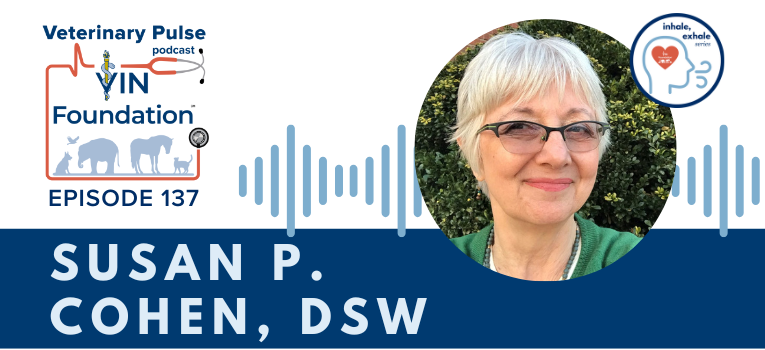
Listen in as VIN Foundation Executive Director Jordan benShea has a conversation with Vets4Vets® team member Dr. Susan Cohen about suicide risks in the veterinary profession, how adverse childhood events play a role, and the impact of perfectionism. This episode kicks off the Veterinary Pulse’s Inhale, Exhale Series on mental wellness in the veterinary profession. Learn the warning signs of mental distress, what to do if you or someone you know is struggling with thoughts of suicide, and where to go for help.
GUEST BIOS:
Dr. Susan P. Cohen
Susan has been called a pioneer in the fields of pet loss, human-animal interaction, and the human side of veterinary practice. Since 1982 Dr. Cohen has helped pet lovers make decisions about the illness of their pets. She developed the first-ever Pet Loss Support Group and began an animal assisted activity program that took the then-unusual form of having volunteers work with their own pets. She originated many training programs for workers in the veterinary and social service fields, and she has been a field instructor for several schools of social work. She has written several book chapters and scholarly articles on social work, veterinary practice, and the human-animal bond. Her most recent book chapter, “Loss, Grief, and Bereavement in the Context of Human-Animal Relationships” (Susan Cohen, DSW; and Adam Clark, LSW, AASW) was published in 2019. She is currently working on a chapter on pet loss for Routledge’s International Handbook on Human-Animal Interaction.
These days she consults with veterinary groups on client and professional communication, compassion fatigue, and how to make practice fun again. She facilitates online support groups for veterinarians, animal welfare workers, managers, and those grieving the loss of a pet. She teaches online workshops and lectures widely to veterinary colleges and conferences, colleges of social work, veterinary technician programs, and human health groups on communication, pet loss and bereavement, human-animal interaction, client relations, compassion fatigue, and career development. She is Vice Chairperson of SWAHAB (Social Workers Advancing the Human-Animal Bond), the first such committee of the National Association of Social Workers. Her work has been featured in The New York Times, The Wall Street Journal, The New Yorker, and Smithsonian Magazine. In addition, she has made numerous television and radio addresses nationwide, including “The Today Show,” “20-20,” and “The Oprah Winfrey Show.”
LINKS AND INFORMATION:
- Suicide Prevention Hotline: 800-273-8255
- VIN Foundation Vets4Vets® and Support4Support
- Book a session with Vets4Vets®
- Dr. Susan Cohen Veterinary Pulse Episode 104
- Adverse Childhood Events
- Borderline personality disorder
You may learn more about the VIN Foundation, on the website, or join the conversation on Facebook, Instagram, or Twitter.
If you like this podcast, we would appreciate it if you follow and share. As always, we welcome feedback. If you have an idea for a podcast episode, we’d love to hear it!
TRANSCRIPT
Intro
Susan Cohen, DSW: In the veterinary profession, in the beginning, it could feel so good to save lives and to make a difference and to put in the extra hours, and to be the one with great diagnostic skills or the one that can really handle the angry cats, or the weeping clients or whatever it is you’re good at. And I strongly recommend as a way of surviving in veterinary work and thriving to find your niche, whatever it is you’re good at. The problem comes when you can’t stop.
Jordan Benshea: That is Dr. Susan Cohen from the Vets4Vets confidential support team, and this is kicking off the VIN Foundation’s Veterinary Pulse podcast’s new Inhale, Exhale Series focusing on mental wellness in the veterinary profession. I’m Jordan Benshea, VIN Foundation’s Executive Director. Join me and our cohost and VIN Foundation board member, Dr. Matt Holland, as we talk with veterinary colleagues about critical topics, and share stories. Stories that connect us as humans, as animals, as a veterinary community. This podcast is made possible by individuals like you who donate to the VIN Foundation. Thank you. Please check the episode notes for Bios, links, and information mentioned.
Trigger Warning and Support Resources
Jordan Benshea: Hey, all! A quick heads up that some of the content in today’s episode may include triggers for topics including suicide, self-harm, adverse childhood events, also known as ACEs, and interpersonal violence, including child abuse, sexual violence, and domestic violence. As a reminder, if you are a veterinary student or veterinarian, the VIN Foundation’s confidential support group Vets4Vets is here for you. You can find information to reach out in the episode notes. Please know you are not alone.
Welcoming Susan Cohen, DSW
Jordan Benshea: Welcome, Susan, thank you for joining us again.
Susan Cohen, DSW: Great to be here, Jordan.
Jordan Benshea: So, some of our audience might remember. Dr. Susan Cohen joined us for Episode 104, where she shared about red shoes syndrome and caring too much or are you caring too much? We will put a link to that in the episode notes. Let’s just remind our audience of your role with the VIN Foundation Vets4Vets team, Susan. How do you support that team, which we are so grateful for?
Susan Cohen, DSW: I love being part of this team. I’m a social worker for many decades now, and I’ve been working with veterinarians for a long, long time. So, I was very honored to be asked to lead a support group. It’s really a peer support group for veterinarians. We meet every Thursday evening online, and people from all around the country get together and talk about what’s going on at work, what the stressors are, what questions they have, whether they should leave the job, you know, that kind of thing. And we help each other.
Jordan Benshea: That’s wonderful. I know that it’s a very popular group. We’ve gotten a lot of wonderful feedback coming out of that group of just how helpful you are. So, thank you for that. This podcast is kicking off a new series of the Veterinary Pulse podcast that we are calling, Inhale, Exhale, and it’s focusing on mental wellness in the veterinary profession.
Understanding Suicide in the General Population
Jordan Benshea: In this episode, we will be exploring how to recognize the warning signs of someone who might be suicidal. This is a very big topic in the veterinary profession, and really, throughout all professions, especially as we are seeing mental health come to more of the forefront and more awareness being brought to this topic. Susan, can you share the current landscape of suicide in our general population?
Susan Cohen, DSW: Sadly, suicide is on the rise and has been for the last 10 to 20 years, and not even just the United States. It’s around the whole world. The World Health Organization has some really horrifying statistics about the rise. In this country, one person takes their life every 11 minutes, which is terrifying. So, in the length of time that we’re going to be talking today, five or six people will have decided to end it all.
Jordan Benshea: Oh, my gosh!
Susan Cohen, DSW: We used to think, and back when I started as a social worker we were taught, that the biggest risk group was older men. Men whose spouses had died. Back in the day it was felt that men didn’t have the same social skills and they didn’t know how to cook for themselves. We had all kinds of explanations about why it was true. Unfortunately, it has become a younger and younger population that’s at risk, and right now, it’s the second leading cause of death in people 10 to 34. So, we’re talking young people who have their whole lives ahead of them are ending their lives, and this is so so sad.
Mental Health Conditions and Suicide Risk
Jordan Benshea: What are you seeing are the majority of the risk factors with suicide?
Susan Cohen, DSW: Well, there are a number of them. Obviously, mental health is a big factor, and it depends on how you define that. Some people say, “Well, how else could you take your life if you didn’t have a mental health problem?” The problem is that while most people who take their life are depressed, the vast majority of people who suffer from clinical depression will not attempt suicide. So, let’s maybe talk about the difference between depression and other kinds of things. We all have rough times in life, and maybe you have a fleeting thought about, ah, well, if I just never had to get out of bed again, that’d be okay with me. Or, boy, I just wish I could faint and, you know, wake up when this is all over or something. Lots of people have those thoughts. Those are kind of dark thoughts. Depression because you’ve had a loss or something like that, being sad about a real event that just happened is perfectly normal. Grief is a normal thing. Sometimes it goes on a long time, and we call that complicated grief, but if you’re progressing through the stages of grief, doesn’t matter how fast you get there, as long as you’re heading in the right direction. Where you start to worry is people who have the mental health condition of depression. That’s a little different from just being profoundly sad. That’s part of it, but clinical depression involves, I think of it as having a leech attached to the back of your neck that just sucks all your energy and joy away. There’s a technical term for it, actually, anhedonia, which means, you know, no joy. So, if you’re having trouble getting up in the morning, for nonphysical reasons, if the foods you used to like to eat don’t taste good, if going out with your friends just doesn’t seem worth the effort anymore, and certainly, if you’re beginning to have thoughts about how much nicer it would be to be dead, that’s depression. If you’re actually starting to have real thoughts about death and starting to look it up on the internet and stuff, that’s serious. That is a real suicide risk. If, for example, you have a friend who’s just got the blues, you can take them out, sit, and have coffee together or whatever. Let them talk to you. That will help. But if you have a friend who is has just sort of disappeared on you, and when you invite them to do things, it’s “No, no, no, thanks.” If you begin to get worried that this person has hit a real low spot, and certainly if they’re talking about it, you’ll probably want to intervene. That’s not the only mental health condition that is associated with suicide. Another big one is called borderline personality disorder, or BPD. We probably all know someone like this. It is a person who I think of as blowing hot and cold. One minute, you’re the best thing in the world, you’re the greatest friend, the best doctor, whatever, and the next minute, you’re a horrible human being and you’ve hurt them deeply, and you’re an incompetent veterinarian, whatever, those kinds of things. That’s not because you’ve changed, and really, I want to say not that they’ve changed their opinion about you. They have I guess, in a way, but it’s not permanent. It is because they, it’s believed, don’t have a strong inner core, because of something that happened in their very early, very early childhood. They never figured out what the rest of us know, which is we’re all kind of a mixed bag, right? We all have our good points and our things that could use some work. People with borderline personality tend to see the world in black and white. Now, a hallmark of borderline personality disorder is threatening suicide, and it’s often done somewhat dramatically. “That’s it. You won’t go out with me tonight. I’m going to kill myself.” So, if you’re around somebody like that, you can either get very scared, or you can say, “they’re just talking again, you know, they’re off on one of their tantrums.” The problem is people with borderline personality disorder do have a much higher rate of suicide, and it’s believed that 30% will attempt suicide over their lifetime. So, if you happen to know someone with that diagnosis, or you have a friend that’s kind of, on and off, very sweet and then raging, or you’re a wonderful person, but that one over there is like a permanently bad person. Those are signs that they might have borderline personality, which makes them very volatile, makes the relationships unstable, and since they don’t have a strong sense of themselves, it makes them very afraid to either get permanently attached to somebody, or to be alone. And that comes with a lot of suicidal talk, but also suicidal attempts. So, we’ve talked about depression. We haven’t talked about anxiety, but anxiety is part of this. We’ve talked about borderline personality disorder. There are also groups of people who seem to be at higher risk. Now, in the veterinary field, we hear all the time that veterinarians are and veterinary teams, technicians, everybody who’s associated with animal health and welfare, are at greater than average risk. That’s true, but they’re not necessarily the highest risk. Some of the professions that are really high are farmers and people who live in rural areas, people in protection, so veterans. We’ve all heard about that. There’s a brand new study out about people who are in the military now. You might think, oh, this must be because of the horrible things they’ve seen in war. According to this study, it is people within the first two years of enlistment, who have not been deployed yet. So, whether having emotional stress is something that makes you join the military, like, I’m going to get out of here and start a whole new life for myself, or whether there’s something about the way people are integrated into the military that brings on terrible stress, the risk factors is pretty high among police officers, newly enlisted soldiers, and veterans who have seen horrible things. No question about that. Even the medical professions as well. Sad to say, as a social worker, that psychiatrists are just about at the top of the MD profession for suicide. Of course, one of the difficulties is it’s one thing to have thoughts, it’s another thing to be able to carry it through. What do veterinary teams and medical teams have in common? Knowledge of how to get to be dead, and access to things that can make you dead. I think it’s the same for people in rural communities who have guns as part of everyday life. Or police officers or military people who have weapons and know how to use them. This is not a political statement, but we know that the presence of guns is a risk factor, and many more people die of suicide with a gun than die through murder.
Jordan Benshea: It seems part of what you’re saying is that having access as a way to complete the suicide thoughts, there is a lot higher risk than if they don’t.
Susan Cohen, DSW: Exactly.
Susan Cohen, DSW: Jordan Benshea:
Susan Cohen, DSW: If they’re doctors and they have access to medication, if they are in some line of work where they carry a weapon, anything where they have that access, it almost allows them or gives them that availability to see that as a more viable option because they see an almost a clear path to the end through those vehicles.
Susan Cohen, DSW: That’s exactly right, Jordan. You’ve nailed it. That’s exactly what I’m saying. We’ll talk a little bit about that more in a minute, but one of the reasons that men have more completed suicides is because they do not seek health care as much as women do. Women may attempt to ignore, but men don’t get the mental health care in the first place and are more likely to have access to lethal means easy and quick. So, you can’t start to take pills and rethink it and say, “You know what, maybe I should just go to a hospital and get my stomach pumped.” And nobody else can find you, they are using things that work fast so that they can’t change their mind, and you can’t help them. So 55, almost 56% of men use a gun to take their lives. For women, it’s 31%. 55% of people who die by gunfire don’t have a mental health condition that anybody knows about. Doesn’t mean they don’t have it; means they haven’t sought treatment for it.
Jordan Benshea: So, they’re suffering internally on their own, in solitude?
Susan Cohen, DSW: Absolutely. And when they decide to do it, which can often be impulsive. They pick the most immediate, most lethal means. Something that you can’t really help with.
Impact of Adverse Childhood Events (ACEs)
Jordan Benshea: In the mental health space, specifically around suicide awareness and suicide risks, we hear a lot about ACEs [adverse childhood events]. Can you talk a little bit about that as it relates to suicide?
Susan Cohen, DSW: Absolutely. ACEs is a relatively recent term in the mental health field. As you said, it stands for adverse childhood events. These are things that have been demonstrated that if you were exposed to these as children, your rate of depression and anxiety and potential for suicide goes up. For example, if you’re in a household where you had psychological abuse, or sexual abuse, or other kinds of physical abuse, you’re a pretty high risk to have what’s considered a suicide attempt and a pretty serious one. Emotional neglect is a risk factor, especially for men. Turns out men who were emotionally neglected as a child are more likely to be depressed and more likely to be suicidal.
Jordan Benshea: Can you give our audience an example of what that would be, or how that would look?
Susan Cohen, DSW: Okay, so if you’re a child whose parent has, and these may be our separate risk factors, but let’s just talk about the emotional neglect part of this. Suppose you have a single mom who has a substance problem or is working three jobs to put food on the table, and just doesn’t have any energy left for you. Maybe there’s the minimal food on the table and that kind of thing, but there’s not a lot of hugging. It’s funny, I hadn’t thought about this until you just said that, but I remember reading a long time ago, a long time ago, that even though there are no rules about it, we stop hugging our little boys very early on. We hug little girls until they become adults, but boys we stop hugging. What does that feel like? Is that teaching them to be a man and stand up strong? Or is that leaving them to feel like oh, I’m on my own now, I guess, or, you know, maybe I’d like a hug. It’s part of the reason animals are so important to people, because you can hug them. So, if you have a parent who maybe is getting food on the table, and keeping a roof over your head, but doesn’t hug you, doesn’t talk to you, doesn’t seem very interested in your school activities. Tells you to just suck it up if you try to go to them with a problem. That kind of thing. That’s emotional neglect, and there’s a whole theory base about attachment. I won’t go into it but people who are securely attached grew up in families where the parents care and when you go to them for help, they help you or respond to you. People who have anxious attachment have parents that are emotionally neglectful. There’s always this underlying fear, ‘am I going to be abandoned, am I going to be on my own?’ That sets you up for problems as an adult. That’s emotional neglect.
Jordan Benshea: So emotional neglect on its own is an ACE.
Susan Cohen, DSW: It is. These are all separate psychological abuse. So, where somebody makes fun of you, bullies you, that kind of thing is separate from….
Jordan Benshea: And that could not even happen in the home, that could be at school, that could be in other social environments.
Susan Cohen, DSW: Right, right. Another risk factor that we haven’t really talked about is being LGBTQIA. So, which is obviously people who are not straight. Anything else.
Jordan Benshea: Not considered heterosexual.
Susan Cohen, DSW: Right. Obviously, one of the reasons that’s a risk factor is because people who are different in any way from the general population get bullied.
Jordan Benshea: Right, they get singled out for being different.
Susan Cohen, DSW: Exactly. Whether you’re too thin or you’re heavier than your girlfriends, or you love somebody of the same sex or whatever it is that makes you different, you stand to get bullied for that. Unfortunately, not just by the kids in the school grounds. I’ll tell you a personal story. We’re pretty food relaxed at my house, you know, try to eat healthy, but you want dessert have dessert, you know, that’s our family. I can’t tell you the number of my daughter’s friends when she was a preteen who would come to the house and say things like, “I love eating dinner at your house, because if I want seconds, she just lets me have them and you always offer me dessert. At my house, if I asked for seconds or I want dessert, my mom will say, “Are you sure you want that? I mean, you don’t want to put on weight.” That kind of thing is so destructive to kids,
Jordan Benshea: I grew up with somebody who in elementary school was perhaps a few pounds overweight by some sort of standard, and her mother was so strict that she wouldn’t let her in the kitchen. She wasn’t allowed to open the refrigerator door in her own house. There were a lot of factors that went into this. That girl had, from what you’re explaining, quite a few ACEs. She went on to experience rape and drug abuse and now has turned her life around and is in a much better spot. Growing up with somebody and seeing the direct correlation there, there’s definitely impacts that you can see.
Susan Cohen, DSW: That is heartbreaking. I just want to cry hearing that story. In addition, there are things that are maybe somewhat out of your parents’ control. If they have their own mental health issues, if they have a substance problem, which as I said, can lead to emotional neglect, but it’s its own risk factor. So, if you have mom who stays home and has a few too many cocktails during the day, that kind of thing. If one of your folks goes to jail, or if your parents get divorced, so the standard list on a lot of the research studies is 10, and it’s pretty easy to get to three or so.
Jordan Benshea: When you say 10, you’re saying if you have 10 or more of these ACEs maybe it’s a combination..
Susan Cohen, DSW: 10 on the list.
Jordan Benshea: Oh, got it. Okay.
Susan Cohen, DSW: 10 on the list. So, it turns out that men with mental health problems, who have 2 on that list are..
Jordan Benshea: For instance, emotional unavailability, emotional neglect, and perhaps a bit of bullying on the schoolyard?
Susan Cohen, DSW: Right, or a dad who has a substance problem, so the parents get divorced, and you witnessed, which we didn’t talk about yet, but you witnessed some violence in the house.
Jordan Benshea: Some domestic abuse, right.
Susan Cohen, DSW: That is three right there. Think about your friends. How many of our friends grew up in a family where there was divorce, there was substance abuse, there was some violence. You know, forget, forget sexual abuse and things like that, that are just tremendously scarring for people.
Jordan Benshea: And are also ACEs. On top of it, when we talk about bullying, not only are the people that are getting bullied, have ACEs, but the people that are doing the bullying, they have ACEs, right? Because it’s probably coming from a place, not for sure, but I’m saying it’s probably coming from a place of insecurity, anxiety, stress, etc. on their end that’s causing them to feel like they need to have some sort of power and control over the situation, over somebody else. That could be something that’s happening at home to them, too.
Susan Cohen, DSW: I was doing some research on the effect of witnessing a certain kind of violence, which we’ll talk about in a second, on kids who witnessed this kind of violence and what happens to them as adults. People who have witnessed violence, do one of two things. They either internalize it and say, “Oh, I’m somehow responsible. I should have done more. Maybe I’m equally guilty.” Whatever, or they externalize it, and they become this person you just described who’s violent and breaks rules and delights in committing crimes and going against the grain and that kind of hurting people. You know, and again, it’s how much of this is genetic or brain chemistry or something versus how much of this is what you witness growing up, and how you learn to handle it, which is either take it inside or push it all out, will determine what you’re like as an adult, and what you’re like as a parent. When it comes to domestic violence, you hear all the time about breaking the cycle. Just because you grew up in a family where people drank too much, and started throwing the pots and pans around, and then stormed off and wouldn’t come out of their room and comfort you when you were scared, doesn’t mean you have to suffer from depression and anxiety and that you have to be mean to your own family. Once you recognize some of that, you can deal with it. Getting back to ACEs. ACEs we’re discovering, again, adverse childhood events, have a tremendous effect on your mental health as an adult. As we’re discussing here, in our podcast, if you’re worried about somebody, start adding these things up in your head. So, I know that this person suffers from clinical depression. Do I know that her parents got divorced, and that her brother went to jail? Does she seem very volatile? One day she’s my best friend, the next day she won’t talk to me. Again, we’re not going through these so you can diagnose your friends. It’s just so you recognize, I think I’ve heard about this. Start adding that stuff up in your head, and if you start to get a significant list of things, then you have to start saying, well, does my friend, my colleague, my family member have the means to carry this out, are there guns in the house, do they have access to drugs. This is how you begin to evaluate whether somebody you know is at risk or not.
Animal Abuse and Its Psychological Impact
Jordan Benshea: As we discuss ACEs, some of our listeners perhaps are wondering what the impact might be of witnessing animal abuse. Perhaps most of our listeners are in the veterinary profession or are animal lovers. I shared with you that I saw an image of a dog who was chained up by the neck and died sitting up that way, because he couldn’t move any other way and froze to death. That image has been haunting me consistently in the middle of the night. How does that relate to ACEs?
Susan Cohen, DSW: That’s a great question which probably hasn’t been looked at in exactly that way, but one of the ACEs that we haven’t really talked about is witnessing the abuse of a female member of your family. So why, if pets are members of the family, and I think most people think they are. Farm animals, too we get attached to. We talk about pets, but you know, we get attached to the horses we ride and the cows we take care of, and the chickens in the backyard. One thing we know is that people who are abusers, who are trying to control the family will very often use threatening violence to the pets as a way of controlling people. We’ve known for a long time that people who are being abused, primarily women who may want to take the kids and leave, can’t find a place that will take them, their kids, any of their stuff and their pets. So, they stay in dangerous situations far longer than they should to protect the animals. What we do know is that kids who have been exposed to animal abuse, it’s a way of controlling them. One study I read said that 76% of all animal abuse takes place in the presence of children.
Jordan Benshea: It’s such a high number! [sigh]
Susan Cohen, DSW: It’s an incredibly high number. That means that if there’s animal abuse in a house, and there are children, that children have almost certainly seen it. Again, it’s controlling the human beings or punishing the human beings or threatening the, you know, whatever, controlling people. That’s why there’s a growth now in shelters that will accommodate families with their pets. In New York, I think we’re up to three or possibly four now. It’s taken a lot of work to set up shelters that can accommodate people and their pets. I know this is separate from the whole suicide question, but again, if you know somebody who is afraid to leave a bad situation because of the animals, it’s important to try to find these shelters. I live in New York City, one thing they discovered would happen is you’ve gone off to a secret location, a shelter, nobody knows who you are and it’s a shelter that takes you and your dog. So, you’re out now in the neighborhood walking around with your dog. What happens? You meet people. You meet people who love your dog and want to talk, and they’ve got a dog. Now you’re not this anonymous person walking a dog anymore, who is hiding out from her abusive spouse. You’re a known quantity, and that word can somehow get out there. So, they realized that it wasn’t just enough to let the animals live in this domestic violence shelter, they needed to provide space inside the shelter, a garden area, say for people to walk their dogs so they don’t run into strangers on the street who might somehow identify them. Exactly. It’s complicated, but if you want to do something about animal welfare and human welfare, support building shelters where people can come.
Homelessness and the Importance of Pets
Jordan Benshea: I live in the central coast of California, and we have a lot of homelessness around here. A lot of homeless people are not able to get into shelters because they won’t take their animals, and their animals are everything to them. Right? It’s their best friends.
Susan Cohen, DSW: Absolutely, and their protection and it makes them look less scary to passersby and more attractive. Just think of any of us that love animals, if there’s a not well-dressed person with dirt on their face saying, “Hey, you got a buck?” You may not stop, but if that person has a dog or a cat or something with them; “Oh, what a cutie. Yeah, let me give you some money.” Right? So, it makes them less frightening to us, and brings them resources plus comfort, companionship, keeping you warm at night, all of that?
Mental Health Benefits of Pets
Jordan Benshea: Well, and it probably really improves their mental health to have their friend with them. I know the impacts of having animals around and the benefit of that. Personally, I’ve experienced it and do experience it and that’s a huge, huge benefit. It’s all about the VIN Foundation for me personally, for a lot of us, it’s about the love of the animals, right?
Susan Cohen, DSW: Absolutely. Frankly, we’ve known for a long time having an animal to take care of, I’m thinking primarily pets, but farm animals, whatever it is, can often keep you from slipping all the way under. If you’re an older person going out starts to seem like a big deal. You know, it’s cold, you’re going to have to get dressed, get your cane out, and whatever is involved in getting outside. It’s easy to start thinking well do I really need to go out for milk today? I’ll just do without milk.
Jordan Benshea: But your dog has to pee!
Susan Cohen, DSW: Your cat needs food and the bird needs it warm enough in your apartment. So, people will do things for their pets rather than themselves, that they won’t do just for themselves. Pets give them structure, gives them something to nurture which is so good for us. So, you can see why people who are in the throes of some domestic difficulty will go to great lengths to protect your animals.
Impact of Animal Abuse on Children
Susan Cohen, DSW: In doing some research on this question, I found a very surprising study. Kids who witnessed animal abuse but weren’t involved with the animal anyway will not react particularly if the animal is injured. When they grow up, they don’t have more depression, they don’t have more anxiety. Kids who are moderately attached to their pets and witness abuse, have a very high rate of anxiety and depression as young adults. This was the strange finding. The kids who are super attached and bonded with their animals, if they see the animals hurt, will have more anxiety and depression, but not as bad as the moderately attached kids. The belief is that the power of that relationship to support kids that are going through a bad time is so strong, that even if the animal is hurt, it’s painful and bad. It’s not a good thing, but the power of that relationship to give you an emotionally healthy adulthood is so strong, that you wind up in better shape than the kids who were just moderately attached and witnessed animal abuse.
Jordan Benshea: Wow, that’s really interesting.
Susan Cohen, DSW: Not intuitive, but it does speak to the power of that relationship with animals to make you into and help you be an emotionally strong and resilient adult.
Jordan Benshea: Wow, that’s so interesting, and that really speaks to the power of the animal-human bond.
Susan Cohen, DSW: Absolutely. Absolutely.
Veterinary Profession and Suicide Risk
Jordan Benshea: You mentioned a little bit earlier about the veterinary profession and suicide risk? Can you dive a little bit deeper about what makes the veterinary profession specifically at high risk? Rather not, it seems based on what you’re saying from some of the latest studies, not maybe perhaps the most but definitely high. What are some of those factors?
Susan Cohen, DSW: In my experience, most veterinarians go into the profession because they love animals, and they want to help them. They’re kind of cause driven, and in order to get through vet school, you have to be pretty smart and pretty good at school. A lot of those folks tend to be perfectionists. Now, what’s a perfectionist? It is not someone with a healthy striving for excellence or trying to do your best or trying to learn from your mistakes. That’s not perfectionism. Perfectionism is a kind of unhealthy approach to life where you feel you must always be the best. Any little thing that goes wrong is either a catastrophe for you and you immediately go to “I’m a horrible veterinarian, a horrible person, I’m just a failure at dance lessons”, whatever we’re talking about here. You might either, again, internalize that as no point going on with whatever this activity is, because clearly I’m just hopeless, or you lash out at other people. “It’s your fault. If only you had not interrupted me when I was doing that. If only you had handed me that surgical instrument at the right time.” You know, it’s always somebody else’s fault, because you can’t tolerate being imperfect. It’s funny, I did a talk recently. I did a very quick and dirty poll with people who were there about what were some of their stressors. The number one, by far, was imposter syndrome, which is feeling like boy, if people only knew what a flawed person I am, they would reject me, I’d have to leave my home, my profession, whatever it is, you think you’re an imposter about. But again, you also have, by and large, people who are introverted.
Challenges in the Veterinary Field
Susan Cohen, DSW: Now, when I started in this field, veterinarians would stand up proudly and say, “I’m an introvert and I don’t like people at all. That’s why I chose to be a veterinarian.” Well, in this day and age, it’s pretty hard to be successful as a veterinarian if you have zero people skills. Maybe if you’re in some sort of gigantic teaching hospital, and you’re just the world’s best surgeon, they can wall you off, and you just do surgery, and you don’t speak to anybody. But you know, they’re all those people who have to hand you those surgical instruments and if you’re busy being a jerk, which is different from being an introvert, you know, throwing things around and yelling at people. They might just say they could do with the second-best surgeon in the world and not want to put up with your moods because some of the issues that make the whole animal health and welfare field sort of at risk for depression and suicide things are not within the realm of the person. So, you have your individual life. You have whatever your substance issues are. You have your own mental health, all that kind of stuff. You have being a perfectionist, being an introvert, being passionate about the cause of animals without always understanding maybe the human component to that. But on top of that, you have structural problems in a lot of the veterinary animal health and welfare settings. You have that surgeon who’s maybe a brilliant surgeon but throws things around. You have the click of employees who are Mean Girls, and the three of them hang out and gossip about everybody and whisper in the ear of the boss, “she’s really very slow”, whatever it is, so that other people feel excluded and picked on. If nobody addresses that kind of bad behavior, then the people who work there are going to leave. You’ll have high turnover. You’ll have high stress. You’ll have what we run into in the Vets4Vets support group all the time, which is veterinarians who have been out in the world, and they’ve had one or two jobs that went really south, and they come out saying, “Wow, I did so well in school, and I really loved it. What’s the matter with me now? Have I changed? Am I suddenly a bad clinician? Do I have an attitude that I’ve never encountered in my whole life before?” Often it is something about the structure of the place and what problems are allowed to run rampant. Again, owners of practices have their hands full, too. We have lots of competition. We’re all just still living with COVID, but it could be any other flood or disaster that’s impacted your community. So, owners are hard up for money, and they’re pushing their staff to extend the hours. I hear constantly about when I took this job, I was told I was going to be paid X amount and that the hours would be [I’m making this up now] nine to five let’s say, three days a week, and suddenly I’m putting in 8, 10, 12 hours, because I have all these records to fill out because there’s no longer any time now during the day to do my callbacks, or write up notes, because every little slot is now packed. It seems like they’re going to cut my salary or not give me the benefits or whatever. So, we understand that a lot of practices are under tremendous financial pressure, but you can’t change your practice’s situation just by working the handful of people you have left even harder. If you’re the practice manager, if you’re the owner, if you’re the medical director, whatever your Big Cheese title is and Big Cheese responsibility, you have to watch out for the physical and mental health of your staff, because they’ll quit. I can’t tell you how many I run into now who are saying, “you know, maybe I should just get out of this altogether, because this is not what I thought at all.”
Jordan Benshea: And when you say out of this, you mean the veterinary profession.
Susan Cohen, DSW: And when I say veterinary, I’m not just talking about DVMs. I’m talking about technicians, animal handlers, kennel help, shelter workers, and all that whole group of people, because they’re smart, they’re perfectionists, they’re passionate. Some are often working in situations where they don’t have control. Even if you have a beautifully run practice, if a client comes in and says, “I’m sorry, I have 150 bucks, and you’re telling me my dog has cancer and needs radiation therapy. There’s no way in the world I can do that.” Even if you’re a compassionate person, and you say, “Wow, that must be really difficult to have $150 and have a very sick dog and have to be thinking about euthanasia, for money reasons.” You can be the most compassionate vet in the world and still feel bad about that and say, “well, I could fix it if I were allowed to or whatever. It’s a terrible moral dilemma for a lot of people. These are all reasons that it’s really tough to be in the animal health field.
Jordan Benshea: We’ve talked about some of the risks specifically in the veterinary profession, in general for suicide, and I’m wondering if there’s some connection between, or if you have any information on the impact of colleagues who are on the frontlines in the veterinary profession, and the impact of witnessing the aftermath of animal abuse. A lot of veterinary colleagues probably are seeing animals come into their practice, or wherever they are practicing, and seeing animals who it’s clear that this isn’t an accident, and these animals have probably been abused. What is the impact of that? Do you have any information on that?
Susan Cohen, DSW: I think wherever you are in the animal health and welfare field, whether you’re the veterinarian who’s having to patch up a dog that’s been starved, or, and I don’t want to be too graphic here, but I work with people who care for animals that have been abused or used in fighting rings, that kind of thing, and it’s extremely painful and difficult. The laws have been rather slow to catch up with what people on the frontlines see. I remember years ago, speaking in Michigan to animal control officers. Again, this is a long time ago, but the law in Michigan at the time was if the owner brought the animal in, in any state whatsoever, you picture it, picture the worst thing you can imagine, the mere fact that they had finally brought the animal into a veterinarian was enough to get them off the hook legally. This made animal control officers enraged. It’s been a long, slow process to get overt cruelty made a felony, for example.
Compassion Fatigue and Burnout
Jordan Benshea: Obviously, along with witnessing animal abuse, there are a lot of factors in the veterinary profession for practicing veterinarians that create situations of compassion fatigue and burnout. We have talked in other episodes about the tie of student debt to mental health, and the stress of that. What things can you speak to in the veterinary profession that you are seeing as reasons for potential suicide risks?
Susan Cohen, DSW: We were just talking about having to witness the aftermath of animal abuse or neglect. Well-meaning but, people who have no resources to cope with things. There’s a phrase that’s been used a lot, compassion fatigue. That was a term coined by a psychologist named Charles Figley. He coined it to cover what’s called secondary trauma. Trauma is when you personally have been hurt by something. Secondary trauma is when you are exposed to somebody who’s been hurt. For example, 911. There were people who were injured during those attacks, but all of the caregivers, which includes veterinarians looking at injured animals, injured people, caring for their psychological upset. People who live with rape survivors, people who come from families where people died in World War II, the Holocaust. All of those people are more prone to secondary trauma, and that’s the official definition of compassion fatigue. Burnout is when there have been too many changes, there’s been too much work, nothing is changing. We can all keep it together for a while, right? There’s some sort of emergency and you just plow through. You can’t keep it up month after month, year after year. So, what happens to some people is that they just turn off. They just get to the point where, I don’t care whether I go to work or not, or I go to work and I don’t care what happens, and I don’t have anything left to give the clients or my colleagues at work. You know, easy come, easy go. Burnout can be helped by getting a little time away, maybe taking a vacation, maybe taking a leave of absence, and sort of restoring yourself. Thinking about what you want to do going forward with your career. How you can set some better limits. That’s pretty fixable. Compassion fatigue involves really thinking about where you’re going to go here. Are there fundamental systemic things that you can do something about? Whether it’s the whole work environment, or maybe you want to volunteer part of your time at a shelter, or maybe you want to donate to a cause or something where you feel you’re making a difference in the overall cause. You have to treat yourself like a traumatized person. There’s another group that we talked about on the other podcast, and this is a term that I made up, but I see something in addition in the veterinary profession that I call red shoe syndrome, which is not exactly compassion fatigue or burnout. In burnout, you turn off. What I think of as red shoe syndrome, I’ll explain that term in a minute, you can’t turn off. You’re just so committed that you can’t stop. You can feel that it’s hurting you. You know that you should probably take a break or ease up on yourself or ease up on the people around you and you can’t do it. I got the term from an old story by Hans Christian Andersen which was turned into a beautiful ballet movie called The Red Shoes. The main character is a ballerina who’s torn between two men. One is her boss who wants to make her the greatest ballerina in the world, but she’s supposed to give up everything else in her life. The other is her sweetheart who wants her to just go off and be with him, and yes, she could dance a little on the side. So, she’s torn between these two men, love and work. Around this, or at the heart of it, is this new ballet based on the Hans Christian Andersen story where the ballerina goes to a fair and buys a pair of red ballet shoes that look like the most beautiful ballet shoes she’s ever seen. We, the audience, can tell from the guy who sold them, there’s something funny about these shoes. When she first puts them on, they feel great and she dances as she’s never danced before, full of energy, and she dances through the fair. Then she dances on through the woods, and she goes from town to town. At some point, she decided she’d like to go home. She’s tired now and she tries to go home, but her shoes won’t let her go there. She gets into more and more bad, scary situations. The shoes won’t let her stop. In the end, of course, she dies from exhaustion and the tainted red shoes. That’s what I think happens to some of the people in the veterinary profession. It feels so good to be saving lives in the veterinary profession. In the beginning, it could feel so good to save lives and to make a difference and to put in the extra hours, and to be the one with great diagnostic skills or the one that can really handle the angry cats, or the weeping clients or whatever it is you’re good at. And I strongly recommend as a way of surviving in veterinary work and thriving to find your niche, whatever it is you’re good at. The problem comes when you can’t stop
Jordan Benshea: Do you think that that is tied with a risk for suicide?
Susan Cohen, DSW: I do, because it’s almost like an addiction. You know that this thing you’re doing is bad for you, but you can’t stop. You’ve got those poisoned, enchanted dancing shoes on, and even when you say, “Oh, I know I ought to go home. I know I ought to be a little easier on myself. I know I ought to not yell at my colleagues. I know I ought to not take every kidney case for 50 miles around myself. Yes, I am maybe smarter than most people are, better at this than most people, but I can’t do it all.” I see people in the group, for example, who say I have my home phone number on my answering machine. I’m on an island, let’s say, and I’m afraid that if I don’t answer the phone in the middle of the night, that some poor animal is going to be suffering because I’m on an island and who else are they going to go to? If you don’t learn that sometimes you have to turn your phone off and get a good night’s sleep or hang out with your sweetheart or take a vacation or whatever, then you’re going to just collapse. Whether you’re suicidal or you’re just depressed and sitting at home unable to function, if you don’t learn to set some limits, and to hopefully not even put on those shoes in the first place. In other words, not buy into the idea that you’re the only one that can save these animals and it’s all up to you. And again, the smarter and more talented you are, the easier is to buy into that. Right?
Jordan Benshea: Right.
Recognizing and Addressing Suicide Risk
Jordan Benshea: So, if we have colleagues who are listening now and think they know someone who might be suicidal, how should they be evaluating the situation? What steps should they be taking to determine the level of risk?
Susan Cohen, DSW: First, let’s go over some of what we’ve already talked about. Here’s what you want to look for if you’re a friend or a colleague. Does this person seem not just in a temporary bad spot, but chronically depressed, no energy, no life, no enthusiasm? Does this person, from what you know about them, have a mental health condition, especially one of the ones that’s associated with suicide, like clinical depression, or borderline personality disorder? Is this person someone who has been or could be bullied because they belong to some minority or they’re LGBTQIA, or whatever? Not because there’s something bad about that inherently, but because it attracts bullies and mean people. Is this person working in a really chaotic kind of job situation? Are you aware that they have their own substance abuse? One thing we didn’t really talk about. One out of three suicides is associated with having had alcohol. One of the problems, and we haven’t talked about this, is you want to intervene, but 50% of suicides have a very short lead time. That’s why access to lethal means is so dangerous, because if you suddenly get the impulse, ‘that’s it, I can’t take it anymore’, and you also have access to a gun or euthanasia drugs or pills are around, then it’s too easy to act on that impulse and end your life before you even have a chance to try to work things through. So, if you are aware that your friend is depressed, has things from their childhood, the ACEs we talked about that could set them up for depression, and you know that they keep a gun in the house, or that they are currently at their vet practice where they could just grab lethal drugs or something, that’s somebody you want to intervene with.
Jordan Benshea: Right. What information would you want to leave our audience with now if there are colleagues who are concerned that there might be somebody that they know who is potentially suicidal? What resources are there available? What steps should they take? Say they just listened to the different parameters that you mentioned, and if those boxes are being checked off, what do they do?
Susan Cohen, DSW: Suppose you have a friend, or a colleague and you are going through checking off these boxes, and you say, “Well, I think this person has been depressed for a while. I happen to know that she’s been drinking more than usual, that her parents got divorced, and that her mom committed suicide.” Whatever the risk factors are that you can tick off. I want you to take some very deep breaths, and go to your friend, and you’ll be nervous. The first time you do this, your heart will be pounding out of your chest, but you’re going to look at your friend, you’re going to sit down and maybe even put a hand on theirs and say, “you know, I’ve known you a while. I’ve seen this, this, this and this,” and you tell them what you’ve observed. “I’m worried about you. Are you thinking about hurting yourself?” Now the first time you do it, it’s terrifying. You’re convinced they’re going to blow up at you or punch you in the nose. They don’t. They’re really grateful that somebody cared. Now, most of the time when you ask, they’re going to say, “No, no, I wouldn’t do that. I mean, yeah, I feel bad, and yeah, I know if I didn’t wake up tomorrow, okay, but.” Then you can both breathe a sigh of relief, and you can offer your friend all the support in the world. Make sure that you continue to reach out to them even though they’re depressed and so on. If they either say, “yes, I am thinking about killing myself, the world would be better off without me”, or they say, “no, no, everything’s fine” and you don’t believe it, then you go on to the next question, which is basically, do you have a plan. So, you say, “Oh, wow, that’s that sounds really rough. How would you do it?” Now again, most people are going to say, “I don’t know. I just I just, if I got hit by a car, it’d be alright.” It’s sort of a plan, but not really. But this is serious now, because they’re beginning to collect ideas, are beginning to think about how to pull this off.
Jordan Benshea: So turn this into action.
Susan Cohen, DSW: Now you have to really take action. If they ever say to you, and this again, is going to be so rare in your life, but if they ever say to you, “yep, yep.” And you say, “how would you do it?” and they say, “Well, you know, I’ve got a gun in the house, or I know how to get to the roof”, or whatever their plan is, or you figure out they’re researching this online, something like that, you can’t leave that person alone. You stay with them until you can get them help. You keep the Suicide Prevention Lifeline number, which is an 800 number, everybody can find it, handy.
Jordan Benshea: We’ll put that in the episode notes as well, along with all the other links that we’re discussing.
Susan Cohen, DSW: If you’re in a big city like New York, there are free mental health numbers you can call. A lot of them will let you chat. So, if you don’t like the phone or whatever, you can text a message and say, “I’m really in a bad place here.” So, make sure your friend has that and do not leave them alone if they’re really, really imminently at risk. You can take them to the local emergency room. You can help them contact their therapists. If you know their family and you feel comfortable with this, you can call somebody in their family to come and get them. If worse comes to worse, you call the police, you call 911 and you say I have a person here who’s actively suicidal. Now, I had a veterinarian say to me one time, if I call the police on a client, I’m going to lose that client. You know what, if they go out in your parking lot and shoot themselves, you will have lost the client. At least this way, you have a prayer because remember, 50% of the time suicides have a very short lead time. If you can get a person past that initial impulse, if you can see it coming and head it off and get them some help, you will have saved a life.
Outro
Jordan Benshea: Also, we want to say our confidential support group, Vets4Vets is here, and if you are in that situation, and you’re not sure exactly what to do, you can reach out. You can call the phone number also. Depending on how immediate it is, absolutely reach out to the suicide prevention hotline. We’ll put all those links in the episode notes. If you think perhaps a colleague is suicidal, and you’re not totally sure, and you want to reach out to somebody, Vets4Vets is here for free for veterinary students and veterinarians. You are not alone in having a colleague that might feel this way. If you are somebody who is personally struggling as well, you are also not alone. Please, please reach out because you’re not alone. If you have a colleague, we are here to help you. There are a lot of resources available to help you through this. Susan, thank you so much for taking the time to talk with us today. Are there any last tips or things that you want to say to our audience? What advice do you want to leave everyone with?
Susan Cohen, DSW: I guess I would say thank you for your big, big heart. Thank you for caring enough to listen to a podcast like this and being concerned about other people. I would say remember that whatever is going on before, in your life in somebody else’s life, today’s a new day, we can always start over. So please have hope. If you ask for help, you’ll probably find it, and you can get through pretty much anything with support. So don’t be afraid to ask whether it’s for yourself or for somebody else. But thank you for caring.
Jordan Benshea: Absolutely. Thank you, Susan. If anyone listening wants to join Susan’s weekly peer to peer support group, you can reach out to Vets4Vets. All that information, we will put in the episode notes as well. Thank you so much, Susan, for your wisdom and your kindness and for everything that you do in the veterinary profession. We’re really, really grateful.
Susan Cohen, DSW: Thanks again.
Jordan Benshea: Thank you for joining us for this episode of the Veterinary Pulse. Please check the episode notes for additional information referenced in the podcast. If you enjoyed this podcast, please follow, subscribe, and share a review. We welcome feedback and hope you will tune in again. You can find out more about the VIN Foundation through our website, VINFoundation.org and our social media channels. Thank you for being here. Be well.