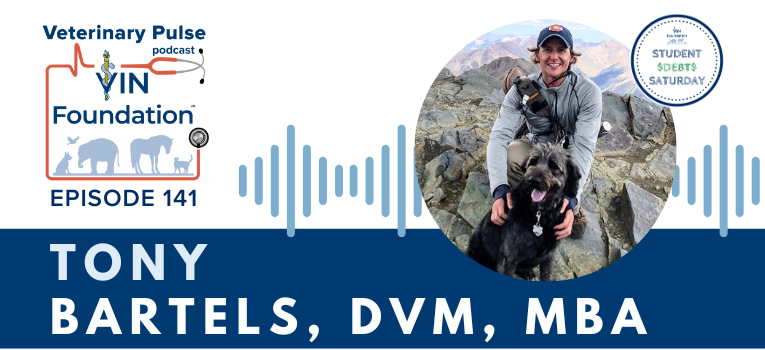
Listen in as Executive Director Jordan benShea chats with student debt expert and Board Member Dr. Tony Bartels in this next installment of our Student Debt Series. In this episode we’re discussing the latest news announced today by President Biden extending the pause on federal student loan repayments for an additional 90 days — through May 1, 2022, and what borrowers need to know, and do now.
GUEST BIO:
Dr. Tony Bartels
Tony Bartels, DVM, MBA graduated in 2012 from the Colorado State University combined MBA/DVM program and is a VIN Foundation Board Member and Student Debt Expert, and an employee of the Veterinary Information Network (VIN). He and his wife, a small-animal internal medicine specialist practicing in Denver, have more than $400,000 in veterinary-school debt that they manage using federal income-driven repayment plans. By necessity (and now obsession), his professional activities include researching and speaking on veterinary-student debt, providing guidance to colleagues on loan-repayment strategies, and contributing to VIN Foundation resources. Beyond debt, his professional interests include small- and exotic-animal practice. When he’s not staring holes into his colleagues’ student-loan data, Tony enjoys fly fishing, ice hockey, camping, and exploring Colorado with his wife, Audra, and their two rescued canines, Addi and Maggie.
LINKS AND INFORMATION:
- White House Statement
- VIN Foundation Student Debt Center
- Check your current student loan servicers and other loan details — VIN Foundation My Student Loans tool
- VIN Foundation WikiDebt
- VIN Foundation Webinars
- VIN Foundation Blog post
FedLoan Servicing- StudentAid.gov
- Federal Student Loan Servicers
- StudentAid PSLF
- New Graduate Student Loan Playbook
- Stay up to date with VIN Foundation updates
- Personalized assistance is available via the special Student Debt Message Board areas.
If you do not have an active VIN username and password, you may gain access through the VIN Foundation access application - Email VIN Foundation: [email protected]
- Get updates to stay tuned for the VIN Foundation webinars on student debt.
You may learn more about the VIN Foundation, on the website, or join the conversation on Facebook, Instagram, or Twitter.
If you like this podcast, we would appreciate it if you follow and share. As always, we welcome feedback. If you have an idea for a podcast episode, we’d love to hear it!
TRANSCRIPT
Intro
Tony Bartels, DVM, MBA: This has been a significant benefit for anybody who’s holding and managing federal student loans, but it also does make it confusing, and we got an early glimpse of that as the administration said, “This is the final extension. This is the final extension.” The last couple of months, people have really been stressing out and wondering how to prepare for repayment. We had that as something we were potentially going to have to start and now, we’ve just kind of paused it for a little bit again.
Meet the Hosts and Podcast Overview
Jordan Benshea: That is student debt expert and VIN foundation board member, Dr. Tony Bartels, and this is the VIN Foundation’s Veterinary Pulse podcast special Student Debt Series. I’m Jordan Benshea, Executive Director of the VIN Foundation. Join me and our cohost and VIN Foundation board member, Dr. Matt Holland, as we talk with veterinary colleagues about critical topics, and share stories. Stories that connect us as humans, as animals, as a veterinary community. This podcast is made possible by individuals like you who donate to the VIN Foundation. Thank you. Please check the Episode Notes for Bios, links, and information mentioned. Welcome, everyone!
Breaking News: Extension of Student Loan Relief
Jordan Benshea: We are back here again with our VIN Foundation board member and student debt expert, Dr. Tony Bartels, to talk about the latest news in student loans. We had a podcast episode ready to record for today, didn’t we, Tony?
Tony Bartels, DVM, MBA: We did. Yeah, we had to switch gears again relatively quickly.
Jordan Benshea: Yeah, we had to switch gears relatively quickly, because about an hour ago, news broke that President Biden has extended the COVID-19 emergency relief for federal student loans, making the new repayment restart date of May 1st. So, we’re pivoting as people are regularly doing, and now we’re back to oh, my gosh, what does this mean? Does May 1st, even really mean May 1st at this point, because we’re always asking ourselves that. Tony, let’s dive right in and help us make some sense of this. What do you think?
Understanding the Impact of the Extension
Tony Bartels, DVM, MBA: Well, I think it supports the moniker that you should never mark anything as final. I remember reviewing the prior statements on this pandemic forbearance and over and over and over again, they said, this was the final extension. Today, it turns out, it was not the final extension. So yeah, we have another 90 days. The pandemic forbearance benefits for federally held student loans have been extended from February 1, 2022, to now May 1, 2022. That means that no payment will be due, no interest will accrue. If you’re working towards any kind of federal student loan forgiveness, that time will also count towards forgiveness as well. This has been a significant benefit for anybody who’s holding and managing federal student loans, but it also does make it confusing, and we got an early glimpse of that as the administration said, “This is the final extension. This is the final extension.” The last couple of months, people have really been stressing out and wondering how to prepare for repayment. We had that as something we were potentially going to have to start and now, we’ve just kind of paused it for a little bit again. Yes, so some of the same things apply.
Staying Updated with Loan Servicers
Tony Bartels, DVM, MBA: We definitely want people to pay attention, right? The way that you can stay plugged in to all this is to make sure that your contact information with your loan servicer and with the Department of Education is up to date. That’s your email address and your current mailing address, because they’re going to be sending you email notifications and post mail notifications to tell you a lot of this information. In some of the conversations we’ve had to people close with us, a lot of people still have their school email listed with their loan servicer or with the Department of Education and they don’t necessarily check that one anymore, so they don’t get this information. So, basic steps making sure that you know who your student loan servicer is, which can be challenging because there’s a lot of loan servicer shakeups that are still going on concurrently here, making sure your contact information is up to date with your loan servicer as well as on the studentaid.gov portal where you can update that profile information as well.
Jordan Benshea: Yes, we have heard that a lot recently. We were told by a fellow colleague the other day, “Oh, no, I created a fake email, or an email just for internet stuff, so, I didn’t have to pay attention to that stuff.” Well, this is the stuff you’re going to want to, have to pay attention to, you know?
Tony Bartels, DVM, MBA: Yeah, absolutely. First, baby steps here, so log in to your loan servicer account, log into studentaid.gov and make sure your current email, the one that you’re actively checking, is the email in those profiles, as well as your current mailing address. You’re going to want to be able to receive all of the information that’s being sent out regarding student loans.
Jordan Benshea: Right, right. Another thing where we’re getting questions about a lot is the auto pay information. That is something far from people’s minds now, that set it and forget it auto payments for their student loans. What should they do about that?
Auto Pay and Its Benefits
Tony Bartels, DVM, MBA: Auto payment is another one of those benefits that come with your federal student loans, particularly direct loans. If you enroll in the auto pay feature, meaning that you add your bank account to your loan servicer account so they can automatically deduct the minimum payment that’s due when it’s due each month, you’ll receive 0.25% interest rate reduction across all of your direct loans for using that auto pay feature. When the pandemic forbearance went into effect, they turned all of those auto pays off, and they can’t turn them back on. You have to opt into those. You have to acknowledge that yes, you want to opt back into the auto pay, and make sure that your bank account information is the current bank account information to use to have that monthly payment automatically deducted. So, making sure that you log into your loan servicer, renewing that auto pay or opting back in or if you’ve never used it before, you want to add that information so you’re receiving that auto pay benefit once repayment does start. This would apply to anybody who has a $0 payment on their student loans. You can have scenarios, particularly if you follow the VIN Foundation New Grad playbook for those of you that have graduated into this pandemic forbearance, for example, in 2020, or 2021. We encourage people to graduate, consolidate, and apply for an income driven repayment plan. In most cases, if you do that, you’ll have a $0 payment on your student loans which doesn’t look like a payment, but you can still get the auto pay benefit once the pandemic forbearance period ends if you enroll in the auto pay feature or renew that bank account information with your loan servicer.
Jordan Benshea: Right. We’re hearing from so many people, the auto pay is just one example of it, they have not been thinking about student loans and restarting the repayment on Feb 1rst. We started to hear, as you mentioned in the beginning, a little bit of panic coming through for some borrowers. We were starting to see emails going out of things to do, and people started getting a little bit sweaty and a little bit uncomfortable trying to figure out how to deal with this. Now that we’ve got an extended 90 days from Feb 1rst, which gives us four plus months from this timeframe, there is the opportunity to make smart choices and to set yourself up for success. One thing that’s going to be happening during this new extension timeframe is taxes are due.
Preparing for Tax Season and Its Implications
Jordan Benshea: So, what should be people thinking about as they’re getting ready to submit their 2021 tax return?
Tony Bartels, DVM, MBA: This is normal end-of-year tax time, so we do want to start thinking about any of those items that or any of those financial moves that we can make before the end of the year that will impact our 2021 tax returns. In a lot of cases, for those of us with federal student loans that are using an income driven repayment plan, those same kinds of impacts to your tax return will also impact what your future monthly student loan payment will be. So, we want to start thinking about what do I think my adjusted gross income is going to be for the 2021 tax year? How much money did I earn and what kind of benefits that I take advantage of during the course of the tax year that might reduce my gross income, yielding that adjusted gross income, contributions to 401K’s or traditional IRAs, health insurance premiums, health savings accounts or flexible spending account contributions. All of those things will be subtracted from your gross income and end up with the adjusted gross income which determines how much you pay in federal income taxes. It is also a metric you can use to renew your income documentation for your income driven repayment plans when you are in fact due to renew, which again, is going to get pushed into the future. When the pandemic forbearance and not to switch gears here too much, but when the pandemic forbearance was scheduled to end on this February 1st, we were told that nobody was going to have to renew their income documentation before August of 2020 at the earliest. You could imagine that maybe that date is probably going to get pushed in the future as well.
Jordan Benshea: Do you mean August 2022?
Tony Bartels, DVM, MBA: Yes, 2022, yes.
Jordan Benshea: Okay, yeah. So, there’s a possibility that that might get pushed, but even if it gets pushed anytime later in 2022, that’s still going to be based on the AGI that you report in 2021.
Tony Bartels, DVM, MBA: Correct. You’ll have that option of using your adjusted gross income from that most recent tax return, which at this point, is going to be your 2021 tax return.
Jordan Benshea: Right. Okay. You know, this part is not surprising, but we hear this a lot in the different webinars that we do, and we’ve done quite a few in the last few weeks.
Refund Options for Payments Made During Forbearance
Jordan Benshea: There are some people who have made payments to their loans during this time, even though they don’t need to, and they don’t know that there’s a refund option. So, there is a refund option, correct?
Tony Bartels, DVM, MBA: Yes, that’s correct as part of the pandemic forbearance benefits. If you’ve made a payment towards your federal student loans anytime between March 13th, 2020, when the pandemic forbearance period started, through the end of the pandemic forbearance period, whenever that’s going to be, you can request a refund of those payments. In many cases, it makes a lot of financial sense to do so, particularly if you’re projected to hit student loan forgiveness. That’s where I would really encourage people to make use of this bonus time that you have where you don’t have any payments due on your student loans, you don’t have any interest accruing, by researching your short- and long-term repayment options. You should have a pretty good handle on what your income is, even if you graduated this past May in 2021 from veterinary school. You should have a pretty good idea of what your income and earning potential is for this year and the coming year. So, you can start to use those things in your student loan repayment projections using the VIN Foundation Student Loan Repayment Simulator. If you are projected to reach forgiveness, then it doesn’t make any sense to make any payments during this pandemic forbearance period. Your best move is to pay the minimum that your income requires and to plan for the forgiveness.
Jordan Benshea: Right, and there are ways during this time, as hopefully borrowers have been doing so far, to really improve your financial wellness.
Maximizing Financial Wellness During Forbearance
Jordan Benshea: Right?
Tony Bartels, DVM, MBA: Exactly right. Instead of making payments towards those student loans, you should be looking for opportunities to maximize your retirement savings, make sure you have a robust emergency fund. You’re looking for at least six months of expenses to have on hand in a dedicated emergency account.
Maximizing Your 401K Contributions
Tony Bartels, DVM, MBA: If you’re working for an employer who is offering you something like a 401K and they provide a matching incentive, you want to at least contribute the amount that you need to require the maximum match from your employer, but even beyond that. I try to get people to contribute at least 10% of their gross income into some kind of tax advantaged retirement account but challenge yourself to hit the IRS maximum contribution limits. For example, a 401K has a maximum contribution limit of $19,500 for the 2021 tax year, see if you can hit that limit. You don’t have to make a student loan payment, use that money wisely, and if you do that, that’ll also reduce your adjusted gross income in a lot of cases, which means your student loan payment will be lower when you do use that adjusted gross income to document your income for an income driven repayment plan.
Jordan Benshea: Some of the things that Tony’s mentioned here and I’ve mentioned, as always the links will be in the Episode Notes. What else do you feel like people should know? Is there any other vital information that you feel like we need to share at this time?
Tax Filing Strategies for Married Couples with Student Loans
Tony Bartels, DVM, MBA: The overlap and this is a common question that we get a lot, even outside of the pandemic forbearance, is how you should file your taxes, particularly if you’re married. Again, with the timing of all this, you’ve got some extra time to work through that exercise. If you’re recently married in 2021, or maybe you were married already, you’ve got federal student loans and you’re wondering should I file my taxes jointly or separately from my spouse? How is that going to benefit my student loan repayment strategy? How might it impact my taxes that I pay? This is an outstanding time to start working through that. In many cases we see that it can be extremely financially beneficial for married households, if just one of you, the veterinarian, has the student debt, to probably file your taxes separately from your spouse. That’s going to incur some tax penalties, if you will, or you’re going to lose access to certain tax benefits, and maybe even end up paying more in federal income taxes, however, you could end up saving a significant amount in student loan payments whenever we’re due to start student loan payments again. So, considering what that might look like for you, and because nobody’s going to have a payment that’s due until at least almost midway through the 2022 year, it may be that you don’t have to file separately this year, because you’re already getting a benefit on your student loans through the pandemic forbearance for the next half of 2022. But you want to get those wheels turning. You want to start doing that cost benefit analysis, because it may make sense for you to file your taxes separately in the 2022 tax year. It’s just about understanding. Am I using the right repayment plan that allows me to separate my income from my spouse if I file my tax return separately? A plan like IBR or Pay As You Earn allows you to do those things, if you’re using repay, even if you file your taxes separately, you can’t separate your income from your spouse. So, taking stock of the repayment plan that you’re currently using, and if that will allow you to have that flexibility of reducing your payment if you choose to file your taxes separately from your spouse.
Taking Advantage of Pandemic Forbearance
Jordan Benshea: Yeah, this is a great opportunity, as it has been since March 2020, to do some housekeeping. Right? To take care of the things that otherwise would seem so pressed and so pushed to figure out and decide. Borrowers are given a lot of opportunity here to spend the time on the financial wellness, think about the best tax situation, run simulations on the on the VIN Foundation Student Loan Simulator, which of course, we’ll put a link to as well. Look at what the best repayment plan is, even public service loan forgiveness, doing some of the housekeeping there to make sure that things are lined up for you. These are really great opportunities to take advantage of.
Tony Bartels, DVM, MBA: Right, and in running those simulations, if you discover that you’re constantly seeing an amount forgiven, make sure you’re looking at that forgiveness planning module, and how much should I start saving towards my forgiveness? Or how much should I start boosting my forgiveness savings plan? Right, again, with no student loan payment due, this is an outstanding time to work on that forgiveness savings plan. I hope that nobody has to actually use it, but you want to have some kind of forgiveness savings on hand in the event that we reach student loan forgiveness, and that incurs a tax liability. The sooner you can start saving for that, the longer time you give yourself to save for that, the easier it’s going to be to reach that target. The easier it’s going to be to adjust, if need be, if you need more, or maybe less, or none at all when and if you reach student loan forgiveness.
Jordan Benshea: Right. As always, you can stay up to date on the VIN Foundation website. We’ll put a link there to stay up to date with information and news. We can help by sending out news alerts and on this podcast, checking in for new episodes as well as on social. Any other suggestions that you have, Tony?
Navigating Loan Servicer Changes
Tony Bartels, DVM, MBA: I’m encouraged by this decision to extend the pandemic forbearance particularly while the loan servicer shakeup is happening. I wonder if this also didn’t have something to do with it, in addition to the new COVID variant that we’re all monitoring and dealing with. FedLoan Servicing has announced that they are quitting, so they’re in the process of moving loans from FedLoan to one of the other loan servicers. Navient announced that they are exiting the loan servicer business and they’re moving their loans to Aidvantage. Those of you that have Navient will probably have seen those emails presuming that your contact information is up to date. That is going on right now. Those loans are being moved, and it was getting close to when the repayment was due to restart. They’re still in the process of moving loans, and when loans get moved, mistakes get made. Just like when you move from one location to another, something always gets lost or damaged in the move. For whatever reason, the same thing seems to apply with your student loans when they move it from one server to another. So, you really have to pay attention while those loans are getting moved to make sure all that information is translating over to the new loan servicer correctly and that you’re seeing everything that you expect to see in that new loan servicer account.
Jordan Benshea: Right.
Engaging with the VIN Foundation Community
Jordan Benshea: We also want to say that these podcasts, I know they can seem sort of one-way. You can’t ask questions, but we are here to answer questions. There is a huge resource on the Student Debt folder on VIN that you have access to from the VIN Foundation for free, you don’t need to be a VIN member. We’ll put that link in Episode Notes as well. Any questions that you’re having, I assure you, others are having them as well. We’ve started to see some emails being sent out from FedLoan Servicing a couple of weeks ago, and I’m sure there’ll be more emails coming with now adjusted comments, and adjusted suggestions, and timeframes. If you have any questions about those, please share them because there are lots of other colleagues who are in your situation. We encourage you to post questions and Tony can answer, other colleagues can answer, and you even have the option of doing so anonymously. So, we really encourage you to reach out. You are not alone in this process. We are here to help you. And yeah!
Tony Bartels, DVM, MBA: That’s how we learn a lot of the information we’re sharing with you. A lot of the questions about some of the snags that have been happening with loans being moved from Fedloan and Navient, and people trying to make sure that they can document all of their historical progress towards forgiveness, and how to go about that, and where to look for that information. So, we’re developing quite a database of information that answers those common questions that are happening while people are working their way through repayments. Also, trying to give you all this, the best practices to use so you can avoid some of the common mistakes that we’ve seen made over the years with student loans and repayment.
Jordan Benshea: Yeah, and really, it’s only through colleagues being willing to share their stories that we’re able to learn more and through that be more helpful. So, we really encourage you guys to reach out and engage and ask questions.
Final Thoughts and Encouragement
Jordan Benshea: All right, well, I think that we’re going to keep this somewhat short, mostly because we just want to get this out and get everybody the information. Anything else you think we should leave our audience with, Tony?
Tony Bartels, DVM, MBA: Yes, eyes open, pay attention, ask questions. I guess I wouldn’t have anticipated that they were going to extend this one again, and they did. Right? So, you never know what can happen. You have to keep staying plugged in and keep working on your overall financial wellness. Enjoy this student loan payment/interest free timeframe and use that to explore other areas of your financial wellness, which in my opinion, are way more important than worrying too much about your student loans.
Jordan Benshea: Right. Yeah. We’re here to help. Thank you for being here and listening and stay tuned. We’ll be back with more news, I’m sure soon. Check out the episode links and we hope to see you on the message boards and engaging. Thanks, everyone.
Tony Bartels, DVM, MBA: Thank you, Jordan.
Jordan Benshea: Thanks, Tony.
Outro
Jordan Benshea: Thank you for joining us for this episode of the Veterinary Pulse. Please check the Episode Notes for additional information referenced in the podcast. If you enjoyed this podcast, please follow, subscribe, and share a review. We welcome feedback and hope you will tune in again. You can find out more about the VIN Foundation through our website, VINFoundation.org and our social media channels. Thank you for being here. Be well.