
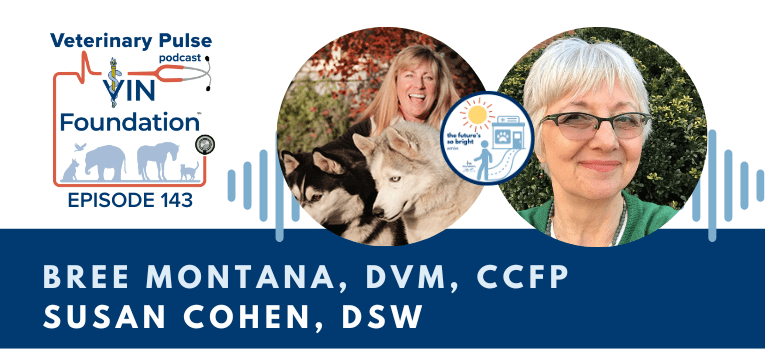
Listen in as VIN Foundation Executive Director Jordan benShea has a conversation with Dr. Bree Montana and Dr. Susan Cohen in the 3rd installment of the podcast series The Future’s So Bright, the ins and outs of selling a veterinary practice. This episode we’re diving into the mental and emotional aspect of making the choice to sell a veterinary practice.
From exploring how identity can be tied up with owning a practice, to how to deal with a shift in life priorities. Bree shares her personal experience, Susan offers tips on how to assess when the right time to sell might be based on a colleague’s individual life circumstance, and we discuss how colleagues can set themselves up for mental success.
Most importantly, we want to hear from YOU our listeners, please weigh in on the discussion, and we want to know what topics YOU want to hear about from experts. Please email us to share your thoughts: [email protected].
GUEST BIOS:
Dr. Bree Montana
Bree Montana, DVM, CCFP graduated from the University of Cincinnati with a Bachelor of Science degree focused in the field of Biology followed by a Doctorate in Veterinary Medicine from The Ohio State University’s College of Veterinary Medicine. After graduation from veterinary medical school, Dr. Montana worked exclusively in small animal outpatient and emergency hospitals while pursuing additional medical training in the latest technologies. Dr. Montana has advanced training in ultrasonography, echocardiography, chemotherapy, dentistry, emergency medicine and surgery, transfusion medicine, class IV laser therapy, pain management and rehabilitation. A past member of UC Davis’ College of Veterinary Medicine’s External Advisory and Admissions Boards, and a past Board member of the VIN Foundation, Dr. Montana is the Director of the VIN Foundation’s Vets4Vets® programs. When not practicing medicine, Dr. Montana will generally be found playing with her daughter Ember and their ponies, hiking with her huskies, and skiing or snowboarding with her husband.
Dr. Susan Cohen
Dr. Susan P. Cohen has been called a pioneer in the fields of pet loss, human-animal interaction, and the human side of veterinary practice. Since 1982 Dr. Cohen has helped pet lovers make decisions about the illness of their pets. She developed the first-ever Pet Loss Support Group and began an animal assisted activity program that took the then-unusual form of having volunteers work with their own pets. She originated many training programs for workers in the veterinary and social service fields, and she has been a field instructor for several schools of social work.
She has written several book chapters and scholarly articles on social work, veterinary practice, and the human-animal bond. Her most recent book chapter, “Loss, Grief, and Bereavement in the Context of Human-Animal Relationships” (Susan Cohen, DSW; and Adam Clark, LSW, AASW) was published in 2019. She is currently working on a chapter on pet loss for Routledge’s International Handbook on Human-Animal Interaction.
These days she consults with veterinary groups on client and professional communication, compassion fatigue, and how to make practice fun again. She facilitates online support groups for veterinarians, animal welfare workers, managers, and those grieving the loss of a pet. She teaches online workshops and lectures widely to veterinary colleges and conferences, colleges of social work, veterinary technician programs, and human health groups on communication, pet loss and bereavement, human-animal interaction, client relations, compassion fatigue, and career development.
She is Vice Chairperson of SWAHAB (Social Workers Advancing the Human-Animal Bond), the first such committee of the National Association of Social Workers. Her work has been featured in The New York Times, The Wall Street Journal, The New Yorker, and Smithsonian Magazine. In addition, she has made numerous television and radio addresses nationwide, including “The Today Show,” “20-20,” and “The Oprah Winfrey Show.”
LINKS AND INFORMATION:
VIN Foundation Vets4Vets®: https://vinfoundation.org/v4v
Book appt with Vets4Vets®: https://vinfoundation.org/v4vappt
Veterinary Pulse Podcast on VIN: https://vinfoundation.org/podcast_v
VIN Foundation application access for VIN: https://vinfoundation.org/vinapp
You may learn more about the VIN Foundation, on the website, or join the conversation on Facebook, Instagram, or Twitter.
If you like this podcast, we would appreciate it if you follow and share. As always, we welcome feedback. If you have an idea for a podcast episode, we’d love to hear it!
TRANSCRIPT
Intro
Bree Montana, DVM, CCFP: I can’t tell you how many times, like every, every week, I have a conversation with somebody who’s a wonderful practitioner, a wonderful person, and is just crispy because they think that they can’t work any less. The reality is they’re close to not being able to work at all because they won’t work any less. It’s such an important thing to be able to grow in the direction where you’re taking better care of yourself so that you can be a better doctor.
Meet the Guests: Bree Montana, DVM, CCFP and Susan Cohen, DSW
Jordan Benshea: That is Dr. Bree Montana. She is joined by Dr. Susan Cohen. This is the VIN Foundation’s Veterinary Pulse podcast, and the third installment of The Future’s So Bright series on the ins and outs of selling a veterinarian practice. I’m Jordan Benshea, VIN Foundation’s executive director. Join me and our cohost and VIN foundation board member, Dr. Matt Holland, as we talk with veterinary colleagues about critical topics, and share stories. Stories that connect us as humans, as animals, as a veterinary community. This podcast is made possible by individuals like you who donate to the VIN Foundation. Thank you. Please check the Episode notes for bios, links, and information mentioned. Welcome, Bree and Susan! Thank you for joining us again.
Bree Montana, DVM, CCFP: Great to be here.
Susan Cohen, DSW: Happy to be here. Hey, Jordan, I’m so happy to see both of you. It’s just like makes me happy to see your faces.
Jordan Benshea: Self-love, Bree, self-love. So, this is another episode of our Future’s So Bright series; the ins and outs of selling a veterinary practice. As most of our listeners know, Dr. Bree Montana is our team lead for our Vets4Vets confidential support group with the VIN foundation. She is also a practice owner who’s considering selling her practice. Today, we also have Dr. Susan Cohen, who is also on our Vets4Vets team and a pioneer in the fields of pet loss, human-animal interaction, and the human side of veterinary practice.
The Emotional Journey of Selling a Veterinary Practice
Jordan Benshea: I’m so excited to have both of you together, because today what we’re going to be focused on is the mental state, emotional side of selling a practice. For anybody that’s gone through a big change in their life, which I’m sure it’s nobody on this call or on this podcast, but let’s just pretend. Let’s just pretend a few people understand that. So, anytime we go through big changes in our life there are aspects of that that have to deal with our mindset and our emotional stability and our emotional state. As we know, the veterinary profession is one in which there is a lot of emotional mental struggles because of the challenging work and the amazing work that our colleagues are doing. So, we thought it was a good idea to touch base on that after spending a couple episodes talking with Dr. Lance Roasa on finding your why and thinking about what might be the best fit for you, because this is an important aspect of that. So, continuing, Bree, you are our test case in the area of the ins and outs of selling our practice.
Bree’s Personal Story: Challenges and Changes
Jordan Benshea: Will you share with us your mindset as you begin to consider a sale?
Bree Montana, DVM, CCFP: Yeah, I’m working on this. I’m seeing this great therapist in the Cancer Center and when Bill, my husband, was diagnosed with POEMS, I saw her a little bit. Then I initially had a panic, and I happened to have the Kismet II experience of having a corporation reach out to me with interest in buying my practice. So, I said yes, I’m going to sell it to this person, and that’s all of the research that I did. That’s all the homework that I did. Maybe I had some tequila. So, I said, I’m just going to do this. Yeah, send me a contract. They came out in the visited. They’re very nice, big surprise. And very complimentary, another surprise. So, I sent a copy of the letter of interest or the in-pencil letter of interest that they sent me to a couple of good friends and colleagues, Paul Pion and Rafi, the VIN and VIN Foundation attorney. They both said, “Let’s just take a glass of water and get some sunlight and talk about this.” So, I thought about it, and I thought God, you know, this is a crazy time for me to be making a decision and so I need to sit with it. This is just a complete decision by fiat and it’s not what I want to do. I want to make all the decisions that I make in my life, I’d like to think about them and try to come to terms where I have made that decision in a way that feels good. So, I put it away. I did all the things I had to do for the last year and a half to help Bill get to a healthy plateau where he is now. Now that my personal life is as stable as it can be, it’s time for me to look to my future and figure out what my new future is because my whole life is changing now. My life is much different than it was when my husband was completely supporting my practice, all the things that I do. One time, Jordan said that he does everything for her!
Jordan Benshea: In a positive way! I don’t think that most people understand that.
The Role of Support Systems in Veterinary Practice
Jordan Benshea: Bill is really, Bill is Dr. Bree Montana’s husband, Mr. Bill West, and he acted like your practice manager and your support with everything, right?
Bree Montana, DVM, CCFP: Yeah, he did everything so that all I had to do was get up and get shiny every morning. That’s all I had to do. I could get up. He’s an ultra-athlete, and we would hike our four Huskies, well, three then and then we got four in the middle of it. Why? I don’t know. Now we have four Huskies, so I’m certifiably challenged. So yeah, we hike our Huskies through the forest to work. It’s a four-mile hike, and then he’d go take off and do his hike, and then do the rest of the day. We could call him anytime and say, “We need a coffee run” and he’d show up with coffee for my whole staff. We’d say, “we need bleach”, he’d go get that, just whatever happened. He’d do all the accounting, and all the payroll, and I come home, and there would be some sort of a plant-based diet, wonderful, fresh dinner. All of our animals were cared for. If I needed something at the barn, if I had a horse show, he and my daughter would meet up at the barn and wash my horse for me. Yeah, and my trainer, we put him in the trailer, and haul him. I mean, everything. So, all I had to do was play with my horses, play with my Huskies, run my practice, practice medicine, and do Vets4Vets. And people are always saying, “gosh, how do you do it all?” Well, apparently, Bill is how I did it all, and all the time I spent most of my free time complaining about him, and talk a bit about him, and here he was doing all this stuff. So, my life is very different. He spent months and months not being able to walk at all, and he’s had his foot amputated. He’s learned how to walk with that, but that guy is a different guy now, and my practice is a different practice, and my marriage is a different marriage. So that’s what led me to say, I really do need to sit down and envision my life going forward. Some of this is specific to me, but a big part of this is specific to anyone who’s planning on transitioning from working, even if it’s part time into even if you’re working part time now you’re going to work even less, or you’re working full time now and you’re going to work part time, or retire entirely. All of us are going to have to face the monster, which is the part of our life that we don’t pay any attention to because we’re at work. When my life is having a hard time, like if I am angry with Bill, if I’m having a hard time in any portion of my life, even my practice life, I can shut that down by working. I can avoid my problems by working. I have lived, I’m 61, and I’ve been practicing since 1992, and I am really good at that.
Career Changes and Self-Identity
Jordan Benshea: Well, Susan, I wonder, you work so much in this field with the animal-human interaction and the human side of veterinary practice. How do you see career changes impacting the overall view of self? Because I think that whether you’re looking to retire or sell your practice or a big shift in your life, with the big changes that everyone has in life, how do you see that impacting the view of self for colleagues?
Susan Cohen, DSW: I’m so glad you asked that because I do think listening to Bree and some other practice owners that we’ve had in Vets4Vets, I think it’s different when you have owned a practice for a while, maybe you’ve been at it 20 -30 years, than if you are currently an associate and just not happy with your job. I think those are two different things. More of the people who’ve been through the support group are associates who may just say, “Wow, this isn’t what they told me veterinary practice was going to be like”, or “I’ve now met somebody, and I want to move to a different part of the country.” You know, all of these things where you are thinking about what your life is going to be like, but you think you’re going to stay a veterinarian. One of the difficulties I think for everybody is that most veterinarians seem to know when they’re little kids that they want to be veterinarians, that they really love animals, and they want to help them. Even I wanted to be a veterinarian when I was little until I discovered two things: one, I’m very squeamish, and two, I can’t do math to save my life. So, I found a job where I could hang out with veterinarians and not actually have to study organic chemistry.
Bree Montana, DVM, CCFP: Win, win!
Susan Cohen, DSW: Exactly. When I need pet therapy, they’re always the animals I can go visit. So, for me, it’s been a great way to be in the area, but I think for a lot of people, you’ve wanted to do it your whole life, you do it for love, clearly nobody goes into it to make a pile of money. In some cases, maybe your family is also invested, they’ve been supporting you, you’ve got a spouse, you got parents. I remember a story back from the 60s, a friend of mine, who was a federal prosecutor, which is a very prestigious job and it’s usually big shot law schools and something you really want to stay with as long as you can. He decided, because it was the 60s, that he wanted to quit being a federal prosecutor and raise chickens, you know, on a farm. He was fine with it, but his mom used to say, “I don’t know what to tell my friends. You know, I could talk about you when you were a lawyer, when you have this big fancy job. Now, I don’t know what to say about you.” I mean, it’s a long time since the 60s, and I think we’re a little more open to changing direction, but again, if this is something you, whatever it is that you’ve wanted to do your whole life, to change, to cut back, is very loaded. I think if you’ve been a practice owner, what I’m saying, and again, I probably not talking to all the happy practice owners because they wouldn’t be in the group, but the practice owners that I’m running into, either are in a situation like Bree’s where there’s been a change that they didn’t necessarily want. They develop arthritis in their hands and can’t do surgery, or they have developed a real anxiety disorder and they just don’t want to deal with taking a risk or talking to clients or whatever it is. But many of them seem to be reaching a point where they just kind of snap, and they just say, “I’ve tried everything I can think of to make this work, and all of a sudden, there’s that one last straw on the camel’s back and I don’t want to do this anymore.” Again, I know you all have talked about the legalities and the money and all of that, but for some of them, the decision to get out of veterinary medicine is pretty clear. There isn’t a lot of worry about their self-image, they’ve done it for 30 years, and they’ve had it, it’s just not fun anymore. So those people don’t agonize.
Bree Montana, DVM, CCFP: I feel like there’s a large subgroup of us that are needing to transition into a different phase in their career, and I think it’s really important that as we do make that transition, that we find a way of recognizing what we get from where we are now and seeing that, for example, one of the things I’m recognizing for myself is a big part of my self-esteem comes from my being a juggernaut at work. No matter what comes through the front door, and what I’m doing while it comes through the front door, I’m able to pivot and handle all of that. That’s been a challenge for me this last year, because my bandwidth is so taken up with a variety of other things. I’ve had to recognize that I’m mourning that. I have to lock down my schedule more. I’m having to handle things a little bit differently and sending things to a specialist that I would normally do myself, and that’s going to happen as I sell my practice or as I go to part time. Let’s say I have a partner come in and buy part of the practice. That partner is going to be taking up a lot of that, that theme we get a lot, I get a lot of personal self-esteem, that’s like a mountain, mountain of self-esteem from what I do, and from how I do it, and I have to do it differently. I have to recognize and more in the fact that I’m not going to be the powerhouse of the practice anymore. I’m not going to be the go-to person for the big fat rottweiler spay anymore. I am going to be the person that comes into specialty dentistry. I’m going to be the person that comes in and works a couple hours a week or a couple hours a day. I’m not going to be the person that everybody goes to, and that’s the leader of this practice at some point. And I love being a team leader. You’d be hard pressed…
Susan Cohen, DSW: Let me ask you a slightly different but related question, because it’s come up in a group lately.
The Importance of Finding Balance and Free Time
Susan Cohen, DSW: That is how much of this, and I get it you’re the star and you deserve to be the star, you’re actually really good at what you do, but one of the things that’s come up in the group lately is this drive to be busy. That there’s no excuse for not being busy, preferably at a paid job all the time. That if you’re home, you really ought to be cleaning out the closets, and at it all the time.
Bree Montana, DVM, CCFP: Want to see my pantry? With all the labels, I swear to God, you have to see my pantry. I bought a bunch of clear glass jars from a supply company, and everything is – yeah, I have a problem.
Jordan Benshea: That sounds like heaven to me.
Bree Montana, DVM, CCFP: I know, it really does make me happy. Okay, yes, that’s a real thing and that’s touching back on what I originally was mentioning. In order to handle some things that are difficult for me, and I’m probably the only guy that does this, I get busy instead of sitting with my discomfort. Sitting with learning how to relax is hard. Sitting with free time is hard. When I first moved to California, a year after I graduated, the Navy was going to send us in one direction. My husband at the time was an emergency medicine physician for the Navy and the Navy was going to detail us in one direction. They actually sent us to a different state, and it took me a while to get my state license. So, I taught college, and I taught aerobics. I almost went crazy. I had a newborn. So, you know, a lot of people just having a newborn is enough, but I had a kid, and I taught college and I did all these things, because I clearly have the devil living in my head. What’s that the busy work or something about the devil? I don’t know. Idleness is a problem for me. So yes, all of us as we are growing through our lives, I would encourage each of us to struggle a little bit with quietude. With mind, some peace and friendship in artists comfort, because that’s one of the things I’m working with as I go forward. I’m worried that I’m going to become lazy, and for those of you that know me, it’s not actually a possibility.
Jordan Benshea: No.
Bree Montana, DVM, CCFP: I take some comfort in recognizing that for myself, and I think most of us are so hard charging. We’re really the sharp end of the stick all the time. At some point, it’s nice to just not be the sharp end anymore. That’s something that I encourage all of us to think about if we’re thinking about moving into a part time job or a complete retirement job, figuring out ways of becoming comfortable with free time.
Jordan Benshea: Yes, and so it seems that for some, their identity, as you’re expressing Bree, is really caught up in being this rockstar, unicorn, veterinary professional that owns your practice, and you’re the one that does all the super awesome things all the time. Sharing that is going to be a shift, but I would also imagine that probably part of the reason that you have gotten to this point, which I’m curious if this is the case is you find yourself where, especially with Bill’s situation, you find yourself finding more meaning in that area of your life. Where you find yourself almost not there quite yet, but still dealing with it, but almost at a level of comfort, because you know that that’s going to enrich you at a level whereas before you see the importance of that, right. When we talk, when you talk to anybody that is of an older age, and that is in a period toward the end of their life, they never say, “I wish I had worked more.” Right? They always say I wish I had spent more time with my family.
Bree Montana, DVM, CCFP: Yeah. It’s such a true statement for me. I just find myself every day, like at three or four, it’s almost like clockwork, somewhere between three and four in the afternoon, I work until seven every day, and I just find myself missing Bill.
Reflections on Life and Work During COVID
Jordan Benshea: Yeah, but I think part of that is also if there are some blessings out of COVID or some positives out of COVID, part of that is a majority of people are really, I think if they’re paying attention, really reassessing their life and really reassessing what is important to us. I think that’s part of why we see this great resignation. I think it’s part of why we see so many shifts of where people are living and the jobs they’re doing and how they’re spending their days in and days out. You, Bree, had this happened during COVID, so you sort of had this double whammy.
Bree Montana, DVM, CCFP: Yeah. It was really not fair.
Jordan Benshea: It was really not fair plus lots of other things that, on the personal side, I know about. So, I think that that’s part of the shift that we’re seeing in society as well as specifically with colleagues.
Bree Montana, DVM, CCFP: Absolutely! That’s an absolute factor for me.
Balancing Work and Personal Life
Bree Montana, DVM, CCFP: I’ve changed my schedule, and through COVID I was changing our schedule at the hospital, and really focusing on keeping my team healthy, keeping myself healthy, keeping our practice safe. And safe because we were practicing good medicine, we were not allowing ourselves to make mistakes by being too fatigued. So, we’re very careful about all of that. Then I’ve also adjusted my schedule so I have more time to be at the barn and more time to be home with Bill. Truly, I’ve realized that my riding is very important to me, and the horses are important to me. When I’m at the barn, I’m paying more attention. I’m really taking a minute and not like I tend to rush like the rabbit in the movie, from one thing to another thing, always feeling like I’m late. Instead, I’ve been taking more time. I know I’m not late. I’m really spending all of the time that I have in that portion of my day, being present in that portion of the day, and really being careful to turn off my phone and not be at work when I’m with the horses. Then when I’m at work, I have been remiss at work in that I haven’t been a good leader this last year and a half. I’ve been mostly letting my team carry me and now that I’m feeling my feet a little more balanced underneath me, I’m making some good decisions. I’m really recognizing that I need to step in and be more present for my team. So, my focus is going to be really being there with my team when I’m there. When I am with Bill, I am not going to be at the barn in my mind, I’m not going to with my practice in my mind, I’m going to be focusing on being with Bill. We went away last weekend to see my mom for her 82nd birthday. Bill and I carved out two days before the time we spent with her and then another day at the other end, and it was great. We did the things that we love doing. It’s a different way for me. I’m very much ADHD and like Gemini, Gemini In My Head. There are always skeletons doing strange things in there, and they’re still doing that, but I am being able to sort of embrace the moment a little bit more. That’s the current process.
Reevaluating Career Satisfaction
Jordan Benshea: So, since Bree is our test case, she’s an example of someone that’s chosen this is a path she wants to go down, whether she chooses partial sail, full sail, what type of sail, all of that is still up in the air. But, Susan, I’m wondering if you can shed some light on there’s probably some colleagues listening who haven’t for sure made the decision. Do you have any suggestions on tips or ways to help them decide whether now is the right time for them?
Susan Cohen, DSW: I think in general, whether you own a practice or you’re an associate or whatever, that it’s good to check in with yourself once a year. Pick a date, it can be January 1, it can be your birthday, it can be some midpoint in the year, where you stop and do what Bree is doing, which is take a breath, and just let whatever’s going on in your head speak to you. I think of it as like an answering machine. It’s got a list of messages that you haven’t listened to, and just ask yourself, “Am I happy at work 75% of the time?” I mean, nobody’s got a perfect job, but if you’re at 75%, you’re probably doing okay. But you could always even at 75% say, “Well, what, at this moment in my life, would I like to be doing more of? How do I get to do that?” Keep thinking about what are people coming to you for? What are you the unicorn for in your practice? What have you discovered you like to do and nobody else does? Whatever it is, just think about those kinds of things. Try to keep yourself happy as you go, but if you’ve reached a point where all of the things you’ve tried are not enough, speaking to your boss, and writing lists, and having goals, whatever it is you’re doing, having therapy, then it’s time to really think about how you’re going to spend the rest of your time and you want to look around for what in your life is bringing you joy.
Finding Joy Outside of Work
Susan Cohen, DSW: For example, in the group we’ve had people who just snapped one day and realized that they were enjoying their photography work more than any aspect of veterinary medicine. They’d loved it before, but over time, maybe because they hadn’t really stopped to ask themselves, ‘am I still happy?’, they were done. I know someone else who transitioned very slowly and realized that she worked a number of different jobs, and she was good at it and successful, but there were things about it she just didn’t like, but she did like to write. So, she taught English as a second language and all while staying veterinarian, and then eventually transitioned into being a copywriter for veterinarians. So, you need something done on your website, or you need an article on blah, blah, for some magazine, she’s your person. So, if you have time, and you can see it coming, you can think about the parts of your life that make you happy, and head in that direction. One of the problems comes when, and it’s something Bree’s alluded to, if I’m not a veterinarian, or if I’m not a veterinarian full time, or if I’m not doing all the tricky surgery, whatever, who am I, and what am I supposed to be doing? If I’ve invested time and money, and my spouse has made sacrifices, how do I think about myself?
Jordan Benshea: Setting yourself up for success.
Susan Cohen, DSW: Well, and how do I make this change? Bree has talked about it in a way that makes me still feel good about myself and feel like I’ve learned to embrace life in a new way, or I’ve decided to pursue a different interest. I suggest, if you can, that it’s really important to take some time away. If you can, take a vacation, if you can, just cut back for a little bit. The guy that discovered this concept of type A behavior, which is this time driven aggressive sell, you know how he did that? He was a cardiologist, and he said, again, this is back in the day when we thought it was a man’s issue. He’d be in the hospital and talking to all these guys who would say, “Thank God, I had a heart attack, I hate what I do for a living, I just didn’t know how to stop.” So sometimes it’s forced on you to stop and reevaluate your life.
The Importance of Self-Care
Susan Cohen, DSW: But what I find, another issue that we haven’t really talked about is in addition to you being invested in your career and your parents and everybody in your family, your clients and your staff are invested in you. One of the things I’ve learned from people who like our owners of maybe one or two doctor practices in a rural area, or on an island or something like that, and they know their clients or clients know them, they feel incredibly responsible to their clients who don’t have a million other places to go. In some cases, especially the owners who are thinking about selling, they’re concerned about their staff, and what’s going to happen when this corporation takes over. So
Bree Montana, DVM, CCFP: Yes, we love our staff. We love our teams.
Susan Cohen, DSW: Yes, you want to protect your clients, you want to protect your team. It is one of the things, in addition to being a workaholic and all the other stuff we’ve talked about, that makes even small changes difficult at first. We’ve had a number of people in the group who say, “I have to keep my phone on 24/7, because I’m the primary game in town, and they’ll have to drive an hour and a half if I don’t pick up that phone.”
Bree Montana, DVM, CCFP: I’m going to stop you there for a second to shine a light on the fact, what I believe to be the fact, that almost every single dingle one of us feels like we’re that important. In this particular profession, I think it’s a huge misunderstanding of our importance in the world that really burns us out. We feel like nobody’s going to be able to survive if we’re not available to them 24/7, but the reality is that we’re less important to the world than we probably would like to think. I want to encourage you to give us truth to realize
Jordan Benshea: It may be more important to each of your own individual lives.
Bree Montana, DVM, CCFP: Yeah, exactly.
Susan Cohen, DSW: Yes, exactly. All of us can push, cram for exams, or write the big paper, whatever it is, we can all do that. You can’t work at that level, month after month, year after year. If you tell yourself, I must answer the phone every time it rings, I must get up in the middle of the night, and whatever, forever, then you’ll wind up leaving the profession when maybe you didn’t have to, because you couldn’t allow yourself to turn the phone off or take a long weekend or whatever it is you’re not doing. That’s really the only way
Bree Montana, DVM, CCFP: I wish you’d say that say that 10 times, I wish you’d say that 10 times in a row, and we could put it on people’s ring tones. I can’t tell you how many times, like every, every week, I have a conversation with somebody who’s a wonderful practitioner, a wonderful person, and is just crispy, because they think that they can’t work any less. The reality is they’re close to not being able to work at all, because they won’t work any less. It’s such an important thing to be able to grow in the direction where you’re taking better care of yourself so that you can be a better doctor.
Susan Cohen, DSW: Absolutely.
Jordan Benshea: I love how I feel like you’re talking to me, even though I’m not a veterinarian.
Bree Montana, DVM, CCFP: It’s true for all of us! We all feel like we’re the only person that can carry that box into the house.
Jordan Benshea: Well, we do the very best job of it, Bree! Nobody else can carry that box.
Susan Cohen, DSW: That is part of the problem. It happens to veterinarians, it happens to technicians, it happens to social workers, which I am. We’re all good at stuff, and if you’re like smarter than average, and you work hard, you really are probably better than the average bear. There’s this feeling if I go home, if I don’t answer the phone, if I don’t arrange all the surgical instruments, or whatever, somebody is going to die, or something horrible will happen.
Bree Montana, DVM, CCFP: We just can’t let ourselves off the hook.
Susan Cohen, DSW: Yeah, exactly.
Bree Montana, DVM, CCFP: So that’s something that we’re going to have to work with, all of us.
Building a Support Network
Bree Montana, DVM, CCFP: Those of us that are taking this walk together, whether it’s today, or three months from now, or a year from now, or two years from now, when you listen to this podcast, because you’re considering transitioning and selling your practice or part of your practice, and spending more time in your own personal life, we’re going to have to come to terms with the fact that it’s going to hurt our feelings that somebody is going to do it. Someone’s going to do our job, they’re going to do a good job at our job.
Susan Cohen, DSW: Not, maybe as good as us, right? But it is still okay.
Bree Montana, DVM, CCFP: No, no. Not with whatever I bring, the Juneau Se Qua, that I bring to that room. Yeah, somebody’s going to do the job, they’re going to do a good job of it. Somebody is going to tell us that they love the new Doctor. It’s going to hurt our feelings. I’m not that big of a girl. We’re going to miss the feeling that we have when we pull that spleen out, and the dog is doing great. It comes back for the suture removal and the history path is good. Our team, we all feel it, we all feel it, it’s a big, it’s a big touchdown for all of us. We all participated in it. We’re going to miss that. So, we need to, if we aren’t already building out the part of our life that challenges us, if we’re not already sucking at something other than veterinary medicine, you need to get out there and start sucking. Get out there and start slipping in the ice. You need to get out there and start trying something new, trying something that you’ve always wanted to do or that you used to love in college. What did you use to love in intramural sports that you could do something similar to now? If you played tennis, maybe you play some more tennis. If you drew, maybe get yourself some pastels. It’s time for us right now, even if we’re starting our career, to remember to build out the other part of our lives so that we can challenge ourselves in other forums.
Susan Cohen, DSW: Yeah, I couldn’t agree more.
Preparing for Career Transitions
Jordan Benshea: That sort of perfectly leads us into the next thing I wanted to ask both of you, which is, whether you’re choosing or looking at a partial sale or a full sale, there is going to be additional time in your life. Where you are not the unicorn inside the exam room or the surgery room. I guess a question I would ask is, how can we help set our colleagues up for success and help them be proactive? What are some suggestions that you have, Susan, if you’re about to find yourself with some more time on your hands? For some people with a lot of hobbies, that might sound fantastic, but for somebody that really lives and breathes their career and their job, and it’s a large part of their identity, what suggestions do you make to help them make that shift in a way that sets them up for success?
Susan Cohen, DSW: Well, I would say as I mentioned before, obviously, if you can see this coming and start thinking about it, and as Bree said go back to elementary school even. What did I used to like to do? It’s not that you grew to hate it, it’s that you ran out of time to do that thing, or you couldn’t compete in intramural sports at the level you wanted to, so you gave it up. You’re allowed to go back to that stuff. Taking a vacation, going someplace new, visiting family that you haven’t seen who’ve been begging you to come out. All of that can be enormously helpful. If you’re thinking about maybe alternative careers, or other ways of being connected to science, or whatever it is, it’s time to brush up your resume, and get on LinkedIn, and whatever social media things there are, even your Facebook page. Just keep putting it out there. “Hey, I’m still around. I’m doing this, that, and the other thing” and stuff will fall in your lap that will keep you either professionally occupied or that are fine. As we’ve been talking, I had another idea. There are a couple of us social workers that found that we were doing exactly what I’ve been telling everybody here not to do, which is to keep saying yes to things because they’re interesting. It’s maybe less of a drive to be busy all the time and not let the devil make work for our idle hands, and more a ‘well, that sounds like fun, I could do that and nobody else.’ So, we formed a little support group a month or two ago to help each other say no to things even when they’re fun, and even, especially when they’re not fun and we’re saying yes to them anyway. So, I would suggest that if you are really thinking about how you want the rest of your life to go, that it might be good to find a couple of colleagues that you can be accountable to, all three, four, however many there are. Whatever it is your goal, I need to get myself out there doing hobbies, I need to say no to baking cookies all the time, whatever it is you’re trying to accomplish, get a couple of your friends to join with you in this effort and check in by email, phone, text, or whatever. This group of friends of mine and I are writing each other about once a month to say, “What have you said no to this month?”
Bree Montana, DVM, CCFP: Susan, we can talk about wolf packs all the time. When we talk to our new grad colleagues, people that are just coming out of school, we talk about the importance of developing a wolf pack – a group of classmates, colleagues, friends, that you’re going to be supportive to and who you are going to meet with by phone or by zoom nowadays, for coffee once a month or so, and support each other. Susan, that’s exactly it. It’s just the wolf pack is a little gray now. That’s so good.
Susan Cohen, DSW: I love the idea of the wolf pack, and you can do that as an adult, and when you’ve been in it a long time, too.
Seeking Professional Help
Susan Cohen, DSW: I realized one of the reasons we have the Vets4Vets support group is because it is confidential. If you don’t have people in your community that you feel safe talking to, oh, wonderful. If you don’t have people that you feel safe talking to in your community, because you might still want another job or you don’t want everybody to know you’re thinking about selling your practice, then find some, as you said, some classmates that don’t live near you, or if you’ve kind of lost touch, we could probably hook you up in Vets4Vets with someone who’s not in your community, or somebody new to help you talk these things out. You don’t have to be in therapy your whole life for every little thing.
Bree Montana, DVM, CCFP: You don’t have to be a wreck to be in therapy.
Susan Cohen, DSW: Most of us solve our problems all by ourselves most of the time, but when you’ve hit a wall, or when you keep having the same problem, and you can’t seem to think your way out of it, find a professional who’s heard it all to help you sort this stuff out. There are people, plenty of people, frankly, who need a little medication, or they need to run more, or they need some sort of specific kind of intervention so that they can think straight and have less anxiety just in life in general. That’s okay, too. We’re given whatever time we’re given, and we don’t know how long that is, and let’s make the most of it. Let’s keep each other happy and comfortable and productive and whatever it takes to get there, that’s okay.
Jordan Benshea: I love your opinion on this.
Outro
Jordan Benshea: I think this has, hopefully, been really helpful to our audience. We want to encourage people. As always, we are collaborating with VIN, so all of these podcasts are available for free on VIN. You don’t need to be a VIN member. Let’s continue this conversation on the message boards. Let’s continue having people ask questions and engage. If there are specific other topics you want to know about, we’re here to listen. You can email [email protected]. We will have links in the Episode Notes with additional helpful information. We want to keep this not too long so that our audience stays engaged. Thank you both so much for your time. I really appreciate it.
Bree Montana, DVM, CCFP: Yay.
Susan Cohen, DSW: Love talking to you, always!
Jordan Benshea: Thank you. Thank you for joining us for this episode of the Veterinary Pulse. Please check the Episode notes for additional information referenced in the podcast. If you enjoyed this podcast, please follow, subscribe, and share a review. We welcome feedback and hope you will tune in again. You can find out more about the VIN Foundation through our website, VINFoundation.org, and our social media channels. Thank you for being here. Be well.