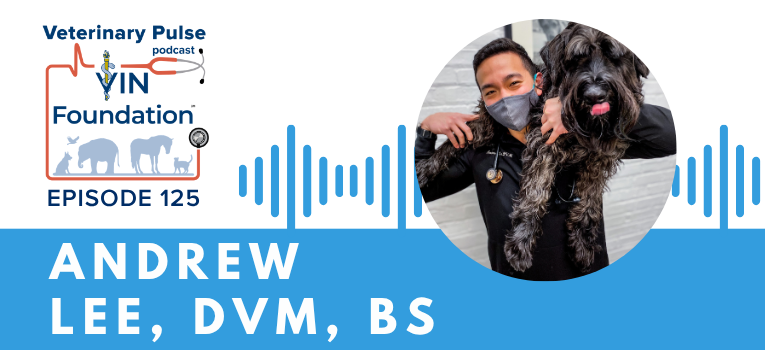
Join VIN Foundation board member, Dr. Matt Holland, as he has a conversation with Dr. Andrew Lee about the importance of leadership by example, his journey to veterinary medicine, and his first-hand experience in changing jobs as a new grad.
GUEST BIO:
Dr. Andrew Lee
Dr. Andrew Lee is a graduate of the University of Illinois-Champaign-Urbana where he received his doctorate in veterinary medicine (2017) as well as receiving his BS in Biochemistry from the University of Illinois-Chicago. Dr. Lee is passionate about forming life-long relationships with clients through education, compassion, trust, and works with owners to be active participants in the healthcare of their pets. In his free time, Dr. Lee likes to spend time with friends and family, travel, exercise (but hates running), work with his hands, fancying a new whiskey, watches movies, loves to try new cuisine, and also appreciates a lazy Sunday afternoon. He lives with Scout (a sweet mixed breed dog), Sawyer (an energetic Schnauzer) and Lego (a mischievous siamese cat).
LINKS AND INFORMATION:
Model Employment Contract: https://vinfoundation.org/resources/model-employment-contract/
Learn more about the VIN Foundation Veterinary Pulse podcast, or explore the VIN Foundation and join the conversation on Facebook, Instagram, or Twitter.
If you like this podcast, we would appreciate it if you follow and share. As always, we welcome feedback. If you have an idea for a podcast episode, we’d love to hear it!
TRANSCRIPT
Intro
Andrew Lee, DVM: As a new grad everyone feels imposter syndrome, but eventually you learn more and do more skills and become more confident in your abilities.
Jordan Benshea: That is Dr. Andrew Lee, and this is the VIN Foundation’s Veterinary Pulse podcast. I’m Jordan Benshea, Executive Director of the VIN Foundation. Join me and our cohost and VIN Foundation Board member, Dr. Matt Holland, as we talk with veterinary colleagues about critical topics and share stories. Stories that connect us as humans, as animals, as a veterinary community. This podcast is made possible by individuals like you who donate to the VIN Foundation. Thank you. Please check the Episode Notes for Bios, links, and information mentioned.
Matt Holland, DVM: Alright, well welcome, Andrew. Thanks for joining us.
Andrew Lee, DVM: Thanks for having me.
Matt Holland, DVM: I usually like to tell the audience how we met, and I think of all the guests we’ve ever had, Andrew and I go the furthest back. We met back in 2013 at vet school orientation and then graduated together in 2017.
Andrew’s Journey to Veterinary Medicine
Matt Holland, DVM: Andrew, can you tell us how you got to vet med school orientation?
Andrew Lee, DVM: Yeah, so I guess me and my love for veterinary medicine go way back. I grew up loving animals. Saturday mornings, I would watch Animal Planet and Discovery Channel instead of watching cartoons. I always have that love for nature and science. Although I didn’t know fully when I was that young that I want to be a vet, but I always had that in the back of my mind. Once I was old enough and begged and begged my mom every day for a dog, got denied a lot of times, I was told I was very irresponsible for wanting a dog, but eventually I nagged her enough until she gave in. That dog was a miniature Schnauzer named Lucky. I was maybe 10 when I got him. He was just the smartest, most loyal dog. Everyone says that about their own dogs, but he just taught me a lot about the human animal bond and as far as like caring for animals go. Our relationship taught me and solidified my passion for becoming a veterinarian. Especially as he aged, you know, schnauzers, they’re not the healthiest of dogs, so, I learned about dental care, heart disease, and senior care. That was what solidified me in pursuing veterinary medicine. Not to say I didn’t have some deviations or other temptations along the way. When I was an undergrad, my brother was a pharmacist, and it was appealing for them to tell me to become a pharmacist. It’s easy money versus veterinary school. Everyone here is how competitive it is and how stressful it can be. So, originally going into undergrad at UIC in Chicago, I did do a pharmacy program straight. So, it’s like a guarantee, you do well in undergrad, you’ll get guaranteed admission to that pharmacy program. I got a little distracted, to say it in a nice way, being I wasn’t focused on vet school going to undergrad. It’s my first taste of freedom, first taste of alcohol, so my grades faltered, and I was kicked out of that pharmacy program, which thinking back on it was terrible at the time but looking back on it was probably for the best because, potentially I could have gone to pharmacy school if I stayed that track. Eventually pick my grades up after that first year. I didn’t apply to vet school right away after undergrad, because I didn’t have a whole lot of veterinary experience. So, I worked for the first year in an animal hospital to gain experience, then I applied. I didn’t get in then, so I worked at an ER for two years before getting into vet school and that was where Matt and I met.
Matt Holland, DVM: I’m not just saying this, I’ve always thought of you as really smart because when you and I would study first year, you were always the one teaching me. I was always a little bit behind and like trying to pick up the concepts and you were like, oh, think about it this way. Think about it this way. Well, I’m glad you didn’t apply right away, because…..
Andrew Lee, DVM: Yeah, yeah that experience was invaluable, especially ER. You see so many cases and you learn technical skills which are really important. All the doctors there at the ER knew I was going to vet school, and they were taking extra time to teach me things and explain things to me. So, definitely helps going into vet school, but I did have somewhat of a leg up over a lot of the other students.
Challenges and Cultural Perspectives
Matt Holland, DVM: Do you think getting Lucky helped the family perception of veterinary school?
Andrew Lee, DVM: You know, I guess, it kind of bothers me like the whole culture, there aren’t very many Asians in veterinary medicine, so it’s hard to know somebody to get into the field. So, growing up, animals weren’t a big part of our family. We had a dog when I was a baby. We couldn’t take care of it, and we gave it away. That’s what we thought of dogs back then, but we had Lucky and he became a much bigger part of our family. We were older, more in a stable place to have a dog at that time and for sure, for the whole family, not just me, it definitely taught us that dogs are part of the family and opened their eyes that being a veterinarian can be a respectable position. Because in our culture, most Asian people are pressured to be human doctors or pharmacists or along those lines.
Matt Holland, DVM: Do you think that’s changing over time or is that a pretty constant thing that you’ve seen?
Andrew Lee, DVM: I hope it’s changing, definitely. I’ve done some talks to other Asian minorities, and they do say how do they find experience. From our perspective, if we can see more Asian vets in the community, I do think for the older generations it can become a more respectable position.
Matt Holland, DVM: I would hope so. From what I’ve seen, and we’ve had some other guests on this podcast talk about the same thing that you’re touching on with cultural differences and cultural understandings of the profession that once somebody like you breaks the mold and does it, then it can break the spell. It seems then like it can trickle down. Your family still loves you. It’s not like you’ve done something horrible or unforgiveable it’s not something that most people with your background do, but that doesn’t mean that you can’t.
Andrew Lee, DVM: Right, exactly, definitely, at least I’ve found it paves the way. My brother has two little nephews and I’m a veterinarian, so they look up to me because of it. I think that’s good, otherwise, if there aren’t many Asian veterinarians the younger people don’t have that role model figure. Being of the same culture definitely makes a difference. It makes it more relatable for them as well.
Matt Holland, DVM: That is so cute that your nephews look up to you for that. I’ve got four nephews, and they asked me the same question that my colleagues asked me. Are you ever going to be a real vet? But it’s okay. I want to know, other people that might look up to you, I’m thinking of pre-vets or people about to graduate, what would you tell them? What do you know now that you wish you would have known before you graduated?
Andrew Lee, DVM: Growing up, it’s not something I thought about much. My culture being a disadvantage. I just don’t look at it that way, but now that I am a vet, I am a minority and some people find me on Instagram, as a minority they wanted me to speak to different private minority clubs. Speaking to them hit me that yes, I was somewhat at a disadvantage and had to overcome some hurdles to become where I am now, and they do find it inspiring. I had somebody talk to me about a similar situation. Their parents want them to be a human doctor. They’re worried about culturally how it’s going to look to be a vet, because there aren’t many of us. As well as it is a big expectation to go from one program to the other. From high school, you do undergrad and go straight to vet school. I took two years in between working as a vet assistant. I was cleaning up poop in kennels, which I’m sure isn’t something, you know as Asian parents they like to talk about their kids and how well they’re doing, it’s not something to brag about, essentially. But I worked through it. For other people in the same situation, I think if it’s really what you want to do, you got to work through it to get where you want to be.
Career Experiences and Lessons Learned
Matt Holland, DVM: So, you graduated in 2017. What did you do after school?
Andrew Lee, DVM: My first job I worked at Banfield for a year, big corporate hospital. After a year, I moved to a city. I worked at a private clinic for two years and now I’m at a different clinic, in the city as well.
Matt Holland, DVM: That second job in between is I think the reason why I thought you’d be a good guest for the podcast. You and I were just catching up having a phone call and you told me about all this stuff you learned in that second job that you wish you would have known beforehand, and stuff that you would hope that other vets don’t experience. Can you get into more of that? What wisdom you gained?
Andrew Lee, DVM: I definitely feel like with each job I learned a lot. Basically, as we go through, the first two are corporate settings. It’s very enticing for an undergrad, the salary was way better than anyone else is going to offer, also, the benefits were way better than anyone else is going to offer. I took it for the first year. The danger with corporate practices is how the management’s going to be, what the management style is going to be, and what they take importance of. I noticed that it was more about pet numbers. It was more about numbers rather than pet care, or even doctors’ state of mind. They would ask you to work these crazy hours, see all these cases without regard to what kind of cases you’re seeing. It always came out to numbers, and I knew it would be a short-term thing. So, after a year, I moved on to a small animal privately owned practice in Chicago. I was only there for two years, but I learned a lot, positives and negatives. I did get a lot of autonomy. I also had a lot of good technology to be able to enhance my skills and push myself and do more. We had ultrasound and dental X ray, so I can sharpen my skills with those things. We had advanced surgical stuffs, I could do more advanced surgical procedures, which otherwise, if I was still at the previous corporate setting, I probably would have never learned. It probably wasn’t until the pandemic where things started to go the other direction. Things were slow for a little bit, which was fine, but then most of that’s really picked up. That’s where I learned a lot and found the job became a lot more stressful. I think some important tips, especially right now, it’s as a veterinarian, we have so many options.
Advice for New Graduates
Andrew Lee, DVM: Clinics right now are all desperate to hire vets. So, we have to evaluate all of our options before making any decision. Especially for new grad vets, I do worry for them because of COVID and what their learning experiences were, what their externship experiences were, mentorship for them is going to be really big. So, be explicit, ask them what kind of mentorship they’re going to provide in the beginning. Ask them what the hours are going to be like. As a new grad, everyone feels imposter syndrome, so you guys aren’t alone, but eventually you learn more and do more skills and become more confident in your abilities. A mentorship is huge, ask them what they’re going to do to give you the time and how to mentor you. You don’t want to end up in a situation where they say they’re going to mentor you, and then just throw you into the fire and expect you to survive and have a good work life balance. That’s going to be important. My goal with my career is for clinic ownership, so initially, I looked up to my boss for guidance and mentorship. As time went on, there were some red flags there where I knew I wanted to run my own practice differently. Sure, money is important for running a business, no doubt about that, but I do think that there’s a fine line, you can’t expect your associates to work as hard as you do or see all those extra cases when they’re making a fraction of what you’re making. This is unfair, and eventually, was taking a toll. I was working through my lunches, I was staying late, and sure we get production bonuses, but it eventually got to a point where it wasn’t worth it to me. Now, there are other things during the pandemic, such as how COVID was being handled. There are certain questionable practices that I thought weren’t the safest for the staff, because some people in the clinic were exposed and got sick, doesn’t that mean that that one person is not reliable, or not liable to stick to the same rules as that what you expect your staff to be safe. And the election came up, which was awkward. I feel like politics in general are not a good topic to talk about at work, especially when you have a diverse staff. Especially this election, there are definitely wider political views than probably previous elections. It’s something you should be a little bit more cognizant of before opening your mouth, which can make certain employees feel very, very uncomfortable. I think it’s also important to treat all your staff equally, whether they’re male or female and talk to them with respect always. I think that’s very important as an owner regardless of what you’re feeling. You’re looked up to, you’re supposed to be the leader, and you have to keep things politically correct as much as you can. Everybody’s human, but there are certain things that should never come out of your mouth.
Matt Holland, DVM: Yes, and I’m thinking what you said at the end there, treating males the same as females, that, for a lot of us, goes without saying. Of course, that would be the environment at a clinic. Also, we don’t know that just from interviewing or like spending a day there, it can be hard to see something like that in such a small amount of time. I wonder, I don’t even know if this is common practice, but would you suggest that new grads talk with support staff in the clinics and have conversations outside the person that might hire them or the owner?
Andrew Lee, DVM: Yes, for sure. I think you should try and ask for some private time with one of the other associates to get an inside view of what things are like. I think that’s a really good idea. I’ve heard of people who would even do relief work for a month before making a decision to get a better idea about how things are run, what the management is like. Honestly, I think there’s the fact that, you might know this better than I do, but most vets stay at their first job for what is it, one or two years?
Matt Holland, DVM: Yeah, I think it’s below two years. Yeah.
Andrew Lee, DVM: Yes, so definitely below two years, so it’s not common to find the first practice right away. Especially now, be smart about your contracts, I think that’s going to be really big and take a lot of pressure off of you if you find a practice that you’re not fitting in well, that you’re not limited by that contract. I’m lucky, we have a contract lawyer in the family to look over my contracts and read everything over to say what’s fair, what’s unfair, and some of the things that they constantly bring up in every contract is that the non-compete. I think that gives a lot of people stress. If you sign a non-compete, especially in Chicago, it’s like five miles here. That’s a lot of a jobs with a five mile non-compete, you’d have to move versus out in the suburbs, five miles is probably not as bad. Those things are negotiable, and I encourage vets looking for new jobs to negotiate those things. A lot of contracts say five miles but say you’re not going to take it unless they bring it down to two miles, so that if you find that it’s not a good fit for you, you’re not stuck in this clinic that you are miserable at because of this non-compete. You do have the options to look outside of that.
Matt Holland, DVM: You are lucky to have a contract lawyer in the family. We’ve got the model employment contract, which is more of a general starting place, and then to get into the specifics, you want to talk with a human. But that’s a good place to start.
Andrew Lee, DVM: Yeah, for sure. The other thing that kept coming up in contract is arbitration. This is in most standard veterinary contracts. If you and your employer have some sort of dispute, a lot of the standard contracts say that the employee, who is the vet, will have to pay for all legal fees, which is kind of shitty. It could be something small, and then your employer or your boss will try to sue you for something tiny, there’s a little blip in the contract. That’s something that can be negotiated as well. Typically, what I’ve been told was to switch it to the prevailing party shall pay. The prevailing party shall be recuperated for the legal fees, as opposed to the little guy always having to pay for everything.
Matt Holland, DVM: Anybody who’s listening to this, you should send Andrew a check for all the free legal advice he’s giving you.
Andrew Lee, DVM: Yes, I’ll send you guys my memo.
Matt Holland, DVM: I think you said earlier to be explicit, I think that can go into a contract too. I don’t know how explicit or how detailed you want to get in that, but I’ve heard advice for new grads along the lines of I want to be guaranteed that if, for like a certain type of surgery, if I’m doing a GDV, that somebody will be there supervising me. Things like that. As a new grad, if you know there are certain things that will make you feel more comfortable in a work environment, then say in the interview, and if it’s appropriate, put it in the contract.
Andrew Lee, DVM: Yes, exactly. I think that’s, that’s big. Banfield, my first job at corporate was nice because they had me shadow a doctor for three months before really starting to be on my own, which was nice. I don’t think that a lot of practices will do that. Maybe they’ll give you a month, but it’s something to talk about with your potential future employer. Just say I want mentorship for X amount of time before starting to see cases on your own.
Matt Holland, DVM: Yes, that’s big. You touched on it a couple times with how favorable the market is for veterinarians versus the people hiring veterinarians. This is the best time to ask for all you want.
Andrew Lee, DVM: This is the ideal time. A lot of clinics are very desperate for more vet staff. There are a ton of clinics where there’s a long waitlist to be seen, long waitlist for surgery, so we can use that to our advantage as the little guy.
Matt Holland, DVM: Alright, something we were talking about a bit earlier.
Addressing Violence Against Asian Americans
Matt Holland, DVM: I am curious if you have any thoughts you’d like to share about the, I was going to say recent surge, but it’s been for a year or more, the violence against the Asian American community?
Andrew Lee, DVM: Yes, this is something I haven’t personally been involved. I honestly feel like most of the news that I hear is not in Chicago, so I don’t hear about it as often. I think the biggest key factor here is spreading awareness. That’s the only way to get the word out there that this is happening. I think once there’s more awareness, that’s the first step as far as getting change. So, I think that the awareness is still lacking. I do try to share posts on Asian awareness when I see them. I think it’s the awareness is lacking to really make any movements.
Matt Holland, DVM: Yeah, I think so, too. I learned a couple weeks ago about the Chinese massacre. I remember a year ago this time, I hadn’t heard of the Tulsa massacre against the black community there. Those things happened a long time ago and we’re talking about the present-day awareness, but just the awareness that this really isn’t a new thing. It’s been happening for a while. When people say this is a big deal, we should be listening and not just thinking that they’re making a mountain out of a molehill.
Andrew Lee, DVM: Right? Yeah. For sure. I just feel like even the regular media attention I think this probably happens for any crime against minorities, it just gets washed out and that’s unfortunate.
Matt Holland, DVM: Yeah, I agree.
Final Thoughts and Reflections
Matt Holland, DVM: Alright, Andrew, we are about out of time, but what would you tell your veterinary student self or your pre-vet self, knowing what you know now?
Andrew Lee, DVM: There are going to be a lot of bumps in the road. There’s going to be a lot of moments where you just pause and think about are you really making the right decision. But, for me, I feel like I’ve overcome a lot of hurdles, and I certainly don’t have any regrets in the journey that I’ve made. As far as telling my pre-vet self, there were a lot of moments where I had a lot of anxiety. I think if I could just go back and tell myself it was worth it, then it probably would have released a lot of stress.
Matt Holland, DVM: All right. Well, thank you again for joining us. It was great to talk with you.
Andrew Lee, DVM: Thanks for having me, Matt.
Outro
Jordan Benshea: Thank you for joining us for this episode of the Veterinary Pulse. Please check the Episode Notes for additional information referenced in the podcast. If you enjoyed this podcast, please follow, subscribe, and share a review. We welcome feedback and hope you will tune in again. You can find out more about the VIN Foundation through our website, VINFoundation.org, and our social media channels. Thank you for being here. Be well.