
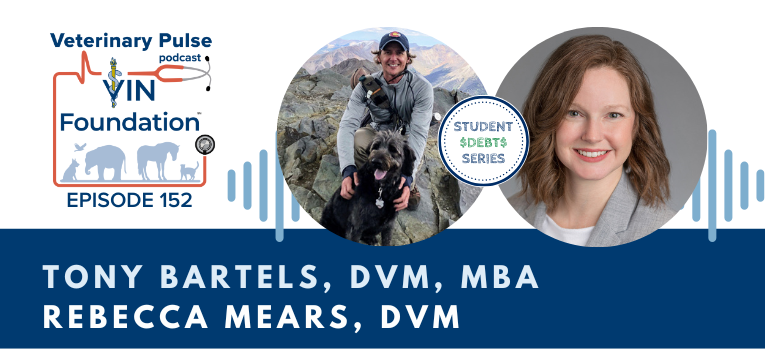
Listen in as student debt expert and Board Member Dr. Tony Bartels and the newest student debt team member Dr. Rebecca Mears chat with Executive Director Jordan benShea in this next installment of our Student Debt Series.
In this episode we cover the following nine topics:
- Latest announcement on Jan 10th
- Phasing out of ICR and PAYE repayment plans
- Is this a different way of doing things?
- Where can a borrower see what repayment plan they are enrolled in currently?
- A ‘new’ income driven repayment plan?
- What is Re-REPAYE?
- ‘New’ plan added to Student Loan Repayment Simulator
- Are there other changes happening?
- What should colleagues do now?
As always, we want to hear from YOU. Please share your thoughts by sending an email or joining the conversation.
GUEST BIO:
Dr. Tony Bartels
Tony Bartels, DVM, MBA graduated in 2012 from the Colorado State University combined MBA/DVM program and is a VIN Foundation Board Member and Student Debt Expert, and an employee of the Veterinary Information Network (VIN). He and his wife, a small-animal internal medicine specialist practicing in Denver, have more than $400,000 in veterinary-school debt that they manage using federal income-driven repayment plans. By necessity (and now obsession), his professional activities include researching and speaking on veterinary-student debt, providing guidance to colleagues on loan-repayment strategies and contributing to VIN Foundation resources. Beyond debt, his professional interests include small- and exotic-animal practice. When he’s not staring holes into his colleagues’ student-loan data, Tony enjoys fly fishing, ice hockey, camping and exploring Colorado with his wife, Audra, and their two rescued canines, Addi and Maggie.
Dr. Rebecca Mears
Rebecca Mears, DVM is from Lexington, KY, where she completed her BS at University of Kentucky. She is a graduate of University of Georgia’s College of Veterinary Medicine. While in vet school, she served as the National Business Certificate Director for the Veterinary Business Management Association (VBMA) and as a board member for Vets for Pets and People. During this time she took an active role in wellbeing awareness and access within the veterinary community. Rebecca then worked as an equine general practitioner and is an active AAEP member. In her time away from veterinary medicine, she can be found hiking, baking, and hosting impromptu dance parties. She is passionate about giving back to the profession and improving the lives of veterinarians, pre-vet and vet students.
LINKS AND INFORMATION:
- VIN Foundation Student Debt Center: https://vinfoundation.org/studentdebtcenter
- Check your current student loan servicers and other loan details — VIN Foundation My Student Loans tool: http://www.vinfoundation.org/mystudentloans
- Loan Repayment Simulator: https://vinfoundation.org/loansim
- VIN Foundation WikiDebt: https://vinfoundation.org/wikidebt
- VIN Foundation Webinars: https://vinfoundation.org/resources/webinars/
- Stay up to date with VIN Foundation updates: https://vinfoundation.org/updates/
- VIN Foundation GIVE page to support these programs & tools: https://vinfoundation.org/give
VIN Foundation Blog Recent Student Debt Blog posts:
-
- A ‘new’ income-driven repayment plan?: https://vinfoundation.org/a-new-income-driven-repayment-plan/
- Common Student Loan Consolidation Questions and Answers: https://vinfoundation.org/fed-student-loan-consolidation-faqs-questions-answers-considerations/
- Class of 2020, 2021, 2022 Income-Driven Repayment Renewal Note: https://vinfoundation.org/class-2020-2021-2022-student-loan-renewal-note/
- Special Cancellation of Up to $20,000 of Student Debt. Are You Eligible?: https://vinfoundation.org/special-cancellation-student-debt/
- Got Federal Student Debt? You’re Now Closer to Forgiveness Than You Think: https://vinfoundation.org/got-federal-student-debt-youre-now-closer-to-forgiveness-than-you-think/
- Student Loan Forgiveness Planning: Preparing for the Tax Bill: https://vinfoundation.org/veterinary-student-loan-forgiveness-planning-preparing-for-the-tax-bill/
- Student Loan Interest Rates Increase for 2022-2023 Academic Year: https://vinfoundation.org/student-loan-interest-rates-for-veterinary-school/
- Personalized student loan Help from VIN and VIN Foundation: https://vinfoundation.org/veterinary-student-loan-debt-help/
- Repay Wiser:
https://vinfoundation.org/resources/repay-wiser-veterinary-school-debt-loan-repayment/ - Borrow Better: https://vinfoundation.org/resources/borrow-better-veterinary-school-loan-debt/
- New Grad Student Loan Repayment Playbook: https://vinfoundation.org/resources/veterinary-new-grad-student-loan-repayment-playbook/
- Federal Student Aid Data, Consolidation, and Repayment Application: https://studentaid.gov/
- New Proposed Regulations Would Transform Income-Driven Repayment by Cutting Undergraduate Loan Payments in Half and Preventing Unpaid Interest Accumulation: https://www.ed.gov/news/press-releases/new-proposed-regulations-would-transform-income-driven-repayment-cutting-undergraduate-loan-payments-half-and-preventing-unpaid-interest-accumulation
- Student Debt Relief Information: https://studentaid.gov/debt-relief-announcement/one-time-cancellation
- Department of Education press release (Nov 2022): https://www.ed.gov/news/press-releases/biden-harris-administration-continues-fight-student-debt-relief-millions-borrowers-extends-student-loan-repayment-pause
- Department of Education press release (April 2022): https://www.ed.gov/news/press-releases/department-education-announces-actions-fix-longstanding-failures-student-loan-programs
- One-time Forgiveness Count Adjustment https://studentaid.gov/announcements-events/idr-account-adjustment
- Federal Student Loan Servicers: https://studentaid.gov/manage-loans/repayment/servicers
- Public Service Loan Forgiveness (PSLF): https://studentaid.gov/manage-loans/forgiveness-cancellation/public-service
Email VIN Foundation: [email protected]
You may learn more about the VIN Foundation, on the website, or join the conversation on Facebook, Instagram, LinkedIn, or Twitter.
If you like this podcast, we would appreciate it if you follow and share. As always, we welcome feedback. If you have an idea for a podcast episode, we’d love to hear it! Reach out to [email protected].
TRANSCRIPT
Intro
Tony Bartels, DVM, MBA: But one of the major issues I have with this approach is, like you said in the very beginning, people don’t know what they don’t know. I mean, every day that we help our colleagues navigate their student loans on VIN Foundation I see people tell me that they’re using a plan that they aren’t actually using, or they’re eligible for a plan that they didn’t know they were eligible for, because it’s just a confusing structure to begin with. And most people, you know, don’t know the ins and outs, right, so they’re not up to date on whether or not they’re using IBR, or they’re using Pay As You Earn, or they’re actually enrolled in Revised Pay As You Earn when they’re eligible for Pay As You Earn, right. They just don’t know those intricacies, and that’s where we help to guide them through that. And we’ve built some of the tools on the VIN Foundation Student Debt Center to help people identify those things, and that’s where this is more important than ever.
Meet the Host and Guests
Jordan Benshea: That is student debt expert and VIN Foundation Board Member, Dr. Tony Bartels with Dr. Rebecca Mears. And this is the VIN Foundation’s Veterinary Pulse Podcast, Special Student Debt Series. I’m Jordan Benshea, Executive Director of the VIN Foundation. Join me as I talk with veterinary colleagues about critical topics, and share stories, stories that connect us as humans, as animals, as a veterinary community. This podcast is made possible by individuals like you who donate to the VIN Foundation. Thank you. Please check the episode notes for bios links and information mentioned.
Diving into Student Loan Changes
Jordan Benshea: All right, we are back once again with our VIN Foundation Board Member and student debt experts Dr. Tony Martel’s, as well as Rebecca Mears to talk about the latest in student loans as part of our Student Debt Series. Welcome, Tony and Becca!
Tony Bartels, DVM, MBA: Well, I guess it means there must be some changes going on because we’re talking about student loans again. So and that would be…
Jordan Benshea: Yeah
Tony Bartels, DVM, MBA: That would be the understatement of the year, I guess.
Rebecca Mears, DVM: Thanks, Jordan, for helping us get this information out.
Jordan Benshea: So as always, let’s just dive right in. The topic today is really that old phrase that we’ve probably heard old, new depending on who you are, what age you are, perhaps, but it’s sort of that concept of you don’t know what you don’t know. And unfortunately, now with student loans, now is really the time to put in the effort to know and to figure it out. So we’re going to help you untangle all of this hopefully, as always, we’ll be here for questions and check the episode notes for links and information mentioned.
Understanding Income Driven Repayment Plans
Jordan Benshea: So we’ve got a bunch of topics we’re going to dive into, and let’s start with the latest announcement from the Biden Administration on January 10th. What did we learn on January 10th?
Tony Bartels, DVM, MBA: Well, January 10th, we saw the proposed changes to Income Driven Repayment, and I think we also just need to back up for a second because there’s been so many changes that have happened particularly since the pandemic and the student loan Pandemic Forbearance Benefits. But as part of the cancellation benefits that were announced last summer that are currently tied up in the Supreme Court, where actually the Supreme Court is going to hear those cases this month to determine the fate of that cancellation benefit, but as part of that cancellation benefit that was announced the administration had dangled the possibility of a new Income Driven Repayment Plan. And we’ve seen new income driven plans added in the past, you know, we started way back in the early mid 90s with Income Contingent Repayment, and then Income Based Repayment was added in 2009, and then we had Pay As You Earn, Revised Pay As You Earn added later in a similar process to what we saw released on January 10th.
Proposed Changes and Their Impact
Tony Bartels, DVM, MBA: But this time, they’re not adding a new repayment plan, they’re actually going to make a bunch of changes to the existing Income Driven Repayment Plans. And the two big ones that I want veterinarians and veterinary students to be aware of are the potential to phase out Pay As You Earn, an income contingent repayment, and then they’re going to modify the existing version of Revised Pay As You Earn, and to date, we haven’t seen this approach taken. They’ve always added a new one and then you can choose based on various criteria to use that new repayment plan, if you meet those criterias. But this time, they’re actually going to phase out some existing plans and modify an existing one that people are using. So that’s a pretty different approach to what we’ve seen traditionally, when it comes to updating the income driven repayment system.
Jordan Benshea: Yeah, that’s a huge radical change and regularly one of the questions that we get is what happens if these plans go away? And, in the past our answer has been, the chances are very slim that that’s going to happen.
Tony Bartels, DVM, MBA: Yeah and, you know, there was a public comment period that closed about six days ago for people to provide feedback on this, and I’m certainly not a big fan of them eliminating any existing repayment plan. But you know, I’d rather see them add like they’ve done before, but the good news is, if you are using either of those plans, when those plans are phased out, you can continue to use them. But one of the major issues I have with this approach is, like you said in the very beginning, people don’t know what they don’t know. I mean, every day that we help our colleagues navigate their student loans on VIN Foundation I see people tell me that they’re using a plan that they aren’t actually using, or they’re eligible for a plan that they didn’t know they were eligible for, because it’s just a confusing structure to begin with. And most people, you know, don’t know the ins and outs, right, so they’re not up to date on whether or not they’re using IBR, or they’re using Pay As You Earn, or they’re actually enrolled in Revised Pay As You Earn when they’re eligible for Pay As You Earn, right. They just don’t know those intricacies, and that’s where we help to guide them through that. And we’ve built some of the tools on the VIN Foundation Student Debt Center to help people identify those things, and that’s where this is more important than ever, because there’s now a ticking clock on your ability to use a plan like Pay As You Earn or Income Contingent Repayment, if it makes sense for you. You have to be in those plans before they get phased out, otherwise, you’re not going to have that opportunity going forward.
Rebecca Mears, DVM: And do we know when that clock is going to expire?
Tony Bartels, DVM, MBA: We don’t have a date yet. When they roll out these proposed changes, usually they take effect on July 1st. Now, that’s not very far away, right, and they kind of rolled out these proposed changes a little bit close to July 1st, compared to when they normally do these things. So I’m not sure if these are going to take effect July 1st, that’s probably the earliest that they would take effect. What I’m hoping is that they actually give people a little bit more time to make that decision and do some investigating on which plans they are eligible for and which ones they should be using before they take effect. But right now, I would say be prepared for them to take effect July 1st, which is why we want you to pay attention to this now.
How to Verify Your Repayment Plan
Jordan Benshea: Right, and if they don’t know what plan they’re in, what do you both recommend is the best way for them to figure that out? With our tools, of course, because we know it can be very helpful, but how would you recommend they go about that process?
Tony Bartels, DVM, MBA: Well, we built those tools because this was the most common question we were getting right? And so we built these tools for that reason, to help answer those questions, because it should be a heck of a lot easier to know what repayment plan you’re in than it currently is, right? So the best way, the gold standard if you will, to verify this is to go to studentaid.gov, grab your student aid data file that’s going to have all of the ugly history of your higher education borrowing career downloaded in this terrible txt file. But you want to save that txt file to your device and then head over to the VIN Foundation Student Debt Center, specifically the My Student Loans tool and upload that file in there, we’ve got all of the algorithms set to show you which repayment options you’re eligible to use. There’s a tab in there that says Income Driven Repayment Eligibility, so I would first check that. But if you expand on the summary and the loan details of error, you’ll also see which repayment plan is listed for your student loans, according to the Department of Education. So I never really want to rely 100% on my loan servicers because they’ve been part of the problem, right, in terms of helping people understand what plans they are eligible for and which plans they’re actually using. So even if I see on my loan servicer website that I’m using a plan like Pay As You Earn and I want to verify that through my student aid data file, that’s the one window we have into the Department of Education universe where we can double check what our loan servicers are telling us.
New Income Driven Repayment Plan Details
Jordan Benshea: Okay, so now we know that there’s a way, hopefully easier way, for them to clearly understand what plan they are in, what about this potential new Income Driven Repayment Plan? What’s the deal with that?
Tony Bartels, DVM, MBA: Right, so the “new plan” actually turned out to be a modification of an existing one. So Revised Pay As You Earn is going to go through some changes. And for folks like myself, who we’re using or are currently using Revised Pay as You Earn because it’s the best plan that I have access to, mostly because I’m not eligible for Pay As You Earn. But I’m not going to have to do anything, right, my Revised Pay As You Earn plan is going to essentially update underneath me. I’m not going to have to do anything the next time I provide my annual income documentation to have my payment recalculated, it will be recalculated under these new guidelines, right, and that will decrease my payment because they’re actually going to increase the allowance that the discretionary income formula uses to calculate your monthly student loan payment. So before for Pay As You Earn, and the current version of Revised Pay As You Earn, it was 150% of the poverty guidelines was essentially the allowance. You were able to subtract from your current taxable income, that would get you your discretionary income, and then you took a percentage of that for your monthly payment. So with a higher factor, multiplied by the poverty guidelines, you will have a lower monthly payment using Revised Pay As You Earn than any other plan that is currently available. Now it’s not a huge difference, at least not for the, you know, the average veterinarian. The lower your income, the bigger the impact in terms of a monthly payment amount, and that’s by design. Most of these plan updates are specifically targeted to improving student loan repayment for undergraduate borrowers, not necessarily graduate school borrowers.
Rebecca Mears, DVM: Yeah, cause I think that’s one of the interesting things about this proposal is, I mean to most people, you know, trying to figure out how to handle their student loans.
Understanding REPAYE vs. PAYE
Rebecca Mears, DVM: It sounds like having the lowest monthly payment would be the way to go, but that’s not necessarily true for all veterinarians. Correct?
Tony Bartels, DVM, MBA: Correct, because the big kicker between, and this was the existing situation, comparing Revised Pay As You Earn against Pay As You Earn, Revised Pay As You Earn requires you to make payments for 25 years before reaching forgiveness, Pay As You Earn, only 20 years. So the sooner you reach forgiveness, the better the plan in general, and by better I mean you’re in repayment for a shorter period of time, which means you’re going to pay less in total overall. So that’s where knowing whether or not you’re eligible for Pay As You Earn and you’re actually using it before it’s phased out is so important, because for many veterinarians Pay As You Earn is still going to be a better long term option than this new version of Revised Pay As You Earn because that forgiveness timeline is shorter.
Introducing Re-REPAYE
Jordan Benshea: And we’ve been doing a lot of work on the back end, and now we’re really happy to say that this new “plan” has been added to the Student Loan Repayment Simulator.
Tony Bartels, DVM, MBA: Yeah, sure. So we just recently added and we’re calling it Re-REPAYE, so revised REPAYE, which is completely redundant, but this whole process is completely ridiculous anyway, so why not? So Re-REPAYE will reflect the math as the proposal currently exists to show you how that might play out for you going forward, so check that out, run your simulation.
Changes in Spousal Income Consideration
Tony Bartels, DVM, MBA: So one of the other interesting updates to the new version of REPAYE, or one of the other, I guess, side effects of REPAYE is that you previously were not able to separate your income from your spouse if you were married, and for many veterinarians, that makes sense if you’re the veterinarian with the student loans and your spouse might not have student loans. Oftentimes, it made sense to file your taxes separately so you can have your student loan payment calculated only on your income and not include your spouse’s income, but people couldn’t do that using Revised Pay As You Earn. After these changes take effect, you will be able to do that. I saw a lot of people that we had counseled over the years where REPAYE would have been a great option if they weren’t married. Those of us using the old version of IBR, which was not terribly beneficial, will now have another reason to look at REPAYE again, because they can separate or exclude their spouse’s income from that calculation, which could be extremely beneficial going forward.
Jordan Benshea: Well, that’s a benefit at least from this right?!
Tony Bartels, DVM, MBA: For sure, yeah, absolutely.
Impact on Different Veterinarian Groups
Tony Bartels, DVM, MBA: So those of us again, I’ll use myself as an example, REPAYE was my best available repayment option, you know, and that plan is going to improve for me without me having to do anything, which is great, right. But, there’s a few groups of veterinarians who are going to be uniquely impacted by this, right. So those folks that are eligible for Pay As You Earn who might not be using it, I’m worried about them because again, you don’t want to find out after these take effect that you could have gotten your loans into Pay As You Earn, but now you no longer can. Right now, for those folks who are also eligible for the new version of IBR, Income Based Repayment 2014 is how I refer to it, and that’s because people who receive their first student loan after July 1st 2014 are generally eligible for the new version of IBR. That version of IBR is very similar to Pay As You Earn. So losing access, to Pay As You Earn for those folks is not that bad, right, because you still have a plan that’s very similar, that you could use going forward. And as we’ve analyzed these changes a little bit, probably the most beneficial repayment strategy going forward, particularly for new graduate veterinarians, is going to involve using a combination of Revised Pay As You Earn and then switching to the new version of IBR, so they can benefit from the shorter forgiveness period. I’d just like to point out that all these changes at the Department of Education, did this in an effort to make this simpler, right, and I can’t. I mean, you all listening to this now, and I, you know, I can hear myself explaining it, and it just makes my head spin. And, you know, that’s why it’s just, it’s almost like a tragic comedy. This is not simple, right, which is why I don’t agree with this approach to doing this, there are going to be people who benefit like myself, there are other people that are going to be on the outside looking in. Overall, that approach that we just described, starting with Revised Pay As You Earn, switching to the new version of IBR will be extremely beneficial for those folks who qualify for those two plans, because it’ll reduce their total repayment costs, even lower than Pay As You Earn currently does. So in that respect, it is significantly more beneficial, if you can navigate it correctly, right, which is going to be a big if.
Jordan Benshea: So what are the other changes that colleagues need to know about?
New REPAYE Interest Subsidy
Tony Bartels, DVM, MBA: So when it comes to the new version of REPAYE, one of the other exciting changes is that there’ll be 100% unpaid interest subsidy. So currently Revised Pay As You Earn provides a 50%, unpaid interest subsidy, meaning whatever amount of interest your payment does not cover each month, the government covers half of that. When these new changes take effect, the government will cover 100% of the interest that your payment is not covering. So what that means, practically, is that the days of watching your loan balance grow are over, which is one of the biggest stressors for folks using Income Driven Repayment Plans. Now, unfortunately, that’s only going to be true for the new version of REPAYE, which is really going to create some interesting behavioral choices for people who might benefit from a plan that will have their loan balance growing, right, whether or not they want to choose REPAYE over that other plan that’s technically more beneficial, like Pay As You Earn.
Jordan Benshea: And what should colleagues do right now?
Steps to Take Right Now
Tony Bartels, DVM, MBA: I would highly suggest doing what we call a physical exam of your student loans, right. So going and grabbing the most recent student aid data file from studentaid.gov, uploading it into the VIN Foundation My Student Loans tool, looking at your income driven repayment eligibility, seeing which repayment plan your loans are actually in. This is particularly important for those of you that graduated during the Pandemic Forbearance Benefits. So a lot of you have posted on the message boards where we provide this type of assistance to folks who have questions regarding their student loans, and you say, “hey, I graduated, maybe I consolidated or I applied for an income driven plan”, but when I look at your loans it says forbearance, right, which is usually indicative that they didn’t put you in a repayment plan, they just put you into the Pandemic Forbearance Benefits. Which it’s hard to tell the difference whether or not you’re in a repayment plan or in the pandemic forbearance because nobody’s had to make any payments and nobody’s had any interest accrue, right, but you want to see that visual confirmation that you’re, in fact, in a repayment plan, right? So I’m looking to see does it say, IBR? Does it say Pay As You Earn? Or does it say Revised Pay As You Earn? Or does it say forbearance. And if it says forbearance, I’m going to highly encourage you to go knocking on the door of your loan servicer to get some kind of written confirmation that you’re actually in an income driven plan, particularly if it’s one of these ones that’s going to be phased out like Pay As You Earn, or Income Contingent Repayment. Then second, I would say run some simulations, right? Explore that new version of Re-REPAYE and see if it’s going to be a little bit better for you. We don’t currently have a way to simulate that situation I described where you can start with REPAYE and switch over to IBR 2014, but we’re going to work on that and hopefully have that out in the not so distant future. But I anticipate that one is going to be, you know, a real financial game changer for those that look at that and see a lot of cash flow, flexibility, and in a lower total repayment cost.
Staying Updated and Supporting VIN Foundation
Jordan Benshea: Well, it’s really important for everyone listening, make sure you are signed up for updates, we will have the link in the episode notes, but make sure you’re signed up for updates and that you’re getting these podcast episodes and the Student Debt News Brief that we’ve started sending out along with a blog post on the foundation website. Because we will be sharing all of this information when those additional things come to the Student Loan Repayment Simulator, as well as our other tools. So highly recommend that you sign up for those updates and, you know, I will also take a moment to say the VIN Foundation is a nonprofit, so all these tools and everything that we’re doing, we are doing based on generous individual donors and grants. So if you find these things really helpful, and you’d like to make a donation and help support it, we would really welcome it and you’ll find that link in the episode notes as well. Is there anything else that either of you think our listeners need to know about this news, or anything else that you feel is pertinent to share at this time?
Outro
Rebecca Mears, DVM: I think for me, the big thing is just no matter what you think is going on with your student loans, grab that student aid data file and upload it to the My Student Loans tool, definitely check out and be sure that what you think is happening, what repayment plan you think you’re using is actually what’s reflected in that file. And if there’s any discrepancies, like Tony was saying, ask questions, find out.
Tony Bartels, DVM, MBA: And I’ll just say, because there’s a lot of detail in these proposed changes and, you know, we’re not gonna be able to touch on all of those differences here in this podcast, we did recently put out a blog post that we’ll include in the episode notes as well, that go through more of those changes in detail. So if you want to read about those or see more detail on how those are going to be implemented and potentially impact your loan repayment strategy, I would highly recommend reading through that recent blog post.
Jordan Benshea: Yeah, that’s a great point as well, and as Tony and Becca both said, all of those things will be in the episode notes. Now is the time to pay attention, make sure you know what’s going on. It takes effort and it takes time, but it’s going to be worth it, and it has the ability to save you lots of money and a whole bunch of stress and angst down the line as well. So take the time to be proactive now with your financial situation. Becca and Tony, thank you both so much for being here and always for your expertise and sharing with colleagues.
Tony Bartels, DVM, MBA: Thanks again for having us.
Rebecca Mears, DVM: Thanks, Jordan.
Jordan Benshea: Thank you for joining us for this episode of The Veterinary Pulse. Please check the episode notes for additional information referenced in the podcast. If you enjoyed this podcast, please follow, subscribe, and share a review. We welcome feedback and hope you will tune in again. You can find out more about the VIN Foundation through our website, VINFoundation.org, and our social media channels. Thank you for being here. Be well.