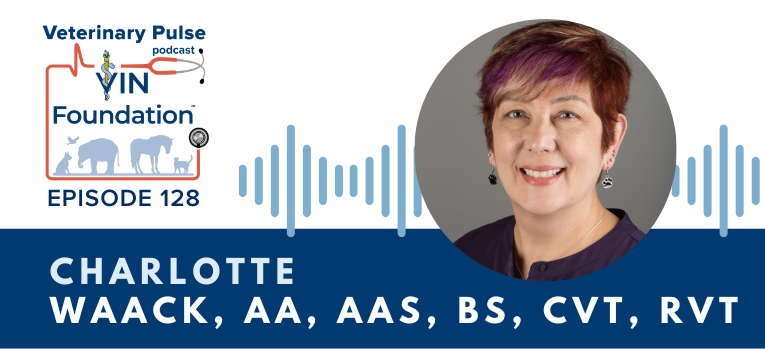
Join VIN Foundation Executive Director Jordan Benshea as she chats with VSPN Director Charlotte Waack about her journey to veterinary medicine, how a back injury set her on an unexpected course, and why the medicine continues to elicit excitement. Charlotte shares an inside look at the veterinary support field, the areas she sees as stressors with room for improvement, and how Support4Support is helping colleagues feel not alone.
GUEST BIO:
Charlotte Waack, AA, AAS, BS, CVT, RVT
Charlotte started working in the field of veterinary medicine in 1990, as a veterinary assistant. She ended up loving the field and pursued the education to become a credentialed veterinary technician. Charlotte graduated from St. Petersburg Distance Learning Veterinary Technology program in 2004, and in 2006 started working for Veterinary Information Network (VIN), assisting with Continued Education (CE) courses for VSPN (Veterinary Support Personnel Network). Charlotte currently serves as the Director of VSPN and VSPN CE. In addition to driving all content to the VSPN website, she is also in charge of hiring instructors and coordinating the CE courses offered to technicians and support staff, is the co-founder and Team Lead of the VIN Foundation peer support group Support4Support, and is a vital member of the VIN Conference team, working at conferences in the US, Canada, and Europe, and has recently started to host interview type vlogs for VSPN, called #lovevspn.
Charlotte served on the National Veterinary Technician Association executive board from 2012-2014, Missouri Veterinary Technicians Association board from 2008-2012; Illinois State Veterinary Medical Association board from 2014-2017. She coordinated three CE conferences for Missouri Veterinary Technicians Association and has served on the CVT and CE committees for ISVMA since 2015 and co-chair of the ISVMA yearly convention since 2017-2019, as well as the technician program chair for Chicagoland Veterinary Conference.
Charlotte’s speaking engagements have included the Wild West Veterinary Conference, Association of Veterinary Technician Educators Symposium, presented webinars for VSPN, Illinois Veterinary Medical Association, and has given presentations to Illinois veterinary technology programs. She has also been published in NAVTA Journal, ISVMA Epitome and Veterinary Technicians Magazine.
As an educator, Charlotte has taught CE courses for VSPN CE, a veterinary assistant course at John Wood Community College in Quincy, IL, and was an adjunct instructor for San Juan College Veterinary Technology Distance Learning program. She also serves on the curriculum advisory committees for San Juan College Veterinary Technology Program and Pima Medical Institute (Las Vegas) Veterinary Technology Program.
LINKS AND INFORMATION:
Learn more about the VIN Foundation Veterinary Pulse podcast, or explore the VIN Foundation and join the conversation on Facebook, Instagram, or Twitter.
If you like this podcast, we would appreciate it if you follow and share. As always, we welcome feedback. If you have an idea for a podcast episode, we’d love to hear it!
TRANSCRIPT
Intro
Charlotte Waack, AA, AAS, BS, CVT, RVT: Right now, I think the biggest thing is low pay. Most people that work at a veterinary clinic, even though that is their main full-time job, they have one or two other side gigs that they have to have because they do not earn a living wage. They can’t afford an apartment, can’t afford health care, can’t afford groceries sometimes. That’s probably the biggest thing and that contributes to burnout that we see. New graduate technicians that are coming out of school, they’re only staying in the field five to seven years after graduation.
Jordan Benshea: That is Charlotte Waack, and this is the VIN Foundation’s Veterinary Pulse podcast. I’m Jordan Benshea, Executive Director of the VIN Foundation. Join me and our cohost and VIN Foundation Board member, Dr. Matt Holland as we talk with veterinary colleagues about critical topics and share stories. Stories that connect us as humans, as animals, as a veterinary community. This podcast is made possible by individuals like you who donate to the VIN Foundation. Thank you. Please check the Episode Notes for Bios, links, and information mentioned. Welcome, Charlotte. Thanks for being with us today.
Charlotte Waack, AA, AAS, BS, CVT, RVT: Thanks, Jordan. It’s great to be here.
Jordan Benshea: I’ve been so excited to have you. I don’t know why it didn’t dawn on us to do this earlier.
Meet Charlotte Waack, AA, AAS, BS, CVT, RVT: A Journey into Veterinary Medicine
Jordan Benshea: Charlotte’s current role is as the Veterinary Support Personnel Network’s [VSPN] director and continual education director. You also do conferences for VIN. Tell us a little bit more about your role.
Charlotte Waack, AA, AAS, BS, CVT, RVT: I oversee VSPN, which is part of the VIN family, and we are VIN for the support staff. So, for technicians, assistants, receptionists, and office managers, VSPN is there, and membership is free to VSPN. We don’t have quite the resources that VIN does, but we’re building resources every day and it’s geared again toward the support staff. I oversee all the content on VSPN and the CE department. I schedule VSPN CE courses and oversee the content on that and make sure everything runs smoothly.
Jordan Benshea: That’s great.
The Role and Impact of VSPN
Jordan Benshea: You know, it’s amazing to me when people don’t know about VSPN, because I feel like it’s such a huge resource for support staff. Regularly, what we hear is that support staff is trying to get on VIN, but really there’s this whole other wealth of resource and information available to the support staff. Like you said, it’s totally free. This isn’t an ad for VSPN, but it’s more we want to share info so that our colleagues know. The Foundation’s mission is we’re here to help and VSPN is here to help as well. So, I wanted to make sure that we shared that.
Charlotte Waack, AA, AAS, BS, CVT, RVT: It is so surprising to me, because working the conferences, I’ve been working for VIN for 16 years now, and I started working in conferences probably 10 to 12 years ago. Talking to the VINners, the veterinarians, probably 80% did not realize that VSPN was out there. They would ask because I’d have my VSPN shirt on and they asked, “Is that part of VIN, what is it?” So, I happily handed them a brochure. Now, a few more do know about it, but we’re still seeing probably 65 to 75% of VIN members don’t realize that VSPN is there for their staff.
Jordan Benshea: Yeah, we feel the same way with some of the VIN Foundation resources. It’s like we’re a great kept secret, but really, we don’t want to be a secret. We want everyone to know and utilize us and get help. I think a lot of times when things are free, people just presume that there’s a lack of value there, but we’re really nice humans, we really do want to help you.
Charlotte Waack, AA, AAS, BS, CVT, RVT: And you know, we are a worldwide community with VSPN. We have about 12,000 to 13,000 members worldwide.
Jordan Benshea: Wow.
Charlotte Waack, AA, AAS, BS, CVT, RVT: We have colleagues from Australia, New Zealand, many from Canada, probably 10% of our membership are Canadians, and several from Europe. It’s growing and hopefully, we’re going to continue having that international presence.
Jordan Benshea: I’m sure that you will. I’m sure that it’ll continue to gain steam.
Challenges in the Veterinary Profession
Jordan Benshea: You’re such an extremely experienced veterinary professional and I think it’d be great for our listeners to go backwards a bit and learn about your journey. How did you find your way to the veterinary profession, into veterinary medicine? Did you always have this passion for caring for animals? How did it start? Share with us your story.
Charlotte Waack, AA, AAS, BS, CVT, RVT: Well, originally, I went to college to be a music producer, record producer, coordinator. When I graduated with my bachelor’s, back in 1982, I was barely 21 years old and I would need to move to either Nashville, or LA. I’m from a very, very small town in Illinois, and went to a very small college in Illinois, so that was a little bit daunting to have to pick up and move to those really big cities, because that’s where the music industry is. I was working at Pizza Hut all through college and they offered me a management job. I took it, it was great pay, I really enjoyed the business side of it, because my degree is in music business. I hurt my back after about 10 years working there, I was 29 years old, and blew a disc in my back. I had to have back surgery that took me out of the running for about a year total between physical therapy, having the surgery, and in recovering for eight months. When I was released, I no longer had the job at Pizza Hut. So, I was looking at ads, and I answered a blind ad for a veterinary clinic. They wanted someone as an assistant, and I got the job. Never had any idea. I mean, I always loved animals. We had dogs; my mother was a dog groomer. But I didn’t have that science drive. I was a music geek. I didn’t think about the science of it all. I just fell in love with veterinary medicine. I think some of it was the veterinarian that I worked for, Dr. David Hall, who just retired from clinical practice. He encouraged us to learn [it was a very small practice]. If we asked about something, no question was dumb. If I wanted to learn more about how anesthesia affects the body, he would hand me an article from a journal and say, read this. So, he helped develop my love for veterinary medicine and at that small clinic, I worked with my first certified veterinary technician. I thought, wow, this is amazing. All of these skills that she has, and all this knowledge she has. At that point in time, I was married, kind of settled, didn’t want to move away to go to college. But I eventually found a distance learning program and went back to school at the age of 39 to become a certified veterinary technician. It took a couple years to do that. St. Petersburg College was a distance learning program I went to, and I was amazed at how much I learned. A lot of people thought, well, you’ve been in the field for 12 years, you probably know it all. No, you don’t. You know the hows, you don’t know the whys behind what you’re doing. That was amazing, very eye opening to go back to school. I continued working in clinical practice until my back gave out again. Through the whole time, probably since 1996 – 97, I’d been volunteering for VIN in an area called the Pet Care Forum back when we were on AOL.
Jordan Benshea: Right, right. It’s early days.
Charlotte Waack, AA, AAS, BS, CVT, RVT: Yes, back in the Pet Care Forum. I started volunteering for VSPN once all VIN and everything moved to the World Wide Web. I’d always been a volunteer in the background and when I had come out of clinical practice, the director of VSPN at that time, asked me to send a resume in and my job has grown from there. I’ve had amazing opportunities and I think a lot of it comes from volunteering. You know, I don’t say no, very often.
Jordan Benshea: There are pros and cons to that.
Charlotte Waack, AA, AAS, BS, CVT, RVT: Of course, you have personally seen that.
Jordan Benshea: I suffer from the same situation, so I understand. That two letter word really gets me. Well, what was it about the veterinary profession and veterinary medicine that really drew you in?
Charlotte Waack, AA, AAS, BS, CVT, RVT: The caring for the animals. I got to know patients that came in as puppies and if you work at that same clinic long enough, you will see them to their last day. I felt it was a privilege to be able to share that journey with them. You know, a patient comes in hit by a car, really critical and 10 days later, they walk out of the clinic. It’s being able to do the healing, to help with that healing and be a part of that. Again, the science just fascinated me. I am a big endocrinology and clinical pathology nerd, I didn’t think that I would have to use a microscope after high school, but I love it. The challenges because the medicine changes every day, so it’s a changing field. You’re always having to learn new things, and to keep up with the medicine and I’m a lifelong learner. If I could, I’d be in college right now, probably.
Jordan Benshea: Well, it’s a great path that has taken you here, from Pizza Hut, to injuring your back, then somehow taking you to veterinarian medicine. We never really know in life what things are ahead for us, right, but the importance of being open and exploring. That was a huge shift for you, and you really just took it on. That’s wonderful. I hear love hearing those stories.
Charlotte Waack, AA, AAS, BS, CVT, RVT: It was and that’s the thing, you don’t ever really know what door is going to open. I’m a big believer in don’t ever burn your bridges, because you never know when something might happen to what you’re doing right now, you’re not able to do that position any longer in clinical practice. Having different opportunities. I think you don’t shut that door, you don’t slam it, and burn bridges. You never know, if you’re in a position where you’re going to leave that clinic, don’t get mad and storm out and cause everyone hell, because you never know you may want to go back to that clinic at some point.
Jordan Benshea: Or you might find yourself working with one of those people in another clinic that you didn’t expect.
Charlotte Waack, AA, AAS, BS, CVT, RVT: Exactly.
Jordan Benshea: Life has ways of showing us lessons that we didn’t know we needed.
Charlotte Waack, AA, AAS, BS, CVT, RVT: Yes.
Jordan Benshea: So, you’ve probably seen a lot over the decades. What would you say are some of the most critical topics for veterinary support staff in the current landscape of the profession?
The Impact of COVID-19 on Veterinary Practices
Charlotte Waack, AA, AAS, BS, CVT, RVT: COVID has changed a lot of things which I know we’re going to talk about in a little bit. Right now, I think the biggest thing is low pay. Most people that work at a veterinary clinic, even though that is their main full-time job, they have one or two other side gigs that they have to have because they do not earn a living wage. They can’t afford an apartment, can’t afford health care, can’t afford groceries sometimes. That’s probably the biggest thing and that contributes to burnout that we see. New graduate technicians coming out of school, they’re only staying in the field five to seven years after graduation.
Jordan Benshea: Oh, interesting. Okay. Yes.
Charlotte Waack, AA, AAS, BS, CVT, RVT: So, there’s a lot of turnover, which impacts the whole veterinary clinic. Because of that high turnover, you’re always training someone. I think that’s probably one of the biggest issues that we have going is that we need to find a way to keep people in the clinic and in this profession, because a lot of people are leaving, and COVID really did not help that very much.
Jordan Benshea: Well, yeah, let’s talk about that. How did you see the pandemic shift the veterinary staff experience in practices?
Charlotte Waack, AA, AAS, BS, CVT, RVT: It became truly unbearable for many people, and they left the field.
Jordan Benshea: Specifically what areas do you feel caused that?
Charlotte Waack, AA, AAS, BS, CVT, RVT: You’re overworked, understaffed, and low pay? Especially when it first started, and people were testing positive, and they’d have to have part of their staff quarantine. My husband works for a big company, a big corporation and when they have like five people out because they have to quarantine, there’s someone who tests positive, it doesn’t make a huge impact on them. When you have that with the veterinary clinic, that is half of your staff. They don’t have backups, they have enough people on that team to run those shifts, they don’t have anyone to backup to help them. Then the people that are still working, they’re doing twice the work, they’re working 10-to-12-hour days with no breaks. They’re working seven days a week, even though that’s federally not legal to do.
Jordan Benshea: Right. Right.
Charlotte Waack, AA, AAS, BS, CVT, RVT: They were doing what they had to do to keep the business running. That probably started a lot of the burnout issues. Clients, for some reason, veterinary clinics have become very, very busy during the pandemic.
Jordan Benshea: I know that we’ve talked about this a lot internally at VIN and the VIN Foundation, etc. and we’ve put videos together about it, etc. It seems to me that there’s really two main reasons: one, an enormous influx of people because they’re at home adopting animals at a rate that we’ve never seen before.
Charlotte Waack, AA, AAS, BS, CVT, RVT: So many were cleared.
Jordan Benshea: Right, right. All of a sudden, all this money that used to go to shelters, all of a sudden, they’re cleared. There’s like no animals to adopt. Then two, is that people are at home and they’re paying attention.
Jordan Benshea: Right, and so all of a sudden, they’re noticing these things, or they have the time to see something in their cat or their dog or bird, etc. that they weren’t seeing before. I would say three is that curbside takes a lot more time.
Charlotte Waack, AA, AAS, BS, CVT, RVT: It does.
Jordan Benshea: Are there things you think we’re missing? Do you think those three things are it?
Charlotte Waack, AA, AAS, BS, CVT, RVT: Yeah, though,
Jordan Benshea: Then you add in that, exactly what you said, someone gets COVID, tests positive, and they’ve got to quarantine. Then you’re short staffed, and then they’re short staffed, and then the doctors are more stressed because part of them have to quarantine if it’s a multi-doctor hospital. Then you have clients who are waiting. We were regularly still hearing veterinarians that are running at 110% capacity, easy.
Charlotte Waack, AA, AAS, BS, CVT, RVT: They are. It was just on Facebook last week, one of my friends in an emergency clinic in Massachusetts had to quit taking referrals, or no, they only took referrals. I’m sorry, they had to quit taking walk-ins for the emergency clinic, because they are short staffed. They don’t have enough people to see all of the patients. So, we’re still seeing it. Even though things are kind of opening up, but a lot of practices are still curbside.
Jordan Benshea: Exactly, exactly.
Charlotte Waack, AA, AAS, BS, CVT, RVT: And that is partially to protect their staff members. They don’t know who’s been vaccinated, who hasn’t been. When you’re in an exam room with someone, you’re in fairly close quarters, there’s not a lot of ways to social distance when you’re in a four by six exam room. It would be great if every clinic had these huge rooms that you could stand six feet apart, but you can’t.
Jordan Benshea: Right. Right.
Charlotte Waack, AA, AAS, BS, CVT, RVT: That’s why a lot of the clinics are staying curbside just because of the safety factor.
Jordan Benshea: Yes, and they’ve got to, because a lot of what you’re saying. Somebody gets out and the whole practice, everybody has a specific role, and that can just snowball. Something that you also mentioned was burnout.
Support4Support: Peer Support for Veterinary Staff
Jordan Benshea: I think that we’ve definitely shared a lot on this podcast about the VIN Foundation Vets4Vets confidential support group. One aspect of that, that we haven’t shared yet that I want to make sure people know about is Support4Support, which is confidential, peer to peer support, completely free again, but specifically for support staff. You lead that, so would you share with our listeners a little bit about Support4Support.
Charlotte Waack, AA, AAS, BS, CVT, RVT: Support4Support is peer support. We’re not mental health professionals, but we’re there, we’ve seen and been around the vet industry for a long time. You can contact us at [email protected]
Jordan Benshea: I’ll just say real quick that we will have the link to Support4Support and how you reach out and everything in the Episode Notes. So, if you’re driving or walking, etc., any links that we mentioned in this episode and any information, you can find it all in the Episode Notes. That information will be there for you.
Charlotte Waack, AA, AAS, BS, CVT, RVT: Once someone contacts us, then either myself or Sarah Stillman, who helps with Support4Support, we will be in touch with you to see if we can arrange a phone call and chat a little bit on the phone, find out where we can best help, whether it’s lining you up with another mentor that we know or that has been through maybe something very similar, or whether it’s finding you a list of resources. We will try to work to help and we’re basically a shoulder to lean on when you need it. We have tried group meetings, didn’t work out really well at first, but we are open to trying again. That’s something that may be coming back up in this summer, hopefully. We’ll see how the group feels, but we have several people that we’ve been in touch with and some of them have said they come to a point where, hey, you know what, I think I’m doing really well. I’m going to head out for a little bit.
Jordan Benshea: That’s the best, right?
Charlotte Waack, AA, AAS, BS, CVT, RVT: But I am glad you’re here if I need to touch base. That’s what we wanted to do when we started out with Bree Montana, the head of Vets4Vets and yourself, that we just want to be able to provide a hand up if we can.
Jordan Benshea: Just to let everybody know, that wherever they are in the profession, they are not alone. We are here for them. Whether they’re a veterinarian, veterinary student, or support staff, Vets4Vets and Support4Support are here to help. We’re consistently looking at ways that we can improve. It’s all free. It’s all made possible thanks to individual donors like you, our listeners, and thank you for your support. I’m so thankful that you’re running that group, Charlotte, because I think that that’s a very important need in the profession right now. Hopefully, more people take advantage of it.
Charlotte Waack, AA, AAS, BS, CVT, RVT: It is and a lot of people are becoming more aware of the suicide rate in veterinary medicine, but just to have someone that says, “hey, I care.” It can make a difference.
Jordan Benshea: Absolutely. And also, somebody that is living the day-to-day veterinary medicine world. It’s very different when somebody knows what you’re going through and you’re able to talk about that with them. Whatever it is that somebody is going through, trust us, we’ve seen it before. There are no stupid questions. You’re not an outlier. You’re very special, but you’re not an outlier. There is somebody who’s been through it, and there are mentors, and there are ways to help.
Charlotte Waack, AA, AAS, BS, CVT, RVT: Yes, so definitely I think that’s a big thing. A lot of times, we thought we were alone worrying about burnout, anxiety, bullying within the clinic, and to find out that they’re not alone, I think is gives them some hope.
Jordan Benshea: Right? Yeah, I think that’s very, very true. So, thank you for all the work that you’re doing with Support4Support.
Opportunities and Changes in Veterinary Medicine
Jordan Benshea: Since you’ve been in this field for so long, I’m curious if there are other ways that you’ve seen or how rather, I mean, change is the only constant, so how else have you seen the veterinary profession change for support staff? We covered from a pandemic perspective, and that’s a big thing, but I’m curious overall, what sort of trends you’ve seen.
Charlotte Waack, AA, AAS, BS, CVT, RVT: I think there are a lot more opportunities too other than just clinical practice than what there used to be. But probably the biggest change are the corporate buyouts now. A lot of us long timers, as I call us, started back when my practice was a one doctor practice. Over the last probably 20 years ago, you probably saw multiple doctor practices, but they were still owned by one or two doctors locally owned. Now you’re seeing most of those practices being bought out by corporations. Everyone may not be suited to work in the corporate environment. In a lot of ways, I think it’s been good because the corporations are able to offer better benefits, health insurance, 401Ks, a little bit better schedule possibly because they might be able to have more staff members that are hired. So, it’s kind of a two-edged sword in a way. That’s probably the biggest change that I’ve seen is the changing from the small practice to the corporation practice
Jordan Benshea: Going from the independent owner to multi practice owners. Right. Okay. What are some areas that you see as opportunities to improve from a veterinary medicine perspective for support staff or for the support staff experience? We talked earlier about low pay and about the turnaround. Maybe you can share with the listeners a little bit about what you think of that.
Charlotte Waack, AA, AAS, BS, CVT, RVT: Like I said, most people that work at veterinary practices have one or two jobs, or maybe more than that. Myself, I was very fortunate my husband makes a decent living, so that I could do what I loved. But in clinical practice back then I was making, what, $10.50 an hour. That’s not enough to pay the rent and pay the bills, have food on the table, much less support a family. So, like a lot of industries, we need to have better pay and offer some benefits, because most people that are working in clinics can’t really retire. They don’t have a retirement plan. They don’t have retirement fund. They can’t go to the doctor because they don’t have health insurance. Luckily, over the last few years, some of that has been alleviated, but still, it’s difficult for them to afford it. Yeah, that’s probably the biggest thing.
Jordan Benshea: You know, that’s a big one.
Charlotte Waack, AA, AAS, BS, CVT, RVT: Yeah. And it’s tough because vet clinics [a lot of clients don’t really think about it], but vet clinics are businesses, and bottom line they have to have a profit to keep going. When you go to the hospital to have an MRI, it will cost you 10 times more than the cost to have your dog get an MRI, and it’s the same equipment.
Jordan Benshea: Exactly, exactly!
Charlotte Waack, AA, AAS, BS, CVT, RVT: Same thing with blood work. It’s the same equipment that we run blood work on, but on the human side, you have insurance companies that help defray that cost. We don’t have that in vet med.
Jordan Benshea: Well, there’s pet insurance, but not nearly as many people have it at a level that you see in human medicine.
Charlotte Waack, AA, AAS, BS, CVT, RVT: Or that you see in Europe, pet insurance is huge over there, probably 90% of their clients have pet insurance. In the US, 10% of the clients have pet insurance.
Jordan Benshea: Oh my gosh, I didn’t realize that difference. That’s huge.
Charlotte Waack, AA, AAS, BS, CVT, RVT: You know what, there are a lot of good things. In England, it’s normal to spay or neuter your dogs and cats. It’s just a taken, hardly anyone has intact pets. It’s amazing to see the differences. One thing that’s hard to understand is the vet clinics have to buy this equipment and maintain this equipment and hire good doctors and hopefully hire technicians, so their profit margin is not as high because people complain about the prices that it costs in vet clinics. It’s a really tough line to try to walk to keep the clinic profitable, but also not too high that the clients can’t afford it any longer. So, I don’t have any answers, I really don’t have any.
Jordan Benshea: We are having the conversation and that’s the first step.
Charlotte Waack, AA, AAS, BS, CVT, RVT: I think so and I know that some of the larger cities are starting to talk with some of the unions and a couple of them have unionized. In state of Washington, I think there are two practices that have unionized to help the employees have a little bit better job security and better working conditions. It also helps the clinic because the first one has shown that they have been able to have less turnover since they were unionized. That’s what we need, we need to hold on to these people. I don’t think it’s for every clinic, but that’s maybe one thing, too for as many corporate practices that are out there.
Jordan Benshea: We’ve talked about a lot of challenges and a lot of changes. What are some things that you’re excited about in the veterinary profession these days?
Charlotte Waack, AA, AAS, BS, CVT, RVT: I was excited about the medicine, because again, like I said, it’s changing and they’re making so many pathways into new treatments, in the mast cell vaccine, just things that the geek inside of me says, “This is so cool!” There are a lot of opportunities also, for us to have a longer career as support staff. That someone who’s a receptionist in a clinic, when they’re saying, “I’ve been here for 20 years, what else can I do?”, there are opportunities for them to turn that into a different path. Working with some of the companies and going to the different conferences. Normally, it’s fun to travel, go out there and talk to people. If you’re good with people, and you know the product, then that’s something they’re always looking for someone from the field to help with some of these companies and support them. The ASPCA Animal Poison Control Center, they hire people all across the country to man their phones, these are credentialed technicians, but working from home. There are a lot of opportunities, teaching. It used to be technician programs only hired veterinarians to teach. Now, the majority of the vet tech programs have a credentialed technician as their program director, which is fantastic, so, being an educator. There are just so many opportunities to do things, working for VSPN online. That is exciting as to how we can branch out and do more. All of the CE opportunities we’ve had, thanks to COVID. Everything is online. A lot of the CE programs are offered for free, so take advantage of that, learn something, see a speaker that you’ve always wanted to see, take advantage of some of these programs. Giving myself a little nudge here for VSPN, we’re doing some daytime conferences, one day, earn five hours of CE, different topics, we have a behavior one coming up. It’s just fast and easy and you can see some of your favorite speakers or some of your favorite topics. Everyone’s doing it now. There are just so many opportunities to further your education and learn something about something new coming out. I think that’s fantastic.
Jordan Benshea: That’s been one of my favorite things. I try to look for silver linings and I would say that’s one of the silver linings about COVID is the opportunities for distance learning are amazing right now. I’m loving it, I’m trying to take full advantage of everything that I can. Where I used to have to travel for the staff development and learn these things, now you can do it all. I’m hoping that plus curbside pickup continues. Those are two things that I see as huge benefits coming out of the pandemic.
Charlotte Waack, AA, AAS, BS, CVT, RVT: You know, so you just don’t want people.
Jordan Benshea: Exactly! I remember when I got my first blackberry and I thought, oh my god, this is going to make me so much more productive, right?
Charlotte Waack, AA, AAS, BS, CVT, RVT: Yes.
Jordan Benshea: And I feel the same way. Yeah, there are opportunities now to make us much more productive, and that’s what I’m excited about, to be able to continue to learn and engage and absorb, but without having to do all the travels so that I can focus on other things. I would never be able to do all that learning so I wouldn’t have to be somewhere else physically. Now, it allows you to do both. I think that that’s really exciting because I am similar to you in as much as I love learning and I hope to be a lifelong student.
Charlotte Waack, AA, AAS, BS, CVT, RVT: It’s not just vet med, it’s all kinds of different things. If you’ve always wanted to learn about, oh, say paint by numbers or something, you can. There’s a class for it.
Jordan Benshea: Yep, nope. Dance class probably, free painting classes. Probably free or at a pretty low rate. So, yes, lots of options.
Charlotte Waack, AA, AAS, BS, CVT, RVT: Yes, definitely.
Personal Insights and Hobbies of Charlotte Waack
Jordan Benshea: We’re zeroing in, almost done here, but I wanted to ask just a couple more questions. One thing that I do like to ask is, what’s a secret talent that you have or something that you enjoy doing that others might not know about?
Charlotte Waack, AA, AAS, BS, CVT, RVT: I have a lot of different things. The music thing, I play bassoon and cello, more cello than bassoon these days. I’m a huge Hugh Jackman fan. Ask me anything.
Jordan Benshea: We should probably tell our audience how huge a fan you are. I mean, there’s a serious dedication here.
Charlotte Waack, AA, AAS, BS, CVT, RVT: I’m planning already to go see Music Man as soon as Broadway opens up and tickets are open again. It’s a group of us that go, and we’ve gone to concerts before. I have flown into Philadelphia for one day to see a concert and then flown back home. Yeah, and thanks to Hugh Jackman and a couple of other people on Instagram, I have gotten into sourdough bread.
Jordan Benshea: Oh, you’ve made, you’ve done it. You jumped on the bandwagon.
Charlotte Waack, AA, AAS, BS, CVT, RVT: I have gone down the rabbit hole, completely down the rabbit hole and now I bake. I bake at least one loaf of sourdough a week.
Jordan Benshea: Wow!
Charlotte Waack, AA, AAS, BS, CVT, RVT: Yeah, I have like three different starters. One’s called Gordon Ramsay; another one’s called Hugh Jackman. You have to name your starter I found out. And yeah, just kind of experiment. I even made gluten free for my brother-in-law.
Jordan Benshea: That’s really exciting.
Charlotte Waack, AA, AAS, BS, CVT, RVT: I started a gluten free starter and made a gluten free quote sourdough loaf. I was very proud of that.
Jordan Benshea: So multiple secret talents is what we’re learning.
Charlotte Waack, AA, AAS, BS, CVT, RVT: And I’m getting into video editing because we did a vlog for most of the year on VSPN that was called Love VSPN. I need to put those episodes up on YouTube so everybody can see them. In the meantime, if you like VSPN page on Facebook, you can find them there. We’re going to probably continue the vlog once we start back on the road with conferences and do some interviews with people on site at conferences. Yeah, I like to garden. I love hummingbirds. I’m getting into photography now. There’s just you know, keeping busy. The pandemic was kind of good for me, because I’m home and I’ve had time to do a lot of things. That’s all going to stop at the end of August through September because everyone pushed their conferences off and all the vet conferences start up again. Yay.
Jordan Benshea: Wow.
Outro
Jordan Benshea: Before we jump off here, is there anything that you want to leave the audience with? A piece of advice or suggestion or some of your best practices or anything that you think that our listeners might want to know or would benefit from.
Charlotte Waack, AA, AAS, BS, CVT, RVT: Always try. Don’t be afraid to network, I guess is what I’m trying to get at. Every opportunity I’ve had, whether it’s serving on a board for the Illinois State Vet Med Association, NAFTA, or working with the VIN Foundation, with Support4Support, my job at VIN, it’s all because of networking. That I wasn’t afraid to go up to someone and stick out my hand and introduce myself. I think that’s really important and not just in vet med, in anything you do, is not be afraid to put yourself out there a little bit because you never know what opportunity is going to land at your feet. It may take you in a whole different direction, but sometimes something new while being scary, it can be really good.
Jordan Benshea: Yeah, that’s good advice. That’s good advice. Thank you so much, Charlotte for your time. I know you’re really busy and I really appreciate you taking some time and sharing your story with our listeners.
Charlotte Waack, AA, AAS, BS, CVT, RVT: Thank you, Jordan. It was great talking with you. You know I always enjoy talking with you.
Jordan Benshea: We always have a good time. We hope you tune in again soon. Thank you for joining us for this episode of the Veterinary Pulse. Please check the Episode Notes for additional information referenced in the podcast. If you enjoyed this podcast, please follow, subscribe, and share a review. We welcome feedback and hope you will tune in again. You can find out more about the VIN Foundation through our website, VINFoundation.org, and our social media channels. Thank you for being here. Be well.