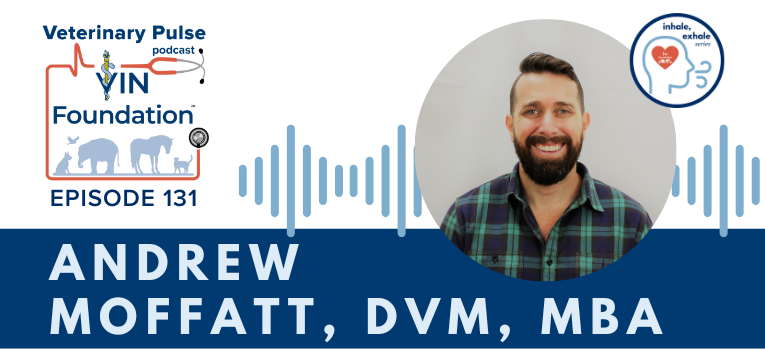
Listen in as VIN Foundation Executive Director Jordan Benshea chats with Dr. Andrew Moffatt about his veterinary career journey from his early dreams of being a fish doctor to the CEO of VetnCare. Andrew shares lessons learned on his path and how his motivation is driven by a passion to help future colleagues be their best selves.
GUEST BIO:
Dr. Andrew Moffatt
Born and raised in Melbourne, Australia, Andrew Moffatt, DVM, MBA, at the age of five, told his mother, with a firm commitment, that he wanted to be an “animal doctor”. Some 20 years later Dr. Moffatt graduated with a degree in Veterinary Science from Massey University, Palmerston North, New Zealand in 2006.
He started his veterinary career at Cliffe Veterinary Group in East Sussex, England, then made the move to London and took on the role of Clinical Director at Chadwell Heath Veterinary Practice. Dr. Moffatt then joined The Village Veterinary Group (CVS) as Clinical Director, managing four busy hospitals and 55 staff. Whilst living in London, he completed an Executive MBA at Cass Business School.
In between these permanent positions Dr. Moffatt worked in another 20 hospitals for varying lengths of time, and made the move to California in the fall of 2011 and lives in San Francisco with his black and white cat Monstey. In his spare time he enjoys traveling, fly-fishing, cycling, and diving.
Dr. Moffatt tries to offer his clients and their pets health care advice that is honest, ethical, and compassionate. His has advanced skills in surgery (both soft tissue and orthopedics), imaging (ultrasound, radiology, and endoscopy), dentistry, oncology, and exotic patient care, enjoys seeing species such as rabbits, ferrets, guinea pigs, birds, reptiles, pigs, goats, and even fish! He is obtaining his certification as a Certified Veterinary Pain Practitioner (CVPP) with the International Veterinary Academy of Pain Management and is Fear Free Certified.
Dr. Moffatt is the Founder and current CEO of VetnCare, Inc, a growing group of veterinary hospitals in the San Francisco Bay Area. These days his main foci are New Graduate mentorship, Veterinarian recruitment, and clinical leadership and operations.
In 2017 Dr. Moffatt was awarded the California Veterinary Medical Association’s “RVT’s Outstanding DVM of the Year”. This award recognizes Dr. Moffatt’s hard work and dedication to his patients, clients and staff alike and rewards his focus on education, training and progressive medicine. He is an active member of the CVMA’s PAC (Political Action Committee) and the Certified Veterinary Assistant Committee. He is also a past Vice President and Board Member of the Alameda County Veterinary Medical Association. Dr. Moffatt is an Expert Witness for the Veterinary Medical Board providing consultation to the board as part of Disciplinary Investigations. He speaks at numerous AVMA accredited schools around the world, covering various business topics including professional happiness, debt management, veterinary business finance, entrepreneurialism, and veterinary business ownership.
LINKS AND INFORMATION:
- VetnCare
- VetnCare on LinkedIn
- VIN Foundation Vets4Vets®
- VIN Foundation Thrive in Five Toolkit
- VIN Foundation Student Debt Center
- Maslach Burnout
- Contact Dr. Andrew Moffatt
You may learn more about the VIN Foundation, on the website, or join the conversation on Facebook, Instagram, or Twitter.
If you like this podcast, we would appreciate it if you follow and share. As always, we welcome feedback. If you have an idea for a podcast episode, we’d love to hear it!
TRANSCRIPT
Intro
Andrew Moffatt, DVM, MBA: One thing that I’ve always really focused on is acting upon what I talk about, and I think this industry is pretty small, your reputation’s important, but if you say something, let’s make it happen or die trying. There’s a lot of good discussion at the moment across the industry covering a number of important areas, but we need to make it happen and it takes action, and it takes collaborative collective efforts through the tertiary education institutions like the vet schools, the subindustry organizations, state board level, private and public sector. Everyone working together to try and address these issues and they can be addressed. These are things we can get through, other organizations have got through them, other industries rather have got through them previously, and are in better positions. Yeah, we’ve got to have some tough conversations and we’ve got to call out some things that are contributing to what’s going wrong.
Meet Andrew Moffatt, DVM, MBA
Jordan Benshea: That is Dr. Andrew Moffatt, and this is the VIN Foundation’s Veterinarian Pulse podcast. I’m Jordan Benshea, Executive Director of the VIN Foundation. Join me and our cohost and VIN Foundation Board member, Dr. Matt Holland as we talk with veterinary colleagues about critical topics and share stories. Stories that connect us as humans, as animals, as a veterinary community. This podcast is made possible by individuals like you who donate to the VIN Foundation. Thank you. Please check the Episode Notes for bios, links, and information mentioned. Welcome, Andrew, thank you for joining us. We’re thrilled to have you here.
Andrew Moffatt, DVM, MBA: Oh, my pleasure, Jordan, I feel really honored to be a part of it.
Jordan Benshea: Well, I’m honored that you were willing to be a guest for us. You’re doing so many amazing things in the veterinary profession and I’m really excited to let our audience hear a little bit about your story and your path. Let’s dive right in.
Andrew’s Journey to Veterinary Medicine
Jordan Benshea: Share with us your veterinary path. Did you always want to be a veterinarian? How did you get to the veterinary profession?
Andrew Moffatt, DVM, MBA: Well, yeah, I was one of those children who decided really early on that they want to be a vet. My mum tells a story of me as a five-year-old asking her what that person was on TV, and she told me it was an animal doctor and I told her then and there that I wanted to be a veterinarian. It’s always been a bit of a calling for me and I feel incredibly lucky. Being a veterinarian is a true gift. It’s really my purpose and I just I pinch myself every day. I feel like the luckiest guy in the world to be to be working as a veterinarian. It was it was just done and dusted. I never had a plan B. There was no, what if I don’t get in, it was just going to happen and fortunately, but you know, I turned up to enough classes and scraped in and then continued to scrape through.
Jordan Benshea: Well, there’s not a lot of people that you hear how to plan initially from childhood and that worked out, so I applaud you for that, for sure. Obviously, our listeners are probably hearing that you have an awesome accent. Why don’t you give us a little insight into where you’re from and how you are now in the US and how did that journey happen.
Andrew Moffatt, DVM, MBA: Yeah, so it’s an interesting journey. I’m from Melbourne, Australia. I left in 2005. I started my veterinary degree at University of Melbourne in 2001, and back then, you could get into veterinary school straight out of school. So, I was in veterinary school as a 19-year-old. In fact, I was still 18 I think at the time, which is a bit crazy, completely unprepared from a maturity standpoint to tackle the rigorous nature of veterinary school, but that was the way it was back then. I started vet school at Melbourne, and it was a great school. I really enjoyed my time there. In my final year, which was going to be 2005, we got informed that University of Melbourne was going to miss out on AVMA accreditation that year. And I didn’t know I was going to work in the States.
Jordan Benshea: Oh, no!
Andrew Moffatt, DVM, MBA: Yeah, and then if you don’t graduate with it, you don’t get it and you’ve got to go through some other paths to be licensed in America and those other paths such as PAVE and so forth are really challenging. At the time, I didn’t know I wanted to practice in the States, but I wanted the option to practice everywhere in the world and for whatever reason, it seemed important to me. I’d just been to the Australasian Students Conference, that’s really just an excuse for a big party, and it was held at Massey University in the summer holidays in New Zealand in 2005 January. I went and met all the guys at Massey and Norm Williamson was, I think, the year coordinator then and Norm, I think, went to Melbourne University. I emailed Norm. Massey was already accredited and has been accredited for a long time. So, I emailed Norm and said, “Norm, look, I would like to graduate from an accredited program, would New Zealand consider me transferring vet schools. I’m actually a half-breed. My mum’s a New Zealander and so that helped a little bit with the student loan piece. Massey agreed. They obviously wouldn’t give me the degree with just six months to go, they asked me to stay down, and I stayed out a year so I could complete a significant portion of the program. So, I, yeah, transferred to Massey and then actually graduated the end of 2006 from Massey University with American accreditation.
Jordan Benshea: So, you end up going five years instead of four?
Andrew Moffatt, DVM, MBA: At that time in Australasia, it was like a five-year program, so I actually ended up going six years. I think I was done and dusted and practicing as a 24-year-old, just ridiculous, you know, I couldn’t even tie my shoelaces and I was set loose on the world. Massey was important for a couple of reasons, because when I left Melbourne, I was obsessed with aquaculture. I wanted to be the next, Paul Hardy-Smith and I wanted to be a fish veterinarian. My favorite lecturer of Melbourne was Paul Hardy, Dr. Paul Hardy-Smith, who is like an incredible fish vet and big into aquaculture. That’s what I wanted to be. I was already looking to get into the aquaculture specialty program in Stirling, Scotland when I left Melbourne. And when I went to New Zealand, I just completely fell in love again with clinical practice. I had some outstanding clinical mentors there in small animal practice and on the farm side. I just realized that as much as I love animals, I love people and sitting on a fish farm in the field lands of British Columbia, there weren’t going to be a lot of people in my life, and I realized that clinical practice may be the right path for me and so I pivoted completely. When I graduated, I went into mixed animal practice. Massey also got me started on my world adventure. Banfield actually helped me with fulfilling my dream of practicing in America and supported me with some of my NAVLE and my California boards initially. But I didn’t go straight to America, I actually went to England as a new graduate and joined an amazing James Herriot style mixed practice about an hour south of London in a town called Lewis in Sussex.
Jordan Benshea: Wow. So, before you’re even 30 you’ve done Australia, Massey, and then the UK.
Andrew Moffatt, DVM, MBA: Yeah, yeah and yeah! I was in the UK for five years, went to business school and got to the US, I think when I was 28, or 29 and had like four or five years under my belt. I was ready to take on America. Yeah.
Jordan Benshea: That’s incredible.
The Move to the US and Practice Ownership
Jordan Benshea: So okay, you come to America, and what age are you at that point, did you say 29?
Andrew Moffatt, DVM, MBA: You know, I think I was 28, I got here in 2011.
Jordan Benshea: Right. Yeah. So, 28, 29 and you’ve had all this experience already under your belt. Where did you start when you got to the US?
Andrew Moffatt, DVM, MBA: Well, so the US, my American dream was very close to not happening when I got a little bit disenchanted with veterinary practice in the UK for a lot of the same challenges that face veterinarians in America. Over there, the level of remuneration is considerably less and you’re on a salary so even if you practice at a higher level, you can’t really improve your remuneration. I was, at that time, I think, managing four sites for a larger corporate group about 60 staff total. We had MRI on site, an American radiologist diplomat, two European diplomats, and four different sites, and I think I was working 80-hour weeks and paid perhaps maybe 70,000 US dollars.
Jordan Benshea: Oh, my gosh!
Andrew Moffatt, DVM, MBA: So, my super relationship was on the cusp of falling apart and I was doing nothing in my life except working. You know, it was a purpose for me. I love veterinary work, but I now know that you’ve got to invest in other things in your life. At business school, I actually got in contact with some human hospitals, and I was very close to taking a role as administrator at a human hospital. I’d given up on my ownership dream, I’d tried to buy a few practices in the UK and at that time, the corporate consolidation of veterinary hospitals was probably 10 years ahead of the US and probably more similar to where it is now over here. I just couldn’t get my foot in the door and so I’d given up the dream of practice ownership and was about to take a job in a human hospital as an administrator when I got a phone call. I got a call from a mate of mine from Massey, a guy called Jerob Leaper. Jerob was a few years below me but had graduated from Massey and came straight to Northern California and started work in a hospital that was owned by his great uncle, a guy called Russ Hackler. I think Jerob on Facebook [back then we didn’t have Instagram, Twitter, or whatever, we were just on Facebook] got the sense that I was getting itchy feet. He reached out and said something along the lines of, “Hey, Andrew, want to buy my great uncle’s practice? I don’t know how to run a practice.” He said, “Do you want to come and do it?” I think I thought about it for about 10 seconds, and I thought this is my chance to be a practice owner and see if I can make it go of it. My girlfriend at the time and I got to have a one-way ticket to America. We came for a month to check it out. I was terrified of coming to America because, you know, at vet school you hear about Davis and Cornell and I was thinking, gee, you know, am I going to cut the mustard? I might not be good enough. I came with a lot of good skills and interviewed at maybe six or seven hospitals in the Bay Area, and no one would offer me a job. I was thinking about what it could be, I was going you know, the accent is pretty good, and I’ve got some clinical skills. What’s going on? I think it was the reality that I needed some visa sponsorship. As an Australian citizen, there’s a great visa, but I still needed someone to activate it with a job offer and at that time there wasn’t a vet shortage in the Bay Area. There would be six or seven candidates for each position. I think these smaller hospitals thought I was a bit too much hard work with a visa and offered the jobs to US citizens, understandably. We came for four weeks to test it out and I couldn’t get a job and with three days to go, I said to Jerob, mate, I’m going to have to go back to the UK. I can’t activate my visa, no one will give me a job. Jerob rang Russ Hackler and Russ didn’t need a vet at the time, but I think Russ felt a bit sorry for me. We only came with $1,000 like we,
Jordan Benshea: Oh, my gosh!
Andrew Moffatt, DVM, MBA: I didn’t have much money. We’d just been traveling through Europe for a few months before we came out here and I think we’d spent everything we had. So overnight, Russ offered me a job and gave me another $1,000 and so with that $2,000 we were able to put a deposit down for an apartment and then Russ gave me a job three days before we’re going back and that was my sliding door moment.
Jordan Benshea: Oh, my gosh. Yeah, the sliding door moments, right? Life comes down to this, really like within three days, I mean, I can imagine you guys are at the limit and thinking that oh my gosh, okay, this could be the end. Gosh, what a great story and how your connections and knowing friends helped with that and with the last minute to be able to get you into the US for your dream. Okay, so now you have your visa sponsored. Did he hire you also as a veterinarian or did he just like find a way to sponsor you?
Andrew Moffatt, DVM, MBA: He hired me as a veterinarian, and this ended up being the first practice that we bought.
Building VetnCare and Overcoming Challenges
Andrew Moffatt, DVM, MBA: Jerob and I bought this phenomenal practice about three months later.
Jordan Benshea: Okay, wow.
Andrew Moffatt, DVM, MBA: Yeah, Grove Way veterinary hospital is where my American Dream started and where the whole concept of VetnCare began, in a little practice in Hayward, California. The last place you’d necessarily start a practice if you looked at all the socioeconomics, but that community has done so much to support me and that hospital, and I feel really proud to be a part of the Castro Valley, Hayward Chamber of Commerce. That community means a lot to me. Really gave me my start over here.
Jordan Benshea: That’s an incredible story. Alright, so you bought this practice after three months of being here. How does that form into VetnCare? How do you get from that to where you are today? I mean you’re doing really well, you are implementing, based on my conversation with some of your staff, really amazing practices from an employment perspective, from a human perspective, that I think a lot of businesses don’t, irrelevant to the industry. I’d love to hear how you go from that to where you are today.
Andrew Moffatt, DVM, MBA: Yeah, a lot of people ask me this question, and I would love to be able to say, gee, I had this big plan, and we did all these demographic studies, Hayward was the perfect spot, and I just knew that America needed a bit of a change up on. But that would all be a lie. Literally on the plane over here, I was writing ideas on the back of an envelope. I had been a part of some fantastic veterinary groups in the UK, and British practice was really the standard in the world at the time. I’ve still got some people that I hold in high regard there. My mentor, Jane Balmain is currently the Chief Operations Officer of the vet group who run the business Vets4Pets and so forth. She’s a tremendous supporter of mine. Brandon Robinson, who ran Village Veterinary Group and is still active in the vet industry was an inspiration to me and my sister, who’s a veterinarian who works over here with me at the moment. So, I think a lot of my experiences there gave me a vision of what we wanted to be, and our style of practice is much more similar to British general practice and its standard in the US, but the concept of coming over with a cookie cutter approach and implementing what I’ve learned would have been foolish. In fact, early on as a young owner, I made lots of mistakes. I came in with too much hubris and at Grove Way, particularly, I made heaps of mistakes. I changed things too quickly. I didn’t listen or ask good questions to the previous employees. I should have done a much better job at partnering and listening to Dr. Russ Hackler, who was an incredible man, and his insights and observations would have allowed me to do a much better job. But I came in as a young guy thinking I knew what I was doing. We had big loans to buy that clinic. We wanted it to perform quickly so that we could show the bank that we knew what we were doing. As much as Grove Way has become a tremendous success over the last decade, it was a real learning ground for me. I think we with that first practice we had a lot of great challenges that taught me a lot about myself, managing practices, and navigating and supporting teams through acquisition. We also went through a lot of hardships. Devastatingly, six months after I bought that practice, Dr. Russ Hackler died in a plane crash.
Jordan Benshea: Oh, how sad!
Andrew Moffatt, DVM, MBA: Russ was someone who I held in high regard and such an important part of that community and someone who I had hoped was going to give me so much mentorship and coaching in the years to come. He gave me so much. He’s really the reason I’m in this country. To not see him have the incredible retirement that he deserved, and for him, not to have seen how great the hospitals have become was incredibly, incredibly sad.
Jordan Benshea: Absolutely.
Andrew Moffatt, DVM, MBA: A lot of what we’re doing is in his name and his late wife, Kathy Hackler, was an incredible supporter of mine and gave me great mentorship as I navigated those early days. So, yeah, in that first practice, there were certainly nights and days where we were thinking, hey, it’s all over, we’re not going to make this. I think the amount of time and energy we put into that first practice, and I have a lot of energy, I’d been managing hospitals at a higher level in the UK, I had an MBA, I had a good team around me, I had a great partner in Jerob and our respective partners, and it was still incredibly tough, you know, like breakingly tough, and we just sort of scraped through. So, you can understand why practice ownership isn’t super desirable for a lot of younger veterinarians who don’t have all the experiences I have. However, I finally got to a point where ownership is not only a lot of fun, incredibly rewarding, financially rewarding also, which I think isn’t something that I’m passionate about talking to young vets about, but if we could get to that point without that crazy hardship that I had to go through, and many other practice owners have to go through, I think that’s what inspired the whole dream. Once we got Grove Way going in the right direction, I realized having managed multiple hospitals in the UK that we could perhaps replicate this. Our second hospital was our first real partnership with Dr. Emily Lin. I don’t know what Emily saw in me, but after just a few discussions, Emily and I hit it off, and she hung her hat on the dream I illustrated to her. Emily’s been an incredible partner of mine through the last decade and now runs an incredibly successful hospital and has been through a lot of that journey with me. Each time we got through another practice, and saw each one performing better, and us being able to go through the transition of acquisition better, we realized that we’re on to something. The model that we embrace in the UK is called a joint venture partnership model and I came out here intending to realize that model here, and slowly but surely, we realized that this might just change the industry, in terms of giving aspiring veterinarians who really want more out of veterinary medicine than just a nine to five, the opportunity to obtain that professional and financial satisfaction that I’ve got out of this career. That’s where we are today.
Jordan Benshea: Wow, yeah. You know, when you first shared about the time and mistakes that in hindsight you’ve recognized, that’s where so much learning happens and being willing to recognize that we made those mistakes and that we’ve learned from them. I mean, we don’t learn things by doing things right. I mean, we learn very little.
Andrew Moffatt, DVM, MBA: Exactly, and I think we’ve got a bit of an unsaid mantra in our organization that you can’t learn without mistakes and that applies to clinical mentorship and also ownership. All the partners who now join our organization get the luxury where they’re part of a community of other veterinary leaders and owners who have been through their own experience within our community. We all learn together. Jerob was able to make less mistakes than I had done, Emily less mistakes than Jerob and I made, Dr. Max Salinas less mistakes than Emily and I had made. Our current partners come in and are primarily applying a clinical or medical director role focusing 95% of their attention on their patients, on their teammates, and on clients to really try and realize these fantastic clinical cultures that I think are pretty rare in America. Everything else, we take off their plate so they can be their best professional selves. If we compare traditional practice ownership to our version of it, it’s actually something that can be well managed by competent individuals so that they can realize their professional legacy in being an owner. They can realize their aspirations to advance clinically and practice at a higher level. They can be a voice in their clinics and be a leader and a mentor. They get the financial security of that position, but they can also have, and I don’t like ‘work life balance’, I think one of your podcasts talked about work life symbiosis, they can realize that concept, because they can be their best self professionally, and they are also in a far stronger financial position. They can then have better personal lives. I think that’s what the industry has to embrace. You can’t be great personally if you’re in a financial hellhole, because you’ve come out of vet school with $400,000 of debt, and you haven’t attended all Tony Bartels’ seminars, and got no financial education in vet school, and you’ve got no mentor to talk to you about ownership and inspire you to consider practice ownership.
The Importance of Mentorship and Mental Health
Andrew Moffatt, DVM, MBA: That’s all I live for these days is helping veterinarians be their best professional selves. In our model that embraces clinical leadership, clinical culture, patient care, and a lot of that goes alongside veterinarians advancing clinically far beyond what’s normal in America. With that comes the financial security that never drives a vet, but gee, it’s a lot easier to be a great veterinarian if you don’t have to worry about your financial stresses.
Jordan Benshea: Well, we definitely see that. We see the student debt challenges that people have, and the immediate tie to the mental health challenges, and vice versa.
Andrew Moffatt, DVM, MBA: Exactly.
Jordan Benshea: You definitely see it in the veterinary profession. I think it’s rational to see that across the board in all industries and specifically in the veterinary profession based on the student to debt ratio that people are coming out of veterinary school with. Combine that with the challenges, like you said in the beginning that you realized you really like people, I think we can agree that’s very rare for most veterinarians, to really like people, they tend to prefer animals. A lot of people get into the veterinary profession thinking that they’re going to be dealing with animals a lot, but really, you’re dealing with people.
Andrew Moffatt, DVM, MBA: Yeah, exactly, exactly. Yeah. Exactly.
Jordan Benshea: So, you were a rarity out of the gate!
Andrew Moffatt, DVM, MBA: Yeah, I’m a bit of a weirdo. I’m cool with that and I think most people in the industry know I’m a little bit of an outlier. But you know, I mean, that’s, that’s cool. It’s nice to be different. I think this industry historically has been pretty stale with its views and values and I mean to touch on some of the challenges in the industry today. What we’re doing right now isn’t working and if it was working, we wouldn’t have the highest suicide rate of all professions, we wouldn’t have an epidemic of mental health crisis, we wouldn’t have consistently anxiety around financial security amongst veterinarians. There’s so much that’s not working in our industry and it’s not an easy fix. You know what I mean? Like, a couple of compassion fatigue webinars aren’t going to do it. The AVMA trying to make a statement on inclusion diversity isn’t going to cut it. We simply need action and representation and pretty significant change and at all levels. I think this is why this podcast is so great, because it really encourages discussion and collaboration of a really wide nature and that encourages good thought and hopefully change. You don’t want to be full of hot air. One thing that I’ve always really focused on is acting upon what I talk about, and I think this industry is pretty small, your reputation’s important, but if you say something, let’s make it happen or die trying. There’s a lot of good discussion at the moment across the industry covering a number of important areas, but we need to make it happen and it takes action, and it takes collaborative collective efforts through the tertiary education institutions like the vet schools, the subindustry organizations, state board level, private and public sector. Everyone working together to try and address these issues and they can be addressed. These are things we can get through, other organizations have got through them, other industries rather have got through them previously, and are in better positions. Yeah, we’ve got to have some tough conversations and we’ve got to call out some things that are contributing to what’s going wrong. That’s when people get a bit sweaty under the collar. If we focus on what we’re here to do, which is to allow our veterinarians to be their best professional selves, knowing that those veterinarians will provide a higher level of patient and client care, that’s where my journey has gone. I grew up loving animals and then I changed my course at vet school realizing I really like clients and the outcomes I could help them towards. Now, my sole focus is veterinarians and technical teams knowing that if I can help them be their best selves, the patients and clients get looked after automatically. I think that’s where the VIN Foundation and others do great, great jobs, but to allow a veterinarian to be their best selves through the entirety of a career takes a number of different issues. The key as a new graduate that first year in practice, if you don’t have a great mentor that can really inspire you forward, it strongly correlates with you either dropping out of that profession or not enjoying it. You get that first year to make or break it in my opinion. I think that’s why I’m so passionate about mentorship. There’s certainly some pressing issues in our industry.
Jordan Benshea: Yes, there are. Yes, there definitely are and there’s a few things that you said that I want to touch on. One is I think that there’s a lot of people out there, organizations out there that want to just check a box as it relates to a lot of different topics. I have said on this podcast many times that we are not here to check a box, or we really want to have meaningful conversations and really dive deep to find out what are the issues and what’s causing the issues? How can we have these deep conversations to help learn from each other how we can improve the profession? So much that you said for new grads it’s so vital. Our confidential support group Vets4Vets found that if new grads were thriving in their first five years out of veterinary school, then they were thriving throughout their careers. If they’re struggling in this first five years, [I know you said first year, fair enough] then they were in general. Our Thriving In Five toolkit that we put together as a new grad combination of resources there to try and help them and we’re always looking for ways to improve that. Even just in talking today, I’m thinking of some ways that we can improve that toolkit, but that’s the vital time. How do we help to get the word out of resources that are helpful? Some that the Foundation has, some that others have, how can we all work together and collaborate? We, as the VIN Foundation, say that we believe a healthy animal community depends on a healthy veterinary community and I’m not a veterinarian, obviously. Yeah, but I love animals and I’m a big believer where I can’t imagine a world with no animals or sick animals. So, why wouldn’t we want to support our veterinary colleagues and support the veterinary profession? That’s a no brainer for me, I realize that not all pet owners feel that way, but I do and very fervently. There is a lot of opportunity for us to improve in the profession.
The Future of Veterinary Practice Ownership
Jordan Benshea: One thing I’m curious about is since you are running so many practices and you’ve got this experience, what are some tips that you would give practice owners as to how they can help their staff from a mental health perspective or student debt perspective? Or if they see them struggling. what are some things that you’ve learned that work well?
Andrew Moffatt, DVM, MBA: That’s a good question. I think some of the challenges we have in this country is the age of ownership in the US is quite a bit higher than Britain or Australia. An example and this is a complete generalization, many of the previous owners who have passed their legacies on to me are tremendous people who I’m still in contact with and have helped me greatly through my career. I think mental health is a good example. My dad was a dentist, and he’s a great man and someone I look up to fondly, but my dad’s generation didn’t really understand or embrace mental health and particularly for like male men from Australia, the concept of being vulnerable and expressing your feelings and letting people know when you’re struggling when I grew up, it was just not a thing that was done. I think knowing that that is a priority, and something important for younger professionals to do as part of getting to know themselves, knowing their limits, and having the confidence to have conversations around how they’re feeling where they feel vulnerable. I think younger grads can only do that if it’s role modeled by mentors and other people in the profession. I tell people widely I had a breakdown probably two and a half years ago. Having listened to Dr. Susan Cohen’s webinar, I’ve definitely got red shoe syndrome and my work consumed me to everything else. It was hard, because it’s my purpose, I actually like it. So, it’s easy to be consumed, but I reckon two and a half years ago, when my life and my marriage fell apart, I realized that I was not investing in lots of other really important things in my life. I had some addiction issues, I was completely burnt out, overworked, obsessed, and consumed with the business. It didn’t make me my best self. I was cranky, I was short with people, I didn’t take time to listen or mentor. My family and friends who are so important to my life, I wasn’t making time for them. I’m an obsessed, extreme sportsman and I wasn’t exercising. I was eating and drinking too much. Sometimes, until your life unravels you don’t really realize what’s going wrong. The last two years, for me, a lot of my spare time has been focusing on learning about myself and trying to grow as a human being knowing that if I can be a better person myself, I can be a better professional to my patients and clients, I can be a better mentor and partner to my veterinarians, and perhaps I can be a better influence to the industry. The silver lining of me having that challenging time is that I’ve been through, and I understand some of the challenges, or many of the challenges put on veterinarians, because I too, have worked myself to the bone, I cared so much. I still do that; my work can consume me. I spent a lot of time thinking about mindfulness. That’s something that business owners can be more proactive with. I think it’s easy, but people of my dad’s era go, oh, that stuff doesn’t matter, just get on with it, you know, see that pain, sink or swim. I had great mentorship, but there was a little bit of sink or swim and I kind of like that, and that was fine for me, but we all know I’m a bit weird. I think for the majority of people that is a bit daunting. Knowing that type of dialogue and mental health and mindfulness is an important value and focus for the younger generation of veterinarians. I think practice owners who are often in the financial position to embrace time off, mindfulness, mentorship, these folks often had the financial position where they can take a bit more time off. You’ve got to role model the right behaviors. So, if I’m telling everybody take a holiday, make sure you get some time off, and I take one week off a year, then we’ve got a problem because, younger vets follow their role model. So, if I’m not embracing mental health, if I’m not taking time off, if I’m not working hard to mentor, if I’m not advancing clinically and taking it seriously, if I’m not passing on my knowledge of practice ownership to the younger Gen and actively trying to make our workplaces more diverse and inclusive, no one else will take it seriously. I think as an organization, that’s why we’re kind of unique, because we’re owned and led by veterinarians who know what it’s like. A lot of our initiatives are created and implemented by veterinarians who are still in the trenches and because of that, I think we’re a little bit more connected compared to organizations who are owned and operated by business people, or people who haven’t practiced in a long time, it’s easy to get disconnected from the challenges of the trenches.
Jordan Benshea: Yeah, that’s a few things that you talked about. You mentioned vulnerability in the beginning and, gosh, that’s like the mother lode of stuff. It’s one of the reasons that I wanted to start this podcast, because I’m a firm believer that everyone’s story is their differentiator. It’s what makes us unique. Only, though, through being vulnerable and being willing to open ourselves up, are we able to really connect. Somebody might be listening to this podcast, and hearing everything until you share that part might think he’s got it all together, he never has any issues. Everything’s great. He’s been to all these different countries. Then you share something like that. About your experience and your willingness to be vulnerable there and somebody is able to connect and say, wow, okay, so he’s had challenges too, or he’s struggled with things too. That’s what really allows us to connect as people, colleagues. It’s one of the main reasons I wanted to start this podcast. To share those stories and find ways to connect so that we can learn from each other. I really applaud you for doing that. When you’re talking about practice owners, and that ability of if you’re not doing it yourself, others aren’t going to do it.
Andrew Moffatt, DVM, MBA: Got to role model it, yeah.
Jordan Benshea: You’ve got to role model it. You know there’s a book that came out this year by Rich Diviney. He’s a retired Navy SEAL commander. He was saying in this book called The Attributes that you can’t tell somebody that you’re a leader. Through your actions you show that you’re a leader, and they can choose to follow you or not. You can’t say to them, I’m your leader. I think that is in line with what you’re talking about. That if you don’t show by role modeling it, then it’s all talk. I think that’s something that you said in the beginning of the podcast was about not just talking it, but actually walking the walk, right?
Andrew Moffatt, DVM, MBA: I think so. You got it. Look, I’m still a work in progress. I’ve got a heap of issues; I think we all do. Today, I would say that one of my strongest attributes now is awareness that I’ve got issues and trying to seek knowledge and coaching and ideas on how I can be a better version of myself.
Jordan Benshea: That’s it!
Andrew Moffatt, DVM, MBA: We only get one body, and we only get one mind, and you got to take care of it. Ultimately, if you can’t take care of yourself, you can’t take care of others. Burnout is something I like touching on a bit and there’s a lady called Christina Maslach, I can’t pronounce her last name, but I like her definition. She’s got a cool YouTube video and breaks down some of the aspects of burnout and how it works. I like that concept. I think that would be a great way for the profession to start. If you look at her breakdown of burnout, which touches on lack of control, value conflicts, insufficient reward, work overload, unfairness, and community breakdown, if we as a profession address those six things, that’ll be a great start. Knowing that burnout is a combination of all six of those, even if we fix three of them, we’re going to dramatically reduce burnout and allow people to enjoy themselves more. If you look at those six things, the industry isn’t doing much to fix a lot of them. I know I always talk take this back to practice ownership because it’s something that I’m passionate about versus corporate ownership model as the only option. I think of all the things that can positively influence those six elements of burnout most significantly is practice ownership if it’s done properly with good mentorship and coaching. That’s why I really hope that in years to come, the industry will reembrace practice ownership at a vet school level where vet schools talk about that being not only an option, but a really important option that should be considered at a higher level and in helping the students with the skills they’re going to need for success in practice ownership. I think currently that’s missing.
Jordan Benshea: Yes. Do you think it’s challenging for the students? When we interview a lot of people on the podcast, and we talk about diversity, what I hear a lot of people say is it’s hard for me to see myself in that role, because I don’t see anyone that looks like me. I would say that is similar from a career path perspective, so if you have new grads coming out, and what they’re seeing are a lot of consolidation, it’s harder for them to see a path to become an individual practice owner, when what they’re seeing is consolidation, consolidation, consolidation. I think that’s what you’re talking about.
Andrew Moffatt, DVM, MBA: It is a bit and I’ll just tell people to watch Star Wars, because remember the Rebel Alliance, everyone wrote them off against the Federation and the Federation got a bit too cocky for themselves, slowly, but surely, the Rebel Alliance come back. So, if you like Star Wars, get on that bandwagon. If I go back to what we started on, you might be seeing that, and you see this consolidation, and it is happening actively, but it happened in the UK 10 years ago, as well. It plateaued out at about 60% consolidation and in the UK, the remaining 40% of practices, many of them who are independent, realized that they had to practice smarter and more efficiently and often do so in communities or collaboratively with other hospitals, and they are actually able to achieve a really fantastic alternative for veterinarians. So, be the change you want to happen. If you’re seeing this, and you’re seeing that in front of you, well, we know that that model doesn’t completely work, because look at the stats on mental health and suicide. It might be happening, but I don’t think it creates a better world for veterinarians. In fact, I’m a fierce defender of vets having their seat at the table. I think when I arrived in America, I realized that vets are at the bottom of the food chain. Corporate businesses, online pharmacies, everyone was taking a slice of the industry and the vets are at the bottom, and they’ve lost their seat at the table. The only way we can truly influence this industry to take care of us as professionals, is to retake our seat at the table and that involves veterinarians getting involved at leadership levels across the board at local organized veterinary medicine. I need to do more there, I contribute where I can, but we need more young people involved, we need more people of color, and minorities to get involved at organized veterinary level, at the vet schools, podcast, VIN is a great representor. We need to reverse this trend, because corporate ownership of veterinary hospitals is, in my opinion, contradictory to vets having a seat at the table, and being the best voice for themselves and their patients, and most importantly, themselves. At the very least, there has to be a strong alternative. If we don’t do something about it, there is going to be a world where the majority of hospitals are under corporate ownership. If you look at the definition of burnout that is presented by Christina Maslach, you can see that it’s very hard to avoid burnout in a corporate ownership model, because a lot of the things within that can’t be achieved by a veterinarian in a corporate ownership model, such as lack of control and value conflicts. It’s hard to have aligned values with candy companies and donut makers, if you know what I mean.
Jordan Benshea: I know exactly what you mean.
Andrew Moffatt, DVM, MBA: Yeah, not that I don’t like candy from time to time.
Jordan Benshea: Not that you don’t like a bag of M&Ms.
Andrew Moffatt, DVM, MBA: Exactly. I do love a donut.
Outro
Jordan Benshea: I so appreciate you taking the time to talk with us, Andrew. I know we try to keep these under an hour so that we increase audience listening.
Andrew Moffatt, DVM, MBA: Oh, yeah. Yeah, no worries.
Jordan Benshea: But I do want to ask one more question which I like to ask people at the end. Do you have a secret talent or something that you might enjoy doing that others might not know about?
Andrew Moffatt, DVM, MBA: Secret talents? Well, my sister Felicity, who’s one of our super vets has just walked in and I won’t give her the microphone, because she will probably give you a lot of my lesser skill sets. I’ve got my pilot’s and yachting licenses. That’s how Paul Pion and I first connected. Yeah. I love dancing and singing. I’m a karaoke amateur.
Jordan Benshea: I feel like that’s a great answer.
Andrew Moffatt, DVM, MBA: Yeah, that’s probably my little unknown that people don’t know. People in VIN and other circles already know I’m an obsessed fly fishermen and mountain biker, hence the broken wrist. I would say my little secret probably is karaoke. I love getting out and having a crack. Yeah, yeah. That’s
Jordan Benshea: That’s a good one. Dude, I never know what sort of answer I’m going to get and sometimes I think I’m going to get one thing and then somebody says something totally different. So. Well, thank you so much for taking the time, Andrew, I really, really appreciate it. I know you’re extremely busy. I really applaud you for everything that you’re doing in the profession, and your willingness to fully show up here, not only listened to every single one of our episodes before doing so, but you also definitely get the gold star for being a guest that’s engaged. Thank you so much. We really appreciate it. Hopefully, this is the beginning of many more podcast episodes together.
Andrew Moffatt, DVM, MBA: Oh, look, my great pleasure. It’s such a great honor to be a part of it and contribute something and happy to help in any way.
Jordan Benshea: Wonderful. Thanks so much, Andrew.
Andrew Moffatt, DVM, MBA: See you. Bye.
Jordan Benshea: Bye, guys. Thank you for joining us for this episode of the Veterinary Pulse. Please check the Episode Notes for additional information referenced in the podcast. If you enjoyed this podcast, please follow, subscribe, and share a review. We welcome feedback and hope you will tune in again. You can find out more about the VIN Foundation through our website, VINfoundation.org and our social media channels. Thank you for being here. Be well.