
- Defining work transitions
- Why thought through work transitions matter
- Build a departure ritual
- Create a rejuvenation plan
- Add in technological barriers
- Build a work transition ritual for homecoming
- Things that go bump in the night
- Where to get help
GUEST BIO:
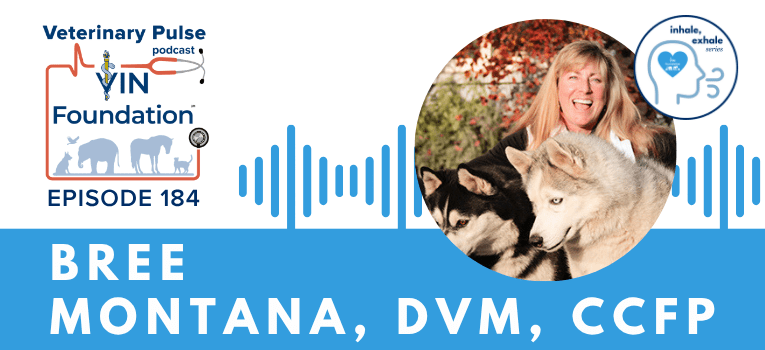
Dr. Bree Montana, DVM, CCFP
Bree Montana, DVM, CCFP, is a small animal practitioner and Founder of the Agate Bay Animal Hospital and Dog Gone Crazy boarding/training facilities in North Lake Tahoe California. Following the completion of a B.S. in Biology at the University of Cincinnati’s McMicken College, Dr. Montana graduated from the Ohio State University’s College of Veterinary Medicine with a Doctorate in Veterinary Medicine in 1992. A past member of the external advisory and admissions committees for UC Davis’ College of Veterinary Medicine, Dr. Montana also served as a working member of the VIN Foundation Board. In 2010, Dr. Montana helped to create the VIN Foundation’s innovative Vets4Vets® program, a confidential support group providing critical emotional care to veterinarians struggling with all forms of stress/addiction/mental health issues. The program is international and free for all veterinarians and veterinary students. Learning to balance the life of a rural solo practitioner, mom, wife, husky wrangler and aspiring dressage queen while coordinating the Vets4Vets® program has allowed Dr. Montana to become an expert at thinking outside of the box when advising veterinarians who feel stuck in their careers and personal lives. Dr. Montana enjoys lecturing on topics at the intersection of personal and professional life balance, including strategies for a healthy mentoring relationship, job seekers’ success techniques, effective communication in the workplace, as well as teaching the workplace ergonomics section of The Other Side of Veterinary Medicine: Healthy Clinicians Make Better Practitioners (a RACE approved course).
LINKS AND INFORMATION:
- Leaving Work at Work: A Daily Transition Checklist
- Brene Brown on transitions
- VIN Foundation Vets4Vets®
- VIN Foundation Veterinary Pulse Podcast Inhale, Exhale Series
- VIN Foundation Veterinary Pulse Podcast Future’s So Bright Series
- VIN Foundation get updates
- VIN Foundation GIVE page to support these programs & tools
You may learn more about the VIN Foundation, on the website, or join the conversation on Facebook, Instagram, and LinkedIn.
If you like this podcast, we would appreciate it if you follow and share. As always, we welcome feedback. If you have an idea for a podcast episode, we’d love to hear it!
TRANSCRIPT
Intro and Episode Roadmap
Bree Montana, DVM, CCFP: What we’re going for with this is to allow our brain to feel safe not worrying, so to feel safe not reworking that emotion with that client, not thinking about that task that we have to get going on at 7:00 AM. We want our brain to understand that it’s okay, it doesn’t need to keep helping us that way, and so we’re going to create these rituals that teach the brain we’re closing one door and locking it, and unlocking and opening another door.
Jordan Benshea: That is VIN Foundation’s Vets4Vets® team lead, Dr. Bree Montana, and this is the VIN Foundation’s Veterinary Pulse podcast, special Inhale Exhale series. I’m Jordan Benshea, Executive Director of the VIN Foundation. Join me as I talk with veterinary colleagues about critical topics and share stories, stories that connect us as humans, as animals, as a veterinary community. This podcast is made possible by individuals like you who donate to the VIN Foundation. If you enjoy this podcast and want to hear more stories, you may support these efforts with a donation at VINFoundation.org/give. Thank you. Please check the episode notes for bios, links, and information mentioned. Welcome, everybody. We are back here again with our VIN Foundation Vets4Vets® team lead, Dr. Bree Montana, for another episode in the Inhale Exhale series, and this time we are talking about transitioning between work and home. Welcome, Bree.
Bree Montana, DVM, CCFP: Hey, so happy to be here with all of you.
Jordan Benshea: So happy to have you here. This is a topic that I initially heard a concept when I attended a very small group discussion with Brene Brown, and she was talking about the importance of transitions for people who are in really high performing jobs, sometimes military, et cetera, and the challenges that that can create between work and home. And I also mentioned to her the importance of how I see this could really play in veterinary medicine, and her and I spoke about that a little bit and it gave me this idea for this podcast episode. So I’m really excited to be here to talk about this, hopefully we can provide some help for colleagues in an area that I think that I don’t think people talk about this enough. We’re so in a go-go world, and it’s just like get in the car and go and get on your phone and do all these things, but taking the moments to transition sets you up for success when you’re leaving home and going to work, and when you’re leaving work and going home. So, I’m really looking forward to this episode and hoping it’ll really help. And while we have a deep love for veterinary medicine and for animals, we know it can be really obviously tough on humans in a lot of ways, and this is one aspect that I don’t think is covered enough, and so I’m hoping this episode will be helpful. We have eight major topics we’re going to be addressing in this episode. So first is number one, defining transitions as a practicing veterinarian. What are transitions? What does that mean? Two, why transitions matter. Three, how to build a departure ritual. Four, create a rejuvenation plan. Five, add in technological barriers. Six, build a transition ritual for homecoming. Seven, things that go bump in the night. I love that one. And eight, where to get help. Let’s dive right in.
Defining Work Home Transitions
Jordan Benshea: Bree, what is a transition as you define it and see it as it relates to practicing veterinary medicine?
Bree Montana, DVM, CCFP: So it’s super important for us to be able to take off our practicing veterinarian hat and put on all those different hats that we wear when we’re not practicing, when we’re at home. I have been informed by my lovely husband that I have a tone when I’m at the hospital, and it’s really important that I don’t bring that tone home with me. When I’m at the hospital-
Jordan Benshea: He’s such a helper.
Bree Montana, DVM, CCFP: I know. When I’m at the hospital, I’m the owner. I’m the lead veterinarian. I have my hand in HR. I have my hand in treatment. I have my hand in protocols. I have my hand in outcomes. I’m just doing all of those things, and I have a very directive, I’m focused on what I’m doing way of being. And when I’m at home, I’m the partner and the mom, and I have a different whole set of roles that I play. And so it’s really helpful for everyone in my life, not just me, but my husband and my kid to be able to see me not as the boss at the hospital when I’m at home, but to be able to relate to me as the partner and as the friend and as the mom. And so it’s really important that I take that hat off, and that’s what our transition from home to work and work to home relies on, the ability to hang up, you know, oh Mr. Rogers, remember? He comes in and he takes off his shoes and puts on his slippers and puts on the cardigan. Well, we need to put on our cardigan when we’re coming home. We need to be able to like, “Ah,” and we need to find a way of doing that before the baby needs to be fed and before the dog throws up on the carpet, or that’s probably a cat’s job. And so, It’s that ability to change our focus and change our energy, and it’s not something we can do with a snap. You can’t snap your fingers and suddenly let go of your concerns about that splenectomy you did earlier that’s maybe at the ER or in your 24-hour hospital. You need to be able to take some time to allow your energy to change to the energy level that it needs to be at home, which is very different from the treatment floor energy.
Why You Need a Reset
Jordan Benshea: Now that we’ve defined what a transition is, why do they matter?
Bree Montana, DVM, CCFP: Ooh. When we are halfway, when we have one foot in the boat and one foot on the dock, we are not going to go anywhere good. If we are not able to release work when we come home, then we will not be fully present in our body and we won’t be available to ourselves and we won’t be available to our family, we won’t be available to our cat and our dog and the important beings that exist at home. We also won’t be able to recharge. One of the major tips and tricks that we use in preventing and recovering from burnout and compassion fatigue is taking time off. And every day we have a little vacation when we go home, but it’s not a little vacation for you if your brain is still at work. So we want to allow our mind and our body to release the work so that we can recover and be excited about going back there tomorrow. If you never leave, you cannot be excited about going there.
Jordan Benshea: Yeah, and I think that what it seems that we hear a lot through Vets4Vets® is the challenge of they’re just so in it all the time.
Bree Montana, DVM, CCFP: Yeah, it’s exhausting.
Jordan Benshea: And when you’re so in it all the time, we know the impact of that stress on our bodies, on our mental health and being able to create something that provides a transition because also you go home and then there’s all the people pulling on you immediately-
Bree Montana, DVM, CCFP: Yes
Jordan Benshea: And then you go to work from home and there’s all the people immediately. You haven’t even-
Bree Montana, DVM, CCFP: Exactly.
Jordan Benshea: As you said before, put down your lunch or done any of those things.
Bree Montana, DVM, CCFP: Yeah.
Jordan Benshea: And if you set yourself up for success with that little bit of a transition, hopefully that can be helpful.
Bree Montana, DVM, CCFP: Exactly. We want those days off. We want our evenings, or if you work nights, we want our days. We want our downtime to be restorative. We want it to be fun, and if we’re feeling overwhelmed by our home life and overwhelmed by our work life, that’s the key that tells us, “Hey, we’re not transitioning well enough, and we need to do some things a little bit differently.” We need to have some conversations and build some rituals, and we’re going to talk you through the recipe for making that delicious soufflé today, and I promise it’ll rise properly.
Departure Ritual Shutdown Routine
Jordan Benshea: Okay. Now that we’ve defined what the issue is, what the problem is, the challenge, let’s talk about how to create a solution. So talk to us about what it means to build a departure ritual.
Bree Montana, DVM, CCFP: Yeah. Okay, so these are going to be strategies that I want you to really practice with that will allow you to leave the hospital behind at the end of your day. So we start with a shutdown routine, and I want you to think about this in a directorial way. Look at your shutdown routine that you have right now. We’re going to modify that. I want you to dedicate the last 15 minutes of your day to your personalized ritual. So for most of us this is going to take place about thirty minutes after our last appointment of the day. Here are the steps I want you to try. I want you to scroll through today’s appointments and lock any charts that remain open. So you’ve locked your charts, and then I want you to take a couple of minutes to reflect on your successes from the day. I strongly encourage you to find three high points from every day, even if one of them was getting your favorite pizza for lunch. Realize that adrenal fatigue is a real thing, and one of the things that recharges our amygdala, that recharges our adrenals, is positive experiences, and reviewing our positive experiences allows our brain to start looking for more of those positive experiences. It starts putting a tracker on good stuff. I want you to stick a tracker on all the good stuff because we already have a tracker on our bad stuff. So you’re going to take a couple minutes to reflect on those. Find three things that worked today and that were good today, and I know sometimes it’s hard, so sometimes it’s just that you had pizza. And then the next thing I want you to do is celebrate at least one new thing that you learned today. I also encourage you to consider commuting this to a highs and grows for your team. When we can with my team, I like to do a highs and grows at the end of the day. We stand in a circle, and it’s like rounding out. Rather than going through each of the clients and each of the patients that we saw through the day, we just go around with each of our team members and each team member states what their high and grow was. And we like to say our grows first, and our grows are something that didn’t go the way we wanted them to or something that we learned that we’re going to do differently in the past, in the future rather. And then our highs are, “Hey, I pulled blood today,” or, “I got that really difficult jug cath.” So, we want to go through that if we can for each one of our teams, and if you guys can’t do it for your team, 100% do it for yourself because you’re the most important person of your team in your world, so let’s make sure you’re as positive and strong as you can be. And then after we’ve done that, we’ve gotten through our three good things and we’ve done some highs and grows for ourselves, I want you to change your costume. I want you to change your clothes. If you don’t have the lifestyle that supports leaving your scrubs at work, at least change your shoes. Changing out of your uniform, changing out of your superhero costume will have the added benefit of preventing you from bringing anything home to your fur family. My personal re-entry ritual basically relies on my saying, “hey” to my family, kind of a quick hey, got to kiss the dogs because they require kissing, and then I head straight into the bath with a Topo Chico or some other sparkly water type beverage to rehydrate and chill before I head upstairs to catch up with the family. And I will admit that I’m not very good at relaxing in the bath because I have to get upstairs and check in with the family, but the bath, the time it takes to fill the water and do all of that requires me to take some time, and that’s when I’m breathing and resetting my whole psyche and resetting myself to be able to kind of bring it all down and be more collaborative in my thinking process. The idea with this change of costume is to make a physical change that reinforces that you’re leaving work behind and heading into the regenerative stage of your day, which is why if you see me after work, I’m always in my jammies.
Commute Tips and Leaving Guilt
Jordan Benshea: And what if somebody has a long commute and it isn’t short-
Bree Montana, DVM, CCFP: yeah.
Jordan Benshea: Between the hospital and the clinic and their home? What ways do you recommend that they might be able to practice some of this while on a commute?
Bree Montana, DVM, CCFP: Yeah, we definitely want to talk about spa-ing our car. We want to turn our car into a spa, and we’ll talk more about that a little later as well. But we can make our car smell nice. We can make our car have nice podcasts or music that is the kind of music that doesn’t fire us up. In the morning, we want to listen to the music that’s, upbeat and kind of energy-driven, and then in the afternoon, we want to listen to that relaxing music or those relaxing podcasts and things. And we also want to have water and a snack in our car because we’re always hungry after work. We never hydrate well enough, so we always want to do all of that. And I think we’re going to talk about-
Jordan Benshea: Okay.
Bree Montana, DVM, CCFP: That a little bit more later. One of the things that people have the hardest time with, Jordan, when they’re finished with their day is this super oppressive guilt that we like to buy into. So I want us to reframe our mindset. I want us to recognize that leaving on time is not an act of laziness. Leaving on time is a chosen action that supports your sustainability, your personal health, and your long-term productivity. Leaving close to on time is better for your patients, it’s better for your team members, it’s better for the financials of your hospital. Remember that leaving on time is a chosen action intended to support several keys to excellence in your medical and surgical practice. Leaving on time, making sure that you’ve got that work life integration, it’s a sustainable life choice. Leaving on time supports your personal wellness to create and sustain long-term productivity. We have to have balanced work-life integration, and leaving on time will allow for this. And, sure, sometimes we have to stay after, and we might miss our planned after-work activities. When this happens, we want to be kind to ourselves and remember that we can reset that after a little bit of self-healing, and we can reset our goals afresh tomorrow. It’s always one day at a time in this busy, busy life that we lead.
Build a Rejuvenation Plan
Jordan Benshea: And what about a rejuvenation plan? What does that look like?
Bree Montana, DVM, CCFP: Ooh, super important, because just leaving work isn’t going to be healing on its own. We need to kind of meta-think this for ourselves. Work is a daily experience for our brains and for our bodies, and recovery needs to be built into our schedule every bit as much as that work is. Here’s a few ways that we can build rejuvenation into our lives. We could schedule an activity into our end-of-day routine that is regenerative. Some folks love an end-of-day workout, whereas others are too tired for a physically challenging event after their workday. So for me personally, I prefer a before-work workout. This sends me into the hospital feeling like I can conquer anything. After-work workouts are a no-go for me because I’m a morning kind of girl. So, think about who you are and what works best for you. Try a few different things to figure out what will work best. Maybe you like a crack-a-bones workout to power up. Maybe you like an after-work yoga class or pilates or maybe you like a walk through the park. Your decompression plan doesn’t have to be hard, but it does have to be something that you love. I want you to consider, just go on a little vacation with your mind with me right now and brainstorm some options. Consider parking a ways away from your workspace if this allows you to spend some time outdoors before heading home. Whenever possible, maybe give yourself a minimum of 15 minutes before you dive into your home life. Maybe you’re going for a walk, maybe you’re doing some yoga, maybe you just sit in your car and you listen to a meditation app before you leave the workspace, or you pull over in a beautiful park or a place with a beautiful view. Maybe you stop by the beach, you watch the waves roll in, you listen to a meditation app. Try to get at least 15 minutes of personal time, and the key is to add a transition ritual that allows you to shake off your day and turn your body and mind towards your cozy home environment. So you kind of have to think through this with your personal obligations and desires and say, “I love going to a ceramics class. I’m going to do one on Thursday night after work. I’ll do that seven or eight o’clock ceramics class,” or, “I have to get home, and as soon as I pull up, the dogs go nuts, so I’m going to take my 15 minutes of personal time away from the home, and then I’ll be ready for those dogs lighting bombs off in the living room when I get there.”
Jordan Benshea: Yeah, and I think even 15 minutes for somebody, it might be 10, it might be 5, whatever it might be-
Bree Montana, DVM, CCFP: Yeah.
Jordan Benshea: Taking that time, and maybe that time increases bit by bit, but even taking that short amount of time and whatever your environment looks like knowing that when you are able to do a meditation or do something for yourself, you’re able to go inward, and that’s your focus versus what’s surrounding you, and providing yourself with that escape within yourself.
Bree Montana, DVM, CCFP: Yeah. And I know a lot of us hold a lot of guilt. We feel guilty that we were gone for so long and away from our family, our animal family, our human family, and so we want to rush home. Recognize it’s more about quality than about quantity. That extra 15 minutes can make the difference between you being able to really listen to what your animals need, what your family needs, to really be able to be present with them. It makes a real value in the quality of your life, and it allows you to heal so you’ll be better for your patients tomorrow.
Tech Boundaries With Phones
Jordan Benshea: So let’s talk about technological barriers. How do those fit into transitions?
Bree Montana, DVM, CCFP: This is such a tough one. We have our phone with us all the time, and our phone- has been specifically created and constantly updated to grab onto our attention. And, those little vibrations, I carry my phone in my back pocket when I’m around the barn. When I’m not on a horse but I’m at the barn, I have my phone in my back pocket, and when I take my phone out of my back pocket, my right butt cheek still keeps thinking that I’m getting texts. My right butt cheek is telling me somebody’s calling me constantly because my body has institutionalized my phone and it’s put it as part of my brain, and so many of us are like that. Have you ever kind of, you feel your phone and it’s not even with you? Well, that’s why we need to break up with our phone. And hey, when you break up with your phone, I don’t want you to worry, you two can start dating again tomorrow. I mean, I love my phone as much as anyone, and I’m not immune to that whole addictive thing that comes with that love. Maybe we’ll say I have a love/hate relationship with my phone. Here’s the problem with our smartphones. Smartphones impact the brain by shortening attention spans. They reduce our cognitive capacity, and they create addiction-like dopamine loops. Excessive use of phones has been linked to structural changes in our brain, including reduced gray matter in areas responsible for emotional processing and cognitive control. If you are experiencing sleep disruption, excessive anxiety, or impaired memory function, then limiting the presence of your smartphone in your life may just be the smart thing to do. And I’m going to walk you through some steps, and we’ll have a little list of this in our website for you.
Jordan Benshea: Yes, we’re going to do a transitions checklist that we will add in the episode notes.
Bree Montana, DVM, CCFP: Yeah, and so here’s how to do it. Don’t worry about remembering this, you can find this on our checklist. But just kind of listen and walk through it with me. First, I’d like you to change your phone settings. Turn off all the notifications except for essential calls and messages. Use your do not disturb or your focus modes on your phone to block distractions. I want you to make that screen less appealing. Yes, there is a reason I have my dog on one of my screens, and I have my horse on another lock screen. That is something that the phone did to make it more appealing to me and make me want to look at it all the time. So I want you to change your screen from that colorful, beautiful screen to a grayscale of black and white to reduce the dopamine hit from those bright, colorful apps that we have on the screen, and also from those pictures that we have on our lock screens. I want you to use some physical distance. Keep the phone out of reach, such as in a drawer or in another room. I’ve learned to keep my phone in an entirely different room when I’m sleeping at night, because I do have a tendency when I wake up to be curious about what’s going on, and that breaks my sleep cycle even more damagingly than just the simple wake up. A simple wake up is normal. A wake up and then looking at our screen damages our ability to get back to sleep. We also want to establish some boundaries. We want to create some no phone zones, particularly in our bedrooms and during our meals. And then, okay, those apps. Apps are how we survive nowadays, so I want you to delete, to hide, or to move time-consuming social media or games apps off of your home screen. You’ll still be able to noodle around and find them when you’re waiting for that plane for an hour and you need something to do, but they won’t be there tempting you to not be living your life on a moment-to-moment basis. And then I want you to use some alternatives. I want you to replace your phone browsing with more analog activities like reading books, engaging in hobbies, or going for walks. And one of the easiest ways to get those things added into your schedule, into your life, is to put the book somewhere where you’re going to see it. Put your book where you usually put your phone when you’re actively using your phone. Put a magazine there. Put your crochet there. Put whatever hobby that you’re trying to get more of in your life somewhere that you would see it. And then finally, I want you to set some speed bumps. Some people have such a hard time not using their phone that they need to use tools like rubber bands around the phone or custom lock screens to prompt them to consider, “Why are we checking our phone right now?”
Homecoming Ritual and Family Talk
Jordan Benshea: We’ve talked a lot about on your way to work, a little bit on your way home. Let’s dive a little bit more into a transition ritual for homecoming.
Bree Montana, DVM, CCFP: Yeah, let’s really create some actionable steps that can make our home commute more rewarding and more regenerative. Let’s say you’ve just worked a 10-hour shift, which typically means you’ve been working for 11 hours or more. Yeah, we work four tens, but there’s a lunch in there. There’s a lunch break that everybody has to have, so it’s definitely an 11-hour day. That lunch break may have been spent completing your morning charts or prepping for a challenging afternoon case. Chances are excellent that you are hungry and dehydrated, and you probably just remembered that you had to pee about an hour ago. Let’s make that homeward bound commute a restorative, restful moment that’ll allow your happiness quotient to rise to the surface. So we’re going to talk about how to spa your car. I know we mentioned that a little bit earlier, now we’re going to take a deep dive. In your car, I want you to have healthy snacks, especially snacks with protein, things like nuts, fruits and vegetables. They are hard to keep in the car, but if you can keep something in your fridge at work and just grab it on your way home, it’s really nice to have that, especially those cruciferous vegetables. They really make the body feel like it’s getting nourished. I want you to have some refreshing beverages in your car. Aromatherapy can also play a really key role. So in the morning, we want to use awakening and focusing scents. So peppermint is known for being a strong, refreshing aroma that enhances concentration, alertness, and mental sharpness. Citrus, especially lemon, orange, bergamot, or grapefruit, that’s found to be uplifting and energizing scent that can reduce anxiety. It can boost the mood and improve energy levels, so if you have a hard time getting to work because you’re anxious or you’re sleepy, these can be super helpful. Rosemary is also an essential oil that promotes alertness and cognitive function, and it helps us overcome that morning grogginess. Eucalyptus provides a refreshing, clearing, and invigorating scent. It’s ideal for opening airways in the morning. If you’re a stuffy person in the morning, a little eucalyptus or sage, which is known to improve focus and help us relax or help us reduce our stress so we can have that focused energy that’s not kind of janky and jingly. After work, we want to rest and relax and rejuvenate, so the scents we use after work will be different from the scents we use in the morning, and you can keep them in a little Tupperware, and there’s a lot of scent diffusers that you can put on your air service in your car as well. So think outside the box in a way that makes it fun for you and kind of luxurious. Lavender, it’s the premier oil for relaxation. Lavender can also boost the mood, reduce anxiety, and promote deep sleep. So lavender is a really nice one for the end of the day. Roman chamomile can be calming and soothing. It’s really good specifically for stress. Sandalwood also promotes relaxation. Sandalwood can be grounding, so if your anxiety takes you and makes you feel sort of that fae feeling where you’re having negative magical thinking, sandalwood might be a good scent for you. It’s really grounding, and it helps with clear, calm thinking. Bergamot is known for reducing anxiety and enhancing mood. Ylang-ylang helps lower blood pressure and induces a calming effect, and also frankincense. Frankincense tends to soothe a frayed mind and promote clarity. So if your brain is switching quite a lot, then frankincense might be a good choice for you, and you can look through these on our website later. Music and podcasts. Music and podcasts can take you somewhere fun, somewhere cool. I encourage you to reserve those medical podcasts for the morning and use recreational, funny, endearing podcasts to encourage optimism and peaceful thoughts. I want you to be selective when you’re creating your car spa environment. If you find yourself daydreaming work thoughts, you need to modify your plan, perhaps changing up the sounds or scents that you’re using. Play with this and be open to trying something new, and recognize that changing the scents and changing the podcasts or the music that you’re listening in your car on the way to or the way from work can be like a recreational moment for your subconscious. So think about your recreational moment. How do you want it to be? We also want to talk about creating our re-entry ritual. Just as we need a little ritual to tell our mind and our body that we’re leaving work, it’s helpful to create a re-entry ritual for our homecoming. When we’re transitioning from our work persona to our home persona, that can be super tricky. I mean, you’re happy to see your family, we’re happy to see our significant other, our child, our fur kiddo, and at the same time, we are still in our work brain space. Jordan, do you have this experience, sometime you’re getting home to Zoe, but you’re still working on the foundation?
Jordan Benshea: I have that experience at 1:00 AM, 3:00 AM.
Bree Montana, DVM, CCFP: Oh. Oh, yeah. Yeah. Yeah.
Jordan Benshea: Yeah.
Bree Montana, DVM, CCFP: What we’re going for with this is to allow our brain to feel safe not worrying. So to feel safe not reworking that emotion with that client, not thinking about that task that we have to get going on at 7:00 AM. We want our brain to understand that it’s okay, it doesn’t need to keep helping us that way, and so we’re going to create these rituals that teach the brain we’re closing one door and locking it, and unlocking and opening another door. In order to do that, you’re going to need to communicate with your family members or your roommates so that everyone recognizes that you’ll be taking anywhere from 5 to 30 minutes to yourself before you connect and catch up on your day. So if you are coming home and you have a nanny or a babysitter, or your beloved has been taking care of the kid or that difficult pet during the day, and they’re just looking at you like the cavalry’s coming to save them, we need to have a conversation ahead of time, not when you’re coming home, but before you leave, and maybe on a weekend or a time when you guys go for a walk and things are pretty chill and sketch that out. How’s it going to look for them? How’s it going to look for you? Because they’re important, too. They need a transition ritual from being the sole person that’s been taking care of the crying baby to being the person that is your beloved, and so we all need to transition. So you want to talk with them and kind of plan this, and this is the hard part. I’m going to tell you that it’s something that I’m always trying to make better in my life, because I tend to be really bad at following my own rules.
Jordan Benshea: Well, and I think It doesn’t mean that you’re going to get it right the first time or the second time or the third time or the fourth time, but-
Bree Montana, DVM, CCFP: Yeah.
Jordan Benshea: It’s about, I mean, new things always take some adjustment, so it’s about testing it out, seeing what works. I think the important part, probably would be helpful is to making sure the communication’s open, like, how did that-
Bree Montana, DVM, CCFP: Yeah.
Jordan Benshea: Work for you? This is how that worked for me, or, I kind of want to adjust it this way. And there’s no right answer for everybody. Everybody’s going to be unique. Everyone’s situation, there’s either kids or not kids, there’s pets or not pets, or there’s nobody else there at the house, and it’s just you. And if you live by yourself, what does that look like. But still the ritual of coming home and that transition’s still important because you want to transition so that when you’re in your home, that-
Bree Montana, DVM, CCFP: Yeah.
Jordan Benshea: You’re not going in your home and still thinking about work, still thinking about your charts, still thinking about the clients, patients.
Bree Montana, DVM, CCFP: Exactly. When you think about it, we do a lot of restorative function when we’re sleeping. Our brain reboots itself. Our brain stores all the things we learned today into the longer term memory, and it takes stuff from the midterm memory and puts it in the super long-term memory, and your brain’s doing a lot of stuff, and your adrenals are healing, your amygdala’s doing stuff. Your whole body is working to heal, so all of this is supportive of that function. This will allow us to be happier, stronger, faster, smarter, have more fun as we move forward. So your restorative ritual, it could be a soak in the tub, it could be leashing up your pups for an evening wander. The key is that it’s a period of time when you are not handed a crying baby, and you’re not being asked to find that essential but missing item that your teenager absolutely needs for school tomorrow. And I will tell you that if your family’s not ready for you to create a transition ritual once you enter that front door, it’s okay to take a few minutes in your car to allow yourself to breathe and reset your head space before heading up that front path. It’s okay to carve out safety zones for you to do this transition ritual if your family’s not there yet. And it’s even more important for those of us that are on our own, because our family’s not there to remind us that we’re not in our family head space, our home head space. There’s nothing to remind us, so we might have that temptation to continually spin and spiral on work. So you really need to lock this in for yourself and keep adjusting it. Keep working to help everyone in your family to develop their own transition rituals. This is going to help them recognize and support yours. Remember, everyone’s been missing you all day, so they’re excited to see you come home, and maybe even a little desperate if the baby’s been fussy. So go gently into this new routine and leave some room for customization as time rolls forward.
Jordan Benshea: Yeah, and it could even be on your way home pulling over on the side of the street and taking 13 deep breaths.
Bree Montana, DVM, CCFP: Yeah.
Jordan Benshea: That might be it for you. That might be your opportunity, and it’s going to be different for everybody. Find that place and work on finding that place that works for you, and adjust it and feel that freedom to know that you might not get it right the first time, you’re going to adjust and see what works for you.
Bree Montana, DVM, CCFP: Yeah, and it’s a day to day. You might be awesome at it on Wednesday and then Thursday you really did a terrible job, and you know what? That’s okay. The best thing that we can do is just keep going back to the drawing board and seeing what’s going to work for this week.
Night Spirals and Sleep Tools
Jordan Benshea: Okay, so let’s talk about number seven, things that go bump in the night.
Bree Montana, DVM, CCFP: Oh man, I cannot be the only one of us who’s lost sleep to the procedure I’m scheduled to do tomorrow. My work spirals like to show up either right when I’m dropping off to sleep or maybe around 2:00 AM. 2:00 AM is my special time when I don’t know what just woke me up, but here I am in awake world where everyone around me is snoring peacefully, and I am just spiraling. So here’s how I handle those brain spins, and the good news is you can handle yours this way too. First, we want to accept the spin. It helps to recognize that our brain is starting a spiral, and the sooner we recognize and embrace that reality, the better our intervention will work. Fighting the spiral just makes it stronger, building more anxiety into the experience and drawing your emotions into the drama of the spin. Rather than fighting, treat the brain spiral the same way you’d treat a wet feral cat. Relax, breathe, assess, and respond. Next, I want you to assess the situation by asking yourself some questions. Is this an emergency? My brain thinks it’s an emergency, but when I ask myself that question, I realize that it’s not. Is this happening in my real life or is it happening in my head? Chances are excellent that there is no emergency happening right now, rather this is happening in my head. I tell myself, “This is my brain trying to prepare me for a challenge that’s not happening right now.” I remind myself that this is just electrical activity in my brain. And when I’m having one of these spins, I literally tell myself that, and I remind myself that my brain is trying to look out for me. It’s working too hard, and I need to let it off the leash, let it relax. Once we’ve reminded ourselves, our hardworking brain, that we are not in an emergency situation, we want to reboot our busy mind with a self-soothing activity. So here’s a couple to try. We could do 4-7-8 breathing. That can work to help us restore our cool. We can do a mindfulness meditation. Remember that even 15 minutes a day of breathwork focused on relaxation and clearing our mind, and those are my beginner steps to meditation, this can significantly, actually physically rewire our brain to support self-soothing and reduce general anxiety. So the 4-7-8 breathing works really nicely with a mindfulness meditation practice. You breathe in for 4 counts, you hold your breath for 7 counts, and you release through the mouth for 8 counts. So breathing in through the nose, holding for 7, releasing through the mouth for 8. And if you have a hard time with meditation, I personally do, I have a brain that’s filled with monkeys always dancing and trying to light off little M80s, what I need to do is I need to see a color in the air that I’m breathing in, and then I need to see the air flowing through my body. I imagine that, and then I see a different color of the air when I’m releasing it, and that kind of helps me keep my brain functioning in the same practice that I’m trying to do. Another one, and this is for a brain that’s just really spiraling and you’re not able to stay focused with the breathing and you’re really having a tough time, this one is a pretty good one. It’s called the category game. You choose a category, for example, types of dog breeds, European cities, musical instruments, and you mentally list as many as you can of items in that category. If you’re super spinny, you can try doing this with spelling. You can start with one kind of animal or breed of dog and spell that breed, then cast your mind about to find another animal or breed whose name begins with the letter that the last one ended with. For example, Friesian ends in N, so maybe we next choose a Noriker or one of those ancient draft breeds. The more esoteric, the better because what we’re doing is we’re pulling our brain out of the emergency fight, freeze, or flight position it’s put us in, and we’re putting it into the parasympathetic intellectual portion of the world and we’re taking it far away from work and putting it into sort of an area where it’s more gentle and more open-minded and more artistic. There’s also a 5, 4, 3, 2, 1 sensory grounding exercise when you find your mind spiraling. And again, this is one of the really hardcore reboots for your brain when your brain is hardcore messing with you. This activity is known as the five senses technique, and it’s well known and effective in drawing your focus away from an overwhelming feeling of anxiety. The aim of this exercise is to engage all your senses and become mindful in the present. The idea with this one is that you’ll ground yourself using the five senses. If it’s truly 2:00 AM and I’m trying not to disturb my husband and my three huskies, because if I get up, everybody gets up and it’s really a nightmare. So if I’m trying to be quiet and cool myself down in bed without letting everybody else know that I’m having a hard time, I’m trying not to disturb my husband, I’m trying not to disturb the dogs, I’m going to do these using real lived sensory input along with my imagined or remembered senses for the things like maybe I can’t taste something. So five, I’m going to look around the room and I’m going to name five items that I can see. Four, next I’m going to want you to name four things that you can touch. Three, three sounds that you can hear, and I promise you, everybody in my house snores. Two, name the two things that you can smell. And finally, one thing that you can taste, and might have to have an imagined taste from your dinner or something like that. But this really allows your brain to detach from that anxiety and center in and become more calm.
Jordan Benshea: That’s wonderful, Bree. A lot of good, helpful tips and recommendations. And as we mentioned earlier, we will create a checklist of these rituals and recommendations and share that in a PDF in the episode links, so make sure to keep an eye out for that.
Where to Get Help
Jordan Benshea: Okay, number eight is where to get help. I mean, somebody can go through these and might just feel like they want to chat, or-
Bree Montana, DVM, CCFP: Yeah.
Jordan Benshea: Are struggling with a transition.
Bree Montana, DVM, CCFP: Absolutely. We’re here for you. We’re happy to be here. Pop into our website where you can just click a button and schedule a confidential consultation with me. We can sit and we can chat. Sometimes I end up sending folks to speak with Dr. Michelle Gaspar, who is a veterinarian and has a degree in pastoral counseling and works as a psychotherapist. Michelle’s not here to be a substitute for psychotherapy, for that one-on-one amazing benefit we get from working with a professional, but she can be here for really difficult situations and work alongside you cybernetically while you find a therapist. And I’m also happy to help you find a therapist.
Jordan Benshea: And it also might just be something that these transitions are helpful, but also you’ve got a simple work thing or a question about fitting in or whatever that might be. It doesn’t have to always be almost crisis mode. In fact, it’s probably better if you reach out before it’s crisis mode.
Bree Montana, DVM, CCFP: Absolutely. You’re having a hard time with a colleague at work, maybe a support staff member, you’re not having good success with connecting with them, or maybe you had a difficult client or a difficult case, or maybe you’re just not sure if this is your forever practice and you want to brainstorm whether you’d like to move to Antigua. I am here for that.
Jordan Benshea: And since Vets4Vets® started in 2010, there has been, as much as people feel alone, and oh my gosh, nobody can be feeling this way that I’m feeling now, I assure you others have, and we have a very deep bench of support and resources and mentors and additional information to help you. So, we’ll put that link, of course, in the episode notes to the website, to the connect form.
Make It Fun
Jordan Benshea: Okay, Bree, anything else our listeners should know?
Bree Montana, DVM, CCFP: I guess the one thing that comes to my mind is, I want you to have fun with this. Play with this. This is a playful thing. This isn’t a painful thing. Play with scents. Play with sounds. Play with places and ways that you can decelerate your brain. Make it enjoyable. Think of scents that you love. Think of snacks that’ll be fun to have in the car. Go to Trader Joe’s and get something yummy.
Jordan Benshea: I love it. Wonderful. Thank you so much as always, Bree, for all of your help. And we will put, again, in the episode notes, we’ll create a checklist for you. And thanks, Bree, for being here and for all of your help with colleagues.
Bree Montana, DVM, CCFP: Always happy to be here.
Jordan Benshea: Thank you.
Bree Montana, DVM, CCFP: Bye, guys.
Outro
Jordan Benshea: Thank you for joining us for this episode of the Veterinary Pulse. Please check the episode notes for additional information referenced in the podcast. If you enjoyed this podcast, please follow, subscribe, and share a review. We welcome feedback and hope you will tune in again. You can find out more about the VIN Foundation through our website, VINFoundation.org, and our social media channels. Thank you for being here. Be well.