
*TRIGGER WARNING* Some of the content in this episode may include triggers on anxiety. As a reminder, if you are a veterinary student or veterinarian, the VIN Foundation’s confidential peer-to-peer support group vets4vets® is here for you, at no cost, please know, you are not alone. Call (530) 794-8094 or visit the website to schedule a session: https://vinfoundation.org/resources/vets4vets/
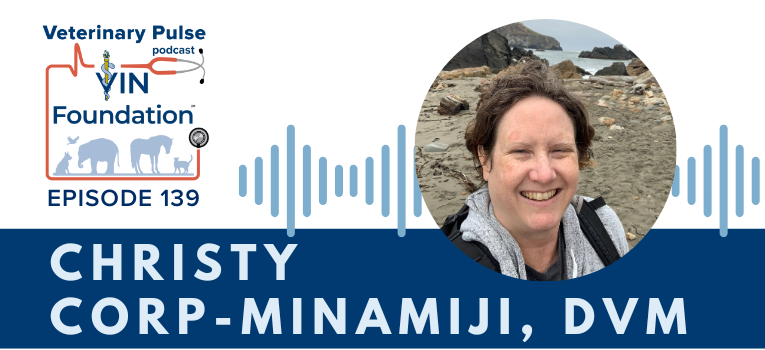
Listen in as VIN Foundation Executive Director Jordan benShea has a conversation with Dr. Christy Corp-Minamiji, a veterinarian with a love for words. Christy shares her non-traditional journey in the veterinary profession, how improving someone’s day is part of her job, and what she sees as the path for mental health, diversity and inclusion amongst colleagues.
GUEST BIOS:
Dr. Christy Corp-Minamiji
Christy Corp-Minamiji, DVM is a 1996 graduate of the UC Davis School of Veterinary Medicine. She has worked as a small animal practitioner, in the biologics industry as a field researcher and technical services veterinarian/marketing director (it was a small company), and for a decade as a large animal practitioner. In 2011, she changed career tracks when the large animal practice was closed due to the recession. Since that time she has worked in communications for the Veterinary Information Network where she learns new job skills every day. She lives in Davis, CA with a rotating array of almost adult and adult offspring. Though she currently has no pets of her own she makes use of friends and family by loving on their furry and/or feathery companions whenever possible.
LINKS AND INFORMATION:
- VetzInsight
- VIN
- VIN Foundation Vets4Vets®
- Imposture syndrome article by Dr. Michele Gaspar
- Salon – Putting Down the Vet Clinic I Loved
- The Horse – Under the Blue Tarps
- Multi Culture Vet Med Association
- Veterinary as One Inclusive Community for Empowerment (VOICE)
- PRIDE VMC
- VOICE President, Indya Woods podcast episode
You may learn more about the VIN Foundation, on the website, or join the conversation on Facebook, Instagram, or Twitter.
If you like this podcast, we would appreciate it if you follow and share. As always, we welcome feedback. If you have an idea for a podcast episode, we’d love to hear it!
TRANSCRIPT
Intro
Christy Corp-Minamiji, DVM: The next call I had was way out at just outside the even broad range of our practice area, but it was somebody who had been trying to get a veterinarian out for their down cow for a couple of days, and there were just no veterinarians. Heck, it’s the last day might as well go. Met with him, and sure enough, it was bad, and we needed to euthanize, but I talked to him you know about what was going on. He felt so horrible because he’d been trying and trying to get a vet and I talked to him down from that. I explained what the euthanasia was going to look like, as I kind of always did, went through and he was so grateful at the end. Driving back from that I realized that I’d been wrong about my career the whole time. I’d always thought that my job was to diagnose and treat animals and fix them. Sure, that’s a part of my job, but I think really, underneath it all, my primary job was always making somebody’s crappy day a little bit better.
Jordan Benshea: That is Dr. Christy Corp-Minamiji. A veterinarian who has taken a non-traditional route into communications, and this is the VIN Foundation’s Veterinary Pulse Podcast. I’m Jordan Benshea, VIN Foundation’s Executive Director. Join me and our cohost and VIN Foundation board member, Dr. Matt Holland, as we talk with veterinary colleagues about critical topics, and share stories. Stories that connect us as humans, as animals, as a veterinary community. This podcast is made possible by individuals like you who donate to the VIN Foundation. Thank you. Please check the Episode Notes for Bios, links, and information mentioned. Hey, all a quick heads up that some of the content in today’s episode may include a trigger as it relates to anxiety. As a reminder, if you are a veterinary student or veterinarian, the VIN Foundation’s confidential support group, Vets4Vets, is here for you. You can find information to reach out in the Episode notes. Please know you are not alone.
Meet Christy Corp-Minamiji, DVM
Jordan Benshea: Hey, Christy, welcome.
Christy Corp-Minamiji, DVM: Hey, it’s great to be here. Thanks!
Jordan Benshea: Thanks so much for joining us. I really appreciate it. This idea for an episode, the other day Christy and I were chatting, and we thought this would be a great idea to just chat on a podcast episode and share this conversation with others. So here we are during work, work chat.
Christy Corp-Minamiji, DVM: Just another chat, Jordan!
Christy’s Journey in Veterinary Medicine
Jordan Benshea: Christy, tell our audience what is your current role in the veterinary profession?
Christy Corp-Minamiji, DVM: Currently, I work and have worked for the past 10 years for the Veterinary Information Network [VIN]. I am loosely categorized under the org chart under communications. That means that I do some writing for our client education blog, VetzInsight. It means that I do some work with the news team. It means that I help write outgoing emails. It means that I chase around after people and try to get them in the same room talking to each other. It honestly means anything with words on any given day.
Jordan Benshea: So, you work with words?
Christy Corp-Minamiji, DVM: I do. This is what I do.
Jordan Benshea: You work with words, and you corral people?
Christy Corp-Minamiji, DVM: Yes, I’ve added in border collie to my tagline, I think.
Jordan Benshea: And you also help with the VIN Foundation. Christy is wonderful in helping us with a lot of our communications, as well. We’re very grateful. I’m sure when you went to veterinary school, your thought was, oh, I’ll utilize this to work with words and corral people.
Christy Corp-Minamiji, DVM: Ironically, I went to veterinary school because I didn’t think I was ever going to be brave enough to talk to people and do anything with English or writing, which was my true love. So, there’s an irony for you.
Jordan Benshea: There is an irony! So, you went to veterinary school thinking, oh, I’ll never get a job doing what I really love, so instead I’m going to work with animals because I love them.
Christy Corp-Minamiji, DVM: Right, and it’s not to say that I wasn’t heavily driven towards veterinary school. From the time I could pronounce veterinarian, which was at a pretty young age, that was what I wanted to do, but by the time I’d reached college, I realized that my strengths really lay in the Liberal Arts, in History, languages, English, literature, and sociology. By that time, I was an animal science major because in the late 80s, early 90s, getting a liberal arts degree was considered learning how to say, “Would you like fries with that?” in Latin. So, I did the thing, I went and did the science major, because I thought if I majored in English, I would be able to be a journalist or teach or write. I didn’t think I was good enough to write for a living. I knew I didn’t want to teach, and I was terrified of humans to talk to them. I didn’t realize that veterinary medicine was going to be all about humans. We can get more into that.
Jordan Benshea: Wow, isn’t that the case? Right? We hear that often. So, you were an animal science major, and you decided to go to veterinary school. Where did you end up going to veterinary school?
Christy Corp-Minamiji, DVM: I did the most traditional route one could possibly do. I graduated high school, I went to UC Davis and got my bachelor’s degree in animal science. Then I went straight from there into veterinary school at UC Davis. Did not pass go, definitely did not collect $200.
Jordan Benshea: You’re not collecting money at that point. You’re paying money at that point.
Christy Corp-Minamiji, DVM: Exactly. I graduated from UC Davis in 1996.
Jordan Benshea: What was your first job out of veterinary school?
Christy Corp-Minamiji, DVM: When I was in vet school, I said the two things I will never do are small animal medicine and research. So, my first job out of veterinary school was part time in a small animal practice where my boss had never before had an associate, I had never before been a veterinarian. Let’s just say we were not well suited for one another. Mentoring was not a thing. It was almost every horror story I’ve heard from new graduates, and that job and I parted ways after a tumultuous three or four months. My next job was doing biologics research. I conducted field trials in dairy cattle and in sheep for vaccines. We were a small company, so I also did Technical Services, a little bit of regulatory work corresponding with state veterinarians and such, and also started at the marketing department.
Jordan Benshea: Wow, so you got to love those startups. Right? You get the opportunity to do absolutely everything.
Christy Corp-Minamiji, DVM: Exactly. I tell my kids not to worry about applying for jobs they don’t feel qualified for because I’ve yet to have one that I was qualified for.
Jordan Benshea: How did you end up at VIN out of veterinary school after your small animal and research jobs?
Christy Corp-Minamiji, DVM: I left my research job in about 2000. I tried to be a stay-at-home mother for a year with my oldest daughter. Turned out that was not a good plan for any of us. I wound up getting my dream job, which was a large animal ambulatory position. That was what I had always wanted to do. I had tracked large animal in school. I got that job five years out of school, never having done any large animal medicine between graduating and that time. I loved it. It was a great practice with great people. I was there for 10 years. Unfortunately, my bosses sold to a corporation as part of their exit strategy, which made sense at the time, in about 2007, maybe 2008.
The Impact of the Recession on Equine Medicine
Christy Corp-Minamiji, DVM: Well, as we all know, the recession hit in 2008, and it turned out shockingly enough that horses aren’t recession proof.
Jordan Benshea: Well, horses themselves, yes, but..
Christy Corp-Minamiji, DVM: Right. Yes, interestingly equine medicine is in fact a luxury item. Who knew?
Jordan Benshea: Did you find that people were unwilling to pay for the veterinary services they needed during the recession for their equine animals?
Christy Corp-Minamiji, DVM: They were unwilling and often unable to. We were in the south Sacramento area, which was hit very hard by the recession, and especially by the home loan bubble. Many of our clients had primary jobs in real estate construction, or they worked for the State of California. So, it started with people becoming a little bit more cautious, even some of our better clients, about how aggressively they would work up a lameness in their horse, for instance, and it got to, you know, maybe I’ll just turn them out in pasture and see how it goes for a month or two. By the end of it all, in about 2010, I was euthanizing somewhere around six or seven horses a week for almost purely economic reasons.
Jordan Benshea: Oh my! Good grief.
Christy Corp-Minamiji, DVM: It would be an older horse, or it would be one with a bit of an issue, but it was an issue that they would have dealt with better in more affluent times. I couldn’t blame them. My clients were facing do I feed my kids or take care of the horse. There was no way to sell the horse because no one was buying. Fully registered paint mares and foals were going for $200 at auction as a set.
Jordan Benshea: Oh, my goodness!
Christy Corp-Minamiji, DVM: These were well bred horses at the time. There was literally almost nothing else people could do. We saw a lot of neglect cases in that time, and it was, honestly, pretty grueling.
Transition to Writing and Joining VIN
Christy Corp-Minamiji, DVM: That was weirdly how my writing career got started. I started blogging while we were slow. Then I wrote an essay called Under the Blue Tarps about the economic euthanasias and it was picked up by a wonderful magazine called The Horse. I wound up freelancing for them for a couple of years. In 2011, the corporation that owned our practice made the decision to sell, and large animal, there were no other jobs for us. I wrote an essay that was published on Salon about that time and that feeling like we were euthanizing a beloved pet. The practice felt like a family. We were all incredibly close. The technician I worked with was in her 40s and had been there since she was 18. It was her first job while she was in tech school. I wrote that essay, and it got circulated around in some of the veterinary community, which I didn’t realize until I started getting random emails from veterinarians. About two weeks before the practice closed, I came in to a phone message and my office manager said there was a Dr. Pion who called and he wanted to talk to you about writing, and that was, a few months later, how I came to work for VIN.
Jordan Benshea: Wow. That’s a great story. It’s fascinating, just the different aspects of things like the recession that you don’t think about. I wonder what things are happening now that we don’t think about as a result of the pandemic, that we will see in months, years down the line?
Christy Corp-Minamiji, DVM: Oh, I think we’re definitely going to see shifts. We’re seeing shifts not just to the profession, but to the world at large. I think we, veterinarians, tend to be very focused on what we do, and we tend not to grasp how the broader world impacts what we do and vice versa.
Jordan Benshea: Yeah, I think people in general tend to be pretty focused, it’s true,
Christy Corp-Minamiji, DVM: It’s true.
Jordan Benshea: on their reality, their lives, their work.
Reflections on the Veterinary Profession
Jordan Benshea: How do you view the veterinary profession today?
Christy Corp-Minamiji, DVM: That’s a fascinating one, and it’s something that I find fun to think about because when I was a practicing veterinarian, I didn’t really view the veterinary profession at all. It was simply what I did day in and day out. I thought about it a lot, now. I think that there are definitely a lot of shifts going on. I think we’re going to see some shake up, as we did with the recession, from the pandemic. People’s views of their animals and what they need and what they can afford changes from time to time.
Christy Corp-Minamiji, DVM: I do think we have an access to care issue in the profession. Being a veterinarian, owning a veterinary practice can be incredibly overhead intensive. There are a lot of costs that go into it, for what people have come to expect as far as levels of care go. But we’re wildly inefficient. You will have five one or two doctor practices in the same town, each with its own X ray machine, each with its own ultrasound, each with its own dentistry suite, each with its own surgical facilities, and you don’t see that in human medicine. I think over time, we’ve talked about this a lot, gosh, over the past decade or two, but I think that at some point, there’s going to be a breaking point between what veterinary clients can pay for care and support and how that translates into a practice owner being able to have the demanded bells and whistles, also have the right number of doctors, and also be able to pay staff a living wage and a thriving wage at that, not just a living wage. I think that those are all problems we see right now. Yes, I’ve seen people say, “Oh, it’s a grim time for the profession.” I think anytime is grim and changes. We’ve survived the demise of the cart horse and the onslaught of the tractor. [laughter] People aren’t going to stop having animals, I think, at least anytime soon, but I do think that the ways in which we look at medicine, the ways in which we look at the human-animal bond are constantly shifting and changing.
Challenges and Changes in Veterinary Medicine
Jordan Benshea: Yeah, that’s interesting, especially now, when you have this, it seems almost unprecedented levels of adoptions from people with new animals during the pandemic, and the fact of them being home and actually noticing what’s going on with their animals that they had already. It’s that combined with curbside, combined with all the staffing issues that we’re seeing across the board with every industry, it’s a lot.
Christy Corp-Minamiji, DVM: Yeah, and I think that is a huge point. I think our greater economy, and what will be considered that intersection of employees, employers, and customers that’s changing everywhere. It would be naive to think it’s not going to impact us in veterinary medicine.
Jordan Benshea: Right, right.
Christy Corp-Minamiji, DVM: Right now, I’d say for people who are coming into the profession, the thing that I think is most important, is really getting a broad view of the issues impacting the profession, and how you as an individual are going to face them. I think we see a lot of people entering and graduating vet school without fully realizing what that means. We are first and foremost a people profession. We’re a service profession. We aren’t foremost an animal professional as much as many of us would like to pretend that that was the case. You’ve seen me disillusion so many undergraduates who are pre-vet.
Jordan Benshea: You know, it’s true. I was speaking to a reporter yesterday for a story that they’re doing on one of the VIN Foundation resources and she’s like, well, I don’t understand. People get into veterinary medicine because they love animals, but you’re dealing a lot with people, not animals, right? I mean, you’re dealing with animals, but when you’re dealing with the animals that are sick, sometimes the clients can’t afford the treatment that they recommend, or they’re unhappy about how much you’re charging. At the end of the day, you are dealing with animals, but you’re dealing with people, and people come with all their baggage as we all have. You’re dealing with them in an instance in which money is involved, and their pet, which they love dearly, is involved, and for some reason, it seems that there are many pet owners that seem to think that veterinary medicine should cost less than human medicine, which I don’t really understand because it’s not as though they use different machines, or tests.
Christy Corp-Minamiji, DVM: True. How often do we actually see our full medical costs?
Jordan Benshea: Right, yeah.
Christy Corp-Minamiji, DVM: I’m 51, so I have the middle-aged let’s do all the blood work, let’s take some X rays of your extraordinarily creaky neck, etc., and just had a battery of bloodwork, X rays, whatnot done at Kaiser, and I just paid my bill. It was $355. That was not the cost. That wasn’t even remotely the cost, but like many people, I’m extremely privileged in that I have great health care through my job. So, I don’t see the top end. I don’t see that cost most of the time, and I think that’s what most people don’t really grasp when they’re dealing with their pet. That’s come up, honestly, in veterinary practice, at least in the 20 some odd years that I’ve been around and before, ever since health insurance has become standard for human medicine.
The Role of Pet Insurance
Jordan Benshea: We could get in the topic of pet insurance, right. I mean, that was something that the reporter asked, she said, “I personally have pet insurance.” That could be a whole episode in and of itself. I personally have it for my dog and it’s been a game changer. That’s how I was able to find out. Go ahead.
Christy Corp-Minamiji, DVM: I was going to say for access to care, it’s important to remember that pet insurance really benefits people who already have a certain degree of economic privilege, because very often not just paying the premiums each month, but quite often you have to pay at the veterinary practice and then you get reimbursed. If you don’t have the nest to be able to front that, pet insurance does you no good.
Jordan Benshea: Right, right.
Christy Corp-Minamiji, DVM: Those are all things that exist as a problem.
Jordan Benshea: Absolutely.
Emotional Aspects of Veterinary Appointments
Christy Corp-Minamiji, DVM: If there was one thing I think I want to impart to people who are considering veterinary medicine or thinking about what veterinarians deal with on a daily basis, or for colleagues, I think the primary emotion we face in a veterinary appointment quite often is fear. It might manifest as anger, it might manifest as complaints about the bill, it might manifest as I have Googled everything pertaining to this one bald spot on my dog. It can manifest in a lot of different ways, but it’s essentially fear. People are bringing an animal that they deeply love to a healthcare provider, and they’re terribly, terribly afraid you’re going to say either there’s something wrong with their pet when they’re bringing it in for a healthy visit, or that there’s nothing you can do about this thing that’s worrying them about the pet, or that it’s time. Sometimes even worse, that they’re going to be faced with, well, we could fix your pet, but it’s going to cost this much, and they know they can’t afford it.
Jordan Benshea: Yeah, those are good points. I think helping pre-veterinary students or veterinary colleagues realize that as they go into the profession, it is so much more than just the animals. At least for the VIN Foundation, our goal is to be able to set them up for success. Give them all the information and allow them to go in and encourage them to go in with eyes wide open. Right? To be there to support them throughout it.
Passion for Pre-Veterinary Students
Jordan Benshea: What are the areas that you’re most passionate about in the profession? We’ve talked a little bit about pre-veterinary students, so I definitely say that’s one of them.
Christy Corp-Minamiji, DVM: That’s one of the areas.
Jordan Benshea: What other areas? You’ve had this non-traditional path, which I love sharing those stories on this podcast as well, because veterinary medicine is made up of so many jobs and careers, and it’s not just small animal practice. So, I think you’re a great example of this different path that you’ve taken in veterinary medicine while being seriously encompassed by it and involved in it. I think it’s great to talk to you about these things.
Flexibility in Veterinary Careers
Christy Corp-Minamiji, DVM: I think part of it is that flexibility. I am super passionate about imparting that, both to colleagues, and to the greater public. You know, I had a friend of mine who’s a scientist who is arguing with me about what a veterinarian means. I was pointing out to him that even though I essentially write and talk for a living now, I am still a veterinarian. My degree doesn’t go anywhere, it didn’t go away when I stopped being in practice, or even when I let my license go a couple of years ago, because I’m no longer in practice. I am still a veterinarian. It is central to what I do. I think for colleagues realizing the flexibility that we have, whether we stay affiliated with the profession, even to move on to other professions, we’ve learned critical thinking, or we should have learned critical thinking skills. We’ve learned how to take essentially clues and work with those clues to try to solve a puzzle. We pick up along the way, some of us more than others, managerial skills, communication skills, all of those things are things that we’ve gotten through our degree in training that we can then move forward with no matter what we’re doing. I think that that’s incredibly helpful.
Diversity, Equity, and Inclusion in Veterinary Medicine
Christy Corp-Minamiji, DVM: I’m also becoming increasingly passionate about diversity, equity, and inclusion [DEI] within the profession, and for me, the emphasis is high on inclusion. I am in many ways representative of the profession. I am a white cis woman in my middle years, but at the same time, that isn’t what the world looks like, and it shouldn’t be what our profession just looks like. We need more cultural diversity, more racial diversity, more gender diversity. We need people who represent the people we serve, and again, I use serve very deliberately for how I view the profession. Then also, as someone with anxiety, someone who identifies as queer, I’ve spent a lot of my life feeling on the periphery of any group that I’m in. So, inclusion for me is a super pet project, and it definitely informs my work on a daily basis. It really informs a lot of what I do and get excited about. I don’t get super into student debt except for on a professional level simply because there are others who are so much better at that than I am even though it’s a huge problem in the profession. Tony Bartels knows that, and I will leave that for him to be passionate about.
Jordan Benshea: He’s got enough passion for a lot of people with that.
Mental Health in the Veterinary Profession
Christy Corp-Minamiji, DVM: Mental health, for me, is a passion and talking about and normalizing. Again, I know it’s probably not surprising when you’re on the org chart under communications, that communicating things, is I think, increasingly important. Many veterinarians have anxiety, have depression, are perfectionists. We often come with a whole host of baggage, and we come into a profession that started originally in agriculture, has its roots in agriculture, and still to this day has a lot of its culture in that sort of, I’m going to use the word toxic masculinity in the deepest sense of the testosterone laden, we are going to work 60-hour weeks and walk uphill both ways in the snow until our fingers bleed mentality. It shouldn’t be that hard. Life shouldn’t be that hard. It’s okay not to be perfect. It’s okay to say I don’t know. It’s okay to say I’m really struggling, and I need help. So many of us, I think, enter the profession without that permission.
Jordan Benshea: Based on what you’ve shared, do you feel that there are currently good resources in the profession to support colleagues that are struggling with anxiety or colleagues that are wanting to feel more included? Or ways to help improve inclusion in the profession as a whole?
Resources for DEI and Mental Health
Christy Corp-Minamiji, DVM: I think absolutely. I’ll speak briefly to the DEI portion first, because that’s where, honestly, I am. I consider myself to be far less of an expert and less effective and I will put in some plugs for people who do good work. Lisa Greenhill, with AAVMC has an amazing podcast and does YouTube videos and does some really wonderful work on looking at the demographics and demographic changes within the profession and promoting those. The Multicultural Veterinary Medical Association, MCVMA, are doing a lot to try to support particularly BIPOC [that’s black indigenous people of color] members of the profession, whether they be pre-vet, all the way up through veterinarians in practice, or in other parts of their career. Then there’s VOICE [Veterinarians as One Inclusive Community for Empowerment] and forgive me because VOICE changed its acronym and I can never remember what it stands for, but they’re a student led organization that works for diversity, equity, and inclusion. They do some really great work. I also try to support and put a plug out there for Pride VMA, I had a moment with my letters there!
Jordan Benshea: No worries, there’s a lot of acronyms. We actually had Indya Woods, one of the presidents from VOICE, on one of our podcast episodes. If somebody wants to check those out, we’ll put all of these links that Christy is mentioning in the Episode Notes as always, so don’t feel like you need to rush and write these down. These will all be in the Episode Notes. Okay, so continue on Christy. Pride VMA is where you left off.
Christy Corp-Minamiji, DVM: There are so many more and I can’t possibly list them all. Lisa Wogan of the VIN News Service did a great couple of roundtables with leaders of some of these affiliate groups. I think that’s a great place to start. I see my role in trying to work in DEI as more of trying to be a highly educated or at least marginally educated ally. You know, there’s a lot that I have not experienced in my life as far as marginalization goes. I’ve had a lot of privileges from family and everything else. So, while I can’t necessarily identify with what a lot of people have lived in their experiences, I can try to amplify that, and I hope to do that sometimes.
Personal Experiences with Anxiety
Christy Corp-Minamiji, DVM: As far as anxiety and mental health goes, I’m going to put out my first plug for Vets4Vets, the VIN Foundation’s peer resource and you know, you can talk way more about this. I know you did a great product podcast with Bree not long ago and with Susan Cohen. I think having that peer group and being able to put colleagues together who have had similar problems with Vets4Vets. I’ve mentored a few colleagues who deal with anxiety, and just kind of going through, no, you’re not alone. This is how I felt. You don’t have to deal with this. Let’s help you find some resources. It’s okay to go to therapy, it’s okay to take medication. These are some techniques that I have found helpful for me. Those resources didn’t exist when I was a young veterinarian, even when I was a fairly seasoned veterinarian. I used to think it was normal. I would have horrible Sunday night/Monday morning anxiety. I would be convinced that all of my patients had died that weekend, or the ones who hadn’t died had gone to some other practice, had been referred elsewhere where the practitioner had decided that I had done a terrible job, or that I was going to get sued, or that I was going to get fired, or that I was going to lose my license. All of course on a Monday morning.
Jordan Benshea: Which sounds very similar to the article that Michele wrote about imposter syndrome.
Christy Corp-Minamiji, DVM: Yes, yes, and imposter syndrome is a huge problem in our profession. I had it so bad in vet school that I literally went through four years expecting a faculty member to come up and tap me on the shoulder and ask me what I was doing in class. But they didn’t have a word for it back then or if they did, it hadn’t made it to us, yet. I think that that’s incredibly common in the veterinary profession, and it’s okay to say to people, “No, you don’t have to deal with that.” You don’t have to go out to your car and throw up on Monday mornings before you drive into work, because you’re so scared of what you’re going to find when you get there. I just assumed that everyone else was facing the same mental challenges and handling them better than I was. It took me nearly 40 years of my life to realize that my brain lies to me on a fairly regular basis. Thank you so much, neurotransmitters!
Jordan Benshea: I remember one time, there’s just the idea that we are this bag of chemicals, right, literally.
Christy Corp-Minamiji, DVM: I think the more that people understand that your neurotransmitters not making enough is just the same as your pancreas not making enough insulin, or your bile duct being occluded, or anything else that we would deal with, and quite often when someone is in the throes of a really bad attack of anxiety or depression, you can’t power through that any more than you can power through an insulin shock as a diabetic.
Jordan Benshea: Right, right.
Christy Corp-Minamiji, DVM: We expect ourselves and we expect other people to do that. I think that has historically been a problem in the profession. That we have a lot of older and seasoned practitioners with our own bouts of anxiety or depression, but we’re in denial about it because there is still a stigma. Trying to nurture or mentor younger practitioners with anxiety, I think at some point it’s necessary for some of us to stand up and say, “Yes, this is real. Yes, it sucks. Yes, it is a health crisis in many ways. Yes, there are resources, we can get help, and that’s okay.”
Jordan Benshea: Yeah, absolutely. That’s something that we see with Vets4Vets consistently is just helping people understand that whatever they’re going through, they’re not alone. Whether it’s addiction, or self-harm, or stress, or anxiety, or any of the things that they might feel very lonely and scared to share, we have heard it all. There are people that have gotten to the other side and you, as an example, as a mentor for Vets4Vets. We’re so grateful for that. I think that’s the most important thing is letting them know that they’re not alone. When they realize that they’re not alone, it helps the process and open up for the potential that there could be good out there. Right?
Christy Corp-Minamiji, DVM: Very much so. You and I talked about the importance of things like this podcast and sharing our stories. I think that that’s a huge part of it. There are many of us in veterinary medicine who are, by nature, introverted, shy, socially anxious, and somewhat isolated. Those things don’t all necessarily go together, but they do have a tendency to overlap. We’re the kids who were kind of nerdy in school, and also would spend our time at the parties petting the family dog or cat, rather than interacting. Many of us were somewhat surprised to find ourselves again in a world that is populated largely by people.
Jordan Benshea: Right, right.
Christy Corp-Minamiji, DVM: So, I think it is super important to reach out for those resources.
The Importance of Therapy and Medication
Christy Corp-Minamiji, DVM: I didn’t start therapy until I was in my 30s, and I actually had to work with friends. I had a couple of friends who are therapists, my sister is a psychiatrist, and I had to talk to them enough first to realize that what I was dealing with wasn’t completely crazy in my head before I was brave enough to go to a therapist. Then it took me therapy before I was able to acknowledge that yeah, I could probably really benefit by antianxiety meds. For me at least, the medication I’m on doesn’t make the anxiety go away. I liken it to going for a hike at sea level with say a 20-pound pack versus unmedicated me hiking up at 5,000 feet with a 40-pound pack.
Jordan Benshea: That’s a very good analogy.
Christy Corp-Minamiji, DVM: You still have to do the hike, you still have to do the work, but it doesn’t have to be as hard.
Jordan Benshea: Yeah, and taking that step, in therapy, my experience with therapy has just been that, if nothing else, just hearing yourself say something out loud, you then realize, wait, that doesn’t sound as bad or that is something that I really need to pay some attention there and I should probably be checking that because it didn’t sound so bad inside and then I say it out loud and that doesn’t sound so good. Or, oh, it’s not as scary once I just vocalize it out loud, right? Or it’s like, wow, really in your brain you’d work this up to be this really crazy thing, but when you say it out loud, that’s actually not as crazy. Right?
Christy Corp-Minamiji, DVM: Exactly. It’s that we can get very lonely in our own heads. It’s possible to get very stuck. Each of us only experiences the world through our own jumbled, jello mass of electrical impulses.
Jordan Benshea: Right, right.
Christy Corp-Minamiji, DVM: So, it’s really very, very easy for us to get incredibly stuck, and it is helpful to say it out loud, to get feedback from someone, to have someone reality check. Some of the most helpful things I’ve had people say to me, okay, well, if you’re afraid of this, what does the worst-case scenario look like?
Jordan Benshea: Yes. What are the range of possibilities? That’s what I call it.
Christy Corp-Minamiji, DVM: And how is that really bad? It turns out you can’t actually die of embarrassment. I’ve tried it on a number of occasions.
Jordan Benshea: You’ve given it a valiant effort.
Christy Corp-Minamiji, DVM: I really haven’t! I’m kind of surprised to realize that no, in fact it seems based on the scientific method, it seems to be very hard. The possibilities are diminishingly small.
Jordan Benshea: But it sounds so realistic inside your brain, right?
Christy Corp-Minamiji, DVM: It really does. There’s a very minor, near zero chance, on any given day that every single person on the planet hates me. If nothing else, many of them haven’t gotten a chance to yet.
Jordan Benshea: Right, right, you haven’t given them that opportunity.
Final Thoughts and Reflections
Jordan Benshea: Oh, Christy, I really appreciate your time, and I so appreciate you coming on the podcast and being willing to be vulnerable and share your story, because I am sure that there are many colleagues out there that hopefully just by hearing your story, it helps them feel less alone and brings some lightness to it. You’re such a wonderful human and coworker that I really enjoy working with. It’s true, it’s true. One of my hopes in starting this podcast was just to be able to share these stories, and through these stories, as we mentioned, being able to connect. That’s what helps us connect as humans and ideally, learn from each other and improve, and always be a work in progress. Is there anything else you want to leave our audience with today?
Christy Corp-Minamiji, DVM: I think, again, that concept that we’re all linked together through all of these things. The bigger global things like pandemics and climate change, they impact our economy, they impact our animals, they impact our health, they impact each of us individually. The more we can move through the world with some kindness towards ourselves, and a willingness to step into somebody else’s shoes, I think the easier it is. I fail at this on a fairly regular basis, but my last day in practice, I’m going to tell this story, I hope I have time for it. My last day in practice, we had only two or three calls, and one was to vaccinate some horses at a farm that was sort of a halfway house for men who had been formerly incarcerated or dealing with substance abuse, addiction, and recovering. These two horses hated needles with 1,000 blinding volcanoes of Hell. They wanted nothing to do with being poked. So, it was always this huge ordeal dealing with them. I went out there with this, great, this is my last day that I get to go try to be killed by a couple of horses who really don’t like me or the needles, but I tend to be pretty patient with them and worked them through and we’ve done this for years. I got them vaccinated. At the end, the man who was working with me said, “You know, I don’t know what we’re going to do without you all. You’ve always been so kind and patient with them. Do you like divinity?” That took me a moment because it was a religious mission and I thought umm, umm, umm? and it turned out he met the candy. He’s like I left some on your seat in your truck. The next call I had was way out at just outside the even broad range of our practice area, but it was somebody who had been trying to get a veterinarian out for their down cow for a couple of days, and there were just no veterinarians. Heck, it’s the last day might as well go. Met with him, and sure enough, it was bad, and we needed to euthanize, but I talked to him you know about what was going on. He felt so horrible because he’d been trying and trying to get a vet and I talked to him down from that. I explained what the euthanasia was going to look like, as I kind of always did, went through and he was so grateful at the end. Driving back from that I realized that I’d been wrong about my career the whole time. I’d always thought that my job was to diagnose and treat animals and fix them. Sure, that’s a part of my job, but I think really, underneath it all, my primary job was always making somebody’s crappy day a little bit better. I’ve tried to remember that going forward that at least for me, that’s my job. It’s not always a success. Like with every job, yes, some days we’re going to be better at it than others, no matter what we do.
Jordan Benshea: That’s a powerful, powerful lesson and realization to have, especially on your last day.
Christy Corp-Minamiji, DVM: See, I can be serious, Jordan.
Jordan Benshea: At points.
Outro
Jordan Benshea: Last question that I enjoy asking our guests. Do you have a secret talent or something you enjoy doing which others might not know about?
Christy Corp-Minamiji, DVM: I live my life pretty much out loud and in front of people. So, I’m not sure how many things people wouldn’t realize about me or think about me, but I do have a superpower which is I can always have whatever I need on me for almost any timely emergency. Whether that’s getting gum out of my son’s eyelashes, sorry Aiden, when he was about four, using bit balm and a Kleenex. Thank you very much. Or being on top of the Cinder Cone at Mount Lassen National Park and having an older gentleman come up to me with his hiking boot which had come apart and say, “The group that you were with said you probably have something in your backpack because you’ve had everything in your backpack to deal with every situation.” I looked and pulled out the first aid tape and taped up his boot and sent him on his way.
Jordan Benshea: So, you’re pretty much like Captain Resourceful.
Christy Corp-Minamiji, DVM: I am Mary Poppins, but without the hat, yes.
Jordan Benshea: That’s fantastic. Christy, thank you so much for taking the time. I know you’re really busy, and time is one of the most precious things we have next to our health. So, thank you so so much. As we always say all the links that Christy mentioned will be in the Episode Notes. We encourage you to share this podcast if you find it interesting and worthy of your time, which we hope you do. Thank you so much, Christy. I really really appreciate your time and your willingness to share your story.
Christy Corp-Minamiji, DVM: That was so much fun. Thanks, Jordan. It’s been great.
Jordan Benshea: Thank you. Thank you for joining us for this episode of the Veterinary Pulse. Please check the Episode Notes for additional information referenced in the podcast. If you enjoyed this podcast, please follow, subscribe, and share a review. We welcome feedback and hope you will tune in again. You can find out more about the VIN Foundation through our website, VINFoundation.org and our social media channels. Thank you for being here. Be well.