
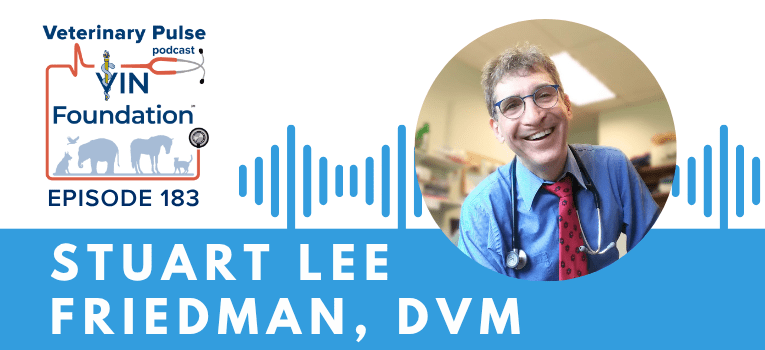
Listen in as we talk with Dr. Lee Friedman as he shares his non-traditional path to veterinary medicine. From selling encyclopedias to training as a Navy fighter jet pilot, heart-touching and fascinating, this story is a great reminder of how life brings us profound learning and through it we find our way.
As always, we want to hear from YOU. Please share your thoughts by sending an email or joining the conversation.
GUEST BIO:
Stuart Lee Friedman, DVM
Woody Allen once said that Parker Brothers offered to buy his memoirs so that they could make it into a board game. If Lee’s story was a board game, it would most certainly be more chutes than ladders.
“I’m more proud of my struggles with failure than my actual successes in life. What I achieved doesn’t define me as much as the failures I prevailed over.”
At first, failure came easily. By the time he hit college, Lee was well-practiced in the art of underachievement. He managed to drop out of college on academic probation after two and a half years for more aimless pursuits. Lee found work as a movie theater usher. Then as a busboy. Then a school janitor. Driving a taxicab lasted all of two weeks before being fired for a minor fender bender. He then sold encyclopedias door-to-door, where he once had his pants torn off by an angry dog. Selling stereo equipment was more lucrative, fun, and promised greater wardrobe integrity. And he helped introduce the idea that bicycle couriers – already popular in the condensed city of San Francisco – could actually work in the sprawling freeway metropolis of Los Angeles. He established himself as the only bike messenger with a city-wide courier agency of automobile messengers – and made it work.
Despite little successes, however, most of his jobs could well be classified as failures – both the way they ended (often at the insistence of management) and the way they failed to measure up to his existing potential. The gift of treading upon failure’s floor was not knowing any ceiling of success. That naivety stood in the stead of accepting less lofty “realistic” goals. Most everything he achieved was launched from the simple question, “Why not?” Friends who offered ready answers to that question soon found themselves outside the small circle of friends who did not.
From nothing, he turned daydreams into goals, and goals into realities. Coming out of life’s starting blocks late, he achieved most of the targets he set for himself while being nothing extraordinary in terms of talent or intelligence. He managed to gain admission to UCLA despite a miserable academic record at SUNY Buffalo (a success which he attributed to turning the required essay on his application into a written treatise on why someone like him could make UCLA proud). He obtained an appointment to the highly selective US Naval Aviation Officer Candidate School (AOCS) at NAS Pensacola with the help of a good citizenship letter written by the San Francisco Police Department after he tackled a suspect running from an officer. At AOCS, he endured a 16-week “pressure cooker” program designed to cull candidates who failed to meet stringent medical requirements, physical training goals, academic performance, and standards of character. Class attrition rates were typically over 30%.
Orders to primary flight training were received at the officer commissioning ceremony (AOCS graduation). Lee’s orders sent him immediately to VT-2 at NAS Whiting Field, where he met performance standards for selection to the strike (jet) training pipeline at VT-19 at NAS Meridian. A failed vision test ended his training, but not his love of aviation. He continued in the civilian sector. earning instrument and multi-engine ratings and is a commercially-rated pilot and instrument flight instructor.
With the airlines in furlough mode, he restructured his goals along a new set of impossible dreams, dusted off his undergraduate studies, and gained acceptance to the University of Pennsylvania School of Veterinary Medicine, having been wait-listed on his second attempt and outrightly accepted on his third. He graduated with his VMD degree in 2003.
From a perfectly average underachiever, he shares his recipe of realizing his goals: one part focus and one part attitude, all mixed together with a willingness to suspend disbelief and an embrace of impossible things. From flying military jets to writing published articles to becoming a doctor in his mid 40’s, each of those goals meant pushing past gate keepers who explained all the ways it could never be possible – while maintaining an optimism that capitalized on the opportunities that made them happen. That same recipe has helped him perform both as a pilot and as a doctor.
Lee also explains how attitude played a role in carrying the debt from his education – a debt assumed in the middle of life that he expected to pay to the grave – and how a positive perspective on a negative burden allowed him to redefine what it was – and carry it with grace.
LINKS AND INFORMATION:
- VIN Foundation Student Debt Education program
- VIN Foundation Student Debt Series podcast episodes
- VIN Foundation Vets4Vets®
- US Naval Aviation Officer Candidate School
- University of Pennsylvania, School of Veterinary Medicine
- If you enjoy these podcast episodes, please support this podcast with a gift
Get updates to stay tuned about VIN Foundation news and updates.
You may learn more about the VIN Foundation, on the website, or join the conversation on Facebook, Instagram, or LinkedIn.
If you like this podcast, we would appreciate it if you follow and share. As always, we welcome feedback. If you have an idea for a podcast episode, we’d love to hear it!
TRANSCRIPT
Intro
Lee Friedman, DVM: Walking away from that big dream of mine, the only solution to that was to pursue something as big as that, and that’s why I chose veterinary medicine.
Jordan Benshea: That is Dr. Lee Friedman, a second career veterinarian, and this is the VIN Foundation’s Veterinary Pulse podcast. I’m Jordan Benshea, Executive Director of the VIN Foundation. Join me as I talk with veterinary colleagues about critical topics and share stories, stories that connect us as humans, as animals, as a veterinary community. This podcast is made possible by individuals like you who donate to the VIN Foundation. Thank you. If you appreciate these podcast episodes, please consider making a donation to support these efforts and make sure to follow this podcast on your preferred podcast platform. Please check the episode notes for bios, links, and information mentioned. Hey all, a quick heads-up that some of the content in this episode may include a trigger as it relates to suicide. As a reminder, the VIN Foundation’s confidential support group, Vets4Vets®, is here for you, and you can find information to reach out in the episode notes. Please know you are not alone. Welcome, everyone. Today you are in for a real treat with our guest, Dr. Lee Friedman. Lee is a second career veterinarian with a fascinating career and story highlighting many, many relatable facets. Welcome, Lee.
Lee Friedman, DVM: Hey, thank you. Just glad to be here.
Jordan Benshea: I’m very happy to have you.
Early Jobs and Sales
Jordan Benshea: So let’s dive right in and talk about, what was your first career?
Lee Friedman, DVM: Oh, gosh. I don’t know if you can call them careers as much as, like little jobs, but I’ve done just about everything I think I could do before I ended up back at school. I was a cab driver in Los Angeles. That lasted about two weeks. And ended up doing door-to-door sales, encyclopedia sales.
Jordan Benshea: Oh, wow. Should we tell the audience what an encyclopedia is, just in case they don’t know?
Lee Friedman, DVM: Oh, yeah.
Jordan Benshea: That was sort of a joke, but-
Lee Friedman, DVM: Yeah. I thought you were going to say which encyclopedia it was because I can tell you that too.
Jordan Benshea: Let’s find out. Which encyclopedia was it?
Lee Friedman, DVM: It was a group called Lexington-Andrews. It’s hyphenated. And they were part of Macmillan Publishing Company.
Jordan Benshea: Oh, okay.
Lee Friedman, DVM: And they had an encyclopedia that I would walk around with a sample book, knock on doors, run away from angry dogs, and get a lot of doors slammed in my face. And if I endured that enough, I would end up talking to somebody, and if I talked to enough people in those few houses that I talked to, I would end up making a sale.
Jordan Benshea: Wow.
Lee Friedman, DVM: So yeah, it taught me a lot about persistence, perseverance. It was pretty much a numbers game, but I did believe in the product. It was a good product. I believe in books, encyclopedias. And after that it was stereo sales.
Jordan Benshea: Like car stereo or home stereo?
Lee Friedman, DVM: Both, actually.
Jordan Benshea: Okay.
Lee Friedman, DVM: It was a huge group called the Federated Group, and they were, I think, all over Los Angeles, and perhaps a little beyond. They would buy old warehouses or grocery stores, gut them out, and take out all the walls, and just put boxes of stereo equipment in there.
Jordan Benshea: Wow.
Lee Friedman, DVM: That’s how they would sell. The reason I did that actually was because I wasn’t making a whole lot of money selling encyclopedias. I love music. I love stereos. So I figured if I sell something I really like, then at least I’ll have fun and maybe that enthusiasm will make it a little more profitable, and that formula actually worked for me. I ended up being one of the top salespeople on the floor because I loved it. I loved the products. I was very enthusiastic, and I think that enthusiasm was contagious with my customers.
Jordan Benshea: So what age were you when you were doing this?
Lee Friedman, DVM: Oh, gosh. I was young 20s, I think. Young to mid-20s at that point. And I was a bike messenger, and that was because I was a car messenger until my car broke down.
Jordan Benshea: Forced you into the bike messaging
Lee Friedman, DVM: I’m sorry?
Jordan Benshea: That forced you into being a bike messenger.
Lee Friedman, DVM: It did. It did. I had to convince my boss that you could actually be a bike messenger in Los Angeles, and I made it work. Downtown Los Angeles is basically on a hill, so even though the main city is very sprawled out, there is a center section of the city that’s very packed, and that’s where I did all my work. I would start at the top of the hill and do all the errands and gradually get down to the bottom of the hill, and there was a parking garage that was built into the hill. You could go into the front of the garage at the bottom of the hill and exit the top of the garage at the top of the hill, and there was a big elevator. So I would get to the bottom of the hill, I’d walk my bike into the elevator, take it up to the top, and start all over again.
Jordan Benshea: Wow. We’ll have to talk offline sort of where exactly that is, because I know downtown LA pretty well, and I don’t know about that, so that’s some insider information.
Lee Friedman, DVM: It’s been a while, so we’re talking the ’80s. Actually, it was during the ’84 Olympics.
Jordan Benshea: Oh, I remember those.
Lee Friedman, DVM: And I was totally into the Olympics.
Jordan Benshea: Yeah.
Lee Friedman, DVM: All about heroes who were unlikely, and it’s those stories of heroes in the Olympics, of people who got there against all odds. So for me the Olympics were very inspirational.
Jordan Benshea: Yeah.
Back to School at UCLA
Jordan Benshea: So where did things lead you from bike messenger?
Lee Friedman, DVM: Well, I ended up back in school because I wasn’t really happy with the opportunities I had having dropped out, and I had been in Buffalo.
Jordan Benshea: So when you dropped out, where in school did you drop out?
Lee Friedman, DVM: I dropped out after two and a half years at State University of New York at Buffalo.
Jordan Benshea: Okay.
Lee Friedman, DVM: I was a pretty poor student because I was pretty unfocused, and ended up with a, I think, about a 2.2 grade point average and left. I took a leave. Figured it would be better to take a leave of absence before they kicked me out. So I had some strategy at least.
Jordan Benshea: Okay, so you’re in your mid-20s, you dropped out after two years in undergrad, and you’re in LA as a bike messenger. You’re in the midst of the Olympics, then you re-enroll in school.
Lee Friedman, DVM: Yeah. Actually, I may have the timeline a little mixed up, but I think I was going to school while I was a bike messenger.
Jordan Benshea: Okay.
Lee Friedman, DVM: So I think that was a summer thing for me.
Jordan Benshea: So where did you go back to school?
Lee Friedman, DVM: I went back, I sort of soaked in at Glendale Community College in Glendale, California. I took two courses, one philosophy and the other one was history of civilization. And they were taught by the same instructor, Dr. Montante. I still remember his name. He was a great guy. And the requirements for both courses were the same, you had to write a big term paper at the end. I asked him if I could combine the two and sort of synergize what I’m learning from both courses and write one single big term paper that would be at least twice as big as either term paper alone, and he agreed. He said, “It’s unusual, but I’ll do it.” And that really solidified my direction. I wanted to be part of technology and part of the general advancement of humanity, and I felt like there should be a place there for me. And that was the motivation that I think I needed, that focus that I didn’t have when I was at Buffalo. Ended up at Los Angeles City College and then at UCLA, and that’s where I graduated.
Jordan Benshea: And what was your major?
Lee Friedman, DVM: My major was biology. I specialized in molecular biology with some more advanced physics in there too.
Navy Flight Dream
Lee Friedman, DVM: And the reason why was because I figured after that report and after that motivation, I wanted to fly. I wanted to be part of that spearhead. So I was aiming for the US Navy flight program.
Jordan Benshea: And what happened?
Lee Friedman, DVM: I got in. It took me a few tries, but I got in. I would walk to my biology classes. A lot of them were in the medical school building, UCLA Medical Center, and the medevac helicopter, big jet helicopter, was constantly taking off and landing on the roof. You could smell the jet fumes, and you could feel the engine and the blades. And I would stop, and it was more than once that I was late for class because I just had to watch that helicopter land or take off when I was walking to class. And at some point I realized, that’s really what I need to go after. So I had the background really for veterinary school, but really my aim was a little different. I got into US Navy Aviation Officer Candidate School, which was a special program designed to take well-qualified civilians into US Navy officers in about 16 weeks. And at that point, if you can handle everything that they dished out to you, it was a very intense 16 weeks, I mean, very intense, then you got your orders to go to flight school, and that’s what happened. I made it through, went through training, did pretty good in primary training, got my first choice, which was jets. You could go into different pipelines, jets, helicopters, props, and then eyesight became an issue. So I had some decisions to make at that point.
Jordan Benshea: So how long were you flying jets in the Navy?
Lee Friedman, DVM: I was flying through the training command, through intermediate training. I was in flight school about a year when I realized I couldn’t finish it. So I had some options. Among them was to go into the reserves and just continue there, and I figured, I think that’s what I’m going to do, because I still want to fly, and I can fly. I still would qualify to fly with the airlines, so I was sort of aiming for the airline. I’ve seen pilots fly for the airlines with glasses. It looks like they have the bottoms of Coke bottles for lenses, but as long as you can pass the eye test with the glasses, you’re okay for commercial flying.
Jordan Benshea: So you went into the reserves. What age were you at that point?
Lee Friedman, DVM: I think I was in my early 30s.
Jordan Benshea: Okay.
Lee Friedman, DVM: Yeah. I’m not good at doing the math right on the top of my head here.
Jordan Benshea: It’s just a rough idea. I just like to give our audience a sense of like, you’re in your early 20s, you’ve kind of-
Lee Friedman, DVM: Yeah.
Jordan Benshea: Dropped out of undergrad initially, then you re-enroll. Then you get out of that. You go into flight school. Now you’re going into your reserves. And the reason I like to do that for our audience is because I think that so many people, especially younger people, are really focused on, “I’ve got to do this by this age, and this by this age, and this by this age,” and there’s all these markers that we have to hit, and one of the beautiful things I keep hearing in this podcast is, through everybody’s stories, there’s just different times and different seasons in life. And it doesn’t mean that you’re going to hit all those typical markers at those typical ages, and just because you don’t doesn’t mean that your story doesn’t end up somewhere amazing and wonderful. So you flew in the Reserves.
Airlines Not Hiring
Lee Friedman, DVM: I pursued civilian aviation in the Reserves and got all my ratings all the way up through commercial multi-engine flight instructor instrument. I was all set and airlines were not hiring.
Jordan Benshea: Oh, no.
Lee Friedman, DVM: So I had friends who were more qualified than I was, and they were paying like $10,000-$15,000 to go through an airline’s flight school for that particular airline, where they would be guaranteed an interview at the end. Not a job, but an interview, and I figured that didn’t sound to me like a good investment. If I’m going to spend money on top of all the work and everything, and all the money I was paying in civilian training, then to me it was ridiculous to throw another huge chunk of cash down just to get an interview. So I had to really think, rethink where I was going. Walking away from that big dream of mine, the only solution to that was to pursue something as big as that, and that’s why I chose veterinary medicine. And again it sort of goes back to that, going from encyclopedias to stereos, I needed to do something where my enthusiasm was a big part of it, and veterinary medicine was the only other thing besides flying that I could be enthusiastic about doing. I loved animals and I loved airplanes. Yeah, those are the big things that I loved when I was a kid.
Jordan Benshea: And was there sort of an aha moment when you realized, “I’m going to go for veterinary medicine” at that point?
Lee Friedman, DVM: I remember when I made the decision. I remember I was standing in the dining room and I just said, “I’m going to do it.” I remember it was as simple as that. I said, “I’m going to do it,” and I just started putting things together and just sort of seeing how far I could get. Really, pretty much any goal in my life has started with a very simple, little decision, and then just one step at a time. I think taking a tour of the vet school at Ryan Hospital at University of Pennsylvania impressed me too, and that was instrumental as well. I was impressed with the physicality of the profession, working with the animals, a very physical profession.
Vet School as Older Student
Jordan Benshea: Were you living in Pennsylvania at the time?
Lee Friedman, DVM: Yeah, I was.
Jordan Benshea: Got it. So you’d moved from Los Angeles after your stint there, after UCLA, and-
Lee Friedman, DVM: After I was out of, yeah, after I was out of flight school with the Navy, I moved up to Pennsylvania.
Jordan Benshea: And so that was your in-state school, which you then applied to, and is that where you attended veterinary school?
Lee Friedman, DVM: It is.
Jordan Benshea: How was your experience attending as a second career veterinarian, or veterinary student at that point?
Lee Friedman, DVM: Yeah. As an older student, and at that point after I’d gone through my civilian flight training and stuff, I was about 38, 39 or so when I went into vet school. And at that point, I did have some issues as an older student. I hope it’s okay to mention the name of somebody who was so incredibly helpful to me, and that was my anatomy professor, Dr. Paul Orsini who saw me struggling. And anatomy is all about memorization. About 90% of it is memorization. You learn functions and things, but really a lot of it is just memorizing all these different bones and ligaments and tendons and things, and I could not keep this stuff in my head. I would study it, I would spend all my time looking at this stuff, and it would just fall out of my head the next day. It just wouldn’t stick, and I could not figure it out. And he saw me struggling, and I didn’t have to tell him I was struggling. He could see it, and he pulled me aside and said, “Look, you don’t think like you did when you were 20. You think differently.” He said, “You’re going to do better in clinics when you have to synthesize, put all this stuff together.” He said, “you’re not going to get an A. You may not even get a B. You’re going to pass the course, and that’s okay. You don’t have to be perfect at memorization to get through vet school.” And that really helped me out a lot. So I think I got a C in anatomy.
Jordan Benshea: But to his point, you probably learned a lot more, and did you find that clinics was a better experience for you?
Lee Friedman, DVM: I did. I found clinics was more fun for me. And of course, what I do as a vet, what I’ve done ever since as a vet is essentially clinics, and to me, that’s the best part of practicing, is working in that dynamic.
Loss and Leaving the Field
Jordan Benshea: So where did your career take you after veterinary school?
Lee Friedman, DVM: Well, there was a complication and I had a friend, a very close friend, we met in fifth grade and immediately became brothers. He was more than a friend. He was a brother to me, and his name was Steve. Steve had a lot of problems later on and I realized that suicidal thoughts were part of that. This was toward the end of my clinics at Penn and before my graduation. I was unable to go over and be with him. He was up in Rochester, New York at the time, which was about 300 miles away. So I spent a lot of time back and forth with emails and that was sometimes the best I could do. And very shortly after I graduated, not just a couple of weeks after I graduated, he committed suicide.
Jordan Benshea: I’m so sorry, Lee.
Lee Friedman, DVM: Yeah. I’ll tell you surviving the suicide of somebody who’s very close to you is different than surviving almost any other death. There’s just something about it, and I think part of it is guilt for not being there when you wish you had been. Although I don’t know if I would’ve been able to save him if I’d been able to spend more time, but one thing I do know is that I blame the profession for it. And being logical through that grief, it is not really part of that process. Blaming the profession, I mean, I look back on it now and I say, “Okay, well that seems a little ridiculous,” but that was the way I felt. I was very angry that I had put all that effort into my education and all that money, and I ended up having lost a friend because I couldn’t be there for him. And I was very, very angry, so I really, at that point, I said, “I just don’t want to do anything with veterinary medicine.” I ended up working for a friend of mine in a title company just wanting to do anything else, and thinking, “Okay, I got this degree and I didn’t really care” kind of thing. It took me a while to work through that.
Returning to Practice
Jordan Benshea: And how did you find your way back to veterinary medicine?
Lee Friedman, DVM: A very good friend who is a dentist, an older fellow who lived in the neighborhood, great guy, David Rothman. He pulled me aside at a neighborhood party and wanted to ask how I was doing as a recent veterinary graduate. And I told him I wasn’t really doing a whole lot with the profession, and pretty sure I shared with him what had happened with my friend. And he told me, he said, “Well, give it a chance, and you’ll probably find, as I do, that the more you do it, the more you love it. If you picked it, if you picked the profession right, and you picked it, that you may find that the more you do it, the more you love it. Maybe you just need to get started.” And I took that to heart, and it turned out to be really true, and I do love it more. I love it more now than I did last year. Way more than I did five years ago. You get a little bit more comfortable with it and you learn a lot from your mistakes, and you learn a lot just from doing it and reading it, reading about it. So that really helped me get back into it.
Jordan Benshea: Well, what just such a huge tough time for you in the midst of having really a not an A to B, but sort of all over place path to veterinary school, and then getting in and then really enjoying the clinics and having this experience and this huge grief at the accumulation of all of that must have been very, very challenging, and I have huge, huge empathy and compassion for that experience. And then still finding your way back to veterinary medicine, and what was it like practicing once you started?
Lee Friedman, DVM: Good question. I started practicing, I wasn’t too happy with the associate positions I held. There were various reasons for that. None of them really to do with my basic love of medicine. It just may be some of the ways that they were practicing. And one of them was, I just felt like I didn’t have the time that I wanted with each patient to do the kind of work that I felt I was capable of doing.
Relief Vet Freedom
Lee Friedman, DVM: The thing that really changed my direction in veterinary medicine and turned me towards accepting work as a relief vet was working at a very unhappy situation, and at the time my mom was up in Rochester, 300 miles away, was in the beginning to middle stages of Alzheimer’s disease.
Jordan Benshea: Oh, that’s so challenging.
Lee Friedman, DVM: Yeah, and I would be talking to her. I remember talking to her every night coming home. On my long drive home, I would get her on the phone and talk with her. Realized I just need to be there, I need to be there, so I would try to get up there as often as I could. And one day she had a crisis and it was on the phone, and I realized I just need to be up there more. And I was working a job that I did not like, and I was spending all that time devoted to this sort of miserable situation while my mom was dying and I couldn’t be there for her, and I said, “No, this isn’t right,” so I quit. And I said, “I’ll just figure it out.” And that was 2012. I remember the year. It was probably the best decision I made. I was able to be with her right at the end, and I also was able to find a niche as a relief vet.
Jordan Benshea: Which allowed you that freedom to be there for her and be there for the one you cared about in that time.
Lee Friedman, DVM: Yeah.
Jordan Benshea: Yeah. Which I would imagine was probably extremely important to you based on what you shared about not being there for Steve and having that opportunity, and you created for yourself the opportunity to be there.
Lee Friedman, DVM: One of the good things about being a relief vet is that you have that time to take care of yourself that you might not have If you get into the wrong situation-
Jordan Benshea: Yeah.
Lee Friedman, DVM: As an associate. Now, I’m not saying being an associate vet is a bad thing. I think my problem is I just could not find the right fit.
Jordan Benshea: At this point, once you became a relief vet, did you find that you were enjoying the medicine?
Lee Friedman, DVM: I did because I was able to pick and choose the practices that allowed me to practice more on my terms, and if I found a practice that understood medicine the way I did and had a philosophy of medicine that was aligned with mine, then it was a much better situation. Being a relief vet is sort of like being Huck Finn. You’re on a raft, and you’re sort of independent, and you can moor on the shore anywhere you want. If they need you, you’re there, and you get back on your raft, and you’re on your own. It really, to me, it was that feeling of freedom was really important to me. I didn’t know how important it was. At first, being a relief vet was just so I could be available for my mom. But once I did it, I realized, “Ah, I enjoy it.”
Jordan Benshea: Well, it gives you that freedom to be there for the people that you love for the important times in your life while practicing in this career that you have a huge love for.
Lee Friedman, DVM: Yeah.
Student Loan Forgiveness
Jordan Benshea: I mean, the reason I originally got introduced to you is because you let us know that you had reached veterinary student loan forgiveness. Let’s talk a little bit about that journey for you. So I’m presuming you took student loans in veterinary school?
Lee Friedman, DVM: Yes, I did. And at the time I took those loans, I thought, “I am fully prepared to pay these until the grave” because I thought-
Jordan Benshea: Okay.
Lee Friedman, DVM: That was how long it was going to take. I said, “Well, at least it’ll make me feel a little younger to be the only guy in the whole old age home paying his student loans.” It’ll keep me connected to my past that way. I worked hard to strategize properly. Forgiveness was not a thing when I first took out those loans, so when I first went into debt to go to veterinary medical school there was no talk at that time, at least that I was aware of, that there would ever be any kind of a forgiveness for the loans.
Jordan Benshea: So what was your process and your strategy, and how did you go from not expecting there was forgiveness to learning about it, strategizing, setting yourself up for success? What did that look like for you?
Lee Friedman, DVM: Well, of course, Tony on VIN Foundation was a huge part of that. He would have podcasts. For me, I’ve had two oath-bound professions in my life. I was a Navy officer and I am now a veterinarian. I’m still a Navy officer, still have my commission. What those asked of me was a lot. Being a Navy officer, flying in the Navy, I lost friends doing what I was doing. I lost 13 people. 13 professional peers that I’ve lost just during the period that I trained. That’s how dangerous it was.
Jordan Benshea: Wow.
Lee Friedman, DVM: And one of them in the Gulf War. So that’s what you sign. That’s what you put on the dotted line. As a veterinary student, I put something else on the dotted line. I put my welfare on that line. Either way, they’re services, and the way I would look at it is this is what I have to give to be in this position to serve. And that’s just what the price that’s required of me. It doesn’t mean that I don’t try to pay off my loans and I carry them like some kind of a badge any more than I try to take care of myself in the airplane when I fly. Just because I know the possible consequences that I signed up for doesn’t mean that I’m going to do everything, doesn’t mean I won’t do everything I can to avoid having to pay that price. So that’s the way I saw it, and that really, that attitude really helped me get through paying my loans, wondering if I was going to get forgiveness, which I wasn’t convinced would happen, but it did.
Jordan Benshea: What were the resources that you leaned on?
Lee Friedman, DVM: Mostly VIN, VIN Foundation was really pretty much it. Tony was a big part of that, and his podcasts.
Jordan Benshea: Yeah, we put out a lot of podcasts, a lot of webinars. There’s a huge effort that goes into that, and it’s wonderful to talk to somebody that has first-hand experience of applying the strategies and have found success there.
Lee Friedman, DVM: It really is. It’s very easy to get wrapped up in the stress of worrying about, “Am I doing it right? Am I doing it right?” There’s a lot of emotional stuff that goes with carrying these loans and wanting to get to forgiveness and wondering if you’re doing it right, because there are so many intricacies to the process. And what helped with Tony and with the VIN Foundation was giving us a good framework to make that happen, a strategy. It did help. It helped quite a bit.
Jordan Benshea: Wonderful. That makes us very happy to know that we’re helpful, because that’s the most important thing that we do.
How He Practices Today
Jordan Benshea: So what’s your current role in veterinary medicine now?
Lee Friedman, DVM: Right now I’m a general veterinarian. I’m working through a relief agency and really enjoying it. I have some other opportunities that have come my way, so I may be working in a different capacity, but always in general veterinary medicine. I do enjoy it, and every visit is an opportunity to meet new people, especially if you work in your own neighborhood. Sometimes I’m lucky enough to do that, and you get to meet your neighbors on a different level and see their animals. And being a general vet allows you to take that 30,000-foot view of everything that comes in. You get the ears or you get the eye infections or the respiratory, but you can look at the whole animal and just say, “Okay, let me go, let me just do my head to toe.” I remember that was really drilled into us in vet school, is like every exam is a full physical exam. And then sometimes you catch things before they become bigger problems.
Jordan Benshea: Yeah.
Lee Friedman, DVM: And things that are unexpected. One of the things I do like about general practice is finding the practices that give you the time that you need to work through a case. I remember one doctor said, it was during a symposium, and I can’t even remember what the technical stuff was in the symposium that he was talking about, but he was just talking in general about the field of veterinary medicine and medicine in general. He said something that stuck with me. He said, “What makes a good doctor is not how much you know, it’s how much you see. And you can’t see if you don’t take the time to see.” That really helped me in my practice, just slowing down, taking the time to really look, and that’s the way I like to practice. It actually, it’s funny, and I’m just making this realization now, it worked for me selling stereos. I was a top salesperson. I sold on good margin, but I took my time with the customers. I would get flack from management saying, “You’re not seeing enough customers. You’re not seeing enough customers,” and I said, “No, I’m taking my time. And when I take my time, I can show them other things and they buy more and they’re happy and I’m happy and they get a really good system.” And it was really like the same thing in veterinary medicine, is you take the time, it allows you to build that trust on every visit, and you see the things that you might otherwise miss and you can take care of.
Jordan Benshea: I was thinking when you were saying earlier that you were in sales how that was really going to set you up for success in veterinary medicine because a lot of that when you’re talking with clients, a lot of veterinary medicine is having that interpersonal relationships, right? And knowing how to work with people, which is important for the client aspects with you, but also important with other staff members. In the inter-, office politics as well. There’s so many different aspects of it that can really set you up for success to have that sales experience.
Lee Friedman, DVM: Well, sales is great. It was very helpful to me. And sales like anything else, there’s good sales and bad sales technique. If you sell not what you need to sell, but what the customer needs to buy, and you focus on that, then the rewards come to you, and you don’t have to think about it. That’s the way I’ve been able to sell, and that’s the way I’ve been able to sell ideas and healthcare as a veterinarian, is I look and I say, “What is really needed here? And what isn’t needed?” Don’t sell the things that you don’t need to sell. But there’s no escaping that veterinary medicine is a business. You take care of the business. But I think that sometimes if you focus on the business before the patient, before what the business is about, that kind of thinking never worked for me.
Jordan Benshea: Are there other areas of cross sections in your life that relate to your experience in veterinary medicine?
Lee Friedman, DVM: Well, I’ll tell you, I love to write. It’s one of the things I love about in there, there is a cross section there. Writing reports is a wonderful opportunity for me to really, when I get done with a case, to really think about what I saw, what I want to do. A lot of times if I write the report properly, I get insights while I’m writing. It’s a thought process, so I very much enjoy writing. Probably one of the biggest things I enjoy about seeing appointments and seeing patients is writing up the reports afterwards. I do get those aha moments. Way too late sometimes, after they’ve already left the building and I put all my thoughts down, I say, “Oh.”
Advice for Career Changers
Jordan Benshea: What advice do you have for colleagues who might be listening or interested in becoming a veterinarian but might feel like it’s too late for them, or that they’ve already chosen one career or maybe they’re not ready to dive into a second one? What would you recommend?
Lee Friedman, DVM: I’m the poster child for doing those things that everybody tells you not to do, and I do them anyway. I’ve gotten to the point in my life where if 9 out of 10 people tell me I can’t do it, then that’s precisely what I’m going to try to do. Everything that I think I’ve done in my life that I’m happy about and that has put me where I want to be, has been with a lot of people who told me I couldn’t do it. I’ll share something with you. When I wanted to get into the Navy and I had my mind set on flying jets in the Navy, I just wanted to fly carrier jets, and my dad told me, he said, “I think you’re like Don Quixote tilting at windmills.” That’s what he said, and he was not supportive of me. And I got there, and I got in, and I went that whole summer, that whole hot summer in that pressure cooker of training to see if I could come out the other side a Navy officer, and I did. And he came to my graduation with my mom, And I remember thinking, I don’t know how I’m going to be able to celebrate this with him. He didn’t support me. I remember having a tough time with those thoughts and he came up to me on the parade grounds after graduation, and he was there for it, and he said, “I’ve never been so happy to be so wrong”-
Jordan Benshea: Aw.
Lee Friedman, DVM: “In my whole life.”
Jordan Benshea: Aw.
Lee Friedman, DVM: Leave it to my dad to say the perfect thing. It just all of a sudden like boom, father and son again. Going back to your point, if you’re going for something and you really want it, just go for it. Be the outlier. I was the outlier in the Navy. I was the outlier in veterinary school. I was an older student. I was the outlier at UCLA. A guy with a 2.2 grade point average from Buffalo and I got into UCLA. You look at the opportunity to do it and you do it, and sometimes the people that you feel should be in your corner, sometimes they’re not. I mean, my own dad wasn’t in my corner and I did it. If you’re thinking about vet school and you think that that’s really what you were meant to do, then that’s what you got to do, and don’t let anybody tell you can’t.
Jordan Benshea: Well, you’ve been so generous with your time today, Lee. I really appreciate it. Is there anything else you want to leave our audience with today?
Lee Friedman, DVM: No, I think we’ve talked about quite a lot of stuff here.
Jordan Benshea: We’ve covered a lot of topics.
Lee Friedman, DVM: Yeah. I think the bottom line is, you got one life, do what you want in this one life. Nothing is really as impossible as most people will tell you they are. And if you get into veterinary medicine, enjoy it. Burnout is an issue, but you stay in touch always with the reason that you went into it, and never lose that, “this is why I wanted to be a vet.” And it’s easy to forget all that when you’re carrying this heavy loan burden or you’re maybe working for a practice that’s not giving you the time that you really feel that you need to do with a patient, or anything else, and they can really distract you from things, and then you realize you just have to find the right niche in the profession. That was a big thing for me. And I wanted to thank you guys at VIN Foundation for what you do. It’s such a tremendous resource. Very helpful.
Jordan Benshea: That’s our goal, is to be here to help, so the fact that we’ve helped you is the best thing we can do.
Secret Talents and An Enlightening Story
Jordan Benshea: Do you have a secret talent or something that you enjoy doing that others might not know about?
Lee Friedman, DVM: I write, and I cook. I cook. Used to cook with pre-made plastic bags full of powdered stuff that you would add hot water to, and all of a sudden you had crawfish etouffee, until we ran out of them, and I said, “I still want crawfish etouffee.” And that was what got me into cooking.
Jordan Benshea: Oh, that’s awesome.
Lee Friedman, DVM: And I ended up hitting the cookbooks just because I’m such a chowhound. I love to eat.
Jordan Benshea: One last question. Do you have, and I didn’t actually prepare you for this, so I was just thinking recently that we want to add this, but do you have, vet med’s made up of this huge love for animals, so do you have a story about an animal that makes you happy or that brought you a lot of joy that you might want to share?
Lee Friedman, DVM: I have a few, but I have one in particular. It was a cat that was diagnosed as being, newly diagnosed diabetic cat, and a gentleman who came in with this cat, and it was at one of these clinics I was working at as an associate. They told me that this guy was fired from the last clinic because he was abusive to the staff, and my thinking was, “Well, I just want to get to his cat. I just want to fix his cat.” And at the time, there was a lot of talk about glargine insulin and being able to remedy and get remission on these diabetic cats, so I said, “If we can do that then I’ll be happy, and I’ll do whatever I have to do to get around the personality issues.” And I was told, “Okay, well, you’re on your own because we’re not going to send any techs in with you.” I said, “Okay, fine.” And the guy was headstrong. He wasn’t abusive, but he was, of course, I was the vet. Sometimes, people act differently toward technical staff than they do toward the vet, but to me, he wasn’t abusive, but he was very headstrong, very opinionated. He had a special diet for his cat that he wanted to feed. I said, “Fine,” and I just said, “Look, you work with me, then we have a shot here of getting remission with your cat.” And he worked with me, and we worked on that, and I ended up on a, I think a four-week notice at that clinic that I was leaving, but I had appointments with him, and I believe the last appointment I had with him was we had whittled his cat down to no insulin at all-
Jordan Benshea: Wow.
Lee Friedman, DVM: And we were doing a recheck to see if that blood glucose was normal. And that last visit, he came in with his wife, and we tested the cat, the cat was normal.
Jordan Benshea: Wow.
Lee Friedman, DVM: And at that point I got the other part of the story, that this cat belonged to their daughter who was at college and was killed in a car accident. All they had from her was this cat and all the love that she put into this cat, and that was what they had.
Jordan Benshea: Wow
Lee Friedman, DVM: it really stuck with me.
Jordan Benshea: Yeah.
Lee Friedman, DVM: And it shows that we don’t really know the whole story about anything.
Jordan Benshea: Yeah.
Lee Friedman, DVM: Sometimes you just do what you do. Our job is to fix animals, and so I fixed the animal, and then I got the rest of the story.
Jordan Benshea: Wow.
Lee Friedman, DVM: And it made me realize that’s why I do this.
Jordan Benshea: Oh my gosh, that’s an incredible story, Lee. And a great story to end our podcast with as well, but also just an incredible story.
Lee Friedman, DVM: Yeah.
Outro
Jordan Benshea: Wow. Lee, thank you so much for being here and taking your time, and for all that you do to help these animals and the clients, and for really wanting to take the time to see people, and your clients and your patients. It’s really inspiring, so thank you for all that you do. And thank you for being willing to come on here, and be brave, and share your story with our audience. I think it’ll definitely connect with a lot of people. So thank you so much, Lee. I really appreciate your time and effort.
Lee Friedman, DVM: Thank you. Thank you. Bye.
Jordan Benshea: Thank you for joining us for this episode of the Veterinary Pulse. Please check the episode notes for additional information referenced in the podcast. If you enjoyed this podcast, please follow, subscribe, and share a review. We welcome feedback and hope you will tune in again. You can find out more about the VIN Foundation through our website, VINFoundation.org, and our social media channels. Thank you for being here. Be well