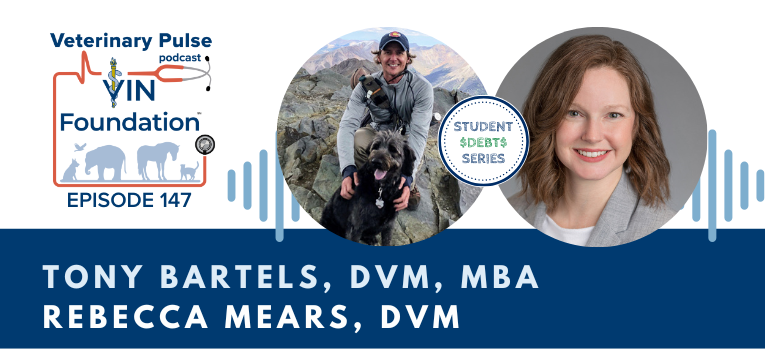
Listen in as Executive Director Jordan benShea chats with student debt expert and Board Member Dr. Tony Bartels and the newest student debt team member Dr. Rebecca Mears in this next installment of our Student Debt Series.
In this episode we’re discussing the latest news about student loan forgiveness from the Department of Education. Is this a time machine for loan forgiveness? What should borrowers know now and if colleagues have been making payments can they get a refund? Find out what you need to do if you federally held loans versus commercially held loans and where to go for updates.
As always, we want to hear from YOU. Please share your thoughts by sending an email or joining the conversation.
GUEST BIO:
Dr. Tony Bartels
Tony Bartels, DVM, MBA graduated in 2012 from the Colorado State University combined MBA/DVM program and is a VIN Foundation Board Member and Student Debt Expert, and an employee of the Veterinary Information Network (VIN). He and his wife, a small-animal internal medicine specialist practicing in Denver, have more than $400,000 in veterinary-school debt that they manage using federal income-driven repayment plans. By necessity (and now obsession), his professional activities include researching and speaking on veterinary-student debt, providing guidance to colleagues on loan-repayment strategies and contributing to VIN Foundation resources. Beyond debt, his professional interests include small- and exotic-animal practice. When he’s not staring holes into his colleagues’ student-loan data, Tony enjoys fly fishing, ice hockey, camping and exploring Colorado with his wife, Audra, and their two rescued canines, Addi and Maggie.
Dr. Rebecca Mears
Rebecca Mears, DVM grew up in Delaware before moving to Lexington, KY, where she completed her BS at University of Kentucky. She is a graduate of University of Georgia’s College of Veterinary Medicine. While in vet school, she served as the National Business Certificate Director for the Veterinary Business Management Association (VBMA) and as a board member for Vets for Pets and People. During this time she took an active role in wellbeing awareness and access within the veterinary community. Rebecca then worked as an equine general practitioner and has been an active AAEP member. In her time away from veterinary medicine, she can be found hiking, baking, and hosting impromptu dance parties. She is passionate about giving back to the profession and improving the lives of veterinarians, pre-vet and vet students. She is incredibly grateful for the opportunity to do so as a member of the VIN Foundation student debt team and Rising Leaders Committee lead.
LINKS AND INFORMATION:
- Department of Education press release
- StudentAid.gov announcement
- VIN Foundation Student Debt Center
- Check your current student loan servicers and other loan details — VIN Foundation My Student Loans tool
- VIN Foundation WikiDebt
- VIN Foundation Webinars
- VIN Foundation Blog post
FedLoan Servicing- StudentAid.gov
- Federal Student Loan Servicers
- StudentAid PSLF
- New Graduate Student Loan Playbook
- Student Loan Repayment Restart webinar recording
- Stay up to date with VIN Foundation updates
- Personalized student loan assistance
- Email VIN Foundation
Get updates to stay tuned for the VIN Foundation webinars on student debt.
You may learn more about the VIN Foundation, on the website, or join the conversation on Facebook, Instagram, or Twitter.
If you like this podcast, we would appreciate it if you follow and share. As always, we welcome feedback. If you have an idea for a podcast episode, we’d love to hear it!
TRANSCRIPT
Intro
Tony Bartels, DVM, MBA: If you’ve already eclipsed the, let’s say 25 year repayment threshold and you still have federal student loans, then you should be expecting some kind of forgiveness of that remaining balance. What’s really, really cool about the details in this announcement, is that any payment you’ve made beyond what that forgiveness timeframe would be for you, you’ll get a refund of that payment. That’s even more encouraging.
Meet the Host and Guests
Jordan Benshea: That is student debt expert and VIN Foundation board member, Dr. Tony Bartels with Dr. Rebecca Mears, and this is the VIN Foundation’s Veterinary Pulse podcast, Special Student Debt series. I’m Jordan Benshea, executive director of the VIN Foundation. Join me as I talk with veterinary colleagues about critical topics and share stories. Stories that connect us as humans, as animals, as a veterinary community. This podcast is made possible by individuals like you who donate to the VIN Foundation. Thank you. Please check the Episode Notes for bios, links, and information mentioned. Welcome back, everyone.
Latest Updates on Student Loans
Jordan Benshea: We are happy to have you with us again and we are back for you guessed it another round of the Student Debt series with VIN Foundation board member and student debt expert Dr. Tony Bartels. We’re talking about the latest in student loans because as we know it’s ever changing. This time we also have another new guest with us. We have our new student debt team member, Dr. Rebecca Mears. So welcome, Tony. Welcome, Becca.
Tony Bartels, DVM, MBA: Yeah, thanks. Thanks for having me again, Jordan. I feel like as soon as we finish one podcast about an announcement, another announcement is made, and we have to jump out and talk about what the new information means for everyone.
Jordan Benshea: Yeah, it’s just nonstop. Welcome, Becca. We’re thrilled to have you here as well.
Rebecca Mears, DVM: Thank you.
Jordan Benshea: Tony, what does retirement look like for you? Because I’m never going to stop changing.
Tony Bartels, DVM, MBA: Well, as soon as my loans are forgiven, then we’ll see what my retirement looks like. I’m still quite a few years off on that even with these new announcements that were made.
Jordan Benshea: Becca, you’re new to the team. Do you want to share any little tidbit of information with our audience about how you came to join the team?
Rebecca Mears, DVM: Yeah, thanks, Jordan. I’m Rebecca Mears. I graduated from University of Georgia in 2020 and was working as an equine veterinarian up until I joined the VIN team earlier this year. Prior to that, I had been working with the VIN Foundation through the Rising Leaders committee. I’m really excited to be here today and dive into this topic with you guys.
Jordan Benshea: Wonderful. So, let’s dive right in.
Understanding the New Forgiveness Guidelines
Jordan Benshea: A couple of weeks ago, we brought you the news about the student loan repayment pause being extended yet again, to August 31rst. That was announced, of course, the day that we chose to do a webinar on student loan repayment. Today, we are diving into the announcement from the Department of Education that was made on April 19, 2022, where they announced lots of changes that will increase eligibility for forgiveness through income driven repayment. Pretty much this is any borrower with loans that have accumulated time in repayment of at least 20 or 25 years. That seems confusing already, so we’ll dive into that. We’ll see automatic forgiveness, even if you’re not currently in an IDR plan. Tony, we’ve been hearing whisperings about forgiveness. There have been threats, lots of threats of forgiveness. Is this what people have been threatening about? Is this what we’ve been hearing about, or is this something different? Let’s dissect this for our audience.
Tony Bartels, DVM, MBA: Yes, and no to all of that. I think that this was probably not how most people were envisioning loan forgiveness happening. There had been a lot of discussion that the administration might and still could just cancel some amount of everyone’s student loan balance, or at least the federal student loan balance and they’d been reluctant to do that. They keep telling us that they’re reviewing whether or not the executive branch has the authority to do something like that. In the meantime, they have come out with these new guidelines that are apparently in their purview to do and that is basically counting any amount of time that you’ve been in repayment on federal student loans towards forgiveness. That will result in forgiveness for a lot of borrowers, particularly borrowers who have been in repayment on their student loans for 17, 18, 20, 25, 30 years and still have a balance remaining. This is really a, I’m kind of jokingly calling it a time machine for student loan forgiveness. I think there was a lot of frustration from past borrowers that missed the boat on a lot of these newer, more beneficial plans, but yet have been paying on their student loans forever. How come I can’t get forgiveness? This is your chance at forgiveness. The more challenging part is knowing whether or not you have the right loan types, and how much time you’ve been in repayment that might count towards forgiveness.
Jordan Benshea: What spurred these changes? I heard rumors that it was an NPR article. I heard, obviously, a ton of political pressure, but what was it, do you think, that was really the linchpin in making this happen?
Tony Bartels, DVM, MBA: If you read the actual press release from the Department of Education, they make reference to having student loans was never meant to be a life sentence of repayment. That’s really what spurred these changes was that making payments toward your student loans for decades was never really the goal, but for a number of reasons with the way student loans are structured, and the way that higher education costs have increased over the last 20 or 30 years greatly exceeding income increases, people are in repayment for a long time. If you don’t do everything exactly correctly, then you can be in repayment for an even longer time. So, I think this is meant to go back and correct some of that. Now, there were some reports about how ineffective the current forgiveness plans, the current income driven repayment plans have been, and honestly, just knowing how those work that was to be expected. So really, the only income driven plan that’s been around long enough for anyone to receive forgiveness was a plan called income contingent repayment. Unfortunately, the way that plan was structured the monthly payment that you would make towards those loans, how much of your income that payment would be really didn’t seem like it was designed to result in student loan forgiveness, which is one of the reasons why we don’t see a lot of people or haven’t seen a lot of people qualify for forgiveness using that plan, yet. They either switched away from that plan because it didn’t result in a low enough monthly payment to work with their budget, or if they made payments under that plan for a long enough period of time, they would have probably paid their loans to zero by then. So that was not a very effective forgiveness plan to begin with and some of the newer versions like Pay As You Earn, income based repayment, and Revised Pay As You Earn haven’t been around long enough to actually result in any kind of student loan forgiveness, but we will see that happen in the coming years.
Eligibility and Implementation
Jordan Benshea: Okay, I sort of alluded to in the beginning, it says this is for borrowers who have been paying for at least 20 or 25 years. Who qualifies for this forgiveness and how do you begin to determine what that is? That seems like a five year span and what is the definition of those? I mean, it seems like there’s a lot of questions that come out of this.
Tony Bartels, DVM, MBA: My best guess on that, because I don’t know exactly, but my best guess on that is going to be based on whether or not you have loans from graduate school or undergraduate school only. Since we’re predominantly tasked with helping veterinarians, my guess is that anybody listening to this has graduate school loans. My guess is that you’re going to be in that 25 year time frame, but until we see them actually start to implement some of these changes and go back and count some of those payments and actually grant forgiveness, we may see something different. I’m not sure.
Jordan Benshea: When are these going to start taking effect?
Tony Bartels, DVM, MBA: Soon, I think they’re going to have a lot of work to do. They’re hoping to start granting forgiveness and doing the retroactive granting of forgiveness counting payments by January of 2023. That’s where they’re hoping to have made, I guess, the first pass or first run through of this for all the borrowers by that timeframe.
Jordan Benshea: So that means if I’m a borrower, and I’ve been making payments for 20 to 25 years, I’m thinking 2023 is going to be a really good year.
Tony Bartels, DVM, MBA: Potentially, or maybe hopefully even sooner than that. If you’ve already eclipsed the let’s say, 25 year repayment threshold and you still have federal student loans, then you should be expecting some kind of forgiveness of that remaining balance. What’s really, really cool about what’s in this one, one of those details that is in this announcement is that any payment you’ve made beyond what that forgiveness timeframe would be for you, you’ll get a refund of that payment. That’s even more encouraging. Although I wouldn’t get too terribly excited by that because federal student loan, the pandemic forbearance has been in place since March of 2020, so nobody’s really had to make a payment since March 2020. So, unless you’ve made payments for 25 years up to that point, you’re probably not going to get much of a refund, but I guess we’ll see. It depends on the specifics of your loans.
Jordan Benshea: What do colleagues need to do to get this forgiveness? Is this just automatic? They’ve been paying, and then suddenly they get a statement that says zero, you’re all done, and they’re okay, cool. Now I’ve got a lot more cash to work with. How does that work?
Navigating Loan Types and Consolidation
Tony Bartels, DVM, MBA: In most cases, this is going to be automatic, meaning you don’t have to do anything. However, given the timeframe that we’re talking about going back 20 and 25 years into the past to look at your loan types, repayment plans, and history on your student loans, we cross over a number of versions of the federal student loan borrowing experiment. Over time, there have been different loan types, and prior to the direct loan program we had what was called a Federal Family Education Loan Program or FFEL program. Within that program, you can have both what’s called federally held or managed student loans, as well as commercially held or managed student loans. There was kind of an indication that there was a public private partnership going on between the Department of Education and private lenders to provide guaranteed student loans. It’s kind of a random issue in terms of whether you have the commercially held versions or the federally held versions. Anyone who has a federally held version doesn’t have to do anything under these announcements. Everything is going to be granted automatically based on your loan types and repayment history. If you have the commercially held versions, then you do have to consolidate them into a direct consolidation loan before they go through this first pass of adjustments. So, you have to do that consolidation before the end of this year if you want to be considered for these adjustments.
Jordan Benshea: If somebody is not sure what type of loans they have, I know that we have tools for that and as always, all these things that we’re talking about will be in the Episode Notes but will you two walk them through what do they need to do to kind of find out if they’re unaware of whether it’s commercially or federally held.
Tony Bartels, DVM, MBA: I would start with studentaid.gov. If you have federal student loans, or you ever had federal student loans, you can set up an account or you will already have an account with studentaid.gov. You use your social security number or an email address and your phone number to set up that account, and they’ll find your federal student loan borrowing history. Once you’re logged in there, you can look for your student aid data file. This is going to be an ugly looking text file that contains the complete history for your federal student loan and borrowing repayment details. Once you have that file, you can take it over to the VIN Foundation Student Debt Center. Using the My Student Loans tool, we have a tab in there that can help you differentiate between federally held and commercially held FFEL program loans. That’s the easiest way. That’s what I do when people ask for help in terms of how do I know if I’m eligible for these. I ask them for their student aid data file, I upload it into the My Student Loans tool on the VIN Foundation Student Debt Center, and I look at the loan servicer tab. In the loan servicer tab, if it says Department of Ed before it says your servicer name, then you have the federally held version of the FFEL program loans. If it doesn’t, if Department of Ed is not there, and it just lists a loan servicer name like American Education Services or Nelnet or Aidvantage what used to be Navient, if it just says that name, and it doesn’t say Department of Ed ahead of it, then you have the commercially held versions and that means you are one of the people who have to consolidate in order to receive the benefit of these most recent announcements.
Rebecca Mears, DVM: Tony, my understanding is that the benefit to these commercially held federal loans there is going to be really impactful because those individuals that have had these commercially held FFELP loans haven’t been able to benefit from some of the pandemic forbearance issues. Is that correct?
Tony Bartels, DVM, MBA: Yes, that was also correct. The pandemic forbearance benefits were only applied to what was called federally held student loans. That included all the direct loans, as well as the federally held FFEL program loans, but it excluded the commercially held versions, so you can see a pattern here. The Department of Education has way more latitude to do these sorts of things with the loans that they have direct control over, but the ones that are in that commercially held realm don’t have as much flexibility, which is why they need you to take those loans, put them into a direct loan, so then they can apply these changes even retroactively.
Impact of Pandemic Forbearance
Jordan Benshea: We touched on it a little bit earlier, but as we’ve mentioned in the last podcast, we talked about how this student loan pause extension has been extended again to August 31rst. Now we have borrowers thinking about this pause extension, and then there’s this forgiveness. Do those impact each other? How does it affect those who are currently in, which is everybody, in forbearance be it the student loan payment pause extension? How does that impact this? I want to see if there’s some way that we can give people some clarity on that.
Tony Bartels, DVM, MBA: In my opinion, I think that this is probably some pretty good indication that they’re likely to stay that course, because if you think about it, they’re giving themselves through January 2023 to go through and apply all these changes. Rather than having to issue refunds from September 1rst through January 1rst, they’re probably going to extend that through January just to make sure that they’ve done their first pass with these expanded changes to forgive as much of the student loans as they possibly can, which means not having to worry about restarting repayment for a number of or 1,000s of borrowers, probably. It logistically seems like it’s quite likely that that will be extended. Now, I don’t get to make that decision.
Jordan Benshea: Which we’re all upset about.
Tony Bartels, DVM, MBA: I’m just kind of reading the tea leaves here. Yeah, exactly. If I had to guess, it probably would be extended to match what this timeframe is for them to go through and make these changes, but we’ll have to wait to see on that, specifically.
Navigating Student Loan Repayment Post-August 31st
Tony Bartels, DVM, MBA: So, we can’t really ignore our student loans. We have to think about what repayment might look like after August 31rst if we are going to reenter repayment. Again, based on how this recent announcement is structured, it seems likely that they may extend that again.
Rebecca Mears, DVM: Tony touched on this earlier as well, they’re giving themselves until January 2023 right now to make these changes, and so it’s been made pretty clear through the Department of Education’s press releases and things that even though those changes are going to start now, borrowers may not be seeing those changes on their accounts until the end of this year, potentially even further is my guess if as the government starts making these changes, and they find they need to give themselves some more time past that January 2023 date. Would you say that’s correct?
Tony Bartels, DVM, MBA: Yeah, absolutely. This is a heavy lift.
Jordan Benshea: Well, everything the government does is totally seamless, so I see no issue.
Tony Bartels, DVM, MBA: Yeah, exactly. This is kind of to quote the current president, this is a big effing deal.
Understanding the Impact of Recent Announcements
Tony Bartels, DVM, MBA: To go back in time and to count any amount of time in repayment where your loans were theoretically in repayment as potentially forgiveness eligible is huge. Hopefully, we’re going to see lots and lots of borrowers who have been in repayment for what seems like forever, just see that go away. You’re going to see your loan balance forgiven and thankfully, now we can see some method to the madness here when Congress passed this forgiveness exemption to tax exemption for loans that are forgiven between 2021 and 2025. Now, that makes a lot more sense, because prior to this announcement there weren’t a lot of people who were probably going to experience student loan forgiveness between 2021 and 2025. Now, we’re going to see probably 10s of 1,000s of borrowers receive some form of student loan forgiveness between now and the end of 2025 and you won’t have to pay tax on that, which is another huge benefit. Normally, if you have some amount of any kind of debt wiped off your ledger automatically like that you would have to pay tax on that amount that’s forgiven. The IRS usually treats canceled debt as if it’s earned income. Again, all of the confluence of student loan events that have happened over the last couple of years here are really, really seeming to be extremely beneficial. I am kind of waiting to see some confirmation from borrowers, and particularly veterinarians who have been in repayment for a long time to actually receive that forgiveness, but I’m super excited about what’s written in this.
Jordan Benshea: Yes, if any of our listeners are out there, and you get a statement that says zero, please reach out to us because we want to share your story. We have had kind of proof of concept for a couple colleagues who have gotten forgiveness for PSLF and that’s really exciting. We’re hoping to do an episode with one of them, but we always want to hear your stories so please reach out.
Clarifying Forbearance and Forgiveness Eligibility
Jordan Benshea: I’m just thinking, if I’m somewhere between the 20 to 25 years, and I’m wondering because of this forbearance, does the 20 year start like now or is it if I was like on my 18th year in 2020 and then we went into forbearance, and because I haven’t had to make payments for the last two years, let’s call it May 2020 to May 2022, and I was in 18 years in May of 2020 and now this May 2022 I’m in 20 years, does that mean I qualify?
Tony Bartels, DVM, MBA: Theoretically, yes because the pandemic forbearance benefit is meant to qualify towards forgiveness. That’s specified in the law that created that pandemic forbearance benefits. Also, in this recent announcement, they talk about prolonged periods of deferment and forbearance also counting towards this special reconsideration towards forgiveness, so there’s a lot of opportunity there for periods of time that otherwise wouldn’t have counted towards forgiveness even under an income driven repayment plan to be considered eligible forgiveness repayment time. That’s all going to be part of this grand accounting exercise where they’re going to go back in time and look at all of the “repayment time” that your loans have been in and if you eclipse the magic 20 or 25 year barrier depending on what kind of loans you have, then you will be that step closer to forgiveness or maybe already received forgiveness.
Jordan Benshea: Okay, so one thing I did hear on a story was if you were in forbearance at some point though, you might not qualify, but that’s a different forbearance than this student loan pause, payment, pause extension, is that correct?
Rebecca Mears, DVM: That’s a loaded question.
Jordan Benshea: Well, I remember hearing that on a couple of different stories that if they were in forbearance, and I think that people might get confused with wait, but I’m in forbearance now, but that’s almost a forced forbearance by the government, which doesn’t make the pause. How does that compare? We don’t want those borrowers to get concerned that they wouldn’t qualify because they’re in this forbearance now.
Tony Bartels, DVM, MBA: We have to separate out the current pandemic forbearance, which is a very, very, very special type of forbearance. It is not like any of the other types of forbearances that people would use and because it’s a very special type of forbearance, it is treated very differently from those previous or other type of forbearance periods. Don’t worry about the pandemic forbearance period, it is extremely beneficial. There’s no interest, there’s no payments, and the time that you’re in it will count towards forgiveness. Prior periods of forbearance, before this announcement, were generally not considered to be eligible for forgiveness, but there is some special consideration now under this new announcement for prolonged periods of forbearance, so more than 12 months or more. So, if you had your loans in a forbearance period because your income was low or you didn’t have any income for a long period of time, they may consider that towards your forgiveness eligibility time as well. That’s a different consideration under this particular expanded announcement.
Jordan Benshea: I just wanted to clarify that for listeners because I think somebody might hear the word forbearance and think, oh, my gosh! There’s just so much confusion. What does this mean for borrowers who, for instance, have been paying for 15 years and are thinking forgiveness seems pretty nice. I’d like to not have that “tax bomb.” I’d like to be able to use that money for other things. Am I going to get my loans forgiven as well? What are the chances that this is going to stick around?
Tracking Forgiveness Progress and Making Decisions
Tony Bartels, DVM, MBA: For those people once they receive or can see notification of how much forgiveness qualifying time they have, they’re going to have to make that decision. I think that that’s another huge part of this announcement, is the pledge to start counting and make visible the qualifying payments you’ve made towards forgiveness. That’s always been one of the big holes that has been still existing in the income driven repayment program is that it was very difficult to know exactly how many months of qualifying time you had. Public service loan forgiveness has a way for you to track that, so there’s actually a field in your student aid data file that after you submit a public service loan forgiveness employment certification form and document that progress, you’ll see the months that you’ve logged towards forgiveness accrue in that file. Now they’re talking about applying that same concept to income driven repayment plan progress, or under these expanded announcements, any kind of federal student loan repayment time that’s eligible towards forgiveness. So hopefully, in early 2023, when we download a student aid data file, we’re going to see exactly how many months the Department of Education says we have towards forgiveness. Then depending on the plan that we’re using or the eligible forgiveness date for us, whether that’s 20 or 25 years, we’ll have to decide whether or not it makes sense for us to keep working towards forgiveness, or if my income and family circumstances are such that I can pay those loans off before that, maybe that makes more sense. It really depends on the specifics of your general circumstances. However, I will say, if you have more than five years before you’d be eligible for forgiveness, well, that’s going to be beyond what is currently the tax exempt window for how student loan forgiveness is treated by the IRS. Unless Congress continues that tax exemption beyond the 2025 tax year, we could see a tax liability incurred for those folks who receive forgiveness beyond 2025. We kind of have to wait and see.
Jordan Benshea: We’re going to have to wait and see on a lot of this stuff. In terms of like the stickiness, and what are the chances this is going to stick around with the political landscape like it is? We just don’t know yet.
Tony Bartels, DVM, MBA: Exactly. I think it’s probably most encouraging for those of you that have already experienced 20 or close to 25 years of repayment time on your federal student loans. It’s really encouraging for those of you who have those commercially held FFEL program loans, although you do have to do something before the end of the year. I really encourage anyone who has federal student loans to double check, see what types you have and whether or not you do have to pursue that consolidation to be considered for these forgiveness counting provisions that have just been announced. I will put up some screenshots too on the blog page in terms of how to discern between a federally held and non-federally held FFEL program loan to make that a little bit more clear. Some of the questions that have come up recently on the Student Debt message board folder regarding the consolidation is is there any downsides to, I’ve been in repayment for 20 or 25 years with these FFEL program loans and in most cases, a lot of those loans have some very low interest rates. You’re still going to keep those low interest rates, the direct consolidation loan is a fixed interest rate, so whatever your interest rate is on those current loans, it will still remain fixed after that consolidation. It’ll just be a direct loan, and because you need that direct loan in this case for those commercially held FFEL program loans to be considered under this grand accounting towards forgiveness payments you want to do that. There is there is no downside to consolidation.
Rebecca Mears, DVM: That consolidation to those FFELP loans is also completed through studentaid.gov.
Tony Bartels, DVM, MBA: Correct. Yep, that’s correct.
Advice for New Graduates and Repayment Strategies
Jordan Benshea: Okay, so we’re doing a New Grad Playbook webinar coming up on May 18th. We do these every year, so this is our annual one to help new veterinary school graduates navigate these student loans, but if we have any listeners right now who are about to graduate, any suggestions that you have for them as it relates to this? Obviously, this is for way down the line, but they might be thinking is there anything I should know?
Tony Bartels, DVM, MBA: Yeah, so attend the webinar! You’re now the third cohort of veterinary school graduates to graduate into the pandemic forbearance period. Generally speaking, I will say that most of you still are doing nothing with your student loans immediately after graduation, which is not the appropriate step to take, so please attend the webinar so we can talk about the better steps to take because I really want you to graduate, consolidate your student loans into a direct consolidation loan, and apply for an income driven repayment plan. If you haven’t filed a tax return for the 2021 year yet, do so. You still can and there are not any penalties of doing that. You can voluntarily file one even if you didn’t have any income, but there are steps that you can take to get started in repayment to make sure you’re on the right track, so you don’t have to hope 20 years from now there’s going to be another one of these grand exemptions or reconsiderations of forgiveness time. You can just get started on the right path right out of the gate, so there’s no question as to whether or not you’re earning forgiveness eligible payment time on your student loans.
Jordan Benshea: Okay. All right. What else do our colleagues need to know about our changes? What other information do either of you think is really pertinent right now?
Tony Bartels, DVM, MBA: I would say that for those of you in repayment already, so not the new graduate class or the students that are still borrowing, take stock of what you’ve been doing with your student loans. I do still see a lot of people that are making payments during the pandemic forbearance, which generally doesn’t make a lot of financial sense. Use that money and use that cash flow flexibility to shore up other areas of your financial wellness, building emergency funds, saving for retirement, particularly in tax advantaged long term savings plans. If you have access to health savings accounts, making sure you’re maximizing those contributions, saving for the down payment on a home, or even a practice, or buying into a practice type of opportunity. There’s a lot of places where you can use that cash flow flexibility that we’re all experiencing right now through the pandemic forbearance benefits to really increase your long term returns on that money. We talked a lot about that in the last webinar that we did pertaining to the extension to the pandemic forbearance benefits, so check that out if you have questions on that. You can request a refund of any payments you’ve made during the pandemic forbearance period, which again, is another huge benefit to go back and almost get a do over if you want those payments back. Be really reluctant, because the Fed is raising interest rates, and we’re going to see student loan interest rates go up a little bit, not on anybody that’s graduated and everything, it’s just for those borrowers who haven’t received student loans yet, the loans that they take out in the future are probably going to be at a little higher rate than what we’re being used to the last several years. For those of you that are in repayment, your interest rates are fixed. I do see a lot of people maybe rushing to consider a private loan refinance, because the interest rates might be going up and they’re kind of like, “Oh, should I do this? Should I pull the trigger?” That is crack for the private loan refinancers. They are really preying off of that kind of thing, but those private loan refinances, unless your debt to income ratio is less than one, and you know it’s going to stay there for the duration of repayment, those are really risky. Your federal student loans, as we’ve seen here, have some really, really, really special benefits that you’re not going to get in a private loan refinance, so I would be really reluctant to take my federal student loans out of that system with all the changes that are going on, and all the considerations for forgiveness, and all the no interest rate and no payment benefits that we’ve been receiving to then replace it with a loan that has less flexibility and some interest rate that’s greater than zero. I would pump the brakes on that a little bit until we know exactly when the pandemic forbearance benefits are going to end and until we see some of these recent analyses play out and how much qualifying forgiveness time, we actually have towards our student loans.
Rebecca Mears, DVM: Well, if a borrower pursues that private refinance, they lose the benefit of any potential future changes to these federal loans as well. Isn’t that correct, Tony?
Tony Bartels, DVM, MBA: That is correct, and that’s a great point because you can’t go back. That’s one of those things that you cannot go back and undo and there has yet to be an announcement that includes private student loans in any of these special considerations, and I don’t anticipate that happening. There’s some special tricks that they can do to get these commercially held FFELPs into the federal system so they can treat them under these special rules, but I’m not aware of any proposal or any announcement that would go and try to apply those same kinds of things to private student loans either. So just be really, really careful before you pull that.
Jordan Benshea: Also, as we’ve said with the student loan pause extension, make sure all of your contact information is up to date, because if you’re going to get a statement that says zero, you want to make sure that’s going to the right place.
Rebecca Mears, DVM: Absolutely.
Outro
Jordan Benshea: Wonderful, thank you both. Any other last words, before we sign off here?
Rebecca Mears, DVM: Tony, if I’ve heard you say it once, I’ve heard you say it 1,000 times about the changes the Department of Education usually gives us with federal student loans generally makes it a better experience, and I think this recent round of changes here really showed an effort to try and improve things overall.
Tony Bartels, DVM, MBA: No doubt, and it is confusing, and it’s head spinning to stay on top of it. For the most part, though, you haven’t had to do anything.
Jordan Benshea: Just listen!
Tony Bartels, DVM, MBA: A lot of these benefits are automatically applied, but you still want to stay plugged in and know what’s going to happen, so you can make the best decisions going forward. Everybody who is always worried about well, what if they just take away all of these benefits, or they make forgiveness go away? The momentum has always been to improve rather than make more punitive and we continue to see that and there’s a lot of this stuff that is enshrined by law, too, which is extremely durable. Forgiveness on its own is provided under the higher education act and the income driven repayment plans and is codified by law, so they can’t really take that away. Now, some of these things that they’re expanding it beyond what the income driven repayment plans intended, yes, some of that can maybe be taken away, but if you already benefit from it, congratulations. It’s maybe some of those folks that aren’t quite to that finish line yet that may have to wait and see exactly how durable some of these extra provisions are, but for the most part, again, your federal student loans continue to get more beneficial rather than less. Explore what those benefits are, take full advantage of them, because there’s 1,000 other better things to do with your money than pay more than you have to toward your student loans.
Jordan Benshea: Thanks, listeners for joining in. Thank you, Tony. Thank you, Becca. We look forward to being here again soon. I’m sure it will not be long before we sign back on with more news.
Tony Bartels, DVM, MBA: Probably not. Thank you, Jordan. If you do need help on any of this stuff, or you have any questions, please ask. We’ve got a lot of different avenues for you to ask, and we learn a lot from your questions, and it makes us look deeper into what we’re reporting here. It also helps us to adjust the tools that are available on VIN Foundation and the Student Debt Center, so use those resources to your advantage and ask lots of questions.
Jordan Benshea: Thanks, you guys.
Rebecca Mears, DVM: Thanks, Jordan.
Tony Bartels, DVM, MBA: Thank you.
Jordan Benshea: Thank you for joining us for this episode of the Veterinary Pulse. Please check the Episode Notes for additional information referenced in the podcast. If you enjoyed this podcast, please follow, subscribe, and share a review. We welcome feedback and hope you will tune in again. You can find out more about the VIN Foundation through our website, VINFoundation.org, and our social media channels. Thank you for being here. Be well.