
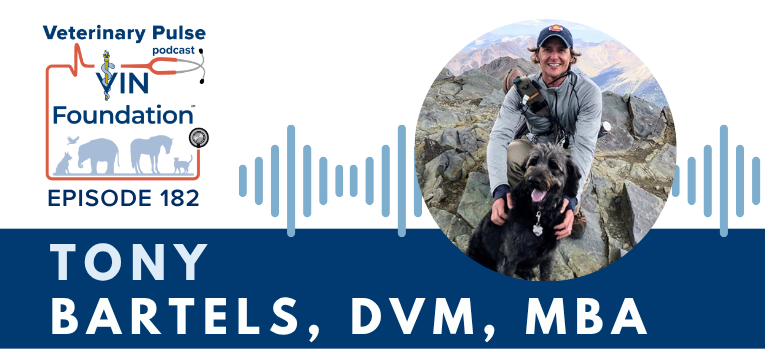
Listen in with student debt expert Dr. Tony Bartels in this next installment of our Student Debt Series covering the latest news and information on student loans.
In this episode we have seven major topics we’re addressing:
- RAP rule change alert
- What does this rule change mean for repayment strategies
- Class of 2026 new grads, STILL do not consolidate
- Determine your IDR profile, know your monthly interest accrual, know your starting repayment balance, & run your Simulations!
- RAP subsidies – what are they? Will you benefit? For how long?
- What’s next? RAP to IBR 2014 vs. IBR 2014 only vs. RAP only vs. other?
- How to get help
As always, we want to hear from YOU. Please share your thoughts by sending an email or joining the conversation.
GUEST BIO:
Dr. Tony Bartels
Tony Bartels, DVM, MBA graduated in 2012 from the Colorado State University combined MBA/DVM program and is a VIN Foundation Board Member and Student Debt Expert, and an employee of the Veterinary Information Network (VIN). He and his wife, a small-animal internal medicine specialist practicing in Denver, have more than $400,000 in veterinary-school debt that they manage using federal income-driven repayment plans. By necessity (and now obsession), his professional activities include researching and speaking on veterinary-student debt, providing guidance to colleagues on loan-repayment strategies and contributing to VIN Foundation resources. Beyond debt, his professional interests include small- and exotic-animal practice. When he’s not staring holes into his colleagues’ student-loan data, Tony enjoys fly fishing, ice hockey, camping and exploring Colorado with his wife, Audra, daughter, Lucy, and their two rescued canines, Addi and Maggie.
LINKS AND INFORMATION:
Urgent message for Class of 2026
2026 New Grad Student Loan Playbook
VIN Foundation WikiDebt: IDR Profiles
Student Loan Repayment Simulator
VIN Foundation GIVE page to support this podcast
VIN Foundation Blog, Related Student Debt Blog posts:
- 2025 Year End Wrap & Preparing for 2026
- 40 veterinary school simulations in 60 days: 40 in 60 Project
- Changes to federal student loans come into focus
- Student Loan Repayment: Trying to leave the SAVE forbearance? Choose PAYE
- Student Loans in SAVE Plan Will Start Accruing Interest August 1st
Personalized student loan Help from VIN and VIN Foundation
Federal Student Aid Data, Consolidation, and Repayment Applications
One-time Forgiveness Count Adjustment
Federal Student Loan Servicers
Public Service Loan Forgiveness (PSLF)
Have a veterinary story you want to share?
Stay up to date with VIN Foundation updates
Email VIN Foundation: [email protected]
Get updates to stay tuned for the VIN Foundation webinars on student debt.
If you like this podcast, we would appreciate it if you follow and share.
TRANSCRIPT
Intro
Tony Bartels, DVM, MBA: Talked about how last year was really challenging, and it was, but last year was largely because we didn’t know what the rules were going to be. Now, this year we know what the rules are, and they’re just not friendly.
Jordan Benshea: Yeah.
Tony Bartels, DVM, MBA: They’re very, very complicated, and we were supposed to get to a point where things got easier, and we’re just not there yet. I mean, all of these transition phases are ugly and change is messy, and unfortunately, this is what it looks like. So there’s a lot of details that we have to kind of manage to best understand what our repayment strategy should be.
Jordan Benshea: That is student debt expert and VIN Foundation Board Member, Dr. Tony Bartels, and this is the VIN Foundation’s Veterinary Pulse Podcast, Special Student Debt Series. I’m Jordan Benshea, Executive Director of the VIN Foundation. Join me as I talk with veterinary colleagues about critical topics and share stories, stories that connect us as humans, as animals, as a veterinary community. This podcast is made possible by individuals like you who donate to the VIN Foundation. Thank you. Please check the episode notes for bios, links, and information mentioned. Hey y’all, if you appreciate this podcast, it would really mean a lot to me if you took a quick moment and hit follow on your preferred podcast platform. Your support helps us share these ideas and stories. Please, please, please take a quick moment and hit the follow button. This small action can provide great benefit. Thank you for your time and effort.
Overview
Jordan Benshea: Welcome, everybody. We are back again with our VIN Foundation board member and student debt expert, Dr. Tony Bartels, to talk about the latest in student loans impacted by the recent information that was updated as of last Thursday, and all the updates that we have to cover. Welcome, Tony.
Tony Bartels, DVM, MBA: Hi, Jordan. Yeah, thanks. Thanks for having me again. It must mean something big has changed
Jordan Benshea: Something big is always changing. It’s definitely been a crazy, I would say, six years since COVID, and it seems like every week, month, it’s just changing even more, which makes it definitely challenging. We know we have said this is the craziest year for student loans, but this one might take the cake, especially with the final borrowing and repayment rules posted, as I mentioned, last Thursday, April 29th, obviously, because we’re super powerful, one week after we had recorded the 2026 New Grad Playbook webinar. So we absolutely have some updates for long-term repayment strategies based on what we had said during that webinar and how those have shifted based on these final borrowing and repayment rules. We have seven major topics that we are going to address in today’s episode. The first is the RAP rule change alert. Number two is, second, what does this rule change mean for repayment strategies? Number three, class of 2026 new grads do not consolidate. In fact, still do not consolidate. And number four, determine your IDR profile, know your monthly interest accrual, know your starting repayment balance, and run your simulations. Number five is RAP subsidies. What are they? Will you benefit, and for how long? Number six is what’s next? RAP to IBR 2014 versus IBR 2014 only versus RAP only versus other? It sounds like maybe a sci-fi movie that we’re just giving you acronyms for. Unfortunately, it’s not. And number seven, how to get help.
RAP Rule Change
Jordan Benshea: Let’s dive right in and start with the first topic, which is the RAP rule change alert. What’s the deal with this, Tony?
Tony Bartels, DVM, MBA: Yeah, what’s affectionately known as the One Big Beautiful Bill that was signed into law last summer, so July 4th of 2025, the law has kind of the framework for what is going to change, and there was a lot of things in that law, but we’re going to just remain focused on the student loan aspects of that. After any law is Implemented there’s always a rule-making process. So they kind of fill in the gaps on, here is what we said in the law, here is what that means in practice, and that’s the rule-making process. They opened up the rule-making process several months ago, and there’s a public comment period that happened earlier in the year where people say, “this is what I like, this is what I don’t like, this is what I wish you would do,” and the Department of Education goes through all of those comments and then says whether they agree or disagree. From all of that feedback they come up with the final rules for how the law will be implemented, and that’s what was released last week, April 30th, and then it was published to the Federal Register on May 1st. And all along that process, there were some draft rules that were out there and things that we were operating under the assumption that this is what looks like is going to happen, and based on the draft rules, it looks like this may change, this may not change, but there wasn’t any indication that there were going to be any major changes, and then Thursday rolls around. So April 30th rolls around, these get published, and lo and behold, there’s a pretty big one in there. And the one that was unexpected is that payments made to the new Repayment Assistance Plan, so RAP, the new income-driven plan that’s going to start on July 1st of 2026 or maybe before, we’re not sure yet, but it should be available by July 1st of 2026, unfortunately, payments made towards RAP will not be eligible for forgiveness under the prior income-driven repayment options if you are eligible for those. That was a big focus of the New Grad Playbook as well as for everybody that has been in repayment using income-driven plans, particularly the SAVE plan that was recently eliminated and people looking for where do I go next, will this RAP option benefit me, and RAP is pretty good. It’s going to benefit a lot of people, but unfortunately the payments that you make under RAP, if you were to leave RAP and try to switch to a different repayment option, those RAP payments wouldn’t count as forgiveness qualifying payments in the other plans. Now, the flip side is not the same. As expected in the draft rules, anybody that has accrued a bunch of forgiveness time using a previous income-driven repayment plan like IBR or Pay As You Earn, if you were to switch to RAP, that forgiveness credit will count towards forgiveness in RAP. The kicker with RAP is that it has a longer time to reach forgiveness. Nobody really wanted to be in repayment longer. RAP, there are certain aspects that we’ll talk about in a little bit that are really helpful and really beneficial, but the time to forgiveness, the 30 years of total qualifying payments you need to reach forgiveness is not something anybody’s really looking forward to. If you need it, that’s fine. That’s great. It’s there. But if possible, it’d be great if you can reach forgiveness sooner. Unfortunately, this unexpected rule change makes it a little more difficult for you to use RAP and still get forgiveness earlier than the 30 years, and that’s where we’re going to have to spend quite a bit of time making sure everybody that attended the new grad playbook or has sought assistance on the message boards that they understand, look, if you switch to RAP, it’s fine, you can benefit from it, but that time is not going to count if you’re planning on switching out of RAP into another income-driven repayment plan. I know it’s a lot and it’s very confusing, but it’s also very, very consequential. So it’s going to be something we’re going to be talking about a lot probably throughout the rest of this year.
Strategy Impacts
Jordan Benshea: And does this rule mean additional changes for repayment strategies as well?
Tony Bartels, DVM, MBA: Yeah, absolutely. So what we were encouraging people to do, particularly new grads because that’s the cleanest scenario, you haven’t started repayment yet so you’re kinda starting from scratch there with your veterinary school loans, we were encouraging everybody to start with RAP because it’s got a bunch of goodies that are really helpful in the front end of repayment, so the early years of repayment, and then switch to a plan like IBR 2014 that allows you to hit forgiveness at 20 years, and that would have helped to lower your total repayment costs. You can still do that and it’s probably still going to make a lot of sense for a lot of new grads to start with RAP, however, the 20-year forgiveness clock, the timeline to reach forgiveness under IBR, 20 years, will not start until you actually enter IBR 2014. So that’s going to be the big change, and again, it won’t make a huge difference, it’s just more confusing, and it will put you in repayment a little bit longer and cost you a little bit more money. So those are the things that we’re going to have to spend a lot of time teasing out and helping people understand.
Do Not Consolidate
Jordan Benshea: And for those that are graduating this year, for our class of 2026 new grads, as we mentioned, we did a 2026 New Grad Student Loan Playbook back on April 22nd and one of the big messages that we shared at that point was do not consolidate. And while these changes have just happened, we are saying still do not consolidate. Let’s dive a bit more into that.
Tony Bartels, DVM, MBA: Yeah, so that still holds. Everybody that’s graduating in 2026, you do not want to use a federal direct consolidation loan to consolidate your federal student loans. If you do, there’s a really good chance that you will not receive that new consolidation loan until after July 1st, particularly if you’re graduating around now. So we’re in the first week of May here, we’re right in the midst of graduation season. Some of you may have already graduated. Some of you are graduating this week, next week, throughout the month of May. Graduating, consolidating your federal student loans used to be kind of the gold standard, and it probably still will be again maybe next year. But this year you cannot consolidate your loans because the timing with the rule changes here. A lot of things are happening on July 1st of 2026. One of those changes are, If you receive a new loan July 1st, 2026 or later you will be limited to using the new Repayment Assistance Plan and a tiered standard plan as your only options for your federal student loans, and that’s going to limit your repayment flexibility. So you can avoid that limitation by foregoing the consolidation loan, so that recommendation still holds. There are some rare cases where it still may make sense for you to consolidate, but they are very rare. I mean, we’ve looked at hundreds of new grad scenarios so far, and I think I’ve found one so far where it’s going to make sense for that person to consolidate. So less than 1% of the time does it make sense for you to consolidate. But if you think you are one of those people, then please reach out. We’re happy to go through your circumstances over on the Student Debt Message Board area to see if you are one of those folks, one of those rare exceptions that could benefit from a consolidation loan. But in most cases, you should forego the consolidation.
Find Your IDR Profile
Jordan Benshea: One of the questions that we get a lot is helping them determine their IDR profile, which is something that we’ve talked about in WikiDebt and we showcase in WikiDebt and we also spoke about in the last podcast episode. So let’s go through that a bit more, like determining your IDR profile, understanding your monthly interest accrual, know your helping them understand their starting repayment balance, and where they can go to run those simulations.
Tony Bartels, DVM, MBA: Yeah, the IDR profile, so IDR, income driven repayment, profile is a VIN Foundation creation. We created this because it’s really confusing to know which repayment options you’re able to use, and that is RAPped up in all of these crazy law, history, rule changes over time, executive actions, any number of things that has happened over the last 20 years or so that has led to kind of the mess that we have in federal student loan repayments. So we try to simplify it down to what we call an IDR profile. So if you go to studentaid.gov and grab a student aid data file, an ugly looking text file that has all of your historical borrowing information, you can upload it into the VIN Foundation My Student Loans tool, and after you do that, we have an IDR eligibility tab and it will tell you what your IDR profile is. It’s kind of a screening test based on what your history is, here’s the collection of income-driven plans that we think you’re eligible for. Now, it’s really good, it’s not 100% perfect, but it gets it right more than 90% of the time. So it will tell you, based on your borrowing history, which IDR profile you fall into. The 2026 graduating class is most likely, the overwhelming majority of them are going to be in what I call IDR profile 1, which means you are eligible for the new version of IBR. You can still use Pay As You Earn while it still is on the books, at least for another couple of years, and then you’ll also have the ability to use this new Repayment Assistance Plan. So that’s the constellation of income-driven options that you would have available to you. That’s the most flexible, IDR profile 1. There’s a few of you that are going to be in IDR profile 2, and unfortunately, folks in IDR profile 2, you’re eligible for Pay As You Earn, but you’re not eligible for the new version of IBR, which means you fall into the old version of IBR, and that’s significant because Pay As You Earn is going away as of July 1st of 2028. That’s another thing that was in the One Big Beautiful Bill, and IBR 2009 is not as beneficial as IBR 2014. You’ll have a higher monthly payment in IBR 2009 and it takes you 25 years to reach forgiveness in IBR 2009. So IDR profile 2 is good, but not as good as IDR profile 1, so we want to make sure we know which one of those we fall into. And then there’s also IDR profile 3. That’s the one I fall into. That’s the one my wife falls into. We’re eligible for the old version of IBR and the new Repayment Assistance Plan once it becomes available. So, more limited options for us. Now, anybody that falls into or anybody that receives a new direct loan, any kind of direct loan including a consolidation loan, after July 1st of 2026 will be limited to RAP as their only income-driven repayment option. We’re going to call that one IDR Profile 6. So there’s a number of ones between 3 and 6, but they’re very, very infrequent, and we don’t see them very often. But once we start seeing people receive loans after July 1st of 2026, we will also have an IDR Profile 6 that will indicate you’re eligible to use this new Repayment Assistance Plan only. So that’s why it’s important to know those. It’ll help you understand which one of these income-driven plans can I use when I enter repayment, but then the other parts that are extremely important, particularly if we’re considering RAP as one of our options, is your monthly interest accrual. For that we kinda need to know your principal, your weighted average interest rate, and from there we can get an average of the monthly interest that you accrue each month. That’s important because for many of you, particularly many of you new or recent grad veterinarians, you’re going to have a payment due, a minimum payment due using an income-driven plan that will be less than the monthly interest accrual. When that happens you’re in what’s called negative amortization, so not a great place to be in on a loan. It means that your monthly payment is not covering the interest and you’re not hitting the principal, you’re not paying the balance down. Where RAP comes into play is that if your payment is less than the monthly interest, the Department of Education, i.e. the government, covers or eliminates the interest that your payment is not covering, so that is an extremely helpful benefit. And while you’re in this negative amortization period, your payment is less than the minimum monthly interest accrual, you’ll also receive a $50 principal reduction against your principal balance, so it’s a great way to actually reduce the principal even though your payments aren’t even covering the interest. It’s only $50 a month, $600 a year, but it’s better than watching your balance grow. So that’s why RAP is so enticing, particularly to use as a new grad, because we know you can get a very low payment using RAP because you really haven’t started earning any income yet so you can benefit from that, what’s called an unpaid interest subsidy and the principal credit. The repayment starting balance for new grads is also a little bit tricky because we’re not encouraging you to consolidate your loans. In fact, we’re discouraging you. We’re recommending that you do not consolidate your loans. Your loans are still going to accrue interest during the grace period and for some of you, you haven’t graduated yet, you still have more interest to accrue, so we have to calculate what that remaining interest accrual is going to be. You can estimate it because we’re already going to look at what our monthly interest accrual is, and we can extend that beyond graduation and through our six-month grace period, or if you want to get a more accurate accounting of it, if you upload your student aid data file into the My Student Loans tool and send it over to the In-School Loan Estimator, you can update your graduation date in there and hit the “Generate Estimation” button, and we’ll calculate the remaining interest for you until you reach graduation as well as the interest that will accrue during your grace period. You can send that over to the Student Loan Repayment Simulator. Now that you have that accurate starting repayment balance, your principal shouldn’t change. Most of you are done borrowing, even those of you that are going to graduate from Arizona, you’re pretty much done borrowing. You may not have received all of your loans yet, but you’re done borrowing. We just need to know what is your interest between now and graduation, and then what is that interest between graduation and the end of that six-month grace period. Once you have all that data, you can run your simulation, start putting your income in there, any family specifics in there. If you filed a tax return for 2025, chances are there’s a pretty low number on there. The exception being for those of you that are already married and maybe filed a joint tax return, you may have an income on there that represents your spouse’s income. But either way, use that most recently filed tax return as documentation for your income when you apply for RAP, and you should get that low monthly payment and start benefiting from that unpaid interest subsidy and principal credit once your grace period ends and you officially enter repayment.
Jordan Benshea: Alright, well that should be enough for the whole episode. Okay.
Tony Bartels, DVM, MBA: It’s a lot, I know, and this is why last year we talked about how last year was really challenging, and it was, but last year was largely because we didn’t know what the rules were going to be. Now, this year we know what the rules are, and they’re just not friendly.
Jordan Benshea: Yeah.
Tony Bartels, DVM, MBA: They’re very, very complicated, and we were supposed to get to a point where things got easier, and we’re just not there yet. I mean, all of these transition phases are ugly and change is messy, and unfortunately, this is what it looks like. So there’s a lot of details that we have to kind of manage to best understand what our repayment strategy should be.
Jordan Benshea: Yeah, and we’re here trying to be in the phone booth with you figuring it out.
RAP Subsidies Explained
Jordan Benshea: Okay, so we’re just a little over halfway on our list, so how about number five? RAP subsidies, what are they? Will you benefit and for how long?
Tony Bartels, DVM, MBA: Yep, and we’ve already kind of touched on this, but the RAP subsidies are the 100% unpaid interest benefit as well as the $50 per month principal credit. And you’re eligible for those when your minimum monthly payment as calculated in RAP, it’s a percentage of your income, if that payment is less than the monthly interest accrual on your student loans, then RAP covers the remainder of your unpaid interest and applies that $50 direct principal reduction per month. So while you’re receiving those RAP subsidies your loan balance will not grow. In fact, it will actually decrease slightly by $50 per month, and the interest that you accrue will slightly decrease because the $50 per month is applied directly to the principal. It’s the principal that generates the interest. You do not get charged additional interest on your unpaid interest, and most of you are going to have a pretty big unpaid interest balance because you accrued a bunch of interest during school, you accrued more interest during your grace period, and you didn’t consolidate your loans. So now you’re starting repayment with the principal that you borrowed plus the unpaid interest that you accrued during school. So that unpaid interest balance will stay as unpaid interest. You will not be charged any additional interest on that unpaid interest. And while you’re receiving the RAP subsidies, you won’t add to that unpaid interest balance and you’ll also slightly decrease the amount of interest that you accrue each month because of that $50 per month principal reduction. So those are the RAP subsidies. Almost every new grad, again, the exception might be if you’re already married and you file the joint tax return, your payment will probably be a little bit higher than the lowest possible minimum payment in RAP, which is $10 per month. But you probably still can get a minimum monthly payment that will be less than your monthly interest accrual, so you should be able to benefit from the RAP subsidy. And then how long will depend upon how long your RAP monthly payment is less than your monthly interest accrual. For some of you, that will only be maybe a year or two. For some of you, it’ll be for the duration of repayment and then everything in between. But you can use the VIN Foundation Student Loan Repayment Simulator to see how long you will benefit from the RAP subsidies. There’s a monthly repayment summary graph, and if you click on the RAP tab, so we have RAP in the simulator for you to review, you will see where your monthly payment crosses the monthly interest that you accrue. Once that happens, then you’re no longer receiving the RAP subsidies and that’s where we start to kind of get into, well, should I leave RAP at that point? Should I stay in there? That’s where things are going to kind of change, and we’re going to have this new evaluation metric that we do for folks based on when you, I’m calling it exhausting the RAP subsidies. So as soon as your RAP payment is greater than your monthly interest accrual, you’re no longer receiving the RAP subsidies, i.e. you’ve exhausted those RAP benefits. That’s when it’s going to make sense to reevaluate things.
What To Do Next
Jordan Benshea: And that, I kind of think leads us into the what’s next number six.
Tony Bartels, DVM, MBA: Exactly, so what’s next? So what do you do after you’ve exhausted those RAP benefits? Well, it depends on how long you’re going to receive them. Some of you, and for a lot of the simulations that we’ve run, particularly for those of you that are graduating, say you have an average veterinary school student loan balance, which is probably somewhere around $250,000-$260,000 for those who have student debt. You’re probably going to benefit from the RAP subsidies for at least the first two to three years, maybe four years of repayment and once you’ve exhausted those RAP benefits, it may make sense for you to switch to IBR 2014 if you’re in that IDR profile 1. Now, if you do that you’ll have a payment in IBR 2014. It’ll probably be a little bit less than your RAP payment. You’ll start to pay down the unpaid interest balance most likely, but you’ll probably hit forgiveness twenty years after that. And if you’re projected to hit forgiveness, that’s going to make the most sense for you to do that, to switch from RAP to IBR 2014. Now some of you, you may look at the simulator and you’re going to see a pretty significant incentive, so a lower projected repayment cost if you just started using IBR 2014 and remained in it for twenty years, and that’s a perfectly fine strategy to do as well. And one of the reasons why you don’t want to consolidate your loans is so you maintain access to this IBR 2014 repayment option. However, the kicker with IBR 2014 is it doesn’t have any of those subsidies that RAP has. So you can still end up having a payment that’s lower than your monthly interest accrual and if you do you’re going to see your balance grow, and that drives a lot of people crazy. If you’re not able to tolerate that, then you may want to use RAP instead and then plan to switch to IBR once you’ve exhausted those RAP benefits. And for others, you’re going to run the simulations, and you can see that you’re going to hit forgiveness at 30 years using RAP. You may just want to use RAP. So I know it sucks to think about being in student loan repayment for 30 years, but some of you have balances that will just require that, or it will make things a lot easier. These are folks that are particularly at the higher end of the student loan borrowing spectrum. So when you have a balance that’s probably $350,000 or more, RAP for the full 30 years might be your best repayment strategy. Now, that’s a long time. There’ll be a lot of time to kinda check in and reassess that, but you’ll start to see that in the simulator too, that it may make the most sense for you to just stick with RAP for the long haul. And then for others, your situation’s going to change. It really depends, particularly those of you that do internships, residencies, become specialists and see a significant boost in your income. You may use RAP for your training and then accelerate your payoff, or maybe you’ll use RAP for the training and then switch to IBR 2014 to hit forgiveness at 20 years after your training. I mean, there’s a whole number of other permutations there. You can even use RAP to pay your loans back as fast as possible, so there’s a lot of different opportunities there for you to utilize all of these combinations that we’re talking about strategically. It really just depends on your starting repayment balance, your income, and then how your career unfolds and income changes along with that.
Where To Get Help
Jordan Benshea: And then because all of this I’m sure is clear as day to everybody, when they are looking to get help, how can they get help? What sort of help or resources?
Tony Bartels, DVM, MBA: Yeah, if you haven’t seen it yet, so we have a way to provide assistance on the Student Debt Message Boards through VIN and VIN Foundation. Just requires a VIN username and password, so most of you already have that from your time as students having free access to VIN, or many of you are already paying VIN members, so thank you, and you can get direct access to those message boards. If neither one of those matches your membership status, then we can get you access to the Student Debt Message Boards via VIN Foundation. We still need you to create a username and password so we know that we’re helping veterinarians only. So that access is free, and you’ll always have access to your dedicated student debt threads on VIN. So we do these via the message boards. You can post anonymously there. I’ll know who you are. My colleague, Dr. Rebecca Mears, will know who you are, but the rest of the community does not. We found that that kind of removes some of the barrier for some folks that would like help if we allow you to post anonymously. Then you get the answers you need, the community gets to learn from that exchange as well, and then we get to use this information to develop these best practices, gold standards, good, bad, and ugly when it comes to navigating all of this craziness that is student loan repayment. So, if you’re on the VIN Foundation Student Debt Center and you’re logged in, you’ll see a link to the Student Debt Message Board area in the menu bar. If you already have a discussion with us, that will take you directly to your most recent discussion. And if you haven’t started one yet we have a student debt help page where we have you fill out a Student Debt and Income Signalment form, and that will start the process to help you get a message board thread started anonymously over on the boards. And we’ll include a link to that page in the podcast notes.
Jordan Benshea: Absolutely. Everything that we’ve spoken about today, as is the case with all of our episodes, will always be in the episode notes, all of the links and information.
Final Cautions
Jordan Benshea: And just to round it all out, is there anything else you think our listeners need to know?
Tony Bartels, DVM, MBA: Yeah, I mean, it’s just kind of a rapidly changing landscape right now, and again, change is really, really messy. It’s hard to know where you fall on this entire spectrum until we start looking. I mean, everybody wants to ask kind of generic questions, but it really requires us to know a little bit more about your specifics to best guide you through this changing landscape. So, you got to be really careful about the information that’s out there. Again, it’s rapidly changing. So I mean, this is one of the reasons why the consolidation thing is such a big deal. We’ve been saying for years and years and years to graduate, consolidate, and choose an income-driven plan, and here we’re forced into a scenario where we kind of have to undo all that, at least for this year. And that’s been really difficult, and that stuff that’s out there has some pretty significant staying power. So you just have to be really careful about the information that you find, and if you have any question as to whether or not it’s the most up-to-date or accurate, then please reach out, and we’re happy to help guide you through that.
Jordan Benshea: Absolutely. Okay. Thank you, Tony, for all of your time and tireless effort to help colleagues. I know it’s a very confusing time for many, and many are very, very appreciative for this and so thank you for your time and effort, and we will look forward to getting this podcast out. And then as always, there will be links on how to follow up and get help and all the additional information we have covered.
Tony Bartels, DVM, MBA: Well, thank you, Jordan, and fingers crossed that we can keep things the same for at least a little while here.
Jordan Benshea: At least until we get this podcast out.
Tony Bartels, DVM, MBA: Yeah.
Jordan Benshea: If nothing else.
Outro
Jordan Benshea: Alright, thanks everybody. Take care.
Tony Bartels, DVM, MBA: Thank you.
Jordan Benshea: Thank you for joining us for this episode of the Veterinary Pulse. Please check the episode notes for additional information referenced in the podcast. If you enjoyed this podcast, please follow, subscribe, and share a review. We welcome feedback and hope you will tune in again. You can find out more about the VIN Foundation through our website, VINFoundation.org, and our social media channels. Thank you for being here. Be well.