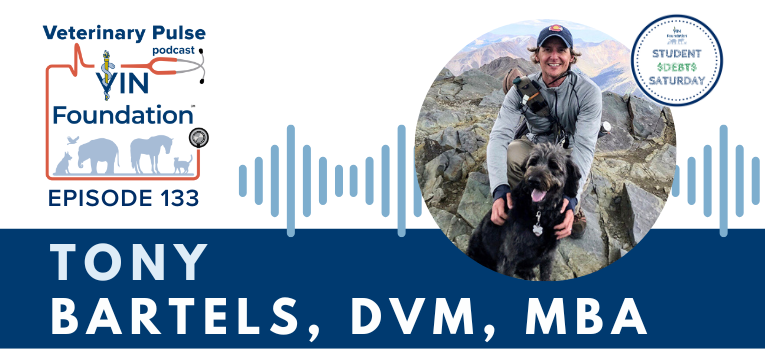
Listen in as Executive Director Jordan benShea chats with Board Member and student debt expert Dr. Tony Bartels in this next installment of our Student Debt Series. In this episode, we’re discussing the latest news about the latest Student Loan Repayment Extension, who it impacts, advice for what to do with this forbearance time, and how to prepare for restarting your loan payments when the extension ends.
GUEST BIO:
Dr. Tony Bartels
Tony Bartels, DVM, MBA graduated in 2012 from the Colorado State University combined MBA/DVM program and is a VIN Foundation Board Member and Student Debt Expert, and an employee of the Veterinary Information Network (VIN). He and his wife, a small-animal internal medicine specialist practicing in Denver, have more than $400,000 in veterinary-school debt that they manage using federal income-driven repayment plans. By necessity (and now obsession), his professional activities include researching and speaking on veterinary-student debt, providing guidance to colleagues on loan-repayment strategies and contributing to VIN Foundation resources. Beyond debt, his professional interests include small- and exotic-animal practice. When he’s not staring holes into his colleagues’ student-loan data, Tony enjoys fly fishing, ice hockey, camping and exploring Colorado with his wife, Audra, and their two rescued canines, Addi and Maggie.
LINKS AND INFORMATION:
- VIN Foundation Student Debt Center
- Check your current student loan servicers and other loan details — VIN Foundation My Student Loans tool
- VIN Foundation WikiDebt
- VIN Foundation Webinars
- VIN Foundation Blog post
FedLoan Servicing- StudentAid.gov
- Federal Student Loan Servicers
- StudentAid PSLF
- New Graduate Student Loan Playbook
- Stay up to date with VIN Foundation updates
- Personalized assistance is available via the special Student Debt Message Board areas.
If you do not have an active VIN username and password, you may gain access through the VIN Foundation access application - Email VIN Foundation
- Get updates to stay tuned for the VIN Foundation webinars on student debt.
You may learn more about the VIN Foundation, on the website, or join the conversation on Facebook, Instagram, or Twitter.
If you like this podcast, we would appreciate it if you follow and share. As always, we welcome feedback. If you have an idea for a podcast episode, we’d love to hear it!
TRANSCRIPT
Intro
Tony Bartels, DVM, MBA: For the 2020 and 2021 graduating classes specifically, repayment is a new experience, right? You haven’t experienced what student loan repayment actually looks like, so this is going to be a little tricky. If you didn’t do anything with your student loans since graduation, then you’re probably going to get a scary statement in January that says you have a standard 10-year monthly payment due, because that still is the default repayment plan for anyone who doesn’t choose another type of repayment plan after your grace period ends.
Jordan Benshea: That is student debt expert and VIN Foundation Board member, Dr. Tony Bartels, and this is the VIN Foundation’s Veterinary Pulse podcast, Special Student Debt series. I’m Jordan Benshea, Executive Director of the VIN Foundation. Join me and our cohost and VIN Foundation Board member, Dr. Matt Holland, as we talk with veterinary colleagues about critical topics and share stories. Stories that connect us as humans, as animals, as a veterinary community. This podcast is made possible by individuals like you who donate to the VIN Foundation. Thank you. Please check the Episode Notes for BIOS, links, and information mentioned. Hey, Tony, welcome back.
Tony Bartels, DVM, MBA: Hi, Jordan. Thanks for having me. This has become a frequent occurrence with all…
Jordan Benshea: It’s becoming a series.
Tony Bartels, DVM, MBA: Yeah, exactly. Not by intention necessarily.
Jordan Benshea: Definitely not!
Tony Bartels, DVM, MBA: It all has to do with the changes that have been going on with federal student loans and repayment recently.
Jordan Benshea: Exactly. There are a lot of changes. Way more in the news, and we usually say, who thought that a pandemic would impact these things so vastly?
Understanding the Pandemic Forbearance Extension
Jordan Benshea: We’re here to talk about the student loan repayment extension and let’s just dive right in like we always do. What’s the latest?
Tony Bartels, DVM, MBA: The latest is that the pandemic forbearance, basically the pause of payments and interest on federal student loans or federally held student loans, has been extended through January 31, of 2022. The Department of Education on their website calls this the “final extension.” Well, anytime you mark anything is final is usually an indication that that’s not going to be the case. I think they’re going to try to make this a final one, but, of course, as we’ve all seen they can’t really control the pandemic, so that depends on what’s going on around that timeframe as to whether or not this will truly be the final extension. Right now, it’s labeled as such. That’s the first time they’ve tried that.
Jordan Benshea: Okay, and who does this news impact the most? Is it everybody with student loans? I mean, you’ve said specifically federal student loans, so for those with federal student loans is there a specific group that impacts more than others? Who do you see as the low hanging fruit of impact here?
Navigating Federal vs. Federally Held Loans
Tony Bartels, DVM, MBA: Well, the impact is, and it has been to what are considered to be federally held student loans. You can have federal student loans that are not held by the Department of Education. Hopefully, since this has been in place for well over a year now, most people have figured out if they have the type of loans that are subject to the pandemic forbearance benefits versus those that don’t. Most of the non-federally held loans that live in the federal student loan database, are those for people who went to school prior to 2010. If you had some of the federal family education loans, sometimes those are federally held, sometimes not. If you have some of the ones that are not federally held, then they wouldn’t be eligible for the 0% interest rates and the payment suspension. You could if you wanted to consolidate those into a direct consolidation loan, but again, at this point, since we’re arriving, or potentially approaching the end of this pandemic forbearance, I would definitely want to check in with somebody before you go ahead and do that.
Jordan Benshea: You said there’s a difference between having federal loans and having federally held student loans. What is the easiest way if somebody still at this point doesn’t know, what’s the quickest and easiest way for them to check that?
Tony Bartels, DVM, MBA: Yes, well, you should be familiar now, I have a very small balance from my undergraduate education of non-federally held student loans, and those are still in repayment. I’m still accruing interest on them. I’m still having an automatic payment set for those, and those have been continuing in repayment like the pandemic forbearance never happened. So, if you have non-federally held loans, then chances are those are still in repayment. Anybody that has federally held loans that pandemic forbearance has automatically been applied. So, you didn’t have to do anything, they would have automatically turned off your payments and automatically set your interest rates to zero. One of the other ways that you can tell is if you obtain your federal student aid data file that will still contain both federally held and non-federally held loans. If you upload it to the VIN Foundation My Student Loans tool in the loan servicers tab, you can see who holds your federal student loans. So, anything that’s held by the Department of Education, a federally held loan, will have Department of Ed at the beginning of that loan servicer name.
Jordan Benshea: Got it. So, anyone that’s got private loans or federal loans that are not held, they’re still paying as regular, they haven’t had this sweet period of no payment.
Tony Bartels, DVM, MBA: Right. Now, there is some variability there. Some of the private lenders have put a deferment or made a deferment eligible for you if you wanted to take it. Those are highly specific to the loan type that you have. The federally held loans have the pandemic forbearance consistently applied across them.
Preparing for Repayment Resumption
Jordan Benshea: Okay, so what should colleagues do now for all the repayment plans for the federally held loans to make sure they’re ready for January? I know that we ask this question whenever we have part of the Student Debt series podcast, but I feel as though there’s got to be some people that are just like, “Oh, well, I don’t have to pay anything, so I’m just going to not think about it.” If this is, dare we say the final extension, how should our colleagues be prepping for it?
Tony Bartels, DVM, MBA: Yeah, so I would still enjoy the remaining non payments and the fact that interest is not accruing, but you want to start thinking about what repayment looked like before the pandemic forbearance period for you. If you had a monthly payment due prior to the pandemic forbearance period starting, then that’s going to be the monthly payment that starts, presumably, in February of 2022, when the pandemic forbearance period ends. Start digging up that information, what was my monthly payment before the pandemic forbearance period started. If you lost track of that, you could obtain your federal student aid data file and upload it to the VIN Foundation My Student Loans tool. It’ll show you what your monthly payment and the repayment plan that you were using prior to the pandemic forbearance period starting. Update your budget. Make sure that you’re prepared to have that payment hit your budget as it currently exists if that happens in February. Getting familiar with all of the information that you had prior to the pandemic forbearance period taking effect.
Jordan Benshea: That’s really helpful for colleagues who have paid student loans before, but now we are seeing not only one, but two graduating classes from veterinary school come out and both of those classes [class of 2020 and class of 2021] have never paid student loans. For those colleagues who have never paid those student loans due to forbearance period, how do you recommend they use this time?
Tony Bartels, DVM, MBA: Yeah, that’s an excellent question. I think that we have to point that out for the 2020 and 2021 graduating classes specifically, repayment is a new experience, right? You haven’t experienced what student loan repayment actually looks like, so this is going to be a little tricky. If you didn’t do anything with your student loans since graduation, then you’re probably going to get a scary statement in January that says you have a standard 10-year monthly payment due, because that still is the default repayment plan for anyone who doesn’t choose another type of repayment plan after your grace period ends. If you graduated into the pandemic forbearance period in 2020 or 2021, you still had a grace period, and that grace period will end in a couple of months here. Your loans will automatically go into that standard 10-year repayment plan. You won’t have a payment due until the pandemic forbearance period officially ends, so you have to pay a little bit of extra special attention to prevent having what could be a significant monthly payment due once the pandemic forbearance period ends. That’s where we try to get new graduates specifically through the New Grad Playbook webinar that we do to graduate, consolidate, and apply for an income driven repayment plan. You can still do that during the pandemic forbearance period, and you will still benefit from the no interest and no payment due. You just can control which repayment plan you’re in, as well as the loan servicer that you’re using after repayment starts.
Jordan Benshea: Everything that Tony’s mentioning, as you guys know, we will put the links and information in the Episode Notes, and we will also do a webinar. As we get close to this end of January time, we will do a webinar on what to do, what to look out for, especially for those that have never paid, so that when you get that scary notice, like we’re at least here to help you a little bit.
Impact of Loan Servicer Changes
Jordan Benshea: This is, of course, not the only news for student loan borrowers. We’ve heard of a few loan servicers now, not just fedloan, who are not going to be servicing loans after this year. How does that play into this continued extension? It sounds like we have some loan servicers who are going to stop servicing loans before the end of this year in December, but yet the forbearance continues into January. That seems a little tricky. How does how do we begin to navigate that?
Tony Bartels, DVM, MBA: Yeah, that is also complicating things and I believe that’s probably one of the major reasons why the pandemic forbearance was extended for another several months. Anyway, it was because we have two loan servicers that have announced so far that they’re no longer going to service federal student loans by the end of the year, and the big one being fedloan servicing. The other one is Granite State. So, if you have either fedloan servicing or Granite State, then you want to pay extra special attention to what’s going on as repayment restarts because if you have either one of those two loan servicers, your loans are going to get moved before the end of this year. Unfortunately, mistakes get made when loans get moved from one loan servicer to another. The particularly complicating factor this time around is fedloan servicing is one of the biggest loan servicers. They service the most balance of federal student loans out there as well as the highest number of borrowers out there. They’re one of the major loan servicers, and they were also the loan servicer who was tasked with officially monitoring Public Service Loan Forgiveness progress. This is a pretty big bomb being dropped for borrowers, particularly those who have fedloan servicing and the chances are quite high that you might, as well as anyone who’s working towards public service loan forgiveness.
Jordan Benshea: Is it possible that new graduates from class of 2020 and 2021 who have fedloan, have never had to make a payment, and now they are going to need to find a new loan servicer all before they even have to make a payment?
Tony Bartels, DVM, MBA: Well, there’s a good chance that many recent graduates have fedloan servicing, just by odds that they’re one of the biggest loan servicers, but also because we’ve been recommending that people choose them as part of their consolidation process. That was mostly because of their role with monitoring public service loan forgiveness. Unfortunately, none of the loan servicers are very good at administering the income driven repayment plans and that’s part of the reason why a couple of them are quitting because it takes a lot of time, effort, and money to administer these very complicated repayment programs. Now, there’s no way we could see that happening. Of course, whenever the Department of Education comes out and says whoever the next official monitor of Public Service Loan Forgiveness is going to be, that’s probably who we’re going to recommend going forward after you consolidate your loans. Except for the consolidation process, you don’t have the ability to choose your loan servicer. So, anyone who has fedloan servicing now who’s in repayment, or has Granite Sate Management, your loans are going to get moved automatically and probably randomly reassigned to a different loan servicer. If you have public service loan forgiveness qualifying time, they may make sure that you get moved to whoever they’re going to deem as the Public Service Loan Forgiveness monitor going forward, but we don’t know that yet. The only thing that you can do right now is information gathering. Go into your fedloan servicing account, go into your Granite State student loan account, download as many of the statements as you possibly have access to. If you don’t have access to all of them, you want to request an entire log of your repayment history with that loan servicer. I would make sure that all of your contact information is up to date, [your address and your phone number] with your loan servicers as well as in the studentloans.gov portal. That’s going to be where they go to grab your contact information when they’re going to start rolling out, “Hey, we’re moving your loans from fedloan servicing to somebody else”, or “Hey, repayment’s being restarted.” You want to make sure that that information is up to date anyway, so you’re receiving all of the communication that’s going to be happening as those loans get moved and as we all reenter repayment.
Jordan Benshea: Yeah, of course, we never would have recommended fedloan servicing if we had any idea. I say you’re welcome sarcastically, but we feel horrible, just that anyone be in this situation. We are here to help you and I assure you that you’re not alone.
Resources and Support for Borrowers
Jordan Benshea: Where can colleagues go for updates?
Tony Bartels, DVM, MBA: The best place to go for an update right now is the studentaid.gov website. Right at the top of the page they have a link to all of the announcements pertaining to the pandemic forbearance. That page is actually quite good in terms of providing very detailed answers to many of the common questions that come up, no matter where you are in the borrowing or repayment process. That’s the first place I would start but that’s also where you go to log in to studentaid.gov to find your student aid data file. That’s where you want to check and make sure that your contact information is up to date, [your email and address], so they can contact you with all of the information pertaining to the end of the pandemic forbearance and loans being moved if your loans are serviced by fedloan servicing or Granite State. I would also check out VINfoundation.org, and the blog post that we put up periodically, as well as these podcasts. The VIN Foundation Student Debt Center really is designed to help you make sense of all this. If you grab that student aid data file, you can upload it to the My Student Loans tool. You can see the loan summary you have, which repayment plan you were using prior to the pandemic forbearance, which income driven repayment plans you’re eligible to use, who your loan servicers are, whether or not you have federally held loans versus not. All that information is presented in an easy-to-understand way. Then of course, you can start to simulate your repayment, sending that information over to the Student Loan Repayment Simulator, to see which repayment strategy is going to be best for you once the pandemic forbearance period ends. If you need help with any of that, there’s also a link to the Student Debt message board area where we’ve been providing personalized assistance to our veterinary colleagues.
Jordan Benshea: Yes, and you don’t need to have a VIN membership for that. That is on VIN, but it’s in a separate area where it doesn’t have access to the full community. If you’re not a VIN member, you can get access through VIN Foundation access, we just have a couple questions to get you a login. All those links are in the Episode Notes. Like with everything the VIN Foundation does, it’s all free for veterinary colleagues at every stage. We are here to help you. Make sure you check out those links.
Outro
Jordan Benshea: Is there anything else you think our listeners need to know about this news, Tony?
Tony Bartels, DVM, MBA: Yeah, I know, it sounds like a lot. There’s a lot going on but take a deep breath. It is a great time to reassess your budget as you’re going to roll into, eventually we’re all going to have to start paying back our student loans at some point here, making sure that that’s going to fit into your budget, but also taking stock of whether or not you’re using the appropriate loan repayment strategy for your circumstances. We’re here to help. Ask questions, take a deep breath. We have answers to most of the questions that everybody’s been asking during this confusing time when it comes to student loans and there’s definitely resources and colleagues out there that can help you work through all of this.
Jordan Benshea: Absolutely. We’re here to help. You’re not alone. All those links are there. Feel free to reach out. We have a lot of resources to help you and if we don’t know the answer, we’ll do our best to find it for you. Thanks so much for joining us again, Tony for the Student Debt series, the debt doctor series. We’re going to need to start naming these something.
Tony Bartels, DVM, MBA: Thanks again for having me and we look forward to helping in any way we can.
Jordan Benshea: Thanks, everyone. Thank you for joining us for this episode of the Veterinary Pulse. Please check the Episode Notes for additional information referenced in the podcast. If you enjoyed this podcast, please follow, subscribe, and share a review. We welcome feedback and hope you will tune in again. You can find out more about the VIN Foundation through our web site, VINfoundation.org and our social media channels. Thank you for being here. Be well.