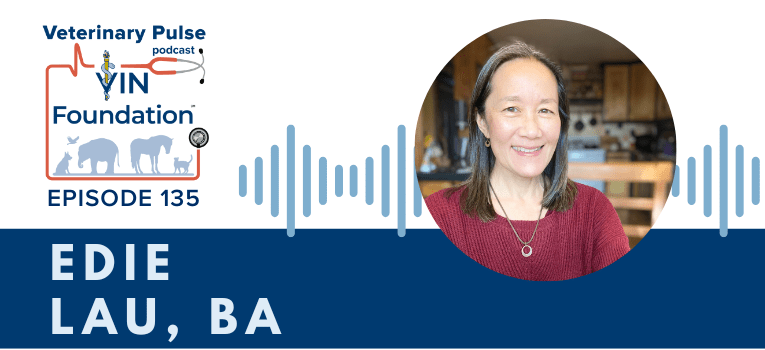
Listen in as Executive Director Jordan Benshea chats with VIN News Director Edie Lau about life as a veterinary journalist and her hope for the profession.
GUEST BIO:
Edie Lau
Edie is the VIN News Service director and has been reporting and editing for VIN News since 2008. Before that, she covered science, energy, the environment, education and whatever else needed doing at newspapers in Sacramento, California; Portland, Maine; Binghamton, New York; and Stockton, California. Edie has a bachelor’s degree in English from the University of California, Berkeley. She lives near Seattle with her husband, daughter and two canine associates.
LINKS AND INFORMATION:
You may learn more about the VIN Foundation, on the website, or join the conversation on Facebook, Instagram, or Twitter.
If you like this podcast, we would appreciate it if you follow and share. As always, we welcome feedback. If you have an idea for a podcast episode, we’d love to hear it!
TRANSCRIPT
Intro
Edie Lau, BA: I think people who aren’t familiar with VIN News off the bat assume that we write a lot about dogs, and puppies and kittens, pet things. Like, that we’re pet reporters and we’re not. We actually don’t write about animals predominantly; we write about things that affect veterinarians.
Jordan Benshea: That is Edie Lau, the director of the VIN News Service, and this is the VIN Foundation’s Veterinary Pulse podcast. I’m Jordan Benshea, Executive Director of the VIN Foundation. Join me and our cohost, and VIN Foundation board member, Dr. Matt Holland, as we talk with veterinary colleagues about critical topics, and share stories. Stories that connect us as humans, as animals, as a veterinary community. This podcast is made possible by individuals like you who donate to the VIN Foundation. Thank you. Please check the Episode Notes for Bios, links, and information mentioned. Welcome, Edie. Thank you for joining us.
Edie Lau, BA: Hey, Jordan, thank you for having me. I really appreciate your interest.
Jordan Benshea: Of course, of course! I’ve been wanting to get you on here for a while, so we’re really excited. Edie is the director of the VIN News Service, which is part of the VIN family and as most of our listeners know, VIN is the Veterinary Information Network. VIN is a separate entity from the VIN Foundation. VIN is an online community of veterinary colleagues. So welcome, Edie. Thank you for joining us. We’re just going to dive right in.
Meet Edie Lau, BA: Journey into Veterinary Journalism
Jordan Benshea: How did you get into journalism, and specifically veterinary journalism?
Edie Lau, BA: I grew up a bookworm, and I wanted to write novels. So, by high school, I was aware that most people can’t make a living writing books right away. That led me to newspaper reporting, because I realized I could get paid to write. I could ask nosy questions and learn about lots of different things, and theoretically, I could live anywhere because every town had a newspaper. Right?
Jordan Benshea: Right, right.
Edie Lau, BA: Those were the days! I studied journalism and English in college. I did some internships. I got my first newspaper jobs in California covering the usual gamut of subjects: local government, police, fire, and community events. Then I moved to upstate New York for a job covering the environment. This was in the late 80s and early 90s. It was the first time I learned about global warming. I went on from there to a job in Portland, Maine, where I covered the marine beat, things like commercial fishing and island culture. Then I returned to California. I was at the Sacramento Bee, and I covered energy, science, and a little bit of medicine. All that added up to 20 something years.
Jordan Benshea: Wow.
Edie Lau, BA: Yeah. Back in the day, I think too probably still today, people moved around a lot in journalism. That was kind of an expected thing, so that’s what we did, and that suited us. I say us because my husband’s also a journalist. In 2007, we’d been at the Bee for 10 years at that point. He was at the Bee, as well, and he and I decided to make a big change. Again, that was 2007 and Craigslist and the Internet were really rocking the paper news model. We thought we should jump out while the jumping’s good. So, we sold our house in Sacramento, and we moved to a small city in Washington State. My husband had a job at a local paper, and I freelanced from home so I could be more available to our daughter, who at that time was in the first grade.
Jordan Benshea: That’s great.
Edie Lau, BA: Yeah.
The Birth of VIN News Service
Edie Lau, BA: In 2008, that next year, Dr. Paul Pion, cofounder and President of VIN, which as we say in news stories is an online community for the profession, set up the VIN News Service. He started it with one reporter/editor, Jennifer Fiala. Jennifer had previously worked for DVM magazine. After a few months with Jennifer doing the job solo, Paul thought it would be a good idea to have another reporter on board because Jennifer was due to have a baby later that year and would be out for a bit. A mutual friend introduced Paul and me and long story long, that’s how I got into veterinary journalism.
Jordan Benshea: So, the VIN News Service started in 2008. Do you know what it was about that timeframe that had Paul start it up, or motivated him to do so?
Edie Lau, BA: Yes, 2007 was the big melamine in pet food crisis. Those who had pets at the time might remember that something was happening. Dogs, mostly dogs were getting really sick, and they didn’t know what it was. Because VIN has all these message boards where veterinarians, practitioners, and clinicians can talk to each other, my understanding is that they were trying to figure it out. VIN became a central hub for trying to uncover what it was, what was the common thread? My understanding of that, that inspired him like, hey, we need our own news service. If we had our own news reporters, our own professional journalists here, we could take what VINners talk about and fact check it, vet it through the usual ways, and then share it with the world.
Jordan Benshea: That’s interesting. That’s a lot how things at VIN and the VIN Foundation work. Both have similar guiding principles, and both of them are really built on when the community or veterinary colleagues share that there is a need or express that there is a need, things get created or improved upon. That’s one of my favorite things about both organizations.
Edie Lau, BA: Yeah, it’s pretty cool that the only impediment is the idea, of coming up with the idea and figuring out how to execute it.
Jordan Benshea: Yes, and that can be challenging as well, of course. Backtracking for just a minute, you went to all these different papers and covered all these different beats. What was one of your favorite assignments, or papers that you worked for? Those were probably the great days of papers. Definitely, we’ve seen a decrease in subscribers and, for sure, printed papers. You’re seeing a lot more digital subscriptions, but I just have to imagine, I’m a little bit, I’m a not a little bit, I’m a total journalism buff, so I’m just curious what was your favorite paper to work for or your favorite beat to work on back then?
Edie Lau, BA: Portland, Maine was my favorite place to work. The Portland Press Herald and Maine Sunday Telegram was a wonderful family-owned newspaper. Portland is the largest city in Maine. I don’t know what the population is today, but at the time, it was about 250,000 which tells you it’s a small city. But as the largest city in the state, it had a lot of big city amenities without big city problems, like a lot of population. So, I had a marvelous time covering the marine beat there. I also had the great good fortune to do an assignment that was in collaboration with, I believe, four other newspapers up and down the eastern seaboard and hiking the Appalachian Trail.
Jordan Benshea: Oh, that’s so cool!
Edie Lau, BA: Really cool. I got the last, the final 200 miles, I say final, but the northernmost 200 miles.
Jordan Benshea: Oh, my gosh, that’s another total passion fascination of mine is the PCT and the CDT and the AT. So, you got to hike the last 200 miles of the AT.
Edie Lau, BA: Yes, and of course, I had to prep for that. So, the summer before I set out, I had probably 70 miles of training hikes that were part of my job.
Jordan Benshea: Oh, my gosh, that is so cool. Well, you and I are going to definitely have to offline some of that conversation because I have a lot of questions.
Edie Lau, BA: It was really fun. I didn’t get sick for a year after that, because my immune system was so revved from that constant being in motion and living outside and that sort of thing. Then on that marine side, I had a really cool assignment. Just before I left there, I got to go to Norway and document the return of the cod fishery. In New England, the cod fishery, the ground fish, which is primarily cod, had collapsed. I think it’s still struggling, but in Norway, which had had the same issue some years before, they really cracked down on how much fishing could be done. As a result, the cod came back. So, I got to go there and see how that worked. See what it looked like. It was in December, so it was really dark.
Jordan Benshea: Wow. Dark and cold.
Edie Lau, BA: Dark and cold, but really exciting. So those were two really fun assignments I got to do back in the day when newspapers had resources.
Jordan Benshea: Some of them still do. This brings us into our next question.
Remote Work and the VIN News Team
Jordan Benshea: You went from multiple newsrooms, hiking the AT, or going to Norway, what was that adjustment like? Was it a big adjustment switching from working in a newsroom to working as a telecommuter and working from home?
Edie Lau, BA: Yes, it is a big difference. Let me tell you a little bit about how VIN News is set up. We are entirely remote, as you know. That’s not unusual for VIN, I believe I could be wrong about this, I think it’s at least half though of the people who work for VIN are remote, and this is long before remote was a thing. Right?
Jordan Benshea: Right, this is pre-pandemic.
Edie Lau, BA: Long before, long before. I mentioned Jennifer Fiala, she works in Ohio. I am near Seattle. The other two full timers on the team are Lisa Wolgan, who is also in Seattle, and Ross Kelly, who’s in Sydney, Australia. We communicate by Slack, text, email, message boards, phone, and zoom. There are lots of other staffers at VIN who support the news operation on a part time basis. It’s very unlike your traditional newsroom, which was kind of a sweatshop look, one giant room, no partitions or like small partitions, the classic look. I remember when I was in Sacramento, somebody coming in and visiting the newsroom, who was just horrified. He was like, oh, my God, how do you guys work in these conditions? It seemed really noisy to him, and it was. We learned to tune out our neighbors, but also, they’d be right there. So, if you’re working on a story, and you had a question, a word question, or how should I say this, you could just look over to the next desk and confer with your colleagues and do that. There’s a lot of interaction that way. We do that some, will hit each other up on Slack and go like, hey, I got a word question for you, but it’s just a little bit different.
Jordan Benshea: It looks a little different.
Edie Lau, BA: You also don’t know if somebody is right in the middle of something. You can’t see them. You’re hoping that they’ll be honest with you and say, “give me a second, I’m in the middle of something.” So, there’s that. So, the difference was coming as a telecommuter. I think a lot of people can probably relate now who have been doing this since the pandemic. It takes a particular sort of discipline to work from home. You got to stay out of that a kitchen, out of the pantry. You might find that folding laundry is a great break from the screen, so you can get something else done while you’re taking a quick 10 minutes away. Back again in the day, I am hoping that this is no longer the case, that there were a lot of people who did not understand that working from home meant that you were working. They would like stop by, want to chat, want to call. Did not get that you were actually trying to work. I do think that has waned. I want to mention the one other thing about VIN. This isn’t so much, well, no, it’s not so much. It doesn’t affect the day to day workings of it, but one thing that is really distinct about VIN News from conventional news operations and news outlets is that we don’t take any advertising, no ads. You’re going on to news.vin.com, which is publicly accessible to anybody who has an internet connection, and you’re not going to get any pop ups. You’re not going to get tracked and get ads coming in. That is, for me as a journalist, a really gratifying thing not to have no deal. I never overtly had any pressure like, you should do this or that. There is a big separation in news operations from the advertising base, but nevertheless, if I go on to just news sites for whoever, the ads make me crazy.
Jordan Benshea: Right. Yes, that’s something I think most of us that work within VIN or VIN Foundation, we almost take for granted now, because we’re so used to not seeing them. When we go to other sites, it’s almost it’s so off-putting because we’re just so not used to it. VIN is great like that. No sponsorship, no advertising, at least for me it feels that there’s a level of trust there and especially a level of trust with the data, which VIN values so highly. I think that people are so used to their data being sold and utilized these days that there are definitely some that just feel like it’s second nature, but I think that that’s a good thing to know about the VIN News Service. I recently signed up for updates and it’s been fantastic because every time you guys write a new story, I get an email. It’s great. We’ll put that link in the Episode Notes, too, so other people can do it and they won’t get spammed with other stuff. I’m literally just getting the news articles that you guys are writing, which are always great. I find it hard to consistently go and check the site, so it’s helpful for me to be able to have those come into my email. I can get a quick read on what’s going on in the profession. I appreciate that, I mean that.
Edie Lau, BA: We don’t publish on a set schedule. I mentioned the size of our team, four full-time. That’s not a lot of people, so we publish, on average, twice a week, but we don’t have the day that’s going to come out. It’s not every Tuesday at three o’clock. We go with what naturally flows, and sometimes we clump, I call it clumping. We try not to, but we might get two in a row, or there might be a stretch of several days before we can get one out. For that reason, we started this subscription for free, where you sign up to get email alerts, and that’s all you get if you sign up for that. You will get an alert when the next story is out, a little synopsis of it, and a link to it. You can open it or if the topic doesn’t interest you, just keep going. We pledge we don’t use email addresses for anything else.
Jordan Benshea: What, if anything, do you feel changed for you during the pandemic workwise? Did that shift anything for the VIN News Service team?
Edie Lau, BA: Not really, except that we were extremely busy doing articles about the Coronavirus and the effects on veterinary practice of the pandemic and lockdown. So, there was a lot. That was one of those where we were severely clumping there. We had some freelancers on board to help us with the workload, and we were cranking for a good couple of months there when everyone was running around trying to adjust to this new crisis. So, we were exhausted, but it didn’t change in the way we operated. We were, as I said, telecommuters all along, so none of that was new. Although I will say that the rise of Zoom, and how comfortable people are with it, and how ubiquitous, I had to change the way I report. So, prior to that I was very much old school, you know, telephone, audio, and also communicating by email with sources. The pandemic made me much more comfortable with video calls. People expect that you’re going to ask for that, and they’re totally at ease with it. So, I’ve been doing that, and I love it. I actually love being able to see people again, and see the environment that they’re in. I think the first one I did it was with an emergency veterinarian in Hong Kong who was dealing with an outbreak of some poisonings. So, there was this crazy time difference, but we managed to make it work, and then he walked around, and he showed me some of the dogs in their space.
Jordan Benshea: That’s so cool
Edie Lau, BA: In recovery, because they’re trying to recover from this poisoning thing. So, the technology has improved, and that has benefited us.
Jordan Benshea: You mentioned that one example of a story that you wrote, and you’ve mentioned a couple others, but in general, what types of things do you write about?
Edie Lau, BA: Yeah, so, so many different things. What haven’t we written about? I think people who aren’t familiar with VIN News off the bat assume that we write a lot about dogs, and puppies and kittens, pet things. Like, that we’re pet reporters and we’re not. We actually don’t write about animals predominantly; we write about things that affect veterinarians. Our core audience are veterinarians in clinical practice, in private practice. So, we have stories on things like practice ownership trends, veterinary student debt, which is a very difficult problem. It’s very high relative to the amount of money they can expect to make, and so that’s a huge concern for the profession. We write about things like laboratory diagnostic and equipment contracts, which can trip up practices if they don’t know the ins and outs of exactly what they’re promising or the standards of service that they can expect contractually. We write about drug shortages, pet insurance, we write about wellbeing and mental health of the people who make up veterinary teams. We write a lot lately about new veterinary schools coming online which is happening a lot both in the United States and in the UK.
Jordan Benshea: That’s right.
Edie Lau, BA: So, we kind of run the gamut.
Controversial Topics in Veterinary Journalism
Jordan Benshea: What are some of the most controversial or weird stories that you’ve covered?
Edie Lau, BA: Jordan, these days it seems like anything that you write about turns out controversial in some shape or form. I think it’s just the mood of the people. I was thinking about this the other day, kind of flipping through thinking, okay, what is really controversial? I would say that one of the things I’ve covered that has really touched a nerve and makes people a little agitated is grain free food.
Jordan Benshea: It’s a very hot topic. It continues. I feel like this was a hot topic a few years ago, and it just continues.
Edie Lau, BA: Yeah, it’s because it’s so great. The deal with grain free food, specifically in health issues is that they found several years ago an association between eating a grain free diet and development of dilated cardiomyopathy, a type of serious heart condition. They found this in dogs. It’s a baffling association, and they haven’t really nailed down precisely what’s going on, haven’t found the smoking gun. Veterinarians, taking precaution would say, you know what, there’s no actual reason that you need to feed your dog this particular diet, it’s okay for them to get grains. So, just in an abundance of caution, avoid that, but people get very passionate about food. It’s very, very near and dear to many people’s kind of philosophy of why. So, it causes friction. I forget what year, I want to say 2017 or 2018, the FDA posted a list of the brands that were most associated with this condition in the reports that they had received from pet owners and veterinarians. So, it’s I forget how many, but like the top six or top 10. That was a big deal. They were saying these are the ones. They weren’t saying that these are the ones, these are a problem, but these names come up most frequently. So, we had the list, and we put it out on Facebook, as a part of a story. It’s the only time that we’ve ever gone viral on Facebook.
Jordan Benshea: Not for the right reasons.
Edie Lau, BA: Shared like 22,000 times. Some people really were PO’ed about that. They didn’t like that we put that out there. They felt like we were maligning these companies. We were just sharing what the FDA had said and helping. Our goal is for people to be informed, and then they can make a decision. They can look at that and go, you know what, I really love this food, my dog seems healthy and fine on this food and go forth, but they’re informed, right? They’ve made an informed decision, and that’s really all we’re after. Interestingly enough, we had a story about raw foods just last week.
Jordan Benshea: I saw that in my email alert.
Edie Lau, BA: The story with raw food, there’s already a little bit of a concern with raw food because when you don’t cook it, pathogens might be there, and they’re not going to get killed in the cooking process. So, these researchers in Portugal found multidrug resistant versions of e. coli in some samples that they tested. They found it actually in cooked as well as uncooked foods, but they found it more. Like every sample of the uncooked like 14 samples of the uncooked taken from two brands came up with these, whereas the proportion was much smaller in the cooked sample. We put that out there and I just saw on Facebook, not viral, but I did see some people were a little upset about it, because of their adherence to raw food.
Jordan Benshea: Definitely more attraction than you’re used to.
Edie Lau, BA: Again, you make your decision, but beware. Wash your hands. Be sure that you know this is a risk and take appropriate precautions.
The Future of Veterinary Journalism and One Health
Jordan Benshea: What story do you want to be writing a year from now about the veterinary profession?
Edie Lau, BA: So, that I want to be writing?
Jordan Benshea: Or you hope to be writing, that you think you’ll be writing, you know, we’re a free flow podcast here. We can go with any of it.
Edie Lau, BA: I’m terrible at predicting the future. I don’t pretend to do that. I’ll tell you what I would like to see happen in the next year for the profession. That is for it to become even more engaged than it already is with the concept of One Health. One Health recognizes that the health of people is inextricably intertwined with that of other animals and of the environment as a whole. This past year and a half has been really showing us how connected our world is. What’s happened to us in the United States, it’s happening everywhere else in the world as far as the pandemic or travel. We’re just so connected. So, we’re all together on this one planet, and taking care of ourselves means taking care of all the inhabitants here.
Jordan Benshea: From the VIN Foundation perspective, I’m not a veterinarian, obviously, but I’m a huge, huge animal lover and to me, it’s a direct connection of, I can’t imagine a world without animals or with just really sick animals, right? It seems to me why would we not want to care for our veterinary profession, professionals and colleagues, so that we have the healthiest animals around? We can learn the ties from a One Health perspective between the two and learn how we can improve both health and also that that small connection that we are all these beings on earth. Yeah, I agree with you about that.
Edie Lau, BA: Yeah, I was just reading an article the other day in the newspaper about, so I’m in the Pacific Northwest, the heat dome!
Jordan Benshea: Right, right.
Edie Lau, BA: At the end of June where it was deep into the hundreds. Not normal for here. Yeah, at least it didn’t used to be. I’ve always wondered what happens with the birds outside. Whatever the weather is doing, they seem to manage to find a way to hide out, but no they were falling from the sky. I didn’t know that. I didn’t see them here fall from the sky, but apparently, in Seattle they had. There was a lot of rescues going on, attempted rescues of these birds. There’s only so much that they can take. So, they’re very, you know, that classic canary in the coal mine, and what happens to them could happen to us.
Jordan Benshea: So true. Yeah, it’s, it’s so true.
Edie Lau, BA: If you don’t have housing, you’re not going to have a place to retreat. Or if you have housing, and the power demands are too great, and you lose power, then you’re vulnerable. I really hope we, and the veterinary professional, that everybody really recognizes that and takes it to heart that we’re not in a bubble. We can’t shield ourselves from the larger environment, we are part of it and we do want to take care of ourselves, then we take care of everything around ourselves.
Jordan Benshea: Right, our animals. You mentioned canary in a coal mine, and it’s so true. If we paid more attention to the animals around us, they are so much more aware of the things going on and can really be almost warning systems to things that are going to happen. We could look at what’s happening with bees, and yes, I’m a little biased there because I’m a backyard beekeeper, but I think that in other areas there’s even if you’re walking around somewhere and you’re on a hike, and you suddenly hear a bunch of crows, and [well you’re probably not, it depends where you’re hiking if you’re seeing crows], but whether it’s birds, etc., that there’s something going on that you should probably be listening to that to understand what is that warning that they’re sharing.
Edie Lau, BA: Yeah, probably from some raptor.
Jordan Benshea: Exactly.
Outro
Jordan Benshea: I’ve so enjoyed chatting with you, Edie, and there’s so much more that I know we could talk about, but we do try to keep these somewhat shortened so that we encourage audience listening. One question I like asking our guests; Do you have a secret talent or something you enjoy doing that most people might not know about?
Edie Lau, BA: A secret talent? You know, just the other day I was talking with our team members. We’re having a hangout and they’re talking about hobbies. The young people on our team [this is a part timer who was an intern last year] asked about hobbies and the other young person, his intern, had some hobbies. Then Lisa and I, who are older, we are like, hobbies? What do we do for hobbies? I cook but it’s not like I’m a foodie. Right? I cook so that we can eat. I like to hike. I don’t backpack anymore. My knees aren’t so happy about that or wouldn’t be so happy about that, but I do love to hike. Does that count? I don’t know if that’s a secret talent. I used to do martial arts, but I don’t do that anymore.
Jordan Benshea: That can be a secret talent.
Edie Lau, BA: If that is secret, I’m not sure it counts as a talent anymore.
Jordan Benshea: What type of martial arts?
Edie Lau, BA: Karate.
Jordan Benshea: Nice. Yeah. See, now it’s important to know those things.
Edie Lau, BA: Is it? In case you piss me off and we’re nearby each other?
Jordan Benshea: Exactly! Be very nice to Edie when you see her next time.
Edie Lau, BA: It’s been a long time since I practiced, so I don’t know how much damage I could do.
Jordan Benshea: Well, thank you so much, Edie, I really appreciate you taking the time. I am such a huge fan of your work and the work that the VIN News Service does. You guys are really doing great journalism. I might be a little bit biased, but it’s very well written and very well researched. I appreciate knowing that I can trust the stories that come out of your virtual newsroom. Thank you for what you’re doing for the profession and our colleagues.
Edie Lau, BA: Thank you, Jordan. I really appreciate your interest and your support. It means a lot.
Jordan Benshea: Absolutely. Take care.
Edie Lau, BA: You, too.
Jordan Benshea: Thank you for joining us for this episode of the Veterinary Pulse. Please check the Episode Notes for additional information referenced in the podcast. If you enjoyed this podcast, please follow, subscribe, and share a review. We welcome feedback and hope you will tune in again. You can find out more about the VIN Foundation through our website, VINFoundation.org, and our social media channels. Thank you for being here. Be well.