
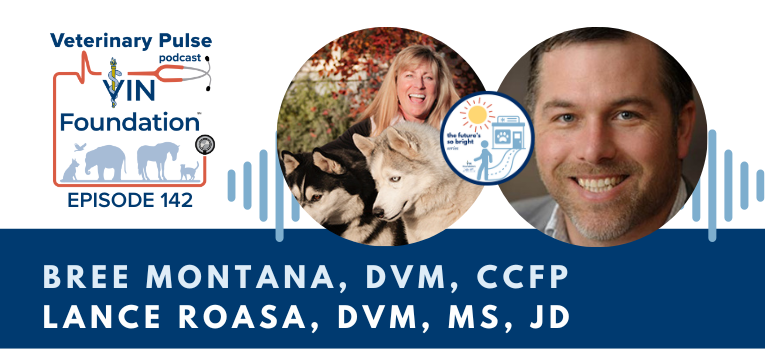
Listen in as VIN Foundation Executive Director Jordan benShea has a conversation with Dr. Bree Montana and Dr. Lance Roasa in the next episode of the podcast series, The Future’s So Bright, the ins and outs of selling a veterinary practice. In this episode, we’re drilling down on the different types of veterinary practice sale options. Lance breaks it down into four main buckets of sale options, with an additional fifth bonus bucket for a more alternative approach.
Are you wanting to sell all of your practice? Maybe you want to stop working? Or perhaps you want to continue working but are curious about the financial options to improve your work/life balance. Listen in to find out how Bree did on her homework assignment and the pros and cons of each sale option.
Most importantly, we want to hear from YOU our listeners, to know what topics YOU want to hear about from experts. Please email us to share your thoughts: [email protected].
GUEST BIOS:
Dr. Bree Montana
Bree Montana, DVM, CCFP graduated from the University of Cincinnati with a Bachelor of Science degree focused in the field of Biology followed by a Doctorate in Veterinary Medicine from The Ohio State University’s College of Veterinary Medicine. After graduation from veterinary medical school, Dr. Montana worked exclusively in small animal outpatient and emergency hospitals while pursuing additional medical training in the latest technologies. Dr. Montana has advanced training in ultrasonography, echocardiography, chemotherapy, dentistry, emergency medicine and surgery, transfusion medicine, class IV laser therapy, pain management and rehabilitation. A past member of UC Davis’ College of Veterinary Medicine’s External Advisory and Admissions Boards, and a past Board member of the VIN Foundation, Dr. Montana is the Director of the VIN Foundation’s Vets4Vets® programs. When not practicing medicine, Dr. Montana will generally be found playing with her daughter Ember and their ponies, hiking with her huskies, and skiing or snowboarding with her husband.
Dr. Lance Roasa
Lance Roasa, DVM, MS, JD is a 2008 graduate of Texas A&M where he was the first student to undertake a 4th year business-track, spending the majority of his clinical training in veterinary business and industry. In 2016 He completed a law degree from the University of Nebraska and his training was centered on the law of small business, taxation and the law of veterinary medicine.
LINKS AND INFORMATION:
- Veterinary Pulse The Future’s So Bright on VIN
- VIN Foundation access on VIN
- Veterinary Pulse Message Board on VIN
- VIN Foundation Vets4Vets® support group
- Podcast email
You may learn more about the VIN Foundation, on the website, or join the conversation on Facebook, Instagram, or Twitter.
If you like this podcast, we would appreciate it if you follow and share. As always, we welcome feedback. If you have an idea for a podcast episode, we’d love to hear it!
TRANSCRIPT
Intro
Lance Roasa, DVM, MS, JD: So, there’s really four big buckets that we can drop these prac transitions into. Think of it like a grid. We can sell to a private veterinarian, or a group of private veterinarians, we can sell to a private equity group, a corporate, if you will. Both of those on the y axis there have two options; we can sell all of the practice, or we can sell a percentage of the practice. To summarize, we can sell a percentage of the practice to a private individual, or we can sell all the practice to a private individual, we can sell part of the practice to a corporate group, and that’s the same partnership that we were talking about above, but the corporates like to call it a joint venture, or JV, and so this is one of our definitions. They’ll use the word JV instead of partnership. Or we can sell all the practice to a corporate or private equity group.
Meet the Hosts and Guests
Jordan Benshea: That is Dr. Lance Roasa, and he’s joined by Dr. Bree Montana. Both are veterinarians, practice owners, and so much more. This is the VIN Foundation’s Veterinary Pulse podcast, and the second installment of The Future’s So Bright series on the ins and outs of selling a veterinary practice. I’m Jordan Benshea, VIN Foundation’s executive director. Join me and our cohost and VIN foundation board member, Dr. Matt Holland, as we talk with veterinary colleagues about critical topics, and share stories. Stories that connect us as humans, as animals, as a veterinary community. This podcast is made possible by individuals like you who donate to the VIN Foundation. Thank you. Please check the Episode Notes for bios, links, and information mentioned. Welcome back, Bree and Lance! Thanks for being here. We are excited to kick off another episode of The Future’s So Bright series: the ins and outs of selling a veterinary practice. Hey, Bree. Hey, Lance.
Bree Montana, DVM, CCFP: Hey, Jordan! It’s so good to be here with both of you.
Lance Roasa, DVM, MS, JD: Hello! Great to hear you.
Defining Your ‘Why’ for Selling
Jordan Benshea: In this episode, we are going to be discussing the different types of practice sales. As many of you listeners know, Dr. Bree Montana is team lead for our Vets4Vets confidential support group and a practice owner. Dr. Lance Roasa is joining us to help shed some light in his areas of expertise, which are quite vast, including being a veterinarian, an attorney, a practice owner, and multiple other things. I want to tie back in to our first kickoff episode. Lance ended with giving Bree some homework and that homework was, as a practice owner, one of the things he suggests starting with is really defining and figuring out what your why is. Why do I want to sell this practice? Let’s just start first and foremost, Bree, how did your homework assignment go?
Bree Montana, DVM, CCFP: Oh, man, homework! You think you’d be done with homework after all vet school, but no, there’s more! Life has homework right there for you. My homework’s gone pretty well.
Bree’s Personal Journey and Challenges
Bree Montana, DVM, CCFP: For those of us that are in a similar stage to where I am in life where you’ve owned your practice, I’ve been practicing for 30 years, and I’ve owned my practice for 20 years, and I’m ready to open up for a different kind of adventure. So, I’ve been spending a lot of time thinking about how much practice do I want to do? What do I want my life to look like in a year, in five years, in ten years? All of this is spiced with that special spice that comes from life. That being that my husband has a very strange and aggressive form of cancer that three other people have. So, it’s all coming together in a way that I could see it as something that’s being done to me, but I’d rather grab the reins and really jump on and have it be something that I’m doing to make my life go in a direction that makes more sense for me. So, my why for right now, and just asked me in five minutes, it’ll be different, my why for right now is that I need to have more latitude and more freedom in my life. I love being an owner. I wanted a Bair Hugger, so I bought a Bair Hugger. When I worked for somebody else, it was never that way. When I wanted an ultrasound, there was never any money for an ultrasound. I’m on my second one now, that’s new and beautiful. That’s what I love about practice ownership, but practice ownership also comes with a 365 day a year obligation to be bonded to whatever’s going on at the practice, and I really need more freedom from that. I want to keep learning and growing and practicing excellent medicine, but I want to do it on a scaled back format, I guess. I want to do it in a way that allows me more freedom to be there when Bill needs me, when he needs to go travel and have some fun with me, when we have the opportunity to enjoy living in North Lake Tahoe and being outside, I want to be able to do that. So, my why is more about I’m pivoting into a lifestyle that’s going to allow me more freedom. I’m really wanting to see this as an adventure and something that I’m creating. Just like I’ve created my whole career really, as opposed to something that life has done to me. So that’s going to be my point of view.
Exploring Practice Ownership Models
Bree Montana, DVM, CCFP: I want to really take this opportunity, because who gets the opportunity to speak with Lance, somebody who’s so knowledgeable and has done so many different kinds of things with his career, with his veterinary license, with his law license, and with his background? Who gets the opportunity to work with somebody like that and say, “what are all the different ways that I can move my practice forward and move my career forward in a way that allows me to have more freedom and less business responsibility?”
Jordan Benshea: Right, and just to touch on that, I think that we hear with the Vets4Vets program a lot just how colleagues are yearning for that more freedom, and the ability to take more control over their life and to, as you said, feel like I’m living my life versus life living me. Right. I think that’s a common thing that we hear in the veterinary profession. I think it’s a common thing we hear across the board in all different types of professions. Especially, I think, one of the blessings out of COVID, if there are any, are people are taking stock in their life. Right? People are taking stock in what’s important to them, and what do they value, and where do they want to put their time and effort. So, I think that this podcast series is very helpful for that as well. I think great job on your homework! I would say A+! Lance, what grade did she get?
Lance Roasa, DVM, MS, JD: Great job. Very, very insightful, very thoughtful. Thank you for the kind words as well. A very well thought out thing I know, and I hate to hear that life has issued you some surprises. The timing is also very interesting with what’s going on in our industry as well as far as the number of practices that are being sold, the number of private equity groups and corporations coming into the practice. So, it’s a very interesting time, both in your life, Bree, and then also in the industry as well. It’s funny how that came together. The one thing that I really pealed out of what you said was you’re really looking for that desire to scale back. I’m hoping you dug in on that, you know, what does that mean? How much are we talking as far as scaling back? What does that mean to you? I think the fact that you’re stopping and saying, “Let me live my life, not the other way around.” But what does that mean, on a very granular level, on a monthly basis, on a weekly basis, on a daily basis when you are talking about scaling back?
Bree Montana, DVM, CCFP: Yeah, that’s like a really difficult to answer question, I think not just for me, but for so many of us, because one day I’m in the trenches, things are going quickly, things are interesting, and cases are cool. I’m just really all about it, and things are great. Then the next day, maybe somebody gives notice at work and like well, I’m just done. You know, I just don’t want this anymore. So, it’s a work in progress what I want things to look like. I think that for so much of my career, like so many of us, I worked when I went to school. I was always working full time and going to school because I was paying for school. Then I was practicing. Then I’m practicing and raising my daughter, and then I’m practicing and doing all these other things. I’ve never had those two beats together to think about things. So, I’m really trying to carve out some time to think about things and I encourage all of us that are thinking about their transition to the next step, to carve out that time to feel like what it would be like for them. One of the things I know for sure is that if I get the freedom of time to not have to work, I know that I will want to work at some level. I just am not the kind of person that’s not going to do anything. I know I’ll continue with my Vets4Vets stuff, and I suspect that I’ll probably want to continue to practice advanced dentistry. That’s one of the things that’s been my field of interest lately, last few years, and so I’m probably going to go more in the direction of specializing on that and provide that to the practice once I’ve sold it.
Lance Roasa, DVM, MS, JD: Interesting. That’s great to hear that you’re not planning on leaving practice completely. From hearing you talk, it really sounds like you really do love practice. You love many components of practice. You just don’t love all the stuff that comes with practice. The one example that you gave was an employee issue, and obviously, that is the number one driver of gray hairs among veterinarians, is managing employees and dealing with the team on a daily basis.
Bree Montana, DVM, CCFP: Yeah. I see things in separate pots in practice management. I have the science and medicine aspect of it, there’s a business aspect of it, and then there’s a team building aspect of it. I really love team building, and I like really love practice. I’m not really that cool with the business management stuff. I don’t really care about any of that as long as there’s money in my checkbook at the end of each month, then I’m satisfied, which is really so embarrassing, but true. I don’t understand any of that aspect of practice management, and I’ve only been doing it 20 years. So of course, I don’t understand it yet! But yeah, I love medicine, I love being a veterinarian, I love practicing medicine, but right now it’s too much for me. So, for me, now, I need to get, part of my big why is I need to get unhooked from some of the carriage that I’m pulling. I can’t be pulling that whole cart. I need to have more freedom to come and go a little bit more so that I can be more in my personal life, when I need to be.
Lance Roasa, DVM, MS, JD: I hear you! The conversation we’re having is not an academic conversation, it really has a lot to do with what your options are. As you start to really elicit what you want, and what are the things that your life needs at this point in time, what do you enjoy in practice from day to day, that really drives what your options are and what you can do with your practice. The beautiful thing is you do have a practice to sell, and practices are very valuable assets, but exactly how you effectuate that sell, to who or to whom and how much of the practice really drives on what you want to look at after you sell the practice or a portion of it. I think that’s what we really need to spend some time talking about today. What are those options, and which of those options fit into your needs and your wants?
Bree Montana, DVM, CCFP: Right?
The Partnership Model in Veterinary Practices
Bree Montana, DVM, CCFP: Yeah, I see today as sort of like a blue-sky brainstorming period wherein we can talk about all the different ways of transitioning from being a solo, or a practice owner where I’m the practice owner. I own everything myself, and maybe I have a bunch of associates, which I don’t, but I would love. Transitioning from being that person that’s responsible for all aspects of the practice to be someone that’s perhaps partially responsible or somebody that has completely divested the practice, whether that be to a corporate entity, or to a veterinarian who wants to own a practice and take the reins, or maybe to a group of veterinarians. Lance, this is where I’m turning to you to say give us a feel for all the different ways we can go.
Lance Roasa, DVM, MS, JD: Oh, you nailed it. You really pointed it out that our first kind of why in the road is more fork in the road is how much of the practice to sell. This is one of the bigger questions that selling veterinarians face and my clients face. Do I sell 100% of the practice, or do I sell a certain percentage of the practice? If I’m going to sell a certain percentage of the practice, how much of that practice do I sell? I don’t want to say it’s regardless of the buyer, but then breaking down from there, we really have another fork in the road – do we sell to a private veterinarian, another practicing veterinarian, or as you mentioned, and I love that mention, a group of veterinarians, or do we sell to a corporate entity? Both of the options, selling 100% or a partial sell, are available to both private practice sells, or private veterinarian sells and also to the corporate side. So, we really have four large buckets more or less that these practice transactions/transitions fall into. A lot of folks make the decision on the flip side first and they’ll say I want to sell to a corporate, or I want to sell to a private entity, and then make the second decision – 100% of the practice or a percentage of the practice after that. I think that we really need to make that decision in reverse and say, “Do I want to sell all the practice or a part of the practice?”, because it’s going to change the way that you ultimately market the practice, the way you talk to those buyers, and the way you set yourself up for the sell as well.
Bree Montana, DVM, CCFP: Yeah, my Barbie’s dream practice fantasy would be that I and two other veterinarians would own the practice together. So, we would each have 33%, or a 30:40:30 split. So that there’s lots of people that can add energy to the practice, and help lift up and carry the practice, and also carry the management duties. I don’t know how to make something like that happen, but that’s been my dream beach house situation.
Lance Roasa, DVM, MS, JD: It’s funny that you say that, because some of the most successful practices that I’ve been a part of, that I’ve worked with and consulted with and some of the most successful transactions I’ve set up were exactly that where we have one or two veterinarians or more come into a partnership. And that’s exactly what you’re describing. Even more so an even partnership, where we can spread out that management, we can spread out that time commitment at the practice. When done right, it is extremely successful. I would argue that some of the most successful practices in veterinary medicine are structured on that partnership model.
Bree Montana, DVM, CCFP: The nice thing about that is that it feels like the practice can continue on and new energy can be added into the practice in five or ten years when they want to bring another associate in to the ownership management group. Then that’s an easy transition for the person who’s transitioning out.
Lance Roasa, DVM, MS, JD: Yes, and I’ll tell you this, if we look at other professions, and on the attorney side I’ve had a chance to look at and study law firms, same thing in other professional firms, be it an accounting firms, or engineering firms, that’s the model that they use regularly in other professions where the practice is intentionally divided into partners and people work until they “make partner”. Obviously, they work after partnership as well. As they near retirement, they cycle off partnership, new individuals come in and take those partnerships and the life of the business, the life of the firm, the life of the practice, continues on. So, this model is not something that’s just successful in veterinary medicine, it’s successful in other professions, as well. I think one of the things we should do today is really look at the pros and cons of each of these advantages and disadvantages of all of these models. That’s a real advantage. To that partner that is giving up their shares, that is selling part of the partnership, yeah, at first glance, hey, I’m selling something that’s very valuable. I only have let’s say 30 or 40% now, I’m only going to take 30 or 40% of the of the profits, but the advantage is you have what Bree’s just described. You have the ability to take vacations and step away from the practice and know someone is there that’s going to care for that practice in the same way that you did as an owner. Let’s talk about some disadvantages here. The disadvantage is obviously working within a partnership. Partnerships are difficult. For those of us that are married, probably know that they certainly have ups and downs. An old, old adage in the law is partnerships are ships that don’t sell. There are plenty of partnerships that have gone sour as well. So, this is one of those things where selecting that partner, bringing that partner on, and then also working with that partnership takes active work. It takes a different set of work. The work doesn’t go away. It takes a different set of skills, of emotional intelligence, communication skills, and just overall work to keep that partnership healthy. Partnerships that aren’t taken care of, that aren’t grown and developed and massaged, they fall apart, and they can fall apart in a very spectacular fashion as well. There are certainly pros and cons to the partnership model. Personally, I am a big fan of partnerships. I’m still in successful partnerships, but I know the work that’s involved in making sure that those partnerships remain successful.
Bree Montana, DVM, CCFP: Lance, are there businesses that are able to kind of help shepherd us through that kind of relationship? Help us find people to buy into our practice. How is that done? Here I am up in North Lake Tahoe, and I’ve got 15 feet of snow all around me. I don’t really feel like I can find somebody today. Who does it? Who do we turn to?
Lance Roasa, DVM, MS, JD: Well, I’m sure that there are consultants, and they’re certainly practice brokers that do those things. The traditional way that this is done, and I’m sure you know this, it’s that those partners are brought on as associates and ultimately, they make partner. This is done over a series of years. Bree, given your set of life circumstances, that time to hire an associate, which is obviously difficult in the year 2022 is going to be difficult, and then grooming that person up to partner is going to be difficult as well. So, you may actually decide to skip, if you do go this route, skip that associate step, and advertise ‘hey, I’m looking to sell a portion of the practice’. Now, that is not very common in veterinary medicine where somebody joins as partner immediately. Usually, there’s a bit of a vetting stage, if you will, a dating stage, we want to make sure that we have the right individual before we make them a partner. So, at the very, very least, we want to find someone, I’ll advise you to find someone that we have excellent references on, that we know what they want to do. Now, I’ll say this that many, many, many, this is a common misconception, and I have the opportunity to work with a lot of veterinary students, and a lot of recent graduates. They want to buy practices, they want to buy parts of practices, these percentages, these partnerships are very enticing to them, because they’re not necessarily, and I’m talking in broad strokes here, generalities, they’re not necessarily ready to buy the entire practice 100% of it, but they feel very comfortable buying a third of it, or 20% of it, with the opportunity to buy more in the future.
Bree Montana, DVM, CCFP: Thinking back to in my early career before I bought my practice, I would have been so stoked to be able to buy into a practice and have a little say into what’s going on. That’s one of the most frustrating things about being an associate is that you don’t have a voice. You can help to train your team members, your veterinary assistants, and your technicians to the things that you want them to do. Here’s how I like my ultrasound to be set up, and blah, blah, blah, but really that’s where your power ends. You don’t get to make key decisions, and being a purchased in partner allows you to have a say in the direction the practice grows in.
Lance Roasa, DVM, MS, JD: Yes, and a cut of the profits as well and something that’s valuable at the end of your career, during your career. So, you’re working into paying for a very valuable asset. So, to me, the partnership model is a very, very good thing for all people involved with that one major disadvantage is we’ve got to communicate effectively, and we’ve got to be stewards of that partnership, and really work to grow and develop the relationship.
Bree Montana, DVM, CCFP: Yeah, you really need to be a grown up who’s willing to play nicely in the sandbox. The positive, the additional unwritten upside to having colleagues like that, though, is the partnership itself is a benefit. It’s so sustaining to our profession to be able to have somebody with whom you can share collegial challenges and successes, with whom you can discuss cases, and discuss business. To have a partner, it’s just as beneficial as having a really good marriage.
Lance Roasa, DVM, MS, JD: Absolutely, precisely. A lot of folks will ask me, well, why should I give up part of my practice? I mean, if this person is going to work for me anyway, why should I sell them 30% of my practice? And I say no, no, it’s not about getting a smaller piece of the pie, the percentage may be smaller, the piece may be smaller, but we’re going to get a bigger pie. There’s going to be a synergistic relationship. The practice is going to grow. That associate turned partner is going to be more productive. They’re going to watch the bottom line more and so done correctly, the pie grows. Maybe the percent of the piece of pie gets smaller, but ultimately your piece of the pie grows bigger because the pie is growing. That’s really the optimism that we want to look at going into one of these relationships.
Four Big Buckets of Practice Transitions
Jordan Benshea: I want to round back to something that you said, Lance, a little bit towards the beginning where you said we really have four buckets. Let’s go over those four buckets for the audience and listeners so that we can make sure that we hit on to all four of those. That might help us drill down on the pros and cons of each of the different options.
Lance Roasa, DVM, MS, JD: There are really four big buckets that that we can drop these practice transitions into. Think of it like a grid, if you will. So, we can sell to a private veterinarian or a group of private veterinarians, or we can sell to a private equity group, a corporate, if you will. Both of those on the y axis there have two options, we can sell all of the practice, or we can sell a percentage of the practice. To kind of summarize, we can sell a percentage of the practice to a private individual, or we can sell all the practice to a private individual. We can sell part of the practice to a corporate group, and that’s the same partnership that we were talking about above, but the corporates like to call it a joint venture or JV. This is one of our definitions, and they’ll use the word JV instead of partnership, or we can sell all of the practice to a corporate or private equity group. Now we do have to mention in kind of smaller bucket, off to the side, we can talk about things like phantom equity, or ESOPs, where we are as part of our team’s compensation, we are giving out shares, or we’re compensating them with shares for their efforts. So, that’s kind of a smaller bucket that’s off to the side, a fifth category, if you will.
Jordan Benshea: So really, the four buckets are: all private one bucket, two all corporate or private equity, bucket three partial to private, and bucket four partial to corporate or private equity.
Lance Roasa, DVM, MS, JD: Exactly.
Jordan Benshea: Okay. Of those four then, Bree has mentioned the benefit, you both have been talking about the benefit of the partnership. So, do you guys want to go through the pros and cons we’ve talked about, pros and cons a bit of partnerships? What do you think are the pros and cons of not partnership, but full private or full corporate private equity?
Lance Roasa, DVM, MS, JD: Yeah, Bree, what questions do you have about a 100% sell to a private individual or a private group of veterinarians?
Bree Montana, DVM, CCFP: Gosh, that one seems like a pretty straightforward one to me. I think the benefit is that you don’t have any continued responsibility, and you get all your money upfront, so you don’t worry about the practice losing value. Let’s say you sell 70% to someone, and over the years, that 30%, the remaining becomes devalued because the practice isn’t well managed. Here, a lot of times when there’s a transition, and when I bought my practice 20 years ago, everybody basically quit within the first six months, because my practice of medicine from San Francisco was really different from the way it was in the cabin, where my hospital was at that time in Tahoe. It was really different.
Understanding the Traditional Practice Sale
Bree Montana, DVM, CCFP: People really freaked out by it. So, the downside, I think, is the or the upside is that you make all your money, and you’re in you’re out. You’ve got what you got, and you know what you have, you have a known entity, and you’re done.
Lance Roasa, DVM, MS, JD: I’ll add another upside as well, that’s also the most traditional way that practices have been sold over the last multiple decades. So 100%, that’s what people are used to. When you list a practice with a broker, or you list a practice on a website, it’s usually a 100% practice acquisition/transaction. That is what people are used to, and that’s how practices normally have been bought and sold. That’s also what a lot of banks are really more comfortable with financing.
Financing Options for Practice Sales
Lance Roasa, DVM, MS, JD: We can have a whole session on financing, and on how to get paid. There are a few banks that will finance a partial sell, like we talked about earlier. They’re comfortable financing that partial sale. Most banks are much more comfortable financing that 100% acquisition, so, you kind of fit into a mold and sometimes when you fit into a mold, it makes things easier to process and to effectuate.
Downsides of Selling to Private Entities
Bree Montana, DVM, CCFP: What are the downsides to selling 100% to a private entity or corporate?
Lance Roasa, DVM, MS, JD: Well, the biggest disadvantage that I can think of is just the overall sales price. That’s the elephant in the room. How much cash are you going to get to cash out? In today’s market, most of the time a private practice veterinarian just can’t pay the same price that a corporate practice could. So that private practice veterinarian has to service the debt and pay the mortgage and pay the bills with the profits of the practice. For some reason, somehow those corporations can reach deeper in their pockets and make those payments and pay a lot more for the practice overall. So, the big disadvantage is you’re probably going to get less with a private practice veterinarian. Now, having said that, some practices and solo doctor practices, all our practices generally less than $750,000, there a corporate sale is really not in the cards. They kind of fly under the radar. They’re not targets for the corporate practices, and so therefore, they’re not really an option anyway. So, the sales price is going to be about the same.
Bree Montana, DVM, CCFP: I’ll just throw in a bit of observed experience from a local hospital here that was sold twice, with the owner financing to the buyer. They bankrupted out twice before they found a third purchaser over the years who was able to make it go.
Lance Roasa, DVM, MS, JD: Wow, that is scary. Scary. That is one of the scary aspects of owner financing as well.
Bree Montana, DVM, CCFP: Yeah, yeah. It’s a very scary downside, potential downside, not always bad.
Emotional Impact of Selling to Corporates
Bree Montana, DVM, CCFP: Downsides to selling completely to a corporate entity, we feel a little dirty?
Lance Roasa, DVM, MS, JD: Well, I’ll be the first to say that. I have sold practices to corporate entities before, and I will be the first to say that I don’t feel it’s the best thing for veterinary medicine as a whole. It is very good money in most cases, but personally, I didn’t feel very good about it after the end of it. And I’m not afraid to say that.
Bree Montana, DVM, CCFP: No, I’ll tell you, I had a corporate consolidator contact me. That’s how you and I met. Contacted me about a year and a half, two years ago after Bill’s diagnosis when I was like, oh, shaking my hands in the air and not knowing what to do with my life. That’s why my practice isn’t sold right now. I’d really like my beautiful small animal practice that I’ve carefully cultivated over the years and grown and grown with a big chunk of my heart to go to somebody who’s going to, somebody or a group of somebodies, who are going to continue to grow and serve my community.
Lance Roasa, DVM, MS, JD: That’s exactly right. You and most veterinarians have huge hearts in that aspect. So, you’re thinking about your patients, you’re thinking about your clients, you’re thinking about the community that you’re going to continue to live in, and the practice that you’re going to probably [I’m putting words in your mouth here], continue to drive by every day. You want to feel good about that and what you’ve done for the long term.
Bree Montana, DVM, CCFP: At some point, those of us that have sold or do sell to folks that turn out to be corporate consolidators, I get it. I mean, I get it. My practice did just over a million two this year, and there doesn’t seem to be a lot of sexy interest in it, because I’m a solo practitioner. So, I understand if you find somebody who’s got the code to the door, and you want to go through the door, I understand going through the door.
Lance Roasa, DVM, MS, JD: No, and that’s exactly where I was, as well. It was the best option for me at the time and also the highest price option for me at the time. But, yeah, that’s a major disadvantage that comes with the territory there.
Jordan Benshea: Yeah. Well, I think that that’s something to think about when we hear, whether it’s in Vets4Vets or just from other colleagues, there are colleagues where that might really be the only option because they don’t have the option to continue working for one reason or another, or they absolutely need the cash influx for one reason or another. Right. Bree, to your point about what’s happened with Bill and the situation that you find yourself in, three years ago, somebody would have told you this, you never would have believed it.
Bree Montana, DVM, CCFP: No, not for a second. This was not my plan!
Jordan Benshea: Right! And there are no indicators, there’s nothing.
Bree Montana, DVM, CCFP: That’s what happens when you follow Waze, when the traffic is bad and you follow Waze, this is what happens.
Jordan Benshea: That’s what happens in life. That’s what we’ve seen with COVID, with so many other things, but we do also want to have compassion for colleagues that find themselves in a situation where a corporation or a private entity really is the best option because they actually need that money. Right. There’s compassion for that situation as well. We joke that it might seem a little dirty, but it also might seem like they might be doing that with a heavy heart, right? At least there is that option for them, if that’s something that they need. Lance, you said that there’s also this like side bucket.
Partial Sales and Joint Ventures
Jordan Benshea: I know that we’ve gone through pros and cons of full 100% sale to a private, full 100% sale to a corporation or private entity, and then also the pros and cons of partials. What about the side bucket of phantom equity and ESOP’s and giving out sharing, compensating shares? Can you dive into that a little bit?
Lance Roasa, DVM, MS, JD: Sure, but we actually need to back up a step and talk about the pros and cons of selling partially to a corporation.
Jordan Benshea: Oh, good. That’s right. Yes, we do. Thank you.
Bree Montana, DVM, CCFP: This is a huge conversation right now on VIN. We’re having a spirited conversation about that.
Lance Roasa, DVM, MS, JD: Yeah, because it’s very common. There’s a spirited conversation on the boards, but it’s also a very common model right now where a corporate will come in, and they’ll buy anywhere from 51 to 90% of your practice, and you will become a partner with them. Again, it’s called a joint venture. That JV model really, there’s a couple of big things to point out there, advantage wise. Someone would say, “Well, why would I want to do that? I’m still going to be the person that’s there at the practice. They’re probably going to be relying on me to manage the practice. I’m probably going to be making the hiring and firing decisions.” Now, that’s all true. You continue to do the same thing that you were doing in that full ownership position, but the reason for that is, every one of these corporate groups, and I’m going to be a little bit nasty here, but in my mind, they fall into two buckets; those that tell you that they’re going to sell or flip your practice, and the others that lie to you. That’s the ultimate goal. With most of these groups that are buying practices right now, ultimately, they are looking to aggregate practices. That’s really what we should be calling them is practice aggregators. Aggregate practices then ultimately sell that as a large group to another corporate aggregator, and it kind of becomes a game of hot potato, if you will. So, people ask, “Well, why would I keep back 10,20, 30, 49%?” The reason for that is when that group of practices, that corporate aggregator goes to flip and sell to that, “bigger fish”, that bigger corporate aggregator, the multiple that they get, the amount of cash that they get for those practices goes up quite a bit. To put this in like real examples, you may sell a practice for a five, six, seven, or eight multiples, 10 is not unheard of to sell your practice to that corporate aggregator. When that corporate aggregator goes to turn and sell, then a lot of times they will get 15, 16, 19, 20 plus times EBITDA [that’s going to be defined in a further podcast] times profitability, you can think of that. So basically, let’s call it your 49% is worth almost as much as the 51% that you sold in the first sale. Some folks will refer to that as a waterfall or a second sell, but basically, what it is, is you will have the option, the opportunity in all likelihood, to sell the percent that you keep back at a later date, and the bet, the gamble, the investment opportunity is it’s going to be worth more on that second sell than the first time. So, to really maximize the value of your practice, that joint venture, that partnership model to a corporate is really probably the best way to maximize. Now the downsides of this, Bree, I can hear the concern like where’s the downside if that’s the upside is they’re worth a lot more money? The downside is that’s a bet, that’s an investment opportunity. It’s like when clients call me and say, “You know, hey, this is what’s on my desk. What do you think about this investment opportunity?” I say well, it’s a lot like going to Vegas and Bree’s not far down the road from Reno, going and putting a million dollars on red. It’s a bet. It’s an investment, and there’s absolutely no guarantee that that investment is going to work out. It depends on a lot of stuff, and those things are out of your control, like the market, the ability of that corporate group to manage their practices, is there going to be a buyer that comes along. We can say historically that there has been and historically those investments have performed very well, but in reality, we don’t know what the future is going to hold for those future sales. The second downside is also a pretty big one, and I also alluded to, it is you’re tied into that group. You’re a partner, you’re still an owner, and you’re still going to be working at that practice for an undetermined number of years. So, for your purposes Bree to plan life, it’s hard to plan life on when that second cell is going to happen. It could happen in six months, it could happen in five years, and you have zero control over that.
Bree Montana, DVM, CCFP: Right. So, during those years, I’m continuing to play my role as the as the lead of my team, and making decisions for my team, only somebody’s telling me what to do.
Lance Roasa, DVM, MS, JD: Yeah, you have another level of complexity there where you have someone, you have a partner that you’re working with, you have probably a Regional Medical Director that you’re working with, you have a regional lead that you’re working with, they have the ability, since they’re a majority owner. I’ve never seen one of these, it wasn’t a majority show. They own the majority of the practice, so they get to have the say on pricing, they have say on hiring/firing decisions. They have say on whether or not you buy a new ultrasound or not. You are now in the passenger seat, you’re not in the driver’s seat.
Bree Montana, DVM, CCFP: I understand they can have some pretty significant production requirements.
Lance Roasa, DVM, MS, JD: Most of the time, veterinarians are paid on production when they work for these corporates. So, the seller is therefore paid on production, and a good percentage of them that I see are actually on straight production. You have to work, and you have to produce to get your normal salary. There are some distinct downsides. Now, for certain veterinarians, I was one of them, I was okay with that. I was at a point in my career where I could continue to do the things that I was doing. I can have this joint venture and hopefully have the upside of that ultimate transaction at the end of it. Many of my clients that I work with, they’re at a point in their career where they don’t have to sell wholly right now. They want to do the same things that you were talking about, Bree. Scaling back, having less management responsibility, having less financial responsibility. I can tell you, as a practice owner, one of the biggest stressors that I had is Hey, payroll comes every two weeks, and you’ve got to make it, and everybody’s got to get paid, and instantly, that stressor went away from my life. That I did not have to worry about human resources. I did not have to worry about finance. I did have to worry about the performance of the practice, ultimately, but not that day to day, you know, writing of checks.
Bree Montana, DVM, CCFP: Yeah, that’s a stressful feeling. It’d be nice to have that lifted off, but can we have everything and none of the bad stuff? Is there a scenario?
Lance Roasa, DVM, MS, JD: I wish the world worked that way, Bree.
Bree Montana, DVM, CCFP: Okay, we have a few minutes left. I feel like we need to cover, what are we missing?
Lance Roasa, DVM, MS, JD: We haven’t covered that fifth bucket. That fifth smaller bucket is a very rare bucket, but it does exist.
Exploring Phantom Equity and ESOPs
Lance Roasa, DVM, MS, JD: It is that ESOP model. ESOP stands for employee stock options plan. Those ESOP ‘s are used extensively through other industries, so large companies, small companies, use an ESOP as a retention tool, if you will. They start offering stock options to their employees in an attempt to retain good talent. So, that stock option can be seen as a gift, it can be seen as part of their compensation package, but those employees become true owners. The devil is really in the details here. There’s a lot of details about when does that stock option become vested? How is profitability dispersed out? What happens if that employee does want to leave? How are their shares bought back out of the company? How are the shares held? Are they held in a trust? Are they held by the individual employee? The bottom line is these are incredibly complex models to set up and so it takes a very specialized legal team to be able to set these up. They’re regulated by this law called ERISA, the employee retirement investment security act. I don’t want to bore you with that, but ERISA is a very onerous law. ERISA is a very highly regulated subject. So, if you do set up an ESOP, you have to, have to, have to make sure that it’s done correctly, and traditionally too, not all of the company is given away in the ESOP. There are small percentages that are given. So, in a situation where a veterinarian does want to retire and really step away in a fairly short order, it’ll take years to effectuate that ESOP and then also they’re going to continue to have to run the practice and manage the practice now, just with less profits overall, but there are some practices that successfully set up ESOPs. They retain great employees, and they do a great job with ESOPs. Typically, those are larger practices, we’re talking specialty centers, 50 to 100 employees, etc.
Bree Montana, DVM, CCFP: Yes, a friend of mine owns a few hardware stores in our area, and she has an ESOP. She’s mostly out of ownership, her employees own the majority of her businesses. She’s super happy with it, but it seems so complicated, and it seemed like something that for me, should have started 10 years ago.
Lance Roasa, DVM, MS, JD: It’s a very complicated situation. It does take years to set up, but I will say that the vast majority of ESOPs are actually set up for retiring owners. I say a vast majority, 70 something percent of ESOPs are put in place to allow that hardware store owner, or that tech company owner, or whoever it is, to retire. Typically, they’re used in heavy industry, so there’s a few big supermarkets, clothing manufacturers that are set up with ESOPs. It is a tool, it can be used, and you’ll see it as you research these things. It’s just not very common in veterinary medicine.
Final Thoughts and Outro
Bree Montana, DVM, CCFP: Okay, Jordan, I feel like we’ve covered a lot of the blue-sky mapping options.
Jordan Benshea: Yes, we covered and so I’m grateful for both of your times. I want to be respectful of both of your times as well, as our listeners. We want to keep these not too long. We want to hear your questions. We are collaborating with VIN, so we have message boards up to continue this conversation. You can also find in the Episode Notes, additional links and helpful information. Lance or Bree, anything else you want to leave the audience with?
Lance Roasa, DVM, MS, JD: Bree, I’ve got to give you some homework.
Bree Montana, DVM, CCFP: Oh, god! There you go.
Lance Roasa, DVM, MS, JD: I know you’re a very busy person and a very tough person to deal with what you’re going through, but I’m going to ask you to be thoughtful about what is it on a day-to-day basis that gives you that grind? What is it that that’s the problem thing? Is it that management? Is it the fact that your phone rings after hours? Really dive in on what is eating into your work-life balance that makes you want to sell. I think that that’s going to help drive yours and, hopefully, the listener’s decision on how much of that practice they sell. I can tell you that I was certainly in that situation where I just want out. I want 100% out. I don’t want to deal with this another three to five years is just not going to work in my family and for my life. Ultimately, I made that work, but it was really me stopping and thinking what is it that was the big problem? Once I had that support structure around me., the partnership wasn’t near as bad. So, that’s your homework is to really get granular on what is the problem.
Bree Montana, DVM, CCFP: Okay, then I guess I‘ll give homework to all the rest of us that are listening. Let’s jump on the message boards and talk about this stuff.
Lance Roasa, DVM, MS, JD: Yeah, I’d love to have this conversation on the message boards.
Bree Montana, DVM, CCFP: If you have something that you need to post anonymously, shoot it to me, my email address.
Jordan Benshea: Or you can email [email protected]
Bree Montana, DVM, CCFP: Oh, perfect. That’s even better.
Jordan Benshea: That’ll be in the Episode Notes as well. One thing off your plate, Bree.
Bree Montana, DVM, CCFP: You always rock! Thank you! Awesome!
Lance Roasa, DVM, MS, JD: Yeah, I will also mention that you also have the ability to post anonymously on the regulatory and legal board, as well. I know it’s not associated, it probably will be cross posted with this podcast discussion, but we do get quite a few anonymous legal and regulatory things that needed to be discussed on that board.
Bree Montana, DVM, CCFP: Cool.
Jordan Benshea: Wonderful. Well, thank you both for your time and your expertise. I just want to say to our listeners, you have great resources here in Dr. Bree Montana and Dr. Lance Roasa, so utilize this and email us. We’ll put a link for the collaboration with VIN. You do not need to be a VIN member to access this message board link. You can get VIN Foundation access which is free to every veterinary colleague. All those links will be in our Episode Notes. Thanks so much Bree and Lance. Take care, listeners.
Lance Roasa, DVM, MS, JD: Always great to visit with you.
Bree Montana, DVM, CCFP: Yeah. Excellent. See you guys soon.
Jordan Benshea: Thanks, you two. Bye bye. Thank you for joining us for this episode of the Veterinary Pulse. Please check the Episode Notes for additional information referenced in the podcast. If you enjoyed this podcast, please follow, subscribe, and share a review. We welcome feedback and hope you tune in again. You can find out more about the VIN Foundation through our website VINFoundation.org, and our social media channels. Thank you for being here. Be well.