
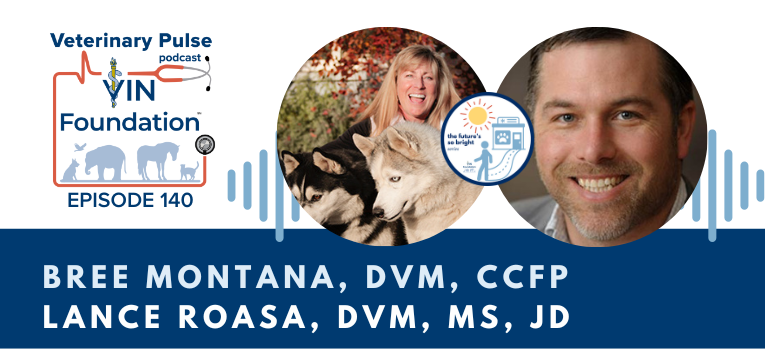
Listen in as VIN Foundation Executive Director Jordan benShea has a conversation with Dr. Bree Montana and Dr. Lance Roasa to kick off the new podcast series, The Future’s So Bright, the ins and outs of selling a veterinary practice. In this episode we discuss our goals for the series, topics we plan on covering, including – various financial aspects of selling a practice, different types of sale options, tips on how to figure out if an associate might be a good buyer, where real estate comes into play, and the impact of mental health. Those interested in this path also get a homework assignment to get started.
Most importantly, we want to hear from YOU our listeners, to know what topics YOU want to hear about from experts. Please email us to share your thoughts: [email protected].
GUEST BIOS:
Dr. Bree Montana
Bree Montana, DVM, CCFP graduated from the University of Cincinnati with a Bachelor of Science degree focused in the field of Biology followed by a Doctorate in Veterinary Medicine from The Ohio State University’s College of Veterinary Medicine. After graduation from veterinary medical school, Dr. Montana worked exclusively in small animal outpatient and emergency hospitals while pursuing additional medical training in the latest technologies. Dr. Montana has advanced training in ultrasonography, echocardiography, chemotherapy, dentistry, emergency medicine and surgery, transfusion medicine, class IV laser therapy, pain management and rehabilitation. A past member of UC Davis’ College of Veterinary Medicine’s External Advisory and Admissions Boards, and a past Board member of the VIN Foundation, Dr. Montana is the Director of the VIN Foundation’s Vets4Vets® programs. When not practicing medicine, Dr. Montana will generally be found playing with her daughter Ember and their ponies, hiking with her huskies, and skiing or snowboarding with her husband.
Dr. Lance Roasa
Lance Roasa, DVM, MS, JD is a 2008 graduate of Texas A&M where he was the first student to undertake a 4th year business-track, spending the majority of his clinical training in veterinary business and industry. In 2016 He completed a law degree from the University of Nebraska and his training was centered on the law of small business, taxation and the law of veterinary medicine.
LINKS AND INFORMATION:
- VIN Foundation Vets4Vets: https://vinfoundation.org/v4v
- Drip.vet: https://drip.vet/
- VBMA: https://vbma.biz/
- EBITDA: https://www.investopedia.com/terms/e/ebitda.asp
You may learn more about the VIN Foundation, on the website, or join the conversation on Facebook, Instagram, or Twitter.
If you like this podcast, we would appreciate it if you follow and share. As always, we welcome feedback. If you have an idea for a podcast episode, we’d love to hear it!
TRANSCRIPT
Intro
Lance Roasa, DVM, MS, JD: That’s the beauty of practice ownership because you’re in the driver’s seat, and you can intentionally make those decisions and drive what the rest of your life will look like.
Bree Montana, DVM, CCFP: Yeah, and the cool thing is that asking questions and learning more, it doesn’t need to be scary. It’s going to be okay. We’re going to figure things out. We’re going to make good decisions, and if we’re not liking the way the decision is feeling, we can change our minds.
Meet the Hosts and Guests
Jordan Benshea: That is Dr. Bree Montana and Dr. Lance Roasa, veterinarians, practice owners, and so much more. And this is the VIN Foundation’s Veterinary Pulse podcast. We’re kicking off The Future’s So Bright Series on the ins and outs of selling a veterinary practice. I’m Jordan Benshea, VIN Foundation’s Executive Director. Join me and our cohost and VIN Foundation board member, Dr. Matt Holland, as we talk with veterinary colleagues about critical topics, and share stories. Stories that connect us as humans, as animals, as a veterinary community. This podcast is made possible by individuals like you who donate to the VIN Foundation. Thank you. Please check the Episode notes for Bios, links, and information mentioned. Welcome back, Bree and Lance. Thanks for being with us.
Bree Montana, DVM, CCFP: Yeah, happy to be here. Nice to see you, as well, Lance.
Jordan Benshea: So, Bree and Lance have both been guests on the podcast before for our listeners who have listened to other episodes. As with all things of the VIN Foundation, our ideas for our resources and our programs, everything comes out of a need that we hear from veterinary colleagues.
Introducing the Practice Transitions Series
Jordan Benshea: Today we’re kicking off a new podcast series called Practice Transitions. This has come from a need that we’re hearing from veterinary colleagues who are at a time in their career when they’re potentially thinking about selling and looking to understand what that means. Is it corporate selling? Is it selling to an associate? The ins and outs of all of this and how do they even go about doing it? So, we brought in some experts, Dr. Bree Montana, who you know, runs our Vets4Vets confidential support group. She is also a practice owner. She and I are going to be tag teaming this series as we talk with different experts. The expert that we have today is Dr. Lance Roasa. He’s going to be joining us and shedding some light on his expertise as a veterinarian and as an attorney. He has a lot of practice buying, and selling experience as well, and is also the leader of drip.vet. I’m going to start by handing this over. Bree, will you share a bit about your thought process in wanting to start this series?
Bree’s Personal Journey and Insights
Bree Montana, DVM, CCFP: Absolutely. So, our Vets4Vets program has been active and working with our colleagues for over 10 years, and over that time period, I’ll occasionally get a colleague who’s trying to transition from being a practice owner to being in partial retirement or full retirement. Typically, we talk about selling corporate, selling privately, getting an associate to perhaps buy a part of the practice. I really didn’t pay as much attention to it as I have in the last year, when some life changes happened for me. I started to realize, hey, I’m 61, I have to have a transition plan. I love practicing medicine, but I’d like to practice differently going into the future. So, I started listening more to our colleagues and paying more attention to the pulse of folks that were making that transition. We have colleagues that are transitioning to a partial practicing, there are some folks selling corporate. Lance is going to handle a lot of that part of the conversation for us. What I wanted was to get some expertise. So basically, I’m the guinea pig for this whole process. I’m realizing, hey, there are a lot of us that are in the area of their career where they’re ready to step down a little bit, yet maybe they want to practice part time, maybe they want to get out of it entirely. So, this is going to be an awesome resource for all of us who are looking at that possible transition and planning next year, five years into the future. We want to get our ducks in order so that we can make a transition as smooth as possible, including all the financial and business aspects of it, as well as some of the personal aspects of it. What do you do with your free time? Obviously for me, I play with my huskies, but you know.
Jordan Benshea: The huskies always come into play.
Bree Montana, DVM, CCFP: The Huskies and the horses! So, I want this series to encompass all of the things that we need to know, and I want it to be a wonderful resource for all of us, not just for the business stuff, but also for the spiritual stuff. How are we going to make that transition and really make it a joyful transition? So, that’s what I’m bringing.
Jordan Benshea: Great. As always, everything that you guys are going to hear in this series, in these podcasts are going to be put in the Episode Notes. We’re going to make sure that this can be an interactive conversation, not a one-way discussion. We will give you links to places that you can share comments, emails that you can reach out to, so that we can make sure that we are including subjects and topics that are important to you as well, our listeners.
Understanding the Current Market
Jordan Benshea: With that being said, Lance, will you help our audience understand what sort of position they might find themselves in if they’re considering selling a practice. What do you hear from colleagues about those who are beginning to inch toward that position in their career?
Lance Roasa, DVM, MS, JD: Got it. Well, the first thing that I’ll say really goes back to what Bree’s comment said. She found herself in this position where she’s starting to look at a transition, at a different place in her life. She mentioned some personal issues that started to drive this thought process. I’ll first start by saying this, you’re not alone, there are a ton of veterinarians that are in a very similar position. It comes from a function of a large group of people got into practice ownership at one point in time, and those folks are now entering the time in their career, their life, where it’s time to start retiring. It’s not a veterinary only issue here. We’re actually facing one of the largest wealth transfers, the decades of the largest wealth transfers in the history of the world, essentially. So, there are a lot of baby boomers, there’s a lot of folks that are nearing retirement right now. Now, you couple that, the sheer age and the types of people that own practices currently, with the influx of corporate or private equity dollars into the profession, it is driving single, without a doubt, the largest transfer of veterinary practices, period. That is the time that we’re living in right now. That is the status of the veterinary profession. There are many people that are in positions, just like Bree. Now, so when I do talk to someone, like Bree and other veterinarian, that’s thinking of selling, I’ll turn that question on its ear, Jordan, and if they call and say, “I’m ready to sell my practice”. Well, my first response to that question is another question. Why? I think the first question we have to stop and understand is why are you in a position where you want to sell your practice? What are the driving factors behind that, and are we selling the practice for the right reasons? So, number one would be is a sell, an actual transition, a transaction, the right thing for you? It wasn’t mentioned earlier, I am a practice owner. I’ve owned quite a few practices over my career. I’ve bought and sold practices personally, as well as helping other veterinarians buy and sell practices. I’ve definitely been in a position before where I come home from work one night, or I come home from a hard week, a hard month, and say, “I’ve got a sell that practice. I want out of here so bad.” So, is this a short-term issue? Is this a short-term fix, or is this a long-term planning goal that we want to sell the practice? Is there something that’s happening in your personal life that it’s time to sell – health, spouse’s health, etc.? Or is it, hey, this is really convenient for me to sell right now, and I just don’t want to be a practice owner anymore? Once we drive in, dig in as to what the answer of that why is, is it you want to invest in something else? Do you want to move somewhere else with your life? Do you want to move geographically? Or is practice ownership just not what you want to do? Is it time to move into full retirement? Once we dig into the why, then we can start talking about what options are out there for you.
Exploring Selling Options
Lance Roasa, DVM, MS, JD: Next, once we answer that why, the next step would be, okay, you have decided to sell the practice, what are your options when it ultimately does come to sell the practice? The way that that why question was answered, really drives where we need to go with the actual transaction of the practice? Now, once we get there, there are a number of options. I think the option that really pops into everyone’s mind first and foremost is a complete 100% sell. You know, I sell the practice and I’m out of there, moving on my way. That sell can really happen to an associate, a group of associates, or a let’s call it a corporate, a group practice, you know somebody that’s backed by private equity. That’s really your two large places where you can sell a practice outright 100%. But I’ll say that there are many other options out there besides selling your practice to an associate, to an outside buyer, or to that corporate buyer. There are a number of partnership options. There are ways to bring in associates into minority equity positions. Honestly, there’s also the ability to manage the practice as an absentee owner. Bring in a group of associates, talk to them about equity or an ownership position down the road, but manage that practice as an absentee. All of these are easier said than done, but they can be done, and they have been done very successfully by many other veterinarians.
Bree Montana, DVM, CCFP: I want to share that when I first started thinking about selling my practice, I reached out to Lance and we had a conversation which really changed the way I want to go forward. It really opened up some opportunities and thoughts that I just didn’t even consider. I thought either sell my practice through a sales place like Simmons and Associates, or something like that, that you guys all know about. I considered either that or selling to a corporation, and my concern was that I wanted to keep the personality of my practice. I really, I love my practice. I’ve had it for 20 years, and we change and grow every year. We really want that, the way it affects my community, to stay the same. I want to continue to provide this great care for my community. My fear was that if I sold to a corporation, I would lose all of that personality and all of the impact on my practice. So, it opened up my thought, and I think that this series is going to allow us to have all kinds of different ways of looking at selling our practices. It’s going to open up all kinds of doors for us, and I want to share the experience that I had in talking to Lance with all of us. I think that’s going to be super valuable for us going forward.
Complexities of Selling a Practice
Bree Montana, DVM, CCFP: I think we’re also going to be pulling in some folks to help us understand what the heck is an EBITDA? I mean, honestly, why do we have to use that word for it? It’s so complicated, and I don’t even understand it. So, we’re going to have some folks come in, and I’m serious, it’s so scary. How can I have such a successful practice and not know what I have? I think that a lot of us might. Hopefully, I’m not the only person that has put it that way. I think that we’re going to be able to look at a lot of different ways of solving the same problem. A lot of different ways of transitioning.
Lance Roasa, DVM, MS, JD: Yeah, Bree, there’s a lot of new words, a lot of new vocabulary, basically, definitions are what are a lot of confusing points. I’ll just go ahead and say it that I do think that some of these become very, especially on the corporate side of the corporate sell side, unnecessarily complex. That’s where we’re going to be talking about things that are much more than just negotiating price. These are very complex transactions, very complex deals. They really became complex when, let’s just go ahead and say it, private equity lawyers came into the picture, came into the veterinary profession.
Bree Montana, DVM, CCFP: Yeah, that’s going to be another wrinkle that I’m hoping that we’ll be able to address.
Protecting Yourself in Contracts
Bree Montana, DVM, CCFP: One of the things that happened when I was looking at selling, is I had an offer from a corporate, well, a corporation who assured me they’re not a corporate consolidator, but I’m pretty sure they were. The letter of interest or letter of intent that they offered was really interesting to me. At first, it looked simple and fabulous, and I shared it with Rafi our VIN attorney. He pointed out all kinds of things that I hadn’t even noticed. So, we’re going to shine the light on that aspect of transitions as well. What do we need in our contract to keep us safe? What do we need in our contract if we want to continue working? This particular contract had no level of protection for me. We’ll talk about all of that, all the things that I didn’t even…, I assume everybody’s going to be a straight dealer. We’re going to be able to highlight some of those aspects of things that we need to pay attention to, and figure out what kind of resources we need to bring to affect the transition that we want, and to make sure we’re safe and protected.
Lance Roasa, DVM, MS, JD: Yeah, I’ll just go ahead and say it too, that there’s a lot of traps for the unwary. The first few times that I saw these traps, I thought, oh, well, somebody just missed something. After I saw them dozens and dozens of times, I soon came to realize that some companies will set those traps hoping that veterinarians will stumble into them. So, we have to protect ourselves as a profession internally and let everybody know what is going on.
Resources and Support for Veterinarians
Lance Roasa, DVM, MS, JD: I think the bottom line with the VIN Foundation is no veterinarian is out there on an island by themselves. There’s lots of resources and lots of help. You’re not the first one going through this, and you’re certainly not the last, as well.
Bree Montana, DVM, CCFP: Another aspect that I am looking forward to covering as we go through the series will be what about an associate who’s wanting to buy into a practice? What kind of tools can we bring to bear to help them make a good decision and make a good contract? What are the ways that folks can step into practice ownership either partially, or then expanding that over time?
Training the Next Generation of Veterinarians
Bree Montana, DVM, CCFP: I think, Lance, you’re going to be able to bring some of that information for our younger associates. What kind of training do they need, so they can take the reins of a practice? I bought my practice in 2003, and a had zero training how to run a practice. I know we could do a better job for folks than I did for myself.
Lance Roasa, DVM, MS, JD: Absolutely. That is really one of my passions.
The Passion for Practice Ownership
Lance Roasa, DVM, MS, JD: I had the opportunity to speak to a lot of veterinary schools and teach things like business and contract law, in negotiations, in a number of veterinary schools. I do always ask, and practice ownership is a passion of mine. It was a passion of mine during veterinary school and out of veterinary school, and now as a national co-advisor for the VBMA, the Veterinary Business Management Association, I want to instill that want and that love of practice ownership for that next generation of veterinarians. I will say, Bree, I’ve got some good news that when I asked a class of veterinary students, and this is the whole class not just the VBMA chapter, the whole class, at some schools, at a lot of schools I’ll get 35 to 40% of the hands go up to say, I’m interested in practice ownership at some point in time. Now, down the road, somewhere, that interest falls off. I think we need to explore why are veterinarians losing that interest once they become veterinarians and out into practice, to become practice owners. Also, what tools can we give them to think about buying that practice, to make that decision to buy that practice and, and just like your experience, my experience delving into practice ownership was exactly the same, although I tried to get the training. It was very much a trial by fire situation where you do really have to learn on the fly on how to be a practice owner. I think there’s a lot of things that we can give to practice, to associates thinking about it and also their employers on how we can spur them on to think about buying a practice. Two things that I’ll say to that.
Challenges and Rewards of Practice Ownership
Lance Roasa, DVM, MS, JD: One is, is it’s really about communication. One of the most disappointing conversations that I’ll have, Bree, is I’ll talk to a practice owner and they’ll say, “None of my associates want to buy a practice. They just don’t want to.” I’ll talk to the associates, and they’ll say, “They just don’t want to sell. They’ll never sell to the associates. They want to sell somewhere else.” It’s extremely painful. I know that we just have a pure breakdown in communication where the want is there, but the lines of communication are not open. So, big, big, big issue on that. Secondly, when it comes to practice ownership, associates stepping into practice ownership, all I can say is, it is hard. There are some days that aren’t fun, but it is very rare that I run across a practice owner that is disappointed in their decision to become a practice owner. It works out well for almost everyone in the field.
Bree Montana, DVM, CCFP: Yeah, I think practice ownership has been a huge plus in my life. It’s allowed me to practice the way I like to practice. One of my pet peeves when I was buying my practice was that I could never have an ultrasound and now I’m on my second one. You get to buy the toys you want, and you get to do the CE that you want. You get to really drive your practice in the direction that you want to drive it in. You can really make a great place for your team as well.
Financial Benefits of Practice Ownership
Bree Montana, DVM, CCFP: Another thing about private practice ownership, the wealth is in the ownership. That’s really how we become financially stable. Right now, with corporations owning practices, all the money’s going to the corporation and not to the associates. I think we need to hold that as part of our future for our profession. I think it’s super important that we empower our colleagues to own their own practices and to share that ownership, and to share the wealth in that way, so that we keep the power with the doctor.
Lance Roasa, DVM, MS, JD: That is correct. You know, there are great financial rewards for becoming a practice owner. A lot of VIN Foundation resources are directed towards student debt. I can’t think of a better way to eliminate that student debt than by achieving practice ownership and the financial rewards that come with it. So, it really goes hand in hand.
Bree Montana, DVM, CCFP: Yeah, I think so.
Empowering Future Practice Owners
Bree Montana, DVM, CCFP: I feel like those are the goals for this series. We want to talk about all the different ways of transitioning our practice ownership. We want to talk about all the ways of bringing new associates into the ownership pool. We’re going to empower each other to really be the architects of our future.
Jordan Benshea: I think one of the things that I appreciate both of you guys saying here is that everything that we do at the Foundation, we want it to be really tangible, and really, really helpful. So, the goal is that with these conversations, it continues and kicks off further conversations amongst colleagues, and that this episode has been a kickoff to let you guys know what’s coming next. Also, we will provide some helpful information and links in the Episode Notes to start getting you thinking. We’re also looking at ways that we can make this, as I said in the beginning, more interactive. We have a great resource here in Lance and another one in Bree, because we were able to get both sides of this. One thing that you touched on Lance, which I think is so vitally important, is there are practice owners who don’t think the associates want to purchase and associates who don’t think the practice owners want to sell. That lack of communication is probably happening, I’m sure, in so many different areas of the profession, and if we’re able to help those conversations happen, and put in the idea of opportunity into both those types of potential buyers and sellers, I think that alone is really helpful and a great place to start.
Bree Montana, DVM, CCFP: Well, Jordan, thanks for putting this together for us. I think this is going to be really helpful to so many of our colleagues, and I totally know it’s going to be helpful to me.
Resources and Next Steps
Jordan Benshea: Maybe one question to both of you is, I mean, this episode is turning into a bit of like a little teaser, so how can we give them something or what could be helpful right now if they are chomping at the bit to learn more? Lance, what would you suggest we can put in the Episode Notes? Some suggestions of resources that you might have. We know there’s been conversations on the VIN boards. Obviously, everything with the VIN Foundation’s free. You don’t have to be a VIN member. We will put info about this as well up on the Foundation blog posts and have other areas that you can go. Lance, are there any things that you would just suggest to our audience right now if they want to get ahead of the game?
Reflecting on the Decision to Sell
Lance Roasa, DVM, MS, JD: My first step would be to really take a step back and ask why is it that you’re wanting to sell your practice, and the second thing that I’ll say to that is that sometimes you can be so far in the weeds, so far behind with your caseload and your workload, so swamped with everything that’s going on financially, that it’s hard to really even hear your own thoughts. If I had to assign some homework to the listeners that have made that decision to sell their practice, it is to go find their quiet space, take four to six hours, you know if it means go get a vacation rental, go take a mini vacation, go find that spot that you can really dive into your thoughts and really get a pen and a piece of paper out and write down what it is that’s going on that makes you want to sell. From there, once we understand that, then we can understand what the best next steps are. I can tell you I’ve been there where your brain in the busy practice life and in the busy practice ownership becomes so foggy that you make a decision that is not the best in the long term, because you’re just more or less rushed into that decision. So, this is one of those decisions where we really want to pump the brakes and really decide the why, but then also, too, we’re not making a binary decision here as to why to sell or not to sell. It’s perfectly okay if you do decide to sell but understanding the why really helps us to drive the best deal down the road, whether that means you staying on the practice and working, or we need to relieve you of the finances and the business activities, or is it finding good associates, finding good staff members. If those are the particular reasons why, then we need to more or less create an antidote for that during the transition process when we’re negotiating the deal.
Jordan Benshea: Yeah, I really like that.
Understanding Your Why
Jordan Benshea: I think taking the time to understand our why probably personally in life, let alone professionally, is really, really important. I love that that’s “homework” that you’re giving them, Lance, because I think that’s a great place to start. It’s so easy to get so focused on just as you said that busy day to day of practice, and just go, go, go, go, and really stopping and thinking, “Wait, why do I want to do this? What is my purpose with this?” Helping them identify the best approach from that is so important. I really like that. I think we definitely need to ask Bree. Bree, do you know your why?
Bree Montana, DVM, CCFP: Oh, God!
Jordan Benshea: The thing for you is it probably shifted over the last, you know, year plus. It probably started with one wine; it’s probably shifting…
Bree Montana, DVM, CCFP: My poor husband, every time we go on vacation, or we have an extra little minute together, he asks me what I want to do with the practice. It’s different every time, the poor man his head is probably exploding! Because I’ll be like, I’m doing this, and I’m committed to this, and this is how I’m going. Then, after I sit with that for a minute, I’m like, no, that’s not good. I don’t like that idea and I’m just completely going the other direction. I mean, that’s just how it is to be married to me, too. So just get used to it. But I will say that I think it’s really helpful to know your why. I think it’s also helpful to just open up the possibility that you could have your life look the way you want it to look. Take a minute and say, “What do I want it to look like?” Three years ago, I would have said I’m going to practice full time until I’m 1000 years old, because I love practice. Then in the last year, things have changed. So, we need to really be willing to blue sky our life, blue sky our plans and say, “What do I want my life to look like?”
Jordan Benshea: And open yourself up to the opportunity.
Bree Montana, DVM, CCFP: To the possibility that you could have everything you want, or many things you want.
Lance Roasa, DVM, MS, JD: Yeah, and that’s the beauty of practice ownership, because you’re in the driver’s seat. You can intentionally make those decisions and drive what the rest of your life could look like.
Bree Montana, DVM, CCFP: Yeah, and the cool thing is that asking questions and learning more, it doesn’t need to be scary. It’s going to be okay. We’re going to figure things out. We’re going to make good decisions, and if we’re not liking the way the decision is feeling, we can change our minds.
Final Thoughts and Encouragement
Jordan Benshea: Right and nobody’s alone in this. As Lance said earlier, which I really appreciate, anyone that’s out there listening, you’re not the only one that’s felt this before. I assure you others have felt this and e Bree’s going to be our guinea pig that we’re taking through this experience. So, sit down and have some quiet time.
Bree Montana, DVM, CCFP: For hours, I cannot sit still for hours. Oh my god. I can’t sit still for this podcast.
Jordan Benshea: Well, maybe what you do is you take the huskies on a walk and then that can be the time that you need to just think and maybe it could start there. I don’t know. Lance is the teacher, so he gets to approve it or not.
Lance Roasa, DVM, MS, JD: Only teacher because I’ve been there before. I very much remember, several times, on what it’s like to make that decision. So, I’ll go ahead and say it too, that this podcast is not just for those that are thinking about retiring. There’s plenty of practice owners like myself that are mid-career and have sold practices and done different things with practices as well.
Jordan Benshea: Yeah.
Bree Montana, DVM, CCFP: This is going to be an exciting workshop.
Jordan Benshea: It’s a free workshop. We’re very grateful for everything that you do, Bree, for our colleagues. Is there anything else that either of you think you want to leave the audience with now? Obviously, we’ll have a lot more episodes, a lot more information, but anything else either of you think we should leave with the audience?
Bree Montana, DVM, CCFP: I’ll just say stay tuned. It’s going to be awesome.
Lance Roasa, DVM, MS, JD: Well, I’d love to hear the feedback and let audience members drive future podcasts. Please send us a comment or email or a message that says, “Hey, I’d really like to talk about this, that or the other.” So, we can talk about it.
Bree Montana, DVM, CCFP: We don’t know what we don’t know. We don’t know what you need. So, we’re a community. We’re here for each other. We’re here for you. Give us some input. Let us know what’s your burning question.
Jordan Benshea: Yeah, absolutely. Thank you, both Bree and Lance, for your time and your effort. We’re really excited about this series. I think it’s going to be great. Check the Episode Notes to find ways to reach out or provide feedback. We’re always here and we’re here for you. Thanks, Bree, Lance. We really appreciate it.
Lance Roasa, DVM, MS, JD: Thank you for letting us take part. Looking forward to it.
Bree Montana, DVM, CCFP: I’m so happy you guys are helping doing this. This is great.
Jordan Benshea: Yay. I hope everyone has the best day possible, and we’ll chat with you soon. Thank you.
Lance Roasa, DVM, MS, JD: Thank you.
Outro
Jordan Benshea: Thank you for joining us for this episode of the Veterinary Pulse. Please check the Episode Notes for additional information referenced in the podcast. If you enjoyed this podcast, please follow, subscribe, and share a review. We welcome feedback and hope you will tune in again. You can find out more about the VIN Foundation through our website, VINFoundation.org, and our social media channels. Thank you for being here. Be well.