Federal Poverty Guidelines
Each year in January, the Department of Health and Human Services (HHS) updates the federal poverty guidelines used to determine financial eligibility for certain government programs. The income-driven repayment (IDR) plan payments for your federal student loans are impacted by these updates. The VIN Foundation Student Loan Repayment Simulator is now using the recently updated 2026 poverty guidelines for IDR calculations.
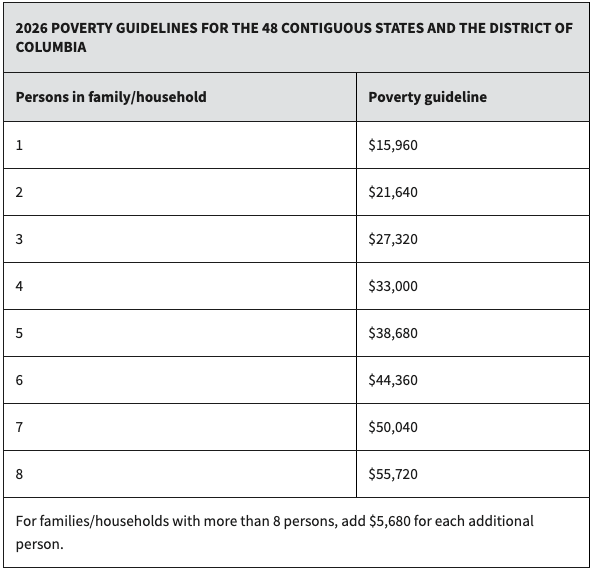
The 2026 poverty guidelines have increased between 1.98% to 2.9% from their levels in 2025. The higher the poverty guidelines, the lower the monthly student loan payment for certain income-driven repayment plans.
Expert Tip
Available Income-Driven Repayment (IDR) plans, as of March 2026:
- Income-contingent repayment (ICR)
- Income-Based Repayment (IBR)
- Pay-As-You-Earn (PAYE)
Not all borrowers are eligible for all IDR options. To see which option you are eligible for, upload your federal student aid data file to the VIN Foundation My Student Loans tool and check your “IDR Eligibility.” A new income-driven repayment option, the Repayment Assistance Plan (RAP) was created in July 2025 but is not scheduled to be available until July 1, 2026. RAP does not use the federal poverty guidelines in its repayment calculation.
Generally speaking, the higher your family size, the higher the poverty guideline, and the lower your monthly student loan payment for IDR plans like ICR, IBR, and PAYE.
IDR options can be extremely beneficial for veterinarians, who routinely start their careers with a student debt balance exceeding their income and who frequently change employers in the first couple of years after school.
Poverty Guidelines, Discretionary Income, and Income-Driven Repayment
For ICR, IBR, and PAYE, your minimum monthly payment is calculated as a percentage of your Discretionary Income. The Discretionary Income formula protects a portion of your taxable income from your student loan payment. Different income-driven plans protect different amounts of your taxable income using poverty guideline multipliers. The higher the multiplier, the more of your income is protected and the lower your monthly student loan payment.
Discretionary Income Multipliers for Income-Driven Repayment Plans:
| Income-Contingent Repayment (ICR) | Income-Based Repayment (IBR) | Pay As You Earn (PAYE) |
1.0 | 1.5 | 1.5 |
The Discretionary Income formula used by the Department of Education (ED) for ICR, IBR, and PAYE:
Taxable Income – Multiplier * HHS poverty guideline
Let’s say you are a single veterinarian living and working in the lower 48 states, and your Adjusted Gross Income (AGI) from your recent tax return is $125,000. Your Discretionary Income for the various income-driven plans would be:
| Repayment Plan | Discretionary Income Formula | Discretionary Income |
| ICR | $125,000 – 1.0*$15,960 | $109,040 |
| IBR | $125,000 – 1.5*$15,960 | $101,060 |
| PAYE | $125,000 – 1.5*$15,960 | $101,060 |
The IDR plan you choose determines the percentage of your Discretionary Income for your minimum monthly student loan payment:
| Repayment Plan | Plan Percentage | Discretionary Income | Monthly Payment |
| ICR | 20% | $109,040 | $1,817/month* |
| IBR | 15% or 10% | $101,060 | $1,263 or $842/month** |
| PAYE | 10% | $101,060 | $842/month |
*ICR payment is the lesser of (1) what you would pay on a repayment plan with a fixed monthly payment over 12 years, adjusted based on your income, or (2) 20% of your discretionary income, divided by 12.
**IBR has 2 mutually exclusive versions: (1) for new borrowers as of July 1, 2014 = 10% of Discretionary Income, or (2) anyone who is not a new borrower as of 2014 = 15% of Discretionary Income.
Poverty Guidelines in the VIN Foundation Loan Repayment Simulator
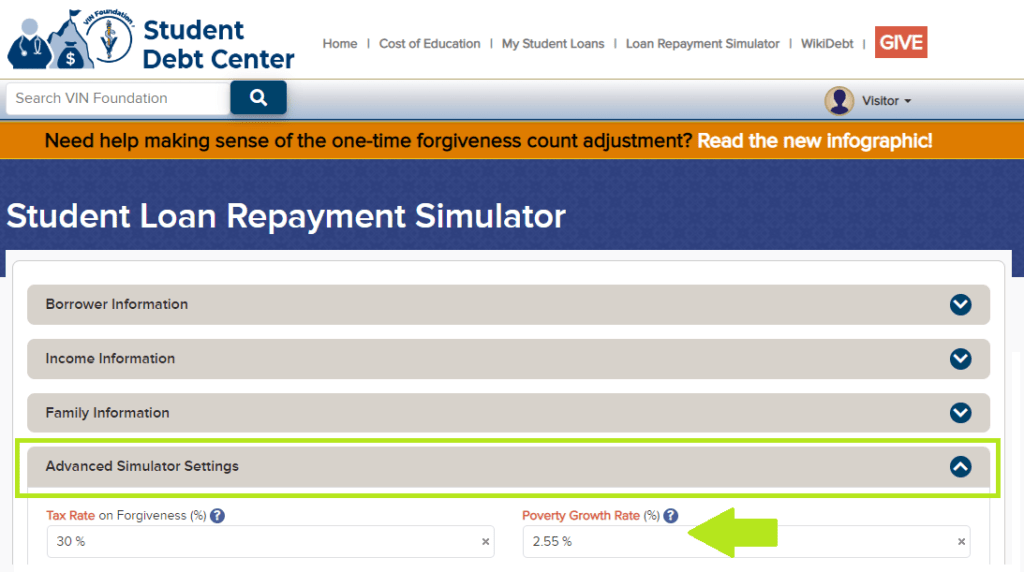
Projecting future payments for income-driven plans requires annual adjustments to the poverty guidelines. The VIN Foundation Student Loan Repayment Simulator is now using the recently updated 2026 poverty guidelines for IBR and PAYE calculations. You can change how the Simulator increases the poverty guidelines beyond 2026 in the Advanced Simulator Settings section of the Simulator. The Poverty Growth Rate field has a default value of 2.55%, but you are welcome to change it to any growth rate you see fit.
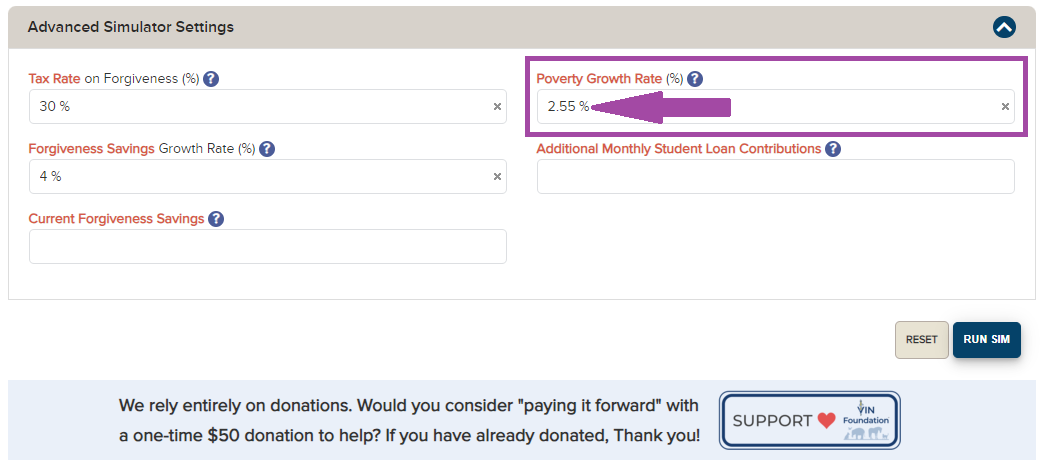
Poverty Guideline Growth Rate in the Advanced Simulator Settings of the VIN Foundation Student Loan Repayment Simulator
You might be asking, “Why is the Poverty Growth Rate so low when inflation has been running much higher for the last couple of years?”
While inflation has been higher than average lately, its rate of growth has stabilized recently. History suggests that it should eventually settle between 2-3%. For example, over the last 10 years, poverty guideline increases have averaged about 3%. Over the long run, assuming a poverty growth rate between 2-3% in your simulations should be a good approximation for your IDR projections.
VIN Foundation receives a lot of questions from veterinarians and veterinary students about how income, tax filing status, and family size play into a student loan repayment strategy. If you’re a veterinarian or veterinary student, you have access to the special student debt message board area where we provide student debt help to our colleagues.
The beginning of the year is a great time to do a good “physical exam” of your student loans and see if you can lower your minimum monthly student loan payment.
We’re here to help!
If you need help understanding your options, reach out to VIN and VIN Foundation. We have free online tools like the VIN Foundation Student Debt Center and special message board areas to help you make sense of your options. If you have questions on any of the available tools and options, reach out to [email protected]. We’re here to help!