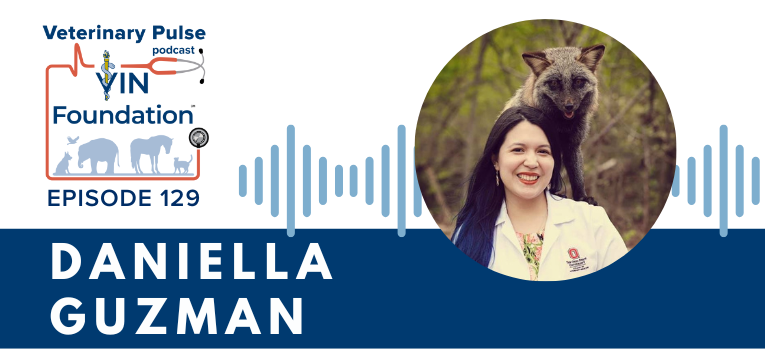
Listen in as Dr. Matt Holland has a conversation with Ohio Veterinary School student Daniella Guzman, and Dr. Tony Bartels about financing veterinary school, and how the school decision has lasting impacts on a veterinary career. They discuss the intersectionality of mental health and money, and how creating your own path in the midst of expectations
GUEST BIOS:
Dr. Tony Bartels
Tony Bartels graduated in 2012 from the Colorado State University combined MBA/DVM program and is an employee of the Veterinary Information Network (VIN) and a VIN Foundation Board Member. He and his wife, a small-animal internal medicine specialist practicing in Denver, have more than $400,000 in veterinary-school debt that they manage using federal income-driven repayment plans. By necessity (and now obsession), his professional activities include researching and speaking on veterinary-student debt, providing guidance to colleagues on loan-repayment strategies and contributing to VIN Foundation resources as a board member. Beyond debt, his professional interests include small- and exotic-animal practice. When he’s not staring holes into his colleagues’ student-loan data, Tony enjoys fly fishing, ice hockey, camping and exploring Colorado with his wife, Audra, and their two rescued canines, Addi and Maggie.
Daniella Guzman
Daniella is an economist and fourth-year veterinary student at The Ohio State University College of Veterinary Medicine and is pursuing a career in zoological medicine and is exploring an interest in veterinary public policy. Highly active in organized veterinary medicine, she is currently the AAZV Student Programs and Services Student Representative, the WDA Wildlife Veterinary Section Student Representative, President of the OSU chapter of VOICE and WVLDI, and holds various other leadership roles. In her spare time, Daniella likes to take her cat on nature walks and paint pet portraits for her friends and family.
LINKS AND INFORMATION:
- VIN Foundation Student Debt Center
- VIN Foundation Apply Smarter
- VIN Foundation Vets4Vets®
- Veterinarians as One Inclusive Community for Empowerment (VOICE)
- OSU VOICE
- OSU
- AAZV Education Committee
- AAZV Student Programs and Services
- WVLDI
- OSU WVLDI
- YouTube video
You may learn more about the VIN Foundation, on the website, or join the conversation on Facebook, Instagram, or Twitter.
If you like this podcast, we would appreciate it if you follow and share. As always, we welcome feedback. If you have an idea for a podcast episode, we’d love to hear it!
TRANSCRIPT
Intro
Daniella Guzman: As a fourth year, and in obviously a very different situation financially than a lot of my peers given the amount of financial support I’ve had, but I’ve got friends that are literally avoiding looking at the options because they’re so terrified at the number that theycurrently have, like “I’m in $350,000 of debt, and I am terrified of even approaching that. So, I’ve just deemed I’m going to die in debt.” It’s been really great to be able to point them towards VIN Foundation and even put in the really basic numbers. Okay, you just told me you’re in $300,000 debt, I can put those numbers in very superficially for you and send you this list of options that you have for repayment, and there is an option where the number is zero at the end. I think having that resource to offer to students is encouraging for them, because then they can feel like maybe I can tackle this huge, intimidating number. So, it’s been great to explore VIN Foundation and offer those resources to my friends that are now beginning the process of deciding what do I do when I grow up and how do I tackle this intimidating, overwhelming number I’ve never experienced before in my life?
Meet the Hosts and Special Guests
Jordan Benshea: That is Daniella Guzman, and this is the VIN Foundation’s Veterinary Pulse podcast. I’m Jordan Benshea, Executive Director of the VIN Foundation. Join me and our cohost and VIN Foundation Board member, Dr. Matt Holland, as we talk with veterinary colleagues about critical topics and share stories. Stories that connect us as humans, as animals, as a veterinary community. This podcast is made possible by individuals like you who donate to the VIN Foundation. Thank you. Please check the Episode Notes for bios, links, and information mentioned.
Matt Holland, DVM: All right, well, welcome, Daniela. Thanks for joining us.
Daniella Guzman: Thanks for having me.
Matt Holland, DVM: I also I want to introduce a special guest. If you’re familiar with sports broadcasting, I suppose I’ll be the play by play and Dr. Tony Bartels will be the color commentator. Welcome, Dr. Tony Bartels, to you. Thanks for joining us.
Tony Bartels, DVM, MBA: Thanks for having me, Matt. Super happy to be here.
Matt Holland, DVM: The reason we asked Tony to join the episode with Daniella is because we’re going to be diving into some financial topics and we thought who better to weigh in on those then Dr. Bartels.
Daniella’s Journey: From Undergrad to Veterinary School
Matt Holland, DVM: Before we get to those questions, Daniela, can you tell us a little bit about how you got from baby Daniela to here. How did you end up where you are now?
Daniella Guzman: Yeah, through a series of really random things. Which kind of leads me to my biggest thing is that the things that you are most upset about in life end up opening so many doors for you. I started out as babies and undergrad and shadowing veterinarians, and everything was sunshine rainbows. Then I wanted to make some money, so I became a vet assistant properly and got a job. Then things were not sunshine rainbows, and you know veterinarians started to be more honest about the struggles they were going through, especially the debt-to-income ratio. Given these less than encouraging statements and the advice of pick any other job, I started exploring the debt and the different options for repayment and randomly contacted Dr. Mike Dicks who was at that point the head of the economics department at the AVMA and just messaged him asking questions. What do you think about only applying to my in-state school given that if I get rejected, that’s like a whole year of my life that’s gone and a bunch of other questions? He was very excited that I was asking these questions and offered me an externship at AVMA with the economics department. I worked on a survey looking at the financial education that students have prior to getting into vet school, in vet school, and then how it’s impacted their lives post-graduation. After that, I finished undergrad and did not get accepted to my in-state school and let Dr. Dicks know thanks for that letter of recommendation. I’m going to need it again in a year and he asked me, “Hey, do you want to do a master’s in economics at Colorado State? I said yes, free degree, he says no to that. In six weeks, I finished my undergrad degree and moved to Colorado, where I have my master’s in agriculture and resource economics, did my thesis on the value of preventative medicine to the small animal client, then got accepted to Ohio State. Now I am in my clinical year, and I’m so happy to be done with didactic learning and ready to be a baby doctor.
Matt Holland, DVM: Okay, so from baby to baby, I guess. All right. There are several things I want to touch on in that story.
Networking and Opportunities in Veterinary Education
Matt Holland, DVM: One, the power of networking, but especially, cold calling, or cold emailing. You didn’t know Dr. Dicks before you reached out, right?
Daniella Guzman: No, he just posted a recent article that they had written. He posted on the pre-vet Facebook page and at the end, he says, if you have any questions reach out. And I was like, I will! And I did.
Matt Holland, DVM: Yes, I think that goes to show that people mean that when they say it, and it can lead to all sorts of opportunities, like look where that lead for you.
Daniella Guzman: I know. That’s definitely not what I thought was going to happen when I sent those messages.
Matt Holland, DVM: Yeah. Can you tell me around what timeframe this was, like what year was the externship, what year was that?
Daniella Guzman: Oh, geez. Oh, that’s a very good question. It was like the second summer of undergrad. Oh, God. I don’t know. 2014? Maybe a lifetime ago?
Matt Holland, DVM: Well, that. Yeah. That is right around when [maybe a year before] when Tony and I first I was going to say met you, but I would say came across you because we saw you on a video that was playing at the AVMA Economic Summit. I think that was 2015. Right, Tony?
Tony Bartels, DVM, MBA: I yeah, that that sounds about right. Yeah.
Matt Holland, DVM: Yeah, and so can you talk about that video and explain a little bit more about what you learned during that externship, how it informed your decisions, applying to you, and after getting into vet school?
Daniella Guzman: Yes, absolutely. The video is basically a culmination of a bunch of different ways that students can minimize their debt load prior to getting into vet school. Just different advice, things like moving to, if you really want to go to X state school, maybe consider moving to that state ahead of time and getting residency and other such things. I have not watched that video since it was made in 2015, because I just cringe inside, and I appreciate when people send it to me, but my soul dies just a little bit because, it’s cheesy, and no one likes to hear their voice on recording. I think it really helped with understanding how important it was to think about those things and make those decisions and gave me the strength, especially when those in the older generation were like, ‘no, it’s fine, you’ll deal with it after.’ And I’m like, oh, no, I don’t think so. And so yeah, that pops up every once in a while like that and “Oh, my God, I saw you on YouTube!” And I’m like ha-ha, cool, please keep that to yourself. But no, I’m so grateful that it exists, and it offered me this opportunity to be known. But I will never watch it again.
Tony Bartels, DVM, MBA: Never say never!
Daniella Guzman: Oh, yeah, I know.
Tony Bartels, DVM, MBA: No, I remember when I first saw that, it was as we were having some, I would say disagreements but yet optimism with the AVMA at the time, because Mike Dicks was still new to us, and we were building a relationship and talking about our experience with student debt. But the crux of the video was take a year off before you apply and save some money and you’ll save some money on your student debt. When I hear things like that, it makes me think about all the people that I help. They are not going to be able to save enough money in a year working as a veterinary assistant to significantly impact their veterinary education costs. We’re so far beyond that in terms of what it costs to become a veterinarian, depending on what school you attend that that was just laughable to me. I think back to before I got into veterinary school, I was making 10 bucks an hour as a veterinary assistant. It was barely enough to make ends meet, let alone save the amount needed to pay or appreciably put a dent in, say a $30,000 tuition bill for the year. So, that to me highlighted some of the frustrations that particularly Paul Pion and I were having with the AVMA at the time in terms of we need to change this discussion around veterinary educational costs and veterinary student debt because the things that we used to talk about back in the day, if you will, just aren’t applicable anymore.
Daniella Guzman: Yeah, absolutely. You could never, never get away with being a vet assistant, you’d graduate undergrad and need to get like a real adult job, if you even wanted to stand a chance, like a real career. Some people do that. Some people coming to vet med, it’s a second career after having paid off their undergrad loans. That’s a whole different thing, because I was very fortunate to not have undergrad loans. If you had them, it’s not wrong to pay them off and use whatever degree you got before starting vet school, which I know is painful to a lot of people who are like, but the dream is to be a vet. Well, I hope that you’ll live a long life, and you don’t have to do it right now, but people don’t want to hear that.
Matt Holland, DVM: I was furiously googling to find this video to see how many views it has. Do you have any guesses, Daniela? I know you said you’ve never watched it again, so you haven’t been there, but it’s got 36,000. I bring it up because Tony also brought up Paul Pion and Paul Pion left a comment on this video. The theme from the comment that I made before about you never know what’s going to lead to what. You don’t know when things like this happen. You can go back and see the comment that Paul, the co-founder of VIN made now five years later, and it echoes what Tony just said. One, that illustrates just how small of a world veterinarian medicine is and two it’s cool to see that unfold over time.
Choosing the Right Veterinary School
Matt Holland, DVM: I think part of this discussion, or at least one thing I’m thinking of, and hopefully I’m leading you there correctly Daniela is why did you choose to go OSU? Were there certain parts about Ohio State that were appealing to your plan and your goals?
Daniella Guzman: Yes, so after my first attempt at vet school, I didn’t get into my state school, so after that I applied to basically every veterinary school that offered in-state tuition after the first year or had automatic residency. OSU was one of them, so that was the main reason why. And I went to the interview, and it was very unique, because I had felt like it was a school that wasn’t making you feel like you’re lucky that we even acknowledged your existence and allowed you to interview. It was more we want you to pick us just as much as we want to pick you. To be honest, I picked OSU because they offered me the best scholarship and they had in-state tuition after one year. The scholarship I received basically offset the cost of the difference of in-state and out-of-state tuition. Not that it didn’t matter to me where I went, but the most important thing was how much money I was going to owe at the end of it. When I talk to students that are interested in going to veterinary school and ask which vet school if you want to do Zoo, or which vet school if you want to do XYZ, I’m like the vet school that gives you the least amount of debt so that when you’re picking a job, money is not the rate limiting step for you. I really want to do zoo medicine and I recognize that my income will never look great and that’s okay if my debt is low, but maybe it’s not okay if I have a ton of debt and I can’t afford to make the choices I want to in life. I love OSU. They were super about diversity and inclusion and made me feel really welcome. I honestly picked it because it was the most affordable option.
Tony Bartels, DVM, MBA: Yeah, there’s a lot of great information. It touched on a lot of the things that we talk about with VIN Foundation in the initiative we call Apply Smarter. I do find that a lot of pre-veterinary students approach the application process as what I call a spray and pray approach where they just apply to as many schools as they can, and they pray that they get into one of them. That can maybe lead to an offer of admission, but the probability is quite high that it could lead to you paying a lot more than you have to towards your veterinary education. As you said, there’s a handful of schools that allow you to switch your residency status after the first year, which is not insignificant. It can save you 10s, if not hundreds of 1000s of dollars on the cost of veterinary education. So, when people ask me, what school should I apply to, first it’s your in-state one, like you said that you started with, but then if you really want to apply to other schools, you can target these other schools that do allow you to obtain or switch your residency status after that first year, which can really keep the cost down. Ohio State’s one of them, NC State, UC Davis, Washington State, and Missouri. I don’t think I missed any other ones. There are five of them that allow you to switch that residency status after that first year, so you can decrease the amount of tuition over the entire four-year period.
Daniella Guzman: Yeah, the difference for that first year is like $40,000 for in-state and out-of-state tuition. Before at OSU you had to apply and basically whoever is up in the clouds decides based on micromanaging your finances and determining whether or not you stayed in Ohio X number of days and spent X number of dollars in Ohio. In the last year or two, they decided that that was really invasive and inappropriate. Now, they just charge a $5 out-of-state fee, so, lucky for students that came after me and I’m happy for them. That’s hopefully something that other places might move in the direction of. So, that I don’t have to micromanage my life, make sure that the school isn’t like, ‘Hey, you went out of the state for 49 hours versus 48.’ I’m not even kidding, stuff like that would get you caught up and not approved. It was dumb.
Tony Bartels, DVM, MBA: Well, that’s great to hear that they made that made that easier.
Matt Holland, DVM: I was going to bet that Tony would have brought up that there’s no Harvard effect and I would have lost that bet.
Tony Bartels, DVM, MBA: Yeah. Right. Well, thank you for bringing it up.
Matt Holland, DVM: You want to talk about that? When Daniela was talking about vet school should I go to, what’s the best for Zoo medicine? Or what’s the best for equine? Where should I go for this? I bring up the Harvard effect or the lack thereof, because it directly addresses those questions that Daniela was posing.
Tony Bartels, DVM, MBA: Yes, that’s another thing we talked about in the Apply Smarter Initiative with VIN Foundation. That at least currently, there’s no data that says you’re going to earn any more or any less because of the school that you graduate from. So, where you end up in veterinary medicine is really a function of your experience during veterinary school and the networking that Matt you were talking about earlier, and then your interests and how you choose to pursue them. Everybody pretty much has, at least from what we can tell from the data so far, no matter what school that they attend and graduate from, can end up anywhere and everywhere within veterinary medicine and what you earn has nothing to do with the school. It has everything to do with the type of veterinary medicine you’re practicing, where you’re practicing, and the market dynamics that determine how much you can earn within that specific area of veterinary medicine.
Daniella Guzman: Yeah, I’m a huge believer in it’s who you know, not what you know. I know that not everyone agrees with that, or they lift their noses up to it, but to be honest, half the things you learn in vet school are outdated by the time you graduate just because of how quickly medicine and science moves. You’re always going to have to take CE for the rest of your life as long as you want to keep your license, but I took an el? owl sometimes and didn’t study as much because I went to conferences instead and I’ve met so many people that have helped me move my career forward. I know that a lot of students don’t want to make that financial investment, or they think that their grades are so important, but I’ve been in so many rooms where I’m the only student and there are a ton of important people and the more often you’re in those rooms, the more often you were associated with important people and being important. That will get you so far, especially in those niche careers like zoo medicine, or where I’m really interested in policy. It’s so much who you know, and networking and not just hitting the books all the time. I think students sometimes don’t want to hear, because that’s what we know, we know how to study. But putting yourself out there is a lot harder, especially in the world of COVID, where everything’s online and awkward.
Matt Holland, DVM: So yeah, I completely agree with who you know being as, if not more, important than what you know.
Balancing Work and Study in Vet School
Matt Holland, DVM: I think it’s a good segue into jobs with that, and where you work and what you do, and a good segue into working during veterinary school, and thoughts around that. When is that a good idea? When might that be trying to squeeze in too much and not necessarily making an appreciable dent in the bottom line of debt? That’s open to either of you, but I know, Daniela, since you’re still in vet school, you went through that thought process pretty recently.
Daniella Guzman: Yeah, so I think is why Tony and I might disagree, and I know it’s going to be very student dependent. I always tell students don’t take a job their first semester, just because vet school’s really hard and transition is challenging, especially if you’re going from undergrad to a professional school. I made the transition from grad to professional, but it wasn’t as jarring. I know a lot of students who are not ready to what I would say is like drinking from a firehose. So, I always say watch how it is. I personally did not choose to get a job and actually really invested in being as competitive as possible for scholarships, and OSU offers some very lucrative scholarships. So, over the last four years, I think OSU has given me about $93,000 in scholarships, which is a very unique experience, but for me, I just didn’t think working was worth it. Even if I got the best paying job as a manager at Aldis, it wasn’t going to touch what I could have gotten in scholarships. I am someone who’s less risk averse and so I put my eggs all in that basket. Obviously, there are a limited number of scholarships, and not everyone can get all of them, so there is that risk that I wouldn’t work, make any money, and get no scholarships, and then have really nothing financially. But I am team scholarship and trying to hedge your bets on those more lucrative higher value scholarships, and not clunk wasting, but using my time more to study and be involved in clubs and stuff, and just really putting myself out there with the school versus working. I do have friends that have three jobs in vet school, and I literally don’t know how they do it. I know like three different kind of vet’s assistance and are getting paid like nothing. I’m like, okay, you live your best life and make your decisions. I just personally didn’t think it was worth it to have three jobs at $7 an hour, and then not study and be exhausted more so that I am already exhausted. But that was just my opinion. I know Tony has different opinions.
Tony Bartels, DVM, MBA: Yeah, well, I don’t differ too much from you on that one. I do think we have to bring it back a little bit to reality there. Congratulations on being able to obtain that amount of scholarship within veterinary medicine, but that’s not normal. That’s outstanding, but the data that we have available shows that about half of veterinary students receive scholarships, and the average amount of that scholarship is about $6,000. So, you are way, way, way at the super end of the bell curve on that one. To give everybody more of a realistic expectation, you can spend a lot of time applying for scholarships, and sometimes the time and effort that goes into that is not necessarily going to produce the kind of results that you saw. It really is school dependent a lot. Some schools like Ohio State and some of the other state schools do a really good job of providing a lot of scholarships and some of the ones that are pretty high in dollar value. But then there are some schools that don’t offer scholarships at all. That is something that the pre-veterinary students should be researching as they’re applying. Do you have the opportunity for some of the scholarships like you received at the schools that are on your shortlist to attend? When it comes to working, it can be really, really difficult to work during veterinary school, particularly during those early years as you’re learning what it means to be a veterinary student. I mean, I did. I don’t know if it really helped all that much in terms of keeping my costs down, but it was something I tried, and there are certain positions that fit nicely, and allow you to still navigate your student’s schedule, and they’re ones that don’t. It really becomes a cost benefit analysis to you in terms of how much can I earn versus how much is this going to pull me away from all the things that I want to learn and pursue in veterinary medicine?
Daniella Guzman: Yeah, definitely, and just taking not only into account the actual hours that you’re working, but take into account that working is tiring, right? You don’t go home from your 8,10, 12-hour shift and you’re like, oh, my God, I really want to study now. No, you just want to go to sleep or watch TV. Take into account those hours that you maybe don’t think about when you’re considering a job, but you should totally think about because I come back from clinics, and I don’t want anything to do with anything. My email inbox is just growing and growing, and I’ll be back to people in three to five business weeks versus 3 to 5 business days, because you come home from working and you don’t want to keep working, and for us working is studying and doing those types of things. So, taking that into consideration too, that it’s not just the hours on your piece of paper schedule, it’s also the hours after that you still aren’t studying or doing school things.
Matt Holland, DVM: Yeah, I would add, I think this is a combination of what I’m hearing from both of you. I wouldn’t say don’t take a job in veterinary school; I would say don’t take a job in veterinary school unless it will also help you grow professionally. Speaking from my own experience, I’m thinking of two jobs, very part time, two jobs, I had in vet school were helping the school’s communications department. I really like that because I have a background in journalism, and it also scratched my networking itch. I got to interview people and understand how the school operated. I thought that was really interesting. Another job I had was as a TA for an infectious disease course; I had a strong interest in that topic, and I also really liked working with students. So, it was work, yeah, and it was tiring, but it helped me figure out what I wanted to do. Versus there were jobs available at the Clinpath lab, for instance and that wasn’t interesting to me, and that would have just stunted my growth. Whereas other people who were interested in that as maybe a career option would have felt great about that position and might have felt like the stuff I was doing would have stunted their growth. I would say there are so many things to do in vet school that are worth your time that if one of them is going to be a job that probably isn’t paying a whole lot, make sure it’s not stunting your growth.
Daniella Guzman: Oh, yeah, definitely. Looking at those different types of jobs, like you said, in vet school, everyone’s thinking vet assistant or vet related thing, but it really makes you competitive when you tutor students, especially for internships and residencies, because part of your job is to teach students. If you teach fourth years who are coming in or if you’re a resident, interns coming in, that’s something you think about when you take the job, but you’d be surprised how well you can sell jobs that aren’t the assistant or have the word vet in it or are directly related to veterinary medicine. So, don’t shy away from these other types of jobs that you’re not wearing scrubs in.
Matt Holland, DVM: For sure.
Advice for Aspiring Veterinarians
Matt Holland, DVM: Okay, so, being cognizant of time, I am curious, just a few wrap up questions. What advice would you give? You can answer one or both, but just a general theme of what do you know now that you wish you would have known then. What advice would you give pre-vet Daniela or first year Daniela? What wisdom have you gained along the way?
Daniella Guzman: I think the biggest thing is if it works for you, it works for you. If other people disagree with that, who cares? There’s no one way to do anything, and some people are going to be upset about that, upset that you’re doing it differently than they are and as long as it’s working, don’t let other people’s opinions impact you. I know that I got a lot of pushback because after I think like the first three weeks of vet school, I stopped going to class because I learned that I was unable to really process the information being given to me and I was not learning the way I needed to. I decided to watch lectures after because everything is recorded at OSU. So, when class was going on, I was doing research or other stuff to improve the professional side of my career and networking and going to conferences. Once the lectures were recorded, I would watch them, and things made so much more sense. I could rewind, I could Google things as the professor was speaking and pause, and I watched my grades improve significantly doing that. So many people are so up my butt about it, and ‘you’re not coming to class’, and it’s how do you even notice my lack of being there? There are 162 of us, go away! Leave me alone! I could have kept going to class, but then my grades would have suffered, and it would have been to appease people I literally don’t remember who they are, at this point four years later. It totally helped me in the world of COVID, because that transition was so easy, and wasn’t even a transition. That was just my life. You know, life is so long, and I say that as someone who’s only 26, but you’ll be fine if you get rejected from like the school you thought you needed to go to and you’ll be fine if you don’t get that position that you thought you would die if you didn’t get in whatever club. A lot of things I thought that I would die if I didn’t get, I’m so glad that I didn’t get them. I’m so glad that I didn’t end up at Cornell. Like sorry Cornell, but [I think I like I’ve been there a couple times] there’s not a lot to do. I’m really glad I’m at OSU and I’m so grateful. If I had got into Cornell, I wouldn’t have a Master’s and I wouldn’t have this cool thing that is so random, not something I ever would have pursued if it wasn’t for the fact that AVMA sponsored me. But in that moment, when I got rejected, I felt awful and terrible. I was like, oh, my life is over. I know I was like 18 or something, you’re fine. So, just not really harping on those losses that you think are going to make or break your life because they aren’t and not letting anyone tell you the right way to do something because as long as it’s working for you and not harming anyone else, like people’s opinions are vastly irrelevant.
Matt Holland, DVM: All right, I am imagining a podcast title here it’s something along the lines of get every scholarship and don’t go to class.
Daniella Guzman: I love it. That works for me. I’m sure that a lot of people are very confused how you can get both of those things, but you can in fact never go to class and get lots of scholarships.
Matt Holland, DVM: I know you’ve talked a little bit about this, but do you have a best guess and or an ideal landing spot for post veterinary school?
The Financial Realities of Becoming a Zoo Vet
Daniella Guzman: I would really like to be a zoo vet in an AZA accredited zoo in North America. I used to think that I wanted to go into the jungles, but I’m in fact a princess and need air conditioning and I hate bugs. So yeah, no, not for me. But that is the goal. How I’m going to get there I’m not really sure being very much pushed in the direction of small animal rotating internship which looking at the salary for that I’m trying everything possible to avoid that route. It’s hard because everyone’s telling me I need to do this and if I don’t, like deciding not to do it, I can’t go back because they want recent graduates and so honestly putting that off for January Daniela’s problem. The zoo vet is the dream, how I get there is still in the works.
Matt Holland, DVM: Okay, and so if I heard correctly, people are telling you that you won’t be a competitive applicant if you don’t do an internship, but you also are strongly opposed to an internship.
Daniella Guzman: Yes, that is where I currently am.
Matt Holland, DVM: Okay and then for an added layer which we also talked briefly about earlier, and Tony can weigh in here, but what’s the average salary for a boarded zoo vet?
Daniella Guzman: Oh God, I don’t know we’re second to last paid vets, I think we’re like right above animal behavior. I know that there actually isn’t a ton of information. There is a paper that should be coming out if it hasn’t already recently come out that is honestly, by now, not even accurate just given the fact that it’s so hard to collect that data and send it out and in time? I honestly don’t even know, but I don’t even think it’s like $100,000. I think it’s less than that.
Tony Bartels, DVM, MBA: Yeah, the best information I have are mostly anecdotes, and that’s right around that same range, somewhere in the 80s to 90s currently, anyway. Once you become boarded, that brings up one of my frustrations with the specialties, for sure they could certainly do a better job of providing some of that income information. I know everybody loves to say in veterinary medicine that I didn’t go into this for the money, at some point it is going to matter. You have to know how much you can expect to earn so you can help plan your life and understand and use that information to negotiate. Those are important pieces of information that unfortunately are not widely available. When it comes to zoo vets, though, [I certainly haven’t had the time to do this yet], but most zoos are state or in other words, publicly run, so you might be able to find that salary information online or through some kind of information requests. That could be a way of learning more about that particular salary, at least when it comes to those specific types of zoos. It would be great if those associations and specialty colleges would actually collect and publish some of that information.
Daniella Guzman: Yeah, and it’s tough because the American Association of Zoo Vets covers such a wide range of zoo vets. We’re talking about boarded zoo vets which takes five to six years, assuming you get it on the first try. Those that aren’t boarded, their salary must be so much less than those that are boarded and there is the option to go that route of experience, but you’re basically getting paid nothing for six years prior to being boarded. I don’t even know what number that is. How do I plan? At the end of the day, I love animals, I love zoo animals, but this is a job. This is a job. That’s what it is, and its purpose is I give you hours of my life, experience, and knowledge and you give me money and benefits. I don’t think it’s wrong to have that conversation or to say, yeah, I did this because I love it, but I also did this so, I can eat and have like electricity.
Tony Bartels, DVM, MBA: Yes, because this is a very common dream for most people who start veterinary schools, they want to be a zoo vet, we have recently opened up the VIN Foundation message board system, using the technology, of course, from VIN [Veterinary Information Network] for pre-vets to jump on and ask questions like that. That question has come up for how much can I expect to earn as a zoo vet, and we have had some of the zoo vets on VIN chime in. That’s where that data that I quoted came from, which is very similar Daniela, to the data that you that you guesstimated. So, if pre-vets are wondering, feel free to join that or the VIN Foundation. It’s free and you have access to ask questions like that on the Apply Smarter and Student Debt message board areas of VIN Foundation. We can actually have veterinarians who are experienced in those areas come in and try to answer those questions for you.
Daniella Guzman: Yeah, that is so awesome. That’s a resource that not only pre-vets, but current veterinary students had. Especially as a fourth year, and in obviously a very different situation financially than a lot of my peers given the amount of financial support I’ve had, but I’ve got friends that are literally avoiding looking at the options because they’re so terrified at the number that they currently have, like “I’m in $350,000 of debt, and I am terrified of even approaching that. So, I’ve just deemed I’m going to die in debt.” It’s been really great to be able to point them towards VIN Foundation and even put in the really basic numbers. Okay, you just told me you’re in $300,000 debt, I can put those numbers in very superficially for you and send you this list of options that you have for repayment, and there is an option where the number is zero at the end. I think having that resource to offer to students is encouraging for them, because then they can feel like maybe I can tackle this huge, intimidating number. So, it’s been great to explore VIN Foundation and offer those resources to my friends that are now beginning the process of deciding what do I do when I grow up and how do I tackle this intimidating, overwhelming number I’ve never experienced before in my life?
Tony Bartels, DVM, MBA: Yeah, for sure. Thanks for mentioning that. I think that’s what we work really hard to do with VIN Foundation, as no matter how much student debt you’ve finished vet school with, there’s usually a way to help you manage it, no matter what you hope to do within veterinary medicine afterwards. It’s always easier to manage less than it is to manage more, but there are a lot of pathways to getting to that zero number. Some of them are more strange than others, but there is always a pathway to get to that zero.
Matt Holland, DVM: This is such a great conversation. I’m trying to remember all the stuff I wanted to say without taking notes. I heard Tony say earlier that we all like to talk about how we don’t care for the money, but at some point, that’s going to matter. Totally agree. Then I heard Daniela say that we do love what we do and also, we need to eat, and we need electricity, and we need shelter. It reminded me of what you said earlier, Daniela [I forget verbatim], but it was along the lines of you don’t want your situation to be such that it prohibits you from doing what you want to do and limit you only to maybe an ER job or something extraordinarily on the high end of the income in the profession. It makes me think of what Tony said just now, you’re going to have to manage, it’s easier to manage less than it is more, but there’s also a way to manage this debt load. So, you can do other things in life that you want and need to. The alternative is managing let’s say you are at a job that you really don’t want to be at, but you feel like you have to be well, then you start resenting that and you have to manage emotions. I think in some ways, it’s easier to manage the financial figures than the emotions of feeling stuck. On that note, another VIN Foundation resource is Vets4Vets. if you are feeling stuck. That is a resource I bring up often, but it’s because it’s relevant to most conversations if you’re feeling stuck at work. It’s also a resource for veterinary students stuck in school with anything from like depression or anxiety to grief or loss, Vets4Vets is there for you. Bringing it back to the discussion, I had one more question, which is if you wanted to leave the audience with one thing, Daniela, what would that be? Or it could be two or several.
Mental Health and Financial Support Resources
Daniella Guzman: So obviously, what I said before and similar to what you were talking about, just the intersectionality of mental health and finances, because when I talked to my friend that had this overwhelming mountain of debt, I was like, it’s okay, if step one is talking to someone about it, is talking to a counselor and learning the way to manage that overwhelming panic, step one doesn’t always have to be the money part. Step one can be the finding the emotional fortitude and strength to even begin the process of looking at the money. Sometimes we don’t talk about that and talk about how important something like Vets4Vets is in even approaching our debt. They’re not mutually exclusive. Talk to people, talk to your peers, talk to your mentors. Hopefully, your school, like mine, offers counselors specifically for vet students that all they do every day is listen to the similar problems. They’re well equipped at managing these emotions. It’s okay for you to schedule an appointment with your therapist, and what’s the purpose of the appointment is to look at VIN Foundation and your debt load and having someone there to emotionally support you while you’re doing these things. You don’t have to do them by yourself. We’re all in the same boat. There’s nothing wrong with admitting that I’m terrified to look at this and I’d rather just ignore it, because that’s easier but harder. Valuing your mental health because it’s going to be so important for all these other scary, intimidating, adulty things that we’re maybe not as well equipped for as we’d like to be
Matt Holland, DVM: I’m just curious if Tony had any thoughts on that?
Tony Bartels, DVM, MBA: No, I think that was pretty good. That was a pretty excellent summary.
Matt Holland, DVM: Yeah, I think so, too. Do you have anything that you wanted to leave the audience with?
Tony Bartels, DVM, MBA: I don’t, other than the fact is to realize that if you are struggling with any of the things that we talked about, you’re not the first or only person. You’re not alone. We have a lot of resources, there’s a lot of people dedicated to helping you understand some of the things that you might be struggling with and helping you to realize that there are plans and people that are specialized in helping you understand those types of things to help you move forward and achieve your goals. So, you don’t have to feel like you’re suffering in silence if you don’t understand something or you’re not quite sure how to tackle something like your emotional stress or your financial stress.
Matt Holland, DVM: Yeah, totally agree. I definitely fell victim to that after vet school. I was being really hard on myself. I was like I should really know what I’m doing because I thought I went to those lectures about this and paid really close attention, but now I feel scared of it again. That’s totally normal. That’s what VIN Foundation is for, we’re here to help.
Outro
Matt Holland, DVM: I think with that, thank you again, Daniela and Tony for the guest appearance. We’ll see you next time and have a good one.
Jordan Benshea: Thank you for joining us for this episode of the Veterinary Pulse. Please check the Episode Notes for additional information referenced in the podcast. If you enjoyed this podcast, please follow, subscribe, and share a review. We welcome feedback and hope you will tune in again. You can find out more about the VIN Foundation, through our website, VINFoundation.org and our social media channels. Thank you for being here. Be well.