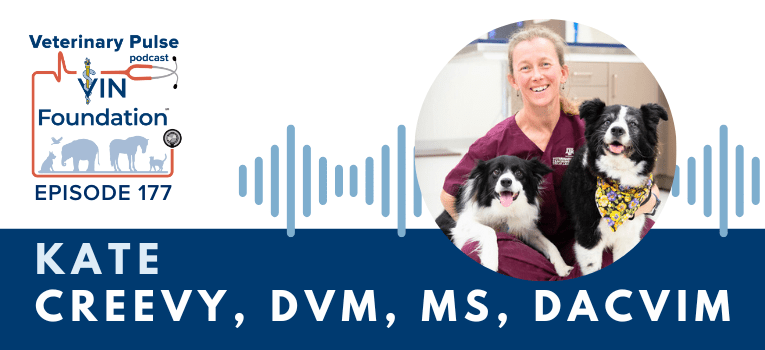
Listen in as we talk with Dr. Kate Creevy about her fascinating and insightful path in veterinary medicine. She shares how decisions she didn’t see as impactful at the time played crucial roles in her career development, and the important role of science and research for the future of human and animal kind. Plus, learn how a phone call that started with “I got this guy in genetics” led to her role as Co-Founder and Chief Veterinary Officer with the Dog Aging Project, and her advice to veterinary students and colleagues as a veterinary school professor. This is one of those episodes you will want to listen to, save, and listen to again.
Photo credit: Texas A&M University College of Veterinary Medicine & Biomedical Sciences photo, Dr Creevy with two Border Collies at different parts of their lifespan journey – Poet at age 3, and Sophie at age 14.
GUEST BIO:
Kate Creevy, DVM, MS, DACVIM-SAIM
Dr. Creevy’s educational path includes Georgetown University (BS), the University of Tennessee (DVM), the University of Minnesota (small animal rotating internship) and the University of Georgia (internal medicine residency and MS in Infectious Disease). Along the way she has worked in emergency practice in the Twin Cities and Washington DC, as well as academic emergency practice at UGA, and completed a Cancer Research Training Award Fellowship developing protocols for chimeric bone marrow transplantation in immunodeficient dogs at the NIH’s National Cancer Institute. After ten years as a small animal internist on UGA’s faculty, she joined the faculty at Texas A&M University’s School of Veterinary Medicine where she is now a Professor in Small Animal Internal Medicine. Dr. Creevy is the Chief Veterinary Officer for the Dog Aging Project, a multicenter, multidisciplinary research collaboration, with over 50,000 dogs enrolled across the US. The long-term goal of the Dog Aging Project is to understand the genetic and environmental determinants of healthy aging in companion dogs. In addition to her work on canine aging, Dr. Creevy’s research interests include infectious disease, and the development of lifelong learning skills and critical thinking skills among professional students and early-career veterinarians.
LINKS AND INFORMATION:
- Dog Aging Project
- University of Tennessee, College of Veterinary Medicine
- University of Georgia, College of Veterinary Medicine
- Texas A&M College of Veterinary Medicine
- One Health
- Zoobiquity
- Lessons in Chemistry book
If you like these podcast and want to hear more, please support these efforts through a donation to the VIN Foundation.
TRANSCRIPT
Intro
Kate Creevy, DVM, MS, DACVIM: Once you’re not afraid, refinements easier. When everything is scary, it’s hard to learn, and when you realize you are just going to handle whatever happens next, now you can open up a much more curious mindset, much more exploratory. You’re less afraid of clinging to something so you don’t make a mistake and more capable of thinking, what can I learn from this? What can I try? What’s the nuance? What’s new and different here?
Meet Dr. Kate Creevy
Jordan Benshea: That is Board Certified Small Animal Internal Medicine Specialist, Professor, and Researcher, Dr. Kate Creevy, and this is the VIN Foundation’s Veterinary Pulse Podcast. I’m Jordan Benshea, Executive Director of the VIN Foundation. Join me as I talk with veterinary colleagues about critical topics and share stories. Stories that connect us as humans, as animals, as a veterinary community. This podcast is made possible by individuals like you who donate to the VIN Foundation. Thank you. Please check the episode notes for bios, links, and information mentioned. Welcome. Today we have a guest I’m very excited about and I’d like to welcome to the podcast, Dr. Katie Creevy welcome.
Kate Creevy, DVM, MS, DACVIM: Thank you. Thanks for the opportunity.
Jordan Benshea: I am very excited to have this conversation and to share your story.
Dr. Creevy’s Journey into Veterinary Medicine
Jordan Benshea: Let’s start with your journey into veterinary medicine. Was there this aha moment where you just thought, yep, my love for bunnies and animals and fish is enough and this is my lifelong goal?
Kate Creevy, DVM, MS, DACVIM: I frequently reflect that there wasn’t a time when I didn’t know that I wanted to do this. I think that’s more true of veterinarians than a lot of other professions, that many of us were drawn to this lifestyle from a very young age before we even understood the notion of a job or a career or profession. That was true of me. I just always wanted to be around animals. I always wanted to understand biology. We had a very biology focused household. My father is a surgeon. He’s retired now. My mom had a master’s degree in microbiology that she earned back in the 60’s when we mostly didn’t let women study the sciences.
Jordan Benshea: Yeah.
Kate Creevy, DVM, MS, DACVIM: So, I grew up in a household where we valued science. We talked about science. We talked about how the world worked. We talked about medicine. We talked about why doctors did these tests, or what these medications were doing inside your body. We talked about that stuff and so I think that was very natural for me to connect to animals. And I just wanted to understand all those things about animals that we talked about, about humans in my household. So yeah, I always knew I wanted a life with animals and when I came to understand what careers looked like, I wanted a career with animals. I entertained a few other options along the way and nothing ever really drew me away from that goal.
Jordan Benshea: Hearing about your mom and studying science at that time, have you heard of the book Lessons in Chemistry?
Kate Creevy, DVM, MS, DACVIM: No.
Jordan Benshea: Oh my gosh. I highly recommend that to our audience. Highly recommend it to you.
Kate Creevy, DVM, MS, DACVIM: Okay.
Jordan Benshea: I’ll put a link in the episode notes. It’s a fantastic book about a woman who’s a scientist in, I think it’s said in the 50’s or 40’s perhaps, but incredible book. Incredible book.
Choosing Veterinary School and Early Career Decisions
Jordan Benshea: So you knew you loved animals and you always wanted a life for animals, you figured out that vet med was your path, and where did you go to veterinary school?
Kate Creevy, DVM, MS, DACVIM: I went to the University of Tennessee as an out-of-state student. I know that recruiting and helping early career people understand veterinary education is one of the goals of the VIN Foundation.
Jordan Benshea: It is.
Kate Creevy, DVM, MS, DACVIM: And so I will comment that I made that choice. I made that choice knowing of the financial penalty that, that choice would carry, and I think that has only gotten more challenging in the four years since I went to vet school. So a big reason that I made that choice was where we were living we actually had two addresses and I could have been an in-state student at either Ohio State. We had an Ohio address. I also had a Kentucky address, so I could have been an in-state student at Auburn in Alabama, which contracts with the state of Kentucky. So I did apply as an Ohio State resident to all of the programs I did, including apply to Ohio State. For me, there were a number of things about the curriculum at Tennessee that were more appealing. It was a relatively smaller class and it was a non tracking curriculum, and we almost don’t have those anymore. But we did then, and so it was really important to me to not have to choose which of the animals I wanted to study. I wanted to do it all. So I made an intentional choice for this out of state education and the associated debt because I wanted that program. Ohio State was also in a big transition period at the time, and they had a lot of building going on and they had a lot of change in leadership. And candidly, my interview there, I didn’t meet anyone who was happy and I didn’t feel that, that was a very welcoming environment in that moment, so I was an out-of-state student at the University of Tennessee and I got a great education.
Jordan Benshea: Yeah, and I think that first of all, you having that foresight that you were purposely making that decision for a reason, and we do try to encourage pre vets, just at least go in with eyes wide open. And understanding there’s no Harvard effect with veterinary school. But also there is value in what culture do you feel like you’re really going to fit in with? And I think I’m hearing that from you, which I think is very valuable because it worked out really well for you.
Kate Creevy, DVM, MS, DACVIM: It did.
Jordan Benshea: So where did you go from Tennessee and what was your experience like in vet med there?
Kate Creevy, DVM, MS, DACVIM: So again, it was a relatively small class size and a non tracking curriculum, and I had just a lot of hands-on experience, a lot of personal attention from the faculty. That was all really, really valuable. I mean, many of those faculty encounters and those mentors remain mentors and friends to this day.
Internship Experience at University of Minnesota
Kate Creevy, DVM, MS, DACVIM: I chose to pursue a rotating internship, so I ended up at the University of Minnesota for a small animal rotating internship, so the College of Veterinary Medicine at University of Minnesota and Twin Cities, which was awesome. I loved it. When I was choosing internships, I really wanted to prioritize a high caseload, but at that time, there were few private practice internships. Mostly they were academic, and academic programs tend to have lower caseloads than private practices. So now as students are considering internship experiences, I tend to suggest that folks who want a high caseload experience, who feel that’s the learning environment that they need at that step, look carefully at the private practice internships. And folks who want a more didactic experience, look carefully at the academic internships. For me, there were very few private practice internships at the time, which I applied to. But I really wanted a high caseload experience, and Minnesota is one of the higher caseload teaching hospitals, particularly the emergency service. And it was great. I learned a ton. I was working all the time. I was tired a lot. I was engaged intellectually. I was engaged physically. I was challenged by the cases and the clients and the personal self-management. I mean, that’s what you want in an internship. I told myself that I wanted to go into my internship and when I was done I wanted to be bombproof and I wanted to know that whatever was going to happen, I could handle it. And I remember early in my internship, again, this was back in the days when we used these things that are called books. They’re on paper and they don’t have a battery, and there was a little book that we would all carry around, all of us interns, that was kind of the emergency cheat sheet book and you could look up any diagnosis that would come in on emergency. A kind of a quick treatment of like, what are your initial stabilization steps? What are your initial drug steps, whatever. And so I had gotten paged from the front desk to be told that, and I used this book very heavily in the beginning of my internship, and I remember a day, maybe two thirds of the way through the year, that I got paged from the front desk there was an emergency. So I got my book out to look it up and I remember realizing, I don’t need to look it up. Whatever is going to walk through the door, I’m going to handle it. I might not know everything about everything. I might not know the ultimate diagnosis. I might not be able to save this animal, but I’m going to handle it. And that was exactly what I wanted out of an internship here. So it was a really fun moment to realize that, that had happened, that I just felt unafraid. Whatever was going to walk in the door, I was just going to handle it.
Jordan Benshea: What an incredible feeling. And you must have felt so proud of yourself to have set off with that goal and to feel, okay, I know, because going in with, I really want a heavy caseload, you don’t hear that very often. And is that because you just wanted the breadth of the experience and to be able to say, I want to be bombproof, and the way to get bombproof…
Kate Creevy, DVM, MS, DACVIM: That’s right.
Jordan Benshea: Is to get that massive experience?
Kate Creevy, DVM, MS, DACVIM: That’s exactly what I wanted. Yeah, exactly what you said.
Jordan Benshea: I think that’s great.
Kate Creevy, DVM, MS, DACVIM: Yeah, it was fun. And it was fun to, and again, to also recognize how much more I had to learn and how much more refinement could happen. But once you’re not afraid, refinements easier. When everything is scary, it’s hard to learn, and when you realize you are just going to handle whatever happens next, now you can open up a much more curious mindset, much more exploratory. You’re less afraid of clinging to something so you don’t make a mistake and more capable of thinking, what can I learn from this? What can I try? What’s the nuance? What’s new and different here? So that was a really formative experience, was great to have.
Jordan Benshea: I think that’s true about fear in all aspects in our life. I was just listening to a leadership podcast with Brene Brown about this line of fear and how you act as a leader when you are above that line and you don’t have those concerns or you don’t let fear drive you versus when you’re below, and I think that’s the case from a leadership perspective and just as a human perspective in our lives. And for you to have that and think, okay, I’m not going to let fear drive this, probably made you such a better veterinarian in those experiences. Not that you were ignorant to the fact that there was more to learn, to your point, but fear is not that driver, and it’s a great lesson for us in life of if we just let go of that, what really are we capable of outside of that zone?
Kate Creevy, DVM, MS, DACVIM: Yeah. We think about that as educators all the time because learning happens when confronted with new situations. So learning always happens in the stretch zone. If I just have students do things that are very, very easy for them, that are very routine for them, they’re not learning. So to learn, to continue to build your skills, you have to be stretched. But if you stretch somebody too far, then they’re in the panic zone and then nobody can learn in the panic zone. And the same I think is true for us as clinicians, particularly early career clinicians. If you’re just completely overwhelmed by the work in front of you, you’re just in survival mode and you’re not learning. And if you get to a point where the work is substantial, but I can do it, now I can move through some of those things with routine and focus on, what am I actually learning, what do I need to learn, because I was not in the panic zone anymore, I was in the stretch zone, and that’s exactly where you want to be.
Jordan Benshea: Yeah. Kudos to you for setting yourself up for success like that.
Kate Creevy, DVM, MS, DACVIM: Yeah, it worked out pretty well. I mean, obviously I suppose the story could have had a different ending.
Jordan Benshea: So let’s continue with the story. What was your experience after that internship?
Navigating Financial Challenges and Emergency Practice
Kate Creevy, DVM, MS, DACVIM: So, I knew that I wanted to pursue internal medicine. I knew that I wanted to do a residency, and in those days there weren’t any support structures financially for that. So, as we already know, I went to school out of state and so I had pretty significant debt and in those days there was no income sensitive loan repayment. There was no public loan forgiveness. There was most of the further training forgiveness also going away, so you couldn’t get your loans suspended or partially paid back if you did further training. If you actually earned a degree you could have your loans temporarily suspended and not have to pay on them while you earned a degree, but most residencies didn’t include a PhD or other research degree, and so I simply didn’t. I couldn’t afford to do a residency. My internship ended and I couldn’t apply for residency because I knew that I couldn’t support myself while I did one. I would’ve defaulted on my loans and that seemed like a bad choice, so I said, “well, I will get a job and I will continue to live like a student and save up all the money that I can until I can afford to go do a residency while using my savings to pay on my loans so that I don’t have default on my loans,” and so that’s what I did. So I went into emergency practice. I was trained to see and handle a lot of emergencies. Emergency practice is one of the more lucrative opportunities for people who aren’t specialists or practice owners. And I was neither of those things, so I stayed in the Twin Cities in an emergency practice for the first year and a half after my internship, something like that, about a year and a half. And this was an emergency practice that did small animal and exotic and wildlife, which I loved. I loved all the species. Then I moved back to Washington DC where I had gone to undergrad and became an emergency doctor at a big private practice in DC that was actually a multi-doctor, multi-specialty practice called Friendship Hospital for Animals, and I was there for a few years and I started to apply. I did my plan. I saved up enough money to go back and do a residency without defaulting on my loans and I started to apply for residency. And as many people in this profession are aware, most people expect folks to do their internship and their residency right away after school, and folks who’ve done stuff other than that look unusual. Now, we’re not actually unusual. If you talk to specialists, many people didn’t go straight from school to internship to residency, but there’s this, in my opinion, misperception that that’s uncommon. And so as a person who’s in private emergency practice applying for academic internal medicine residencies, I got a lot of raised eyebrows and curious looks, and I also didn’t get a residency many times in a row. So I, in continued efforts to try to improve my resume and my experiences and broaden my horizons and make myself a better candidate and continue to do fun stuff in veterinary medicine, I ended up getting a cancer research training award fellowship at the NIH in Bethesda. So on the main campus of the NIH and Bethesda while I was working as a clinician in northwest DC. So I would spend sort of four days a week at the lab, and then I was working also four days a week at the clinic, which I realize is eight days and there’s only seven in the week, so there were days that I worked at both jobs. So I would do both jobs. I would go to the lab in the day and I would work a second shift at the clinic, and I loved it. It was fascinating. I learned so much about research. I learned so much about grants and how all of that works. I learned so much about the scope and capacity of the research enterprise in this country and how to manage a large program. I managed a colony of dogs who had a particular disorder that the folks that I was working with were studying in people and realized that this also happened to dogs, and so they began to study it in dogs as a way of developing bone marrow transplants and other things that could be used in people. And it was really, really important to my later career as a researcher. It might also have helped my resume as a residency applicant, but it was really important to my career as a researcher and my understanding of what was possible.
Jordan Benshea: What was it in dogs that you were researching?
Kate Creevy, DVM, MS, DACVIM: Leukocyte Adhesion Deficiency. This is an immunodeficiency disorder that occurs spontaneously in people, and it also occurs spontaneously in dogs, particularly Irish Setters. One of the things about genetic disorders of dogs is pretty quickly when we recognize them, we can make them go away because we stop breeding the dogs that have them. So Leukocyte Adhesion Deficiency is almost never seen anymore because we figured out what caused it and we stopped breeding dogs who had it, and that’s relatively easier to do in dogs than it is in people. If you figure out what the genetic disorder is in a person, you don’t say, “hey turns out you’re a carrier for this, you can’t have kids.” That’s not what we do with people, and so we are more quickly able to eliminate diseases from dogs than we are from people when they have a known genetic origin.
Jordan Benshea: That reminds me of the Zoobiquity book, but this was way before that, and I’m guessing years before that, and how fascinated to be focused on that one health focus and to really see that change. So where did that residency take you from a research perspective?
Pursuing a Residency and Research Fellowship
Kate Creevy, DVM, MS, DACVIM: Yeah, so this was a fellowship I had at NIH for three years, and so then from there, as I was continuing to apply for internal medicine residencies, I eventually made a connection with Craig Green at the University of Georgia. He is an infectious disease guru and he is retired now, and that’s really what I wanted to study, and he became a mentor and advocate for me. And when I was not matching into residencies, he contacted me and he said, “I know you didn’t get the residency, but we need an emergency doctor down here and if you’d be willing to come to Georgia as an emergency doctor, you’d be applying for a residency from a position on the faculty, and I feel like that’s got to help.” So I said, “okay,” and so I moved to Athens and took an emergency faculty position. Then I did, as a faculty member on the staff, I applied for a residency in the hospital where I was working. And I ultimately did match into that residency, and I did a master’s with Craig Green in Infectious Disease. And Fred Quinn was my other mentor and we worked on Mycobacterium. So all of that came together, and I think my understanding of what was possible in research led to me being interested in and unafraid of doing a Master’s with my residency. I also think that my years of private practice made my residency easier for me than it was for some of my colleagues who did come straight out of internship into residency.
Jordan Benshea: That’s a good point.
Kate Creevy, DVM, MS, DACVIM: Yeah, I definitely didn’t work harder in my residency than I had worked when I was working days in the lab and nights in the clinic in practice in DC. So for me, it was all quite a manageable workload and not harder than my previous jobs. So I think that, back to our conversation about being in a panic zone or the stretch zone for learning, I mean, for me as a resident, I took biochemistry as a graduated veterinarian who had been in practice for six years. I had taken biochemistry as an undergrad, but when you talk about the Krebs cycle, having treated diabetic patients, you just learn it differently.
Jordan Benshea: Yeah.
Kate Creevy, DVM, MS, DACVIM: It’s just different. It’s just different and I was sitting in biochem as part of my Master’s at UGA with all these undergrads and I was just, I mean, I was just loving it. It was so fun, and it’s the same equations that it ever had been and the same molecules that it ever had been. But my capacity to understand why this mattered and how to fit it into my understanding and my patience was just light years ahead of what it had been when I was 19 years old taking it as an undergrad.
Jordan Benshea: And what a gift. I mean, what a gift to be able to have that life experience that you can apply specifically, and as you’re learning this, you are remembering those cases and those animals, and that’s completely different than just reading it in those things called books.
Kate Creevy, DVM, MS, DACVIM: 100%.
Jordan Benshea: Yeah.
Kate Creevy, DVM, MS, DACVIM: 100%. I mean, it was delightful, and not many people taking a Master’s and have their required biochemistry or their required stats course are like, this is so great.
Jordan Benshea: I’m imagining you’re just like the happiest person in the classroom. You’re like, this is so cool, and the other students are like, oh my gosh.
Kate Creevy, DVM, MS, DACVIM: And I think the other thing too is like, I already had a Doctorate. If I got a B in my Master’s Degree Biochemistry, I was still a doctor. So some of that pressure for performance was removed. Anyway, so that was all just a terrific educational experience.
Jordan Benshea: Okay, so you’re at Georgia and you get your Master’s and now you’ve done your residency. It was incorrect, obviously…
Kate Creevy, DVM, MS, DACVIM: Yep. Yep.
Jordan Benshea: Calling the NIH residency before, my mistake. So that was the fellowship. So you’ve done your residency and you’re getting your Master’s and you’re in research.
Kate Creevy, DVM, MS, DACVIM: Yeah, so I did this research degree for my master’s. All residents are required to do a little bit of publication and the magnitude of the research that you do to go along with it can vary. So many people do a clinical publication as part of their residency, but people who do a joint master’s or PhD program will also do bench top research, so I did. So this time I was doing a cell-based research, using cells from catfish to try to cultivate this particular mycobacterium species that affects fish, but is very similar to TB, but it’s safer to study in fish because it’s not transversal to people. So for all of those reasons, it was a really interesting project. It was right in the middle of infectious disease. I was learning techniques I hadn’t previously done bench work, so that was good, and again, knowing that what I wanted was a faculty career. And so I was finishing my residency with research experience at the federal level, a research degree and a Master’s. I didn’t have a PhD. I don’t have a PhD. I probably will never have a PhD. Never say never. And feeling like I could set myself up to be a competitive applicant for faculty positions in internal medicine. And so finished my residency and my Master’s and applied for all the internal medicine positions that were open at faculty level positions all around the country.
Joining University of Georgia and Launching the Dog Aging Project
Kate Creevy, DVM, MS, DACVIM: There were like four that year, maybe five, and I ended up staying at the University of Georgia. They offered to hire me and I decided to stay for a variety of reasons and I think it was a good decision. So now I had been there as a faculty member in emergency, then I was a resident for three years, and then I was back at the faculty meetings. I’m like, hello, it’s me again, we’ve met. So I was early in my faculty career and I wasn’t going to continue my research with fish because I was in small animal medicine and companion animal, dogs and cats, and so while I had learned a lot from that work, it made sense to try to leverage that towards something that was a little clinically applicable to what I was doing. And so this is what happened, as an early career person you look for collaborators, I had Craig Green and I had other people in the department and other people I had met at conferences and things, and you’re forever looking for collaborators to help launch your research, and some of those conversations go well and some go nowhere and you never really know what’s going to stick, but you throw it all at the wall and you hope something sticks. So I was sitting there, and this is weeks into my job, and the hospital director, a man named Doug Allen who’s also retired at this time, who had been my friend and mentor as I was a resident. He was just a terrific veterinarian and a really good person and smart about managing people and smart about managing a hospital and,
Jordan Benshea: Which is hard.
Kate Creevy, DVM, MS, DACVIM: Which is hard, and I learned a lot from watching him and how he connected with people and how he made decisions. Anyway, he reached out to me, and I’m pretty sure this is a direct quote, he said, “Hey, Creeves, you’re new. You’re not doing anything. I got this guy in genetics that keeps calling me up and he wants to talk about these dogs or something and why they died and genetics and stuff. Will you go talk to this guy?” I was like, I don’t know. I mean, I know about genetics in the sense that I know the gene that causes Leukocyte Adhesion Deficiency in the dog, and that’s about it. Like, I certainly don’t know anything about genetics. I wasn’t really looking for a collaboration like that, and then I thought, he’s right that I’m new and I’m not really doing anything and I’m supposed to be looking for collaborators and you just got to keep trying. So I was like, sure, I’ll go meet this guy. So I went and met this geneticist whose name is Daniel Promislow, and long story short, he has been my collaborator ever since. And he and I with our other colleague, Matt Kaeberlein, co-founded and launched the Dog Aging Project. And truly that meeting, that initial meeting was just one of dozens of potential collaborators that I had met with that semester trying to make something get started, and I’m really, really fortunate that this is what got started. But also I think there’s just a testament to how many of those meetings I went into thinking this is going to be my new favorite person, and then it didn’t work. Ooh, this is my new exciting collaboration and it didn’t work. Then this one that I sort of felt like I’m doing it as a favor to my friend Doug, and this turns into the collaboration that has the find my research career. So pretty fascinating stuff.
Jordan Benshea: It’s super fascinating. And to speak back to residency, wasn’t the typical path because it wasn’t immediately after an internship and you’re in practice and you get this fellowship, which then helps you understand and find interest in this research.
Kate Creevy, DVM, MS, DACVIM: Yep.
Jordan Benshea: I mean you made that tie then, and there must have been a moment there to think, wow, I can see where my path has really led me to this. Those are like the best moments, like that’s where all the good stuff is. So you’re embarking on this research at Georgia and…
Kate Creevy, DVM, MS, DACVIM: yep.
Jordan Benshea: How does that path go?
Kate Creevy, DVM, MS, DACVIM: Yeah, so what happened was that Daniel had become interested in the genetics of aging in dogs, he studies aging genetics, and the fact that dogs of different sizes have different lifespans, pretty obvious to all of us who are veterinarians and dog lovers. So dogs of different sizes have different lifespans, which means dogs of different breeds have different lifespans because breeds are different sizes and that creates an opportunity to look at it genetically. So that’s what he was interested in and he had obtained a data set from the veterinary medical database, which is a terrific database that was started in the 60’s by the National Cancer Institute, tracking the summary information from physical exams of the dog, cat, horse and cow that happened at veterinary teaching hospitals around the country. So just this vast database back when nobody was doing vast databases. And he had obtained a data set from them to try to look at causes of death in different breeds of dogs, and it was 88,000 dogs. Then he realized that the way these diseases were coded in the records really required a veterinarian to understand what the cause of death probably was for each dog. We don’t really do cause of death in veterinary medicine the way they do on a human autopsy report or the medical examiner says what the cause of death was or your physician says what the cause of death was. We don’t really formally document that often in veterinary medicine.
Jordan Benshea: Interesting. Yeah.
Kate Creevy, DVM, MS, DACVIM: So he had these records of 88,000 dogs who had died, and at the time of death, the list of things that were wrong with them. But that’s not the same as knowing what their likely cause of death was. So he needed to collaborate with veterinarians to figure that out. So I said, “well, I don’t know much about genetics and I know very little about aging, but I know about dog disease and so I think I can do this.” So I worked with one of my residents at the time, Jamie Fleming, and we developed a system between the two of us and we went through this data set line by line, assigning cause of death. It took a very long time and led to a paper that was really, really, really popular. Got a lot of popular press coverage, as well as being very frequently cited and downloaded within the veterinary medical literature. And because we had coded this data set, then we could go back to it again and again and ask different questions and say, “well now first, let’s describe what dogs of different breeds die from. Great. Okay. Now that we’ve said that, how does it affect it if they’re spayed or castrated or not? How does it affect it if they have a certain specific disease early in life or they like to get other diseases later in life?” So we were able to use this same data set to answer many questions, but it had a lot of limitations. And so Daniel and I began to talk about, we should go out and recruit a population of dogs and build our own lifespan data set from dogs like the Baltimore Longitudinal Study of Aging or the Framingham Heart Study where you enroll people early and you wait for them to develop the diseases of aging when they age. But you’ve collected data about them for their whole lives, and so then when aging outcomes occur, you can look back and say, “is there anything earlier that could have helped us predict this?” And those are fantastic studies, but people live as long as people, and so dogs live a whole lot shorter.
The Genesis of the Dog Aging Project
Jordan Benshea: Yeah.
Kate Creevy, DVM, MS, DACVIM: And in the research career of a person, you can’t study the life of a person because you’re also a person.
Jordan Benshea: There’s this human aspect to that.
Kate Creevy, DVM, MS, DACVIM: But for a dog, in the research career of a person, you can study many, many sequential lifespans of dogs. So we started talking about it, I don’t even know when, a long time ago, and just step by step, chip by chip kind of moved towards this.
Building the Infrastructure
Kate Creevy, DVM, MS, DACVIM: So first we got a small grant to look at a small local population of dogs. And then we got a grant that enables us, it’s called a Network and Infrastructure Grant from the NIH, and it enables you to bring together researchers to design a collaboration. So they actually fund the work that it takes to build the infrastructure that enables you to propose another project for them to fund. So we had a Network and Infrastructure Grant and we worked on that for a few years and traveled around the country and met all sorts of people and held three major meetings and brought all these people together who were experts in dog aging and genetics and large clinical trial design and all this stuff to try to say, “can this be done and what would it look like if we were going to do it?” And the fascinating part was most of the veterinarians that we met said, “no, it can’t be done. It’s too big. Veterinarian is too much. It’s too big. We don’t have enough money. Veterinarians are cheap. We can’t do big, complicated things. We’re just trying to keep our practices functioning, like this is outside the scope.”
Overcoming Skepticism and Securing Funding
Jordan Benshea: And what timeframe, like years, are we talking?
Kate Creevy, DVM, MS, DACVIM: So this will be, let’s see, I finished my residency in 2007, I started working with Daniel very shortly thereafter. We got the our 24, I think in 2011 or 12. So this is 12, 13, 14, 2015.
Jordan Benshea: And we should clarify for the listeners, what we are talking about is the Dog Aging Project, which…
Kate Creevy, DVM, MS, DACVIM: yeah.
Jordan Benshea: You are…
Kate Creevy, DVM, MS, DACVIM: Is now very much going on.
Jordan Benshea: Is very much going on, and is one of your current roles. Not your only role, but one of your current roles in veterinary medicine currently.
Kate Creevy, DVM, MS, DACVIM: That’s right. Yeah, and so a lot of people felt that it was just too big, too ambitious, over the top, outside the scope, this isn’t what veterinarians do. And I think Daniel is an unbelievable optimist. Daniel is always able to see how something can go well, which is a terrific attribute to have. And I think my experience in research at the federal level gave me a different perspective than many of my career colleagues in veterinary medicine. I knew that big research could happen. I knew how much money was available to fund it. I knew how much infrastructure was already in place, and I think that’s because I had worked at the NIH.
Jordan Benshea: Again, you had that experience, which set you up for success here really.
Kate Creevy, DVM, MS, DACVIM: That’s right.
Launching the Nationwide Study
Kate Creevy, DVM, MS, DACVIM: So we started to submit grants to say we’re going to launch a nationwide study of aging in people’s pet dogs, and we’re going to enroll somewhere between 10,000 and 100,000 dogs in this study, and we certainly failed. We submitted a grant that was reviewed, scored badly, and we were given the opportunity to revise, but not with any expectation that we would be successful. We changed our design. We actually changed grant mechanisms. There are a bunch of different ways to submit grants at the NIH and the way that they get reviewed and the way they get funded can vary, and sometimes there are reasons that a particular idea is better suited for a different mechanism. But ultimately in 2018, we successfully received funding to launch the Dog Aging Project, and so that was…
Jordan Benshea: that’s incredible.
Kate Creevy, DVM, MS, DACVIM: 15 institutions and I don’t know, 30 or 40 people, and a five year funding of about 30 million.
Jordan Benshea: Oh my gosh. So 2018, that would take you to just beyond COVID.
Kate Creevy, DVM, MS, DACVIM: Correct, and so…
Jordan Benshea: Our tail end rougher, depending on how you.
Kate Creevy, DVM, MS, DACVIM: Yeah.
Jordan Benshea: What timeline of yours is.
Kate Creevy, DVM, MS, DACVIM: We received our funding announcement in the end of 2018, in like October or November of 2018. We had given ourselves 6 to 12 months to build out the infrastructure, create all of the online tools that were going to be necessary, build publicity so that people were ready to sign up. And a lot of what we do is collect survey based data, so we had to get all of our surveys robustly programmed and make sure that they worked and that their questions were clear and we went through lots of pilot testing and review and changes to make sure everything was workable for participants. We really wanted everyday people who own dogs in all 50 states. We didn’t want this to be something that was unavailable to a person with a dog because it required specialized research knowledge or specialized access. We didn’t want that. If you had a computer with an internet connection, we wanted it to be, that was enough. So, it took us about a year to get all of that organized and we had this big kickoff event in November of 2019, so it’s like giant. We had this big coordinated press releases at all of our universities, and there’s this Gerontological Society of America that’s a research convention that frequently has a public facing lecture, so that was our kickoff lecture and it was in Austin. So we had all of this stuff going on and we got all this enthusiasm, and the first step is to nominate your dog and we had like 27,000 nominations in 72 hours or something crazy.
Jordan Benshea: Oh my gosh.
Kate Creevy, DVM, MS, DACVIM: People were just over the top nominating dogs. There’s dogs coming from all over the place. So after you nominate your dog, then you get access to your research portal and you create a password or whatever and then you sort of trickle out these surveys for people to fill out gradually over time.
Navigating the COVID-19 Pandemic
Kate Creevy, DVM, MS, DACVIM: So we’re having this huge inbox of people signing up, and then January 2020 comes and then February 2020 comes and then March 2020 comes, and in March 2020 we were having a meeting of the whole research team in Seattle…
Jordan Benshea: obviously.
Kate Creevy, DVM, MS, DACVIM: Because we’ve just kicked off. We’ve got to manage all of these people. And I literally was boarding the plane when the cases in Seattle were breaking and they were shutting down the city. And I’m on the phone with Daniel and I’m walking down the little thing to get on the plane, and I’m like, should I still come? He’s like, I think we’re going to cancel. I mean, we can’t be the people who brought researchers around the country to Seattle and gave them all this new disease that we didn’t know was called COVID yet. We hadn’t yet gotten to the acronym, and we can’t be those people, so we’re going to have to cancel the meeting. And I’m like, I’m sure you and I have stuff we can still talk about. I mean, I’m actually boarding the plane, and so he’s like, yeah, why don’t you go ahead and come and we’ll work on stuff. Well, I mean, I got there and Seattle was a ghost town. The cab ride from the airport to Daniel’s house, like it was as if it was the middle of the night. There was nobody on the road.
Jordan Benshea: I remember those days getting on the freeway and it was just nothing. Nothing.
Kate Creevy, DVM, MS, DACVIM: Yes. I mean, like any movie of the apocalypse you’ve ever seen.
Jordan Benshea: 100%. Yeah.
Kate Creevy, DVM, MS, DACVIM: So I got there and we were like, this is not, I don’t know what we’re going to do about this. And then like, we were supposed to be there for five days and there’s a pandemic happening and the rest of the people aren’t there. And he and I kind of worked through some things, so I’m like, I don’t feel like I should stay here. Anyway, so I wanted to leave early, I was supposed to leave on Saturday or something, and I was like, this just doesn’t make sense for me to stay, like we can work remotely and I don’t know what I’m doing here. And this also is a place where there’s lots of this new disease and I don’t really want to get it, so I called the airport on Thursday, I’m like, hello, I’d like to rebook my flight, I’m supposed to go home on Saturday. They’re like, okay, and I’m like, do you need to know what flight it is, and they’re like, whatever. I’m like, well, it’s, Seattle to Houston. They’re like, it’ll be fine. I’m like, is there a change fee? And they’re like, no. And I’m like, do I need to pick a seat?
Jordan Benshea: They’re like, please just come on a plane.
Kate Creevy, DVM, MS, DACVIM: They’re like, the plane’s going to be empty, you can sit wherever you want. And I did, I went to the airport two days early and I got on a plane with like six other people, yeah.
Jordan Benshea: Wow.
Kate Creevy, DVM, MS, DACVIM: So, yeah.
The Role of Participants and Data Collection
Kate Creevy, DVM, MS, DACVIM: Then people were stuck in their homes for many months.
Jordan Benshea: With their dogs.
Kate Creevy, DVM, MS, DACVIM: And I think that what a lot of them did was fill out Dog Aging Project surveys.
Jordan Benshea: Yeah.
Kate Creevy, DVM, MS, DACVIM: I actually think for many people it was a reason to participate because it was something to do that they were interested in that was different and novel and it involved their dog and they were home anyway. I mean, we actually, we have a very strong participant base and they’re very committed to the project. But I think for some people in that peculiar time, it was a reason to be involved. And maybe if the world had been behaving normally…
Jordan Benshea: That’s true.
Kate Creevy, DVM, MS, DACVIM: We wouldn’t have had such a strong commitment from people who kind of got in on the ground floor and feel really, really strongly connected to the Dog Aging Project.
Jordan Benshea: Yeah, and especially during that time, they were so isolated. It was the highest numbers of adoptions.
Kate Creevy, DVM, MS, DACVIM: Yep.
Jordan Benshea: And they were home, and so there was that connection I think that so many people were missing that a lot of people made with their animals.
Kate Creevy, DVM, MS, DACVIM: Yeah.
Jordan Benshea: And then the opposite was true when people started going back to work. That’s a whole other situation, but that connection of, oh, this animal and the connection with dogs specifically in this instance and feeling, I want this dog to live, I want this dog to age well, and to feeling also that you gave them something that they felt they could do something about. So they’re living in this fear that we talk about, and there’s so much fear because there’s just huge unknowns for a lot of people, but they know they love this animal and there’s a connection to this person and here’s something I can do from my computer with this animal that encourages this animal. I mean, it was sort of the perfect storm for that sort of participation almost.
Kate Creevy, DVM, MS, DACVIM: Yeah, I think that’s true. And I think there was a lot of stuff we didn’t understand about COVID and there were a lot of people working to figure it out, but the average person wasn’t in a position to help with the pandemic. The average person was…
Jordan Benshea: Helpless.
Kate Creevy, DVM, MS, DACVIM: Yeah, wasn’t in a position to go into their laboratory and start doing tissue cultures of viruses, like that wasn’t something. And yet, I think most people understand that science and medicine are important, and science and medicine are connected, and this might have been a way that they felt like they could be involved in the future and the growth of science and medicine, even if they couldn’t do anything about the particular virus that was on everybody’s mind.
Jordan Benshea: Right, and it was an action that they could take, which made them feel like they had some control. Some participation that they could have while connection with community, while caring for this animal that means so much. It was really, for a lot of people, a lifeline during that time of huge isolation.
Kate Creevy, DVM, MS, DACVIM: yep. Completely agree. Yeah, so our participants are super motivated and deeply connected to the project, and we acknowledge that the entire project depends upon these volunteers, citizen scientists, community scientists who are providing information about their dogs. We go to a lot of trouble to make sure that the information is returned to them that we’ve learned from their dogs, and they deserve to learn what we’ve learned. So every time we have a publication, we’ll do a blog post summarizing it in lay friendly language for people who don’t read or don’t know how to read scientific publications.
Jordan Benshea: Yeah.
Kate Creevy, DVM, MS, DACVIM: We do monthly webinars with our participants that we focus on particular topics of interests that are interactive and they can ask questions and meet the people who’ve done the research and meet the people who are doing some of the analysis in our labs, and a lot of that started during those times. And I think our, I mean our events were very well attended and our blogs were heavily subscribed because again, I think it was a way for people to feel like they were part of something. They were helping. They were learning. It was an exterior stimulus in a time when there wasn’t always a lot of that. That was very uplifting.
Jordan Benshea: Yeah, and that connection that a lot of people were really missing is vital for us as humans.
Kate Creevy, DVM, MS, DACVIM: Yeah, for sure.
Maintaining and Expanding the Project
Jordan Benshea: And so were you at Georgia this whole time doing this?
Kate Creevy, DVM, MS, DACVIM: Yeah, so I was at Georgia until 2016. So Dan, so we met at Georgia and worked together there for a number of years. Daniel ultimately got recruited out to Seattle, so he was at the University of Washington, and then I got recruited here to Texas A&M and so came here in 2016. So we’ve maintained our long distance collaboration that whole time. Daniel has since now moved back out to Boston and he’s at Tufts University now. We like to say we were on Zoom before it was cool. So we started with this nationwide collaborative group before the pandemic, so we ran all of our research meetings by Zoom and made all of our connections and made all of our hiring and firing decisions and created protocols and created research workflows.
Jordan Benshea: So you were set up for success by the time COVID came.
Kate Creevy, DVM, MS, DACVIM: That’s right. We’d been on Zoom pretty consistently for 18 months before everybody in the world was on Zoom, and other virtual platforms obviously. So that’s been a part of the project all along, is that we’re very hybrid in-person teams with lots and lots of virtual connections all over the country.
Jordan Benshea: And what is your role now at Texas A&M?
Kate Creevy, DVM, MS, DACVIM: I’m a professor of internal medicine in small animal clinical sciences department. So I still have a clinical appointment. I do still do work on clinics, although the amount of time I spend on clinics is getting smaller over the years. I teach as well in the veterinary curriculum, so I actually teach in all four years of the curriculum, first, second, third, and then clinical in the fourth year, and I am the Co-Director of the Dog Aging Project, which is still going on. Our original funding was a five year grant in 2018, because some of the things that we wanted to do during COVID couldn’t be done, we ended up with a substantial part of our first year budget that couldn’t be spent and we were allowed to do what the NIH calls carry forward and spend it at the end of the grant. So we actually, the five years of funding that were granted, we actually spent out over about six and a quarter years. But we are now not currently federally funded for the Dog Aging Project. We’ve just submitted another grant to try to renew a five year funding support, so we literally submitted that like three weeks ago and I hope for good news after the first of the year. We obviously haven’t heard anything from anybody in the government shutdown time, but we expect to have a review and, hopefully favorable review, and funding after the first of the year. We’ve broken off several portions of the project that are funded separately. So we have a clinical trial that is federally funded right now, testing low dose rapamycin in aging dogs. And then we have grants from other non-federal agencies and philanthropic funding continuing to support the project. But we are still here. We’re going strong. We hope to continue to be. We look forward to a good review and funding decision for this central grant through the NIA that would be really, really beneficial to us to have that as a core source of support for the next five years and beyond.
Jordan Benshea: So incredible.
The Future Vision and Broader Impact
Jordan Benshea: I mean, when I first heard about this project, I just thought, this is so amazing and how just, I mean for veterinary medicine, for animal lovers, for the one health conversation, I mean, just all of it, it is just fascinating. And where would you like to see this project in 10 years or 5 years? I mean five years, you just stated you’d like that grant to go out five years.
Kate Creevy, DVM, MS, DACVIM: Yeah, I would love it. I’d love it to have that grant for the next five years.
Jordan Benshea: Yeah.
Kate Creevy, DVM, MS, DACVIM: And then continued funding beyond. I mean, I think for me, this project has a number of factors that really resonate with me. One, I love that we’re studying anybody with a dog who wants to log on and fill out surveys.
Jordan Benshea: Yeah.
Kate Creevy, DVM, MS, DACVIM: Much of veterinary medical research is done in teaching hospitals because that’s where the researchers work. Or it’s done by industry with a specific objective in mind. And teaching hospital patients and cases aren’t typical, so the teaching hospitals mostly see complex, severe, undiagnosable, or weird diseases, and that’s an important role and that’s what I do in my clinical practice and I enjoy it. And that needs to happen, but if that’s the patients from whom you’re recruiting your studies, it’s hard to study common things. You mostly have access to study weird and unusual things. So I love that we are studying typical dogs.
Jordan Benshea: Yeah.
Kate Creevy, DVM, MS, DACVIM: Dogs who never end up in a teaching hospital in their life. Dogs who never need to see a specialist in their life. I hope that for most dogs they never need to see a specialist in their life. So the people who sign up their dogs for the Dog Aging Project didn’t have to go through some medical event or experience to be eligible. They’re eligible because they have a dog and they felt like signing up. So I love that part of it, and I think that’s going to provide information that we don’t currently have easy access to about dog health in this country.
Jordan Benshea: Absolutely.
Kate Creevy, DVM, MS, DACVIM: We don’t really know rates of common diseases among typical dogs. We know rates of diseases at teaching hospitals, but it’s not the same. So I think that’s really great and exciting.
Jordan Benshea: And it’s exciting because you’re allowing animal lovers with a low barrier of entry to feel like they’re participating. And I think that really also encourages positivity within veterinary medicine, because these are animal lovers that want to do something, but to your point, unless they’re animals very sick they might not be able to have that experience and then that experience is not an enjoyable one. So this allows them to have an enjoyable one with a low barrier of entry and they can do it from their computer. I love all that.
Kate Creevy, DVM, MS, DACVIM: The other thing about it for me is that I firmly believe that biomedical science is critical to the future of humanity, and I am not overstating the case when I say the future of humanity. And we are at a cultural moment in which the value of science and even the value of anything that could be called a fact has come under question, and I think that is a dangerous and destructive direction for us to go. We need science. We need truth. We need facts. We need to understand how things work. You can make whatever choices you want about how to manage a medical problem or a scientific problem, but not until you understand what the problem actually is. And I think that’s where policy has a role in disease management. Policy has a role in how we fund or don’t fund certain types of therapies, but political figurations shouldn’t play into what the facts are. What the facts are. And so I think the need for more people to have more touchpoints with how science is done is, has never been stronger. We need more Americans to understand this is how we do it. We gather data. We carefully inspect the data. We interpret what the data show us, and then fine, then we can talk about the politics of how do we manage that disease for the nation. Fine. But first we have to understand how biology works, and biology doesn’t care who you voted for, and biology doesn’t care if you believe in it. Biology is going to happen the way biology happens regardless of someone’s viewpoint on the world. And I think that science feels to many people distant and mysterious, but this project can demystify that. All we are asking you to do is tell us what happened to your dog.
Jordan Benshea: Yeah.
Kate Creevy, DVM, MS, DACVIM: And if enough people tell us what happened to their dog, we can learn things about what happens to dogs.
Jordan Benshea: Yeah, and help them.
Kate Creevy, DVM, MS, DACVIM: It’s very accessible and then we can help them. So I think the project speaks to me in that sense as well, because I feel like this is a really important cultural dimension of how veterinary medicine can be part of the solution to this sort of shift away from confidence in science. So I love that and it’s an open data project. What that means is that we make our raw data freely available to the research community.
Jordan Benshea: I love that.
Kate Creevy, DVM, MS, DACVIM: So anyone who wants to can contact the Dog Aging Project, you fill out an agreement that says you won’t sell the data, you won’t try to make any money from it, you won’t try to discover anybody’s identity through whatever personally identifying information, all of those components, and then please analyze the data and publish your findings. We want you to go analyze the data and publish your findings. This means that veterinarians can start using our data and they don’t have to go collect it and they don’t have to worry about funding how they can collect it. I mentioned that when I was a resident, I did my research project in a laboratory on the bench and most of my colleagues in residency used clinical data, medical records, these sorts of things for their research projects. They can use Dog Aging Project data now.
Jordan Benshea: That’s amazing.
Kate Creevy, DVM, MS, DACVIM: So any resident who wants to use our data can do so. Any intern who wants to, any early career faculty member before they have their own lab up and running can use our data. So that’s another thing about the project that I am really proud of and I hope can be of service to the veterinary profession.
Jordan Benshea: I think that’s incredible, and I love all of it. I love the positivity towards veterinary profession and love how animal lovers are able to participate, because I think it just allows that accessibility, low barrier of entry, which is just so amazing, and we all want our dogs to live longer. I so appreciate your time today and I feel like I could just sit here and talk to you for hours with so many questions, but I know that our listeners only have so much time.
Personal Insights and Outro
Jordan Benshea: So, I just want to close out with, do you have a secret talent or something that you enjoy doing that others might not know about? I always get the most unexpected answers to this, so tell us Katie.
Kate Creevy, DVM, MS, DACVIM: So I have many hobbies, and I work hard, but I play hard too, and I really enjoy doing all sorts of things. But I think the one that always surprises people is that I am a classically trained singer.
Jordan Benshea: Whoa.
Kate Creevy, DVM, MS, DACVIM: And I have a…
Jordan Benshea: Didn’t see that coming.
Kate Creevy, DVM, MS, DACVIM: I have many years of background in musical theater and singing performance, and I’ve been in city choirs and university choirs and sung at weddings.
Jordan Benshea: That’s amazing. I love it.
Kate Creevy, DVM, MS, DACVIM: Yeah, so nothing I’m doing professionally or actively and honestly nowhere near as much as I would like, but something I certainly continue to enjoy.
Jordan Benshea: That’s incredible. I never would’ve seen that coming and what a well-rounded way to spend your time and talent to have. I love that. Is there anything else you want to leave our audience with today?
Kate Creevy, DVM, MS, DACVIM: No, I’m really grateful for the opportunity and I love that part of the mission of the foundation and when you and I spoke about this podcast is I think it’s important for people who are interested in veterinary careers to know that there’s so many ways to be successful.
Jordan Benshea: Yeah.
Kate Creevy, DVM, MS, DACVIM: So many paths that work. It is not a cookie cutter experience and your path is the path for you and it’s different from someone else’s, and I think that’s great. And I just invite people to check us out at the dogagingproject.org. Sign up your dog, access our data, collaborate with our team. We’d love to hear from you.
Jordan Benshea: Yeah, and we will put all those links in the episode notes, so all of you listening who are interested can go explore and we’ll put some of the links we mentioned today as well. Thank you so much for your time, Katie. I really appreciate your time and effort.
Kate Creevy, DVM, MS, DACVIM: Thank you.
Jordan Benshea: And thank you for everything that you’re doing to help our animals and dogs and learn how we can help give them more life, because I definitely know I want that with my dog so.
Kate Creevy, DVM, MS, DACVIM: I know everybody does.
Jordan Benshea: Everybody does.
Kate Creevy, DVM, MS, DACVIM: We want our dogs to live long and well.
Jordan Benshea and Kate Creevy, DVM, MS, DACVIM: Long and well.
Jordan Benshea: Exactly, long and well. Thank you so much, Katie.
Kate Creevy, DVM, MS, DACVIM: Thank you.
Jordan Benshea: Thank you for joining us for this episode of the Veterinary Pulse. Please check the episode notes for additional information referenced in the podcast. If you enjoyed this podcast, please follow, subscribe, and share a review. We welcome feedback and hope you will tune in again. You can find out more about the VIN Foundation through our website, VINFoundation.org, and our social media channels. Thank you for being here. Be well.