
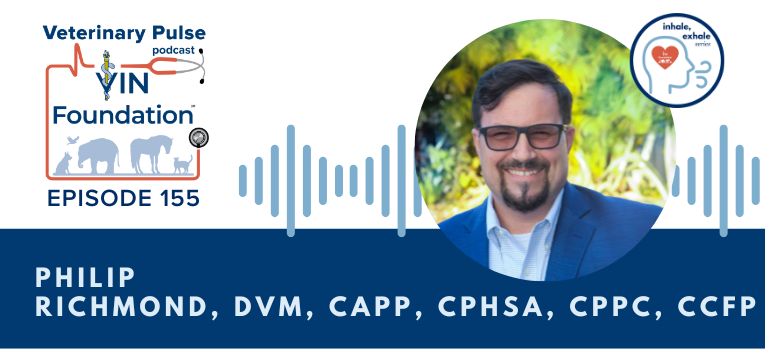
Dr. Philip Richmond vulnerably shares his journey with alcohol substance abuse, and how he takes lessons learned to help colleagues through vital peer support. He shares the importance of clear communication, the needed ongoing effort to work on ourselves, assuming good intent, and the power of positive emotions. This episode digs deep with heart touching stories and an empathic approaches to well being in the veterinary profession. As Philip shares in the podcast one of his favorite quotes: “Be curious, not judgemental” – Walt Whitman
*Trigger warning* hey all, a quick heads up that some of the content in today’s episode may include a trigger as it relates to alcohol and substance abuse disorder, childhood trauma, and suicidal ideations.
As a reminder, the VIN Foundation’s confidential support group Vets4Vets® is here for you and you can find information to reach out in the episode notes. please know, you are not alone.
GUEST BIO:
Philip Richmond, DVM, CAPP, CPHSA, CPPC, CCFP
Dr. Richmond is the Chief Medical & Wellbeing Officer for Veterinary United and the Founder of Flourishing Phoenix Veterinary Consultants. He is an advocate for positive culture and individual, team and organizational psychological health, safety, and wellbeing in veterinary workplaces.
Dr. Richmond both leads and is involved in state, national and international projects for the advancement of workplace wellbeing and culture in veterinary medicine. He currently serves as the chair for both the Florida Veterinary Medical Association’s Outreach and Professional Wellbeing Committees and is a member/advisor for several national committees and boards for workplace suicide prevention and veterinary wellbeing, including those sponsored by the CDC/NIOSH, the American Foundation for Suicide Prevention, AAHA, Fear Free, MentorVet and Appalachian State University.
Dr. Richmond is a speaker and published writer, a frequent veterinary podcast guest, and holds multiple certifications in the fields of applied positive psychology, appreciative inquiry, workplace wellbeing, psychological health & safety, trauma-informed workplaces, resilience training, behavior change, and suicide prevention. He was awarded the FVMA Gold Star for service in 2019 and FVMA Veterinarian of the Year in 2021.
LINKS AND INFORMATION:
- About Dr. Philip Richmond
- VIN Foundation Vets4Vets® and Vets in Recovery and Veterinary Professionals in Recovery
- Veterinary Hope Foundation
- Adverse Childhood Events
- Instead of what’s wrong with you, what happened to you?
- VIN Foundation get updates
If you enjoy listening to this podcast and want to support these efforts, please consider making a donation to the VIN Foundation: https://vinfoundation.org/give
You may learn more about the VIN Foundation, on the website, or join the conversation on Facebook, Instagram, or Twitter.
If you like this podcast, we would appreciate it if you follow and share. As always, we welcome feedback. If you have an idea for a podcast episode, we’d love to hear it!
TRANSCRIPT
Intro
Philip Richmond, DVM, CAPP, CPHSA, CPPC, CCFP: I thought it was either I go on to the bitter end or I, you know, I can’t keep going on again, head in hand, I can’t do this for another 25 years. I didn’t know that there was a door number three because I was scared. And part of that was, Jordan, is because I was scared to talk about it, because there’s such a stigma around alcohol and substance use disorder. Again, 12 to 15% of our colleagues at some point are going to meet criteria for this. We feel like we can’t ask for help because we feel like we’re going to be punished instead of being helped.
Meet Philip Richmond, DVM, CAPP, CPHSA, CPPC, CCFP
Jordan Benshea: That is Dr. Phil Richmond, a veterinarian with a passion for supporting colleagues through recovery and wellbeing efforts, and this is the VIN Foundation’s Veterinary Pulse Podcast. I’m Jordan Benshea, VIN Foundation’s Executive Director. Join me as we talk with veterinary colleagues about critical topics and share stories, stories that connect us as humans, as animals, as a veterinary community. This podcast is made possible by individuals like you who donate to the VIN Foundation. Thank you. Please check the episode notes for bios, links and information mentioned. Hey, all, a quick heads up that some of the content in today’s episode may include triggers as it relates to alcohol and substance abuse disorder, childhood trauma, and suicidal ideations. As a reminder, the VIN Foundation’s confidential support program, Vets4Vets, is here for you, and you can find more information to reach out in the episode notes. Please know you are not alone. Welcome, Phil. I’m really excited to have you on the podcast.
Philip Richmond, DVM, CAPP, CPHSA, CPPC, CCFP: Thanks, Jordan. I appreciate you having me today.
Jordan Benshea: We have been, you know, Phils been an active person within the VIN Foundation for a while, and we’ve been chatting about a variety of things over the years, and it just seemed as I usually tend to beg people to come on the podcast and share their story, I thought, come on, Phil, this would be a great story to share, and I’d love to share your story, and I think our audience and colleagues would be really interested, and love to, you know, learn more about your story.
Phil’s Journey to Veterinary Medicine
Jordan Benshea: So let’s start with your journey. What was your journey like to veterinary medicine. Was there an aha moment? Or how did you know that this was the profession for you?
Philip Richmond, DVM, CAPP, CPHSA, CPPC, CCFP: Right, so I had a circuitous route to, uh.
Jordan Benshea: I love it. Okay, those are the best.
Philip Richmond, DVM, CAPP, CPHSA, CPPC, CCFP: So, yes, yes, and all, and I promise everyone, this will all tie together. So I was rai–. I grew up in a small town called Casselberry, Florida, and so about the age of eight, my dad had a massive heart attack. And so why that’s important, two things, one is that we’re going to talk a little bit as we go on about childhood trauma and how that affects our brains, how that affects, you know, the risks that we have, the risk factors that we have for certain conditions as we get older. The other thing was, is that it greatly affected my father’s, you know, ability to make money, you know, to work. So from about the age of eight on, we struggled quite a bit financially, and so my mom though, was a dog groomer, and she also worked for a couple veterinary hospitals in the Orlando area as a receptionist. So we had, you know, growing up, we had ducks, we had dogs, we had cats, you know. So we had all kinds of animals, and I, just like many of us in veterinary medicine, was very much going through some of the traumatic stuff. You know, my dad was likely, had bipolar disease, and was an alcoholic, and he did the best that he could with the tools that he had. But that did cause, you know, a lot of more trauma as well. Why I’m saying that is that animals, early on, were one of those things that allowed me to find some solace, you know, as I just remember sitting with my dogs, and just, you know, petting them, and just really connecting with animals on a real spiritual level, even as a youngster.
Early Career Challenges and Alcoholism
Philip Richmond, DVM, CAPP, CPHSA, CPPC, CCFP: So progress forward, you know, going on through high school up through college, so part of my journey is that, you know, to be a veterinarian, we have to have some, we have to be somewhat adept at sciences. You know, we have to be pretty decent students. And so what was interesting is, I was a good student, however, my coping mechanism from the time that I was about 15 was alcohol. So, you know, any stressors, anxieties, anything along that nature really was, you know, I used alcohol to treat that. I just really sought out the times to drink, because what I found out later is that it did something for me, that I thought that it did for everyone. Which it just, that screw right in my chest, that anxiety that, you know, I don’t fit in, that I don’t belong, I’m not good enough, you know, a couple drinks in, and it would just unravel that. And it would make me feel like it was a part of, and I, you know, at that age, to have that tool was very powerful. And so that was the thing that I had in my back pocket, you know, all through high school, all through undergrad, and so what happened? So I went to University of Florida, had a scholarship, went to University of Florida my freshman year, and I thought I could just, you know, show up for the tests, kind of like I did in high school, and still get A’s, and it doesn’t work that way. So, I got, you know, I got a fraternity, it was like next level drinking, you know, as an 18 year old without responsibilities. And so I lost my scholarship, and so I ended up having to come back home. So came back home again, my parents, they, we’ve got, thank, I’m grateful for the, you know, how I was raised, but financially, we didn’t have the financial resources for me to, you know, for them to pay for school. So they said, “look, you’re gonna have to get a loan, get jobs, and such”, so I ended up, I was doing personal training. I was doing all these, so I was working three jobs, and going to community college, and I was going to class, which was, you know, and then I was like, oh, what shocker, like, if you go to class and study like you, they
Jordan Benshea: Who knew
Philip Richmond, DVM, CAPP, CPHSA, CPPC, CCFP: Tell you what’s on… Yeah, it’s, who knew that was going to be, you know, and did all the things, you know, got on whatever the President’s list, and all the, you know, the wonderful accolades. And then at 20, my dad passed away in a massive stroke. I was working, I was a server at Olive Garden, I’ll always remember that, you know, and I got a call from my mom that he’s in an ambulance, and they’re taking him to the, you know, the hospital. So at 20, I’m right in this period of time where I’m starting to realize that my dad has always cared about me and has tried to help me, you know, and some of the things, shockingly, some of the things that he’s told me, oh my gosh, they were true, you know, is that it was…and so that was challenging. So, 20 years old, my mom, you know, really took that, took it hard. I mean, you know that my dad passed away. I mean, as she should, I mean, but it, there was a rift that happened, is that, you know, we both kind of separated for a little bit. And so what did I have to fall back on was drinking, you know. And so I was pretty much drinking every night, you know, and I ended up taking taking some time off of school, worked as a personal trainer for a while, and then just realized I didn’t want to do that for the rest of my life. So I took about a year and a half, two years off of school, and then went back to community college, took a course in psychology because I thought maybe I had broken my brain. And ended up doing well and went forward so, and then just realized, okay, just need to go to school, do this. And then I, and I thought that I wanted to be an MD, and so I went home, I ended up getting, going to University of South Florida. Did really well, and I went home over break, and I was like, oh, I know a little bit more like, now I’ve got, you know, I’m leaning into biology and chemistry and microbiology and these types of things. And so I went and worked for one of the vets that my mom had worked for, you know, when I was growing up, and I went there over, it was like, spring break or Thanksgiving break or something. I worked to, you know, to make some extra money, and I was like this is it, like this is what I want to do, like, because I had waivered, and I mean, always loved animals and always. But I, and now what I will say is that part of that was, is that I knew that I was a drinker like I knew that I was and so as you know, I knew what my personality was, and I also didn’t know if I was going to be able to be, not to diminish what it means to be a veterinarian. But like I had this, like, I can’t be this huffy, you know, physician, you know, and now, by the way, knowing physicians, I know that’s not true, not true at all. But that was this thing that I had in my head. So part of it was, but it was like, I wanted to do everything, you know. I loved surgery, I loved cardiology, I loved ophthalmology, you know, I just loved everything. And I realized that I would have to, if I sort of wanted to do that in human medicine, I had to be a trauma surgeon, is what I thought in my head, and I’m like, well, I don’t know, you know, that sounds like a lot. So ended up switching gears and leaned into, switched, started the pre vet society back up at University of Florida, did all the things that, you know, a lot of us that are A type personalities do, so,
Jordan Benshea: I have no idea what your talking about at all.
Philip Richmond, DVM, CAPP, CPHSA, CPPC, CCFP: Yeah, right, all the, yeah, we talk in the uncharted community about red dots, you know, it’s like, tu tu tu, you know. And so that’s, I’m part of that. So that’s, that’s when, you know, I ended up going to University of Florida. And started in 2002 I graduated in 06, and, you know, the thing was, is, again, I did well in vet school, but I, you know, I continued to drink, you know, and I started having some consequences.
The Turning Point: DUI and Recovery
Philip Richmond, DVM, CAPP, CPHSA, CPPC, CCFP: And I, you know, and I’ll share this with everyone, is that, you know, I three months before I graduated, I got a DUI on campus at University of Florida, and they were going to kick me out of school with with three months left to graduate, and I had to go to my professors, hat in hand, as though I was asking for a residency, and ask them to write me letters of recommendation to keep me in school. I say that, because it’s the power of this disease of alcohol use disorder, when we really say alcoholism. So the term is alcohol use disorder, or substance use disorder, is that it’s powerful enough that from the outside, someone would say, how could you ever pick up a drink again, knowing that those are the consequences, and that’s actually one of the definitions of alcohol use disorders, in the face of growing consequences that we continue to use or drink. And so I kept drinking, you know, and because, again, it was the only tool in the toolbox. So I get out, I’m in practice, and I don’t drink for about six months. And six months in, you know, it’s just the rigors of being a new grad, you know, and I’m working, I’m working 80 hours a week. That was not my job that did that, you know, they, my first boss was basically telling me to throttle down. He’s like, you know, this is before burnout was really, you know, 15, 16, years ago, I mean, people knew about, I don’t want to say that, but he was like, you know, I was coming in on my days off to do surgery. I was doing, I was working at the emergency clinic, I was picking up shifts on my days off. And he’s like, you gotta slow down, you know, and so what happened was, is that I just kept working and working and working. I didn’t have any tools, and I remember sitting on my couch, just exhale, and I had my head in my hands, and I’m like, I can’t do this for 20, 30 more years. And I just, you know, I just started. And so I got, I was in a really, really dark place. And again, only tool I have is booze and substances and so I,
Jordan Benshea: And this is six months after graduating, right?
Philip Richmond, DVM, CAPP, CPHSA, CPPC, CCFP: This is, so there’s a period. So it starts, started about six months out, about a year of this to where then I was suicidal. I was just, every day was a struggle for me to just get through the day, you know, and I was visually affected at work, because, again, I was just, I had so much wrapped into me being a veterinarian, it was who I was as a person. And what’s interesting is that they, you know, they will tell you, is that, for medical professionals, if we see a change in a medical professional that is around alcohol or substance use, like we are, we’re really close to the end and part of the disease, because that’s the last thing to go, you know, is that relationships are affected, you know, all the things are affected by that. Now, I want to pause here, because sometimes when we hear the story, people say, well, that’s just, that’s it. It pulls at my heartstrings, or it’s just, you know, or questioning, how could you get that far?
Understanding Childhood Trauma and Its Impact
Philip Richmond, DVM, CAPP, CPHSA, CPPC, CCFP: Or, you know, some of these questions that come up, and one of the things that I want to bring up, and this is why I said with childhood trauma, is that when we talk about adverse childhood experiences, when we talk about the ACES scores, so there’s a list of 10, 10 experiences, and you answer yes or no to these you know, along the lines of, you know before your 18th birthday were you ever physically abused? Were you ever verbally abused? Were you sexually abused? Did you have a parent who had a mental illness? Did you have a parent who had an alcohol or substance use disorder? Did you see violence in your home? Did you sometimes not have enough to eat because of financial pressures or things like that? There’s 10 of these questions, and if you answer yes to four or more of those, or four, actually you answer yes to four, risk of alcohol use disorder is seven times higher than someone who has zero. Substance use disorder, seven to 10 times ADHD, seven times depression, six times anxiety, seven times all of these things happen, and when we see what happens physiologically to the human brain when we’re children, when all that cortisol and the adrenaline or the epinephrine and all the stress hormones hit, the effect that it has on a developing brain is amazing. The reason why I say this is when we see people that are going through that is, perhaps we can begin to look at people through a different lens. And instead of asking, you know, and Oprah recently released a book, Gabor Mate talks about this, is instead of saying what’s wrong with you, is ask what happened to you. You know, it’s to say that something beyond your control, very likely played a part in making this happen. And I say that, and it’s not as, by no means, an excuse or anything of that nature, but if we think about, as veterinary professionals, if we had something, if we knew something was going to increase the risk of disease in our patients seven to 10 times. And then, by the way, suicidal ideation, if I remember the number is, I have to look it up. I have it in some of my talks, but I think it’s, you’re 28 times more likely to attempt taking your own life, you know, and suicidal ideation goes up. So it’s part of this, is that we talk about suicidal ideation, we talk about the issues in veterinary medicine, and we’re just now beginning to talk about this, you know, is that, can we share this? And when I can tell you anecdotally and we can kind of slide into some of the other things we were going to talk about, but I can tell you that probably 90 to 100%, so I’ve been in recovery for 15 years now, and I’ve been very grateful to work with a lot of medical professionals in early recovery, and I would tell you without fail, every single one of those people had things that happened to them when they were children, and every one of them had suicidal ideations. And so, you know, it’s saying, wow, like, that’s, and it doesn’t, you know, intelligence doesn’t have an effect on this. There certainly are protective factors, but that gets into, we talk about mental illness, we talk about mental fitness, and mental health, and we talk about the concern of suicide in the profession, but we don’t talk about 12 to 15% of medical professionals at some point in their career are going to meet criteria for an alcohol or substance use disorder because we don’t ask for help, and we tend to self medicate. And the other thing is, is that 50 to 60% of people who choose to end their own life, there’s alcohol or substances involved. Now, it doesn’t always mean that they have a use disorder, but it’s part of the, it’s a big risk factor for that, and so I hope you know in the profession that we can look at this through a different lens, through a lens of caring and again, of what happened to you, and how can we help, versus what’s wrong with you, you’re weak, like, why would you do those things? Yeah. And that leads into some of our other topics of how, yeah.
Jordan Benshea: You did a great job there, you covered like six questions in one answer.
Philip Richmond, DVM, CAPP, CPHSA, CPPC, CCFP: Yeah, there we are.
Jordan Benshea: But gosh, you touched on so much here, Phil, and I really appreciate your…
Philip Richmond, DVM, CAPP, CPHSA, CPPC, CCFP: Yeah.
Jordan Benshea: Just your courage and you’re willing to be vulnerable because I think that’s really how we can connect, you know, and learn from each other. And there’s a quote, one of my favorite quotes, which has been attributed to Plato, but who really knows, which is, “be kind for everyone you meet is fighting a hard battle” and it’s so, you know, it is, you just never know who you come across in life. You know, specifically with this audience, veterinary colleagues, that we just have no idea what they’re going through, right? And anything from like honking at somebody at a stop sign to, you know, to how colleagues are treated, and how they treat each other, and how they’re treated from clients and staff and again, with each other, just be kind and just presume or hope that everybody’s really doing the best that they can. Right?
Philip Richmond, DVM, CAPP, CPHSA, CPPC, CCFP: Can we assume good intent? I like to make the charitable assumption, you know, is the, if someone does this, is there a way that we can frame that that isn’t that that person is evil, or that person is weak, or that person is something else, which is challenging for us. You know, in this environment, and I do want to say I did talk about some very heavy stuff and we needed to talk about that, but because I’m here, we always say, so we say in 12 step recovery when we share a story, “the beautiful thing is the story has a happy ending”.
Recovery and Advocacy in Veterinary Medicine
Philip Richmond, DVM, CAPP, CPHSA, CPPC, CCFP: Because I’m up here telling this story, and so that’s the other thing is that I was given, so to 2008, August 11 of 2008, so my colleagues, and so let me say this because this is also, my colleagues recognized what was going on with me, one of my and I always get goosebumps when I tell this. So one, they wanted the best for me. One thing is, is that, if it wasn’t for our head technician, Alex Soto, and I always like to talk about her, is that she’s one of the main reasons why I’m still here. You know, veterinary professionals are the reason why I’m still here. Second is, one of the veterinarians that I worked with worked with me when I was a student at Millhopper Veterinary Medical Center in Gainesville, and she was the former president or chair of the Florida Board of Veterinary Medicine. Why is that important? Because she knew the resources that were available to get me the help that I needed, because it’s just like any other disease, is that, get, like, to protect, you know, to allow me to continue to be a veterinarian, but I was able to go to treatment. So, you know, they were able to get me into treatment, and so I was in treatment for three months, so for 90 days, and in that is where I had the awakening, you know, is where I was given tools, where I didn’t know. I thought it was either I go on to the bitter end, or I, you know, I can’t keep going on again, head in hand, I can’t do this for another 25 years. I didn’t know that there was a door number three because I was scared. And part of that was Jordan is because I was scared to talk about it, because there’s such a stigma around alcohol and substance use disorder. Again, 12 to 15% of our colleagues at some point are going to meet criteria for this. We feel like we can’t ask for help, because we feel like we’re going to be punished instead of being helped, and it’s like, can we look upon this? I mean, stigma and mental and veterinary medicine is certainly decreasing, but this is one area where there’s still a huge amount of stigma and a huge amount of misunderstanding and misinterpretation, you know. And so when I went to treatment, I got into 12 step recovery, I learned a lot of the skills of resiliency, and they helped save my life, you know, and they also allowed me the biggest thing Jordan, they allowed me to love veterinary medicine again. I saw the part that I was playing, you know, and how I was perceiving things, and I was given tools to reframe that say, “hey, maybe that’s, you know, maybe that’s not true”, and that understanding, the power of those thoughts is that when I roll with that, my brain can’t tell the difference whether that’s real or not. And I’m going to experience those emotions as though they’re real, and that’s gonna affect the people around me as well. And so it was just, you know, I learned a lot of, you know, powerful evidence based tools, you know, which then led to part of the question, was, how did I get into the wellbeing space?
Jordan Benshea: Right, how do, we we’re gonna get into how did you get into the well being? And so I think that you were, so August 11, 2008
Philip Richmond, DVM, CAPP, CPHSA, CPPC, CCFP: 2008.
Jordan Benshea: Is when you,
Philip Richmond, DVM, CAPP, CPHSA, CPPC, CCFP: Its my sobri, that’s when I went into treatment, yeah.
Jordan Benshea: Okay, and It was a Mon–, it’s amazing how things happen in our life, and we just remember exactly,
Philip Richmond, DVM, CAPP, CPHSA, CPPC, CCFP: It was a Monday. Yeah.
Jordan Benshea: So what is your current job in veterinary medicine today?
Philip Richmond, DVM, CAPP, CPHSA, CPPC, CCFP: Wow. So my current job is that I’m the Chief Medical and Well Being Officer for a group in Michigan called Veterinary United. So I get to help coach and advocate for our doctors and technicians. Also, you know, doing some of the, you know, the nuts and bolts stuff of initiatives and policies and anesthesia protocols and monitoring equipment and that type of thing. But the other thing that I get to do is that, you know, we just rewrote our whole alcohol and substance misuse policy, you know, with evidence based language. When the language is very strong, what that says to me when I come in is that if I do any of these things, I’m fired, right, and that there’s no, that there, that I know this is, but I can’t ask for help, because if I ask for help, I’m going to lose my job. And the same thing, so to go along with this, the same thing is true on medical licensing applications. The AMA, the American Medical Association and the Mayo Clinic found out in 2017 that states that had language around mental illness and alcohol and substance use, those physicians were 40% less likely to seek mental health treatment solely because of what was on the licensing application, that was a factor. So we know that because it puts out, when we talk about psychological safety and how safe do I feel, I know what that means on that licensing application. I know that those questions mean that if I do those things, I don’t get to practice. So we stay quiet and we suffer until we can’t wait, until we no longer can handle it anymore, and then that’s why these things, you know, how could it get to that point? Because there was no door number, I didn’t think there was a door number three. At no point did I consider asking for help, which is horror, scary and horrible and like, how could we in this caring profession that we hold these things in out of fear of repercussions for mental illness, yeah, so.
Jordan Benshea: I think that’s, you know, you’ve brought up a couple different things in one.
Philip Richmond, DVM, CAPP, CPHSA, CPPC, CCFP: Yeah.
Jordan Benshea: I am such a big believer in clear communication, and for those that know me, hear me say this all the time. I think it has, you know, miscommunication, even the smallest amounts can do everything from end relationships to start wars, right? I mean, it’s huge, and just, you talked about shifting the question from not what’s wrong with you to what’s happened with you, right? Those are two to three words different
Philip Richmond, DVM, CAPP, CPHSA, CPPC, CCFP: Fundamental
Jordan Benshea: Right, right, and it’s a huge fundamental difference. And to your point now about the language, right, in reporting and being able to ask for help, versus the language making it seem, okay no matter what, I’m getting fired, right? Again, that’s minimal amounts of communication messaging, which, when shifted, have huge, huge impacts. You said 40% right? That’s a huge number, right?
Philip Richmond, DVM, CAPP, CPHSA, CPPC, CCFP: Huge number.
Jordan Benshea: And it’s so important when we think about how we communicate verbally, virtually, digitally, especially in this age, to understand the weight of our words, the weight of the messaging, the weight of the communication that we are getting across, and the potential impact that it has, positive and negative, right?
Philip Richmond, DVM, CAPP, CPHSA, CPPC, CCFP: Yeah.
Jordan Benshea: And so now you’re in this space. This, space your in,
Philip Richmond, DVM, CAPP, CPHSA, CPPC, CCFP: Right. So, and then to back, because the initial was, how in the hell did I get how did a veterinarian,
Jordan Benshea: Well really it was your journey, right? Like, what was your journey to veterinary medicine, which has been part of this? Yeah.
Philip Richmond, DVM, CAPP, CPHSA, CPPC, CCFP: Yeah, so what had happened, so I was in so, I’m in recovery, you know, I’m going to 12 step meetings, I’m doing these things. My life is just um, you know, I, we say this term in recovery, and it seems trite or just over the top, even though, is “living a life beyond our wildest dreams”. And what I would say is that I was given the tools to be things that I would before I got into recovery, I didn’t think I could be. I did not think I could be a good partner, and here I was, you know, a husband, you know, and I was scared. I was scared to death that my, what my, fiance at the time, she’s my wife now, had been together for, you know, quite a long time. So 16 years.
Jordan Benshea: Congratulations.
Philip Richmond, DVM, CAPP, CPHSA, CPPC, CCFP: Thank you, but I was scared she was going to get pregnant. And the reason why is because I knew that I couldn’t stop drinking, you know, and using, and I just, and I was like, how am I going to be my father, and I knew what, and by then I knew, you know, I knew I was going down that road. But I was able to do those things, and I was able to try to make decisions where I didn’t, I mean, I’m a human being, and I can react, but I was given tools, though, that I could look when someone was reacting that way to me is that that’s, well, we can’t see it, but I’ve got a sign in my office, it’s the old, you know, if you watch Ted Lasso, you know, he quoted Walt Whitman, which is, “be curious, not judgmental”.
Jordan Benshea: I can see that.
Philip Richmond, DVM, CAPP, CPHSA, CPPC, CCFP: Can I ask? Yeah, is can I ask what’s going, you know, the same like we just said, is, what’s happened with you? Why, what’s going on that is creating this threat mode in you? But so, I was in recovery for 10 years, and then I realized that no one, I don’t want to say no one, because that’s not true, but that there was a need for a discussion around alcohol and substance use disorder, on top of the issues with suicide and mental illness that, it’s all, you know, it’s all part of it. And I told my wife, maybe six, seven years ago, I said, I’m gonna have to break.
The Importance of Anonymity in Recovery
Philip Richmond, DVM, CAPP, CPHSA, CPPC, CCFP: You know, in recovery, we try to stay anonymous with our recovery, which there are pros and cons to that. I would say one of the cons is that we see, the media will see the bad things, but we don’t see the people getting better, you know, and helping other people and building and recovering.
Taking on Leadership Roles in Veterinary Wellbeing
Philip Richmond, DVM, CAPP, CPHSA, CPPC, CCFP: And so I said, “well’, I said, ‘I can’t, I feel like I need to be part of this moving forward for the profession”, and so I got with the, I was always active in the FVMA, and so I just said, I was like, hey, you know, they had a call for action for the Chair of the Outreach Committee, which was basically the veterinarian who goes around and talks to other veterinarians who are having a use disorder. I’m like, that sounds like, that’s right up my alley, and so I did that for about six months, then I said, “do we have a wellbeing committee?”, and they were like, no, but we’d love for you to, we’d love for you to share it. And so I’m like, you know, again, red dot, red dot folks, like, that’s all you got to say.
Overcoming Imposter Syndrome
Philip Richmond, DVM, CAPP, CPHSA, CPPC, CCFP: And so it’s like, okay, we’re going to do this, we’re going to do this, we’re going to do this, and then the imposter syndrome kicks in. I’m just a veterinarian who went to AA or went to 12 step recovery meetings while I knew all those things worked, right? What am I so? And that really hit me when I gave my first presentation to the FVMA’s Executive Board. So the dean of the vet school, all the president of the FVMA, all the, so, Dr. Arce was, you know, back Dr. Jose Arce was the President of AVMA, but the, so two of the, this is back a number of years ago, AVMA candidates for president, the eight, the current AVMA president, Dr. Jeon, was there, like, and I’m like, and I have to get up and present, and I’m like, and that’s when it was like, I’m just this, you know, and having the negative self talk and all that. So I ended up, though, going down the road of, hey, well, let me lean into like, I love learning stuff.
The Power of Certifications and Continuous Learning
Philip Richmond, DVM, CAPP, CPHSA, CPPC, CCFP: So I started getting and I knew that I didn’t have, I wasn’t going to be able to do a master’s because of how much I was working, but I ended up taking these really robust like certifications and things, and because I knew that I didn’t necessarily want to do the research, which is why I became a veterinarian. Like I knew I was going to be the person in the lab, but I was going to be able to go out and try to help, you know, help my colleagues. So that started this thing, and, you know, we, I jokingly tell my wife, like, I do certifications like I used to drink. So, you know, I just learn as much, you know, as much as I can. And so I have been able to, and then been able to work with some of the biggest and brightest, and, you know, best people, not only in the US, but you know, in the world, working in workplace wellbeing, you know, and resiliency and these types of things. And so I’m just really grateful to be able to be part of that movement in veterinary medicine.
Jordan Benshea: Yeah.
The Role of Peer Support in Recovery
Jordan Benshea: Well, and I think that there’s huge value, irrelevant to what the exact degree is and without devaluing those, there’s huge value in your first hand experience.
Philip Richmond, DVM, CAPP, CPHSA, CPPC, CCFP: I agree, is that it’s a, you know, it’s a combination, it’s, you know, multi-, I forget, in human medicine, what that, but the, not continuum of care, but there are different roles that are important in the healing of someone. And so, you know, like, my role is not to sit down, while I can be an advocate to discuss childhood trauma, I’m not a mental health professional. I’m not going to, I’m not going to sit down and work through those things on a clinical level with someone, right? However, what I do have is, you know, as an educated, you know, peer, I don’t want to say specialist, but like you know, someone who is a peer, that I know what it’s like to walk through that. And also know that what my path was, isn’t necessarily what your path is going to be, but that I can direct to some of the, you know, to the other resources, but that also, where that comes in is, how does it work?
Creating a Supportive Workplace Environment
Philip Richmond, DVM, CAPP, CPHSA, CPPC, CCFP: Not so much on a one on one healing perspective, but how do we change the workplace like, that’s the next level, is that we’re very focused to on the individual and which is very important, you know, just part of it. But we do have to work on, you know, individual resilience and wellbeing. We have to work on that, on a team level, we absolutely have to say, what are we doing as organizations, you know, national organizations, workplaces, what are we doing to facilitate, you know, workplaces that improve. Not just, not that we just don’t leave sicker than we came in, but how do we create a workplace where we leave and we’re in a better psychological condition than
Philip Richmond, DVM, CAPP, CPHSA, CPPC, CCFP: we arrived in? That’s the goal. That’s the goal.
Jordan Benshea: And that’s definitely not what what you hear on a regular basis currently.
Philip Richmond, DVM, CAPP, CPHSA, CPPC, CCFP: Right, right,
Jordan Benshea: Yeah, and I think there’s huge value in the combination of a mental health professional and also colleagues that can provide that peer support, because it allows you to feel. It allows you to feel really heard with your individual situation from a veterinary professional perspective, which sometimes the mental health specialists are really, or professionals, are really able to help you with areas that are vitally important, as well with that additional support from the peer support is also vitally important, along with that, right. That sort of tag team approach can be so, so helpful and it, you know, the found-, the VIN Foundation’s Vets4Vets group and program, we, I just hear from so many colleagues that just having somebody that they can talk to, that understands the day in and day out pressures, specifically of the veterinary profession along with, you know, mental health professional help outside. But that really offers a lot of value to sort of have that safe space of community where you can share and talk and be safe, you know.
Philip Richmond, DVM, CAPP, CPHSA, CPPC, CCFP: Absolutely, and that was my experience in recovery, is that it was vital to have medical, you know, to have mental health professionals, to have mental, you know, medical professionals as well, but that to also have that group, you know, that social network, that place to feel safe, where I could connect, and that people weren’t you know. And that’s the wonderful thing about a real strong recovery group, is not going to say here you need to do this, or you need to do that, like it’s going to say, I did, you know, I understand where you’re at, and that this is, you know, and that we recommend, like, bringing all these things in together holistically, you know, to get better. And so that’s what I’m really, what I love seeing, is that integrative, you know, approach. And again, that’s where I, you know, just seeing it in 12 step recovery, and then seeing it in the veterinary community is, is having us as, I mean, we’re all caring individuals, but it’s like we, caring isn’t always enough, and we do need, you know, when we have to have experts, and you know in treatment, like you said, is that sometimes we need to have people who understand what it’s like. You know, when you drop a pedicle and a dog bleeds and you question whether you’re doing the right thing, you know, or a medical mistake happens, and or whatever this in the, whatever the situation is, is that we walk through that, you know, and we can be there shoulder to shoulder next to somebody as they’re walking through that, yeah.
Jordan Benshea: Yeah, I think that’s very important, and I think there’s huge value in that.
The Impact of Sharing Personal Stories
Jordan Benshea: And, you know, I really appreciate you being, again, willing to share your story and I think the more that people are, that trick of wanting to be confidential, and the same time, there is huge value in people sharing stories, because that’s the only way that others can know they’re not alone, right?
Philip Richmond, DVM, CAPP, CPHSA, CPPC, CCFP: Right, and again, the numbers tell us 12, 12 to 15%, like knowing, you know, knowing all the people that I know in recovery, and that was a huge thing for me. When I first got into recovery, you know, I found out all these, like professors, you know, right, like people, and all these people that I had no idea. I mean, my first sponsor was a veterinary internist, like I had no, and now I didn’t go, I didn’t necessarily, I didn’t, I mean, I didn’t go out trying to find him, right, but there he, you know, and it was just like, but that, that connection, to have those two things, the veterinary medicine part and the recovery part together and not feel and to not feel shame, you know, to not feel gut level being judged. That was really, you know, really important, and so that too is why our, you know, we say our Sunday night Vets In Recovery meeting that we have for the vets who are in the Vets4Vets program, is so powerful because it’s a space where, you know, we can all share. And it’s more about the things, it’s about, you know, we talk about the same things I think that, you know, most veterinarians do, but we have, we have a set of tools, and we have a set of support, and we say, you know, to our, hey, have you talked, you know, have you talked to this person? Have you talked to your therapist? Have you done, you know, these things where we want everybody to get better together, and it’s just such a wonderfully supportive group.
Jordan Benshea: So I think we should probably tell our audience that
Philip Richmond, DVM, CAPP, CPHSA, CPPC, CCFP: A little pitch to that.
Jordan Benshea: Yeah, we should probably tell our audience that Rich does help run the VIN Foundation, Vets4Vets, Vets in Recovery group. There is a Vets in Recovery group as well as a new group that we just created based out of colleagues requests, which is Veterinary Professionals in Recovery, they’re confidential, we’ll put links in the episode notes. And so that’s the group that Phil’s referring to, and I also want to, for a moment, go back to when you were talking about how when you first started drinking, what you realized is that it almost unscrewed that part of you where you were concerned about not belonging and that you didn’t fit in. Because I think, you know, Brene Brown wrote a book about belonging, and she speaks about it in many of her books, but just at the core of all of who we are, it’s this feeling of wanting to belong, right?
Philip Richmond, DVM, CAPP, CPHSA, CPPC, CCFP: Wanting to belong, feeling like we matter.
Jordan Benshea: Exactly.
Philip Richmond, DVM, CAPP, CPHSA, CPPC, CCFP: Two things so powerful,
Jordan Benshea: So powerful, and that combined with individual ACE scores and childhood trauma, I mean, those could be multiple podcast episodes in and of themselves, and all those things play such a role, and when you talk about how alcohol was your coping mechanism because you didn’t know others, right? And as a child and as you grow up, all of us are trying to figure things out and they, we come to it with the tools that we have, right. And what other way can we learn those, except finding them along our path in one way or another, right, and I think that’s just so important. So I want to take a moment to acknowledge that, because I think that that’s so vitally important, because we all have our own coping mechanisms that are positive and negative, right, and hopefully we’re continuing to learn how to improve those, right, and how to become better people and getting to know ourselves more and more. And a lot of that means looking at what was our childhood like, right? What were the tools I was taught? Are those tools serving me? And so that’s vitally important, I just want to take a moment to recognize that.
Tools and Resources for Veterinary Professionals
Jordan Benshea: Okay, so what are the tools that are around now for colleagues that you think are really helpful?
Philip Richmond, DVM, CAPP, CPHSA, CPPC, CCFP: Yeah, so what I would say there are a number of groups that have come up, like, there, obviously there’s, the Vets4Vets groups that, there are multiple different groups that, you know, have online meetings and an online presence. The, there is The Veterinary Hope Foundation, so that’s, and their facilitated groups of veterinarians. I think that’s where a lot of the power is, is hearing stories and say, ah, I know you felt like that, like I felt like that, you know, and that it validates these, and that I’m not, you know, that I’m open, sharing without the sense of, you know, am I going to be judged for this, or am I going to make this, and that it’s put in a way, you know. In recovery we have, when we’re in these recovery meetings, most of us have a basis of some of these tools to reframe and look at things from a different angle. And, you know, and the more I, you know, over the past six, seven years, it’s very similar to cognitive behavioral coaching, you know, it’s this reframing process that we learn in recovery, and it’s a very powerful tool, but to use that in there. And so it’s different than some of the, very different from some of the things that we see in social media, where it’s co rumination, where it’s just unloading, and it’s just, it’s this, you know, this, it’s just a negative, you know, a negative energy space that creates this emotional contagion, you know, that gives us this release to blame, blame, blame. And so not to say that there aren’t things that we have to look at, but also saying is that, you know, one of the biggest things that I learned in recovery is, what part did I play? You know, what part am I playing in this? And so what I would say is this too, is that I can take that ACES test, and it helps me explain a lot, however, if I don’t do the things, if I’m not talking to my therapist, if I’m not doing some of the work to try to heal that, then I’m not, you know, I’m not doing that awareness is the first, you know, the first step, you know. But I have to, I have to be able to go, am I willing to do the work, like, am I willing to, you know, to do what I need to do to get better. And so for me, like, I literally had to get to the point where I didn’t have another direction, like, I just, I didn’t have any fight left in me, and it was like, okay, yeah, like, I’ll do, you know, begrudgingly, even though I’m, you know, I’m at this point in my life, begrudgingly, I will do these things, and they changed my life. And so it’s like, can we lift the, you know, lift the bar a little bit so that we’re not having to be bludgeoned, you know, with some of these negative self talk and, like, some of the things that we do and, can we lean into these tools of self compassion? Can we lean into these, you know, these tools of reframing? Can we lean into empathy, you know? Can we lean into some of these things? And that’s where, and they want to also say too, is that that then allows us to increase our love for veterinary medicine? Is that when I’m able to see, to be curious, not judgmental, and it’s challenging sometimes, but when I’m able to do that with a client, it changes the whole dynamic, and instead of me walking out of that exam room and going, “oh, Mrs Jones, what appeal”, you know, and then spreading that to everyone, I’ve given her some space to understand there’s something going on with her. I’m not saying what’s wrong with you, what happened to you, and we’re able to process through some of those things, she’s able to see that she might have misjudged something that I said, or what have you, we work through it. And then I go out, and then she’s in a different space, where she felt heard, she feels like she matters, the pet gets the treatment that it needs. I go out and get to share that as a win, you know, with my team, and it’s a fundamentally different effect on the culture of that practice. That’s a fundamentally different effect, then if I came out and I just reacted, which is our normal response, you know, the negativity bias, the threat, all of that, and I can take a pause and try to refrain that, it just, it’s a very powerful thing, and so those are all the things that I, you know, I hope and I wish and I want for our profession, because this is a beautiful profession like it really, it can be the things that we imagine it was when we were kids, to a degree, to a degree, you know. But the opportunity to be of service, and the opportunity to give back any, and a lot of these opportunities are afforded in a way that’s not in any other profession, and we all have, I mean, every, if we were sitting here talking about accounting, I’m sure there are things that we could bitch about, you know, and like, but it’s that, like, everything’s got its stuff. I mean, yes, veterinary medicine has its challenges. We have things, but if we’re only looking at the negative, and we’re not looking at the things that veterinary off-, veterinary medicine offers us, we’re doing it an injustice, a true injustice to not, if we’re. And if we are evidence based clinicians, if we are evidence based, if we are to go through our day and genuinely look at all the good things that happened versus the “bad things” that happened, if we tally that up, I know because we did it at our old hospital, you’re gonna get a 10, like a 10 to one ratio of clients, that said, “thank you”, clients that were like, “thank you so much”, or hey, I just, I’m very glad this happened, or, you know, I did this thing that was really cool. And what happens is attention, you know, where we choose to put our attention is what grows. And so when we do have that negativity bias, and I’m squirreling a little bit, but that it serves us is that negativity bias kept us alive. It’s an evolutionary adaptation, you know, if I’m back trying to hunt for wooly mammoth, and I’m not looking for the saber tooth tiger, I’m not going to make it. However, the ones that were always, you know, head on the swivel, like freaking out, looking for, guess whose genes we inherited, you know, like, thanks a lot, Charles Darwin, you know, it’s but, but the thing is, is that we have to know that some of those things, they don’t serve us as well. And you mentioned that, like, does this thought serve me? And, you know, that’s a powerful question to ask. And so again it’s, the world is the world, and, you know, and I used to think too, like I mean, if we talk about, not to go into, you know, politics in the news and those types of things, but if I want, if I look at those things like, is it going to change what I’m going to do when I walk into the vet hospital? And I’m not saying that we put our head in the sand, but I’m saying that, can I, if there are positive things that I know that I can do to affect change, I’m going to do those things. But that, if I’m sitting and I’m more, you know, if I’m worrying and I’m doing these things, I’m not able to, and then I’m, of no use to anybody, then I just go down the, you know, the rabbit holes.
Jordan Benshea: The rabbit hole
Philip Richmond, DVM, CAPP, CPHSA, CPPC, CCFP: Got a little, got a little, got a little soap boxy.
Jordan Benshea: No, I think, I think the soap boxy though, is perfect, because clearly, there’s way more than one episode here, and we’re definitely going to be having you back for additional episodes on this podcast, and we’re getting kind of close to, we like to try to keep these at an hour because, just for people’s attention span.
Philip Richmond, DVM, CAPP, CPHSA, CPPC, CCFP: Yeah.
Jordan Benshea: But I, you know, I just have a couple other questions, and one is, there’s so much here, and I really want to dive deeper, and I think that, I think we could have a whole other discussion about workplace safety and not safety, like physical safety, but, you know, like emotional, mental safety.
Philip Richmond, DVM, CAPP, CPHSA, CPPC, CCFP: So what we well, I haven’t come up with a lot of things on my own, but maybe somebody has probably said this.
Promoting Psychological Safety in Veterinary Practices
Philip Richmond, DVM, CAPP, CPHSA, CPPC, CCFP: But I think of, like, OSHA for our brains, you know, is that we, where, you know, I’m grateful to be with a group that’s working on some psychological health and safety standards, like some amazing people working on psychological health and safety standards for veterinary practices in the US. But we wear lead shields, you know, we wear lead when we take radiographs to protect us from ionizing radiation. Why? Why aren’t when we have an angry client or when we have things that we know going in, are going to increase our risk of psychological harm? When we talk about conflict, when we talk about that lack of mattering, when we talk about these things, when we talk about not getting reward and recognition, when we talk about trying to see, you know, 50 patients in a day like these external things that get put on us, why can we not be, we need to be proactive, knowing that those things are going to have a detrimental effect on our brains, just like if I walk in and take X rays and I don’t have lead on that’s going to build up over time, and it’s going to cause a problem. The same damn thing is true for these psychological, these psych, call them psychosocial factors, or psychosocial hazards that happen in veterinary hospitals. And so how do we proactively create a system or a hospital or a workplace that proactively prevents those and not only prevents harm, but again, promotes flourishing. How do we make a place where, let me say that one of the best compliments I ever got as a leader is, the hospital that I used to work at, the team would say, we come here to get away from the world, like the team said, and we meant it, we came to work, and the work was our oasis. What a beautiful I mean, I just, oh, I love, I mean, just loved, missed, if they’re listening, God bless them. I love them. So, I mean, we still get to talk and everything, and they’re just wonderful, wonderful, beautiful human beings. But that was true, like we laughed and we, you know, we had Nerf gun fights, and we just, but we did a, we did a great job. You know, it’s very much like scrubs, the show scrubs, you know, it’s like, I always wanted it to be like, yeah, but those are the things, is how can we both protect our professionals from psychological injury, but also promote an environment that makes us want to come to work? And that can be done, that absolutely can be done. We just have to be intentional about it, and we have to, you know, we have to be foundationally, and measure these things. We have to measure what’s going on with our people, because otherwise it’s just us being, and, you know, veterinary professionals walking into a room and looking over and go, oh, well, um yeah, probably got liver disease. So we’re gonna, we run tests, you know, we run diagnostic, you know, we’re measuring these things. So that’s one of the things too, like, are we doing that on a regular basis? So anyhow, another, another.
Jordan Benshea: Well, so that’s a trailer. That’s a trailer for our next episode. Pretty much.
Philip Richmond, DVM, CAPP, CPHSA, CPPC, CCFP: Right.
The Ripple Effect of a Positive Work Environment
Jordan Benshea: Well, and the hope being is that the things that you do in the workplace within, like when you say that your colleagues would come there, and it would be like the oasis away from everything else, is hopefully what’s also happening, is that the benefits of what’s happening in work is impacting the other areas of life.
Philip Richmond, DVM, CAPP, CPHSA, CPPC, CCFP: Happens, 100%, 100%.
Jordan Benshea: Yep.
Philip Richmond, DVM, CAPP, CPHSA, CPPC, CCFP: And so that was one of the wonderful things too, is like they would come in and go, you know, or I remember one of my technicians, she would say, she’d be like, Dr. Richmond, we did, you know, my husband said this thing, and she’s like, and I thought about it, and I was like, maybe I’m not, you know, and
Jordan Benshea: There you go.
Philip Richmond, DVM, CAPP, CPHSA, CPPC, CCFP: And it was just, and your right, like, that’s it has this written, you know, Sean Aker talks about that ripple effect, you know, that happens. It’s like it starts here, but those ripples, and then even something like the butterfly flapping its wings, is that those team members leave that hospital, they go to, you know, we have Publix down here, and, you know, they go to Publix and they smile at the cashier, you know, because they’re in a good mood, and it’s, again, that emotional contagion, the negative stuff spreads like wildfire, but damn it, the positive stuff does too. And so we can have, you know, we can have that positive impact just because we created a wonderful veterinary workplace. It spreads out, and then it’s, whoa, and then I get, then I start getting goosebumps again, like that’s the, you know, can we create that environment too? So I could tell, because I’m getting, I start.
Jordan Benshea: That’s our next episode. That’ll definitely be our next episode.
Secret Talents and Personal Interests
Jordan Benshea: Okay, so one last question for you, which I kind of like to ask our guests, which are, do you have a secret talent, or something you enjoy doing that others might not know about?
Philip Richmond, DVM, CAPP, CPHSA, CPPC, CCFP: You know, I have to say yes. So this is I recently,
Jordan Benshea: We get the most random answers, like,
Philip Richmond, DVM, CAPP, CPHSA, CPPC, CCFP: Yeah.
Jordan Benshea: So I can’t wait to hear this.
Philip Richmond, DVM, CAPP, CPHSA, CPPC, CCFP: This is something, so I was a jock, like in high school and, like, did competitive powerlifting, all this and that. Sadly, it kept me away from playing Dungeons and Dragons like in high school.
Jordan Benshea: There you go.
Philip Richmond, DVM, CAPP, CPHSA, CPPC, CCFP: And I’m, and I just started playing it, like, six months ago, and it’s so, and I play, I know these people. It’s not even like, but I play with, like, some of the, like, the, you know, the vet famous, you know, peeps like,
Jordan Benshea: Oh, there’s vet famous D&D people?
Philip Richmond, DVM, CAPP, CPHSA, CPPC, CCFP: Oh, totes, yeah. It’s like, it’s a whole thing. It’s a whole thing, and it’s just beautiful and wonderful. And it’s like,
Jordan Benshea: Right?
Philip Richmond, DVM, CAPP, CPHSA, CPPC, CCFP: It’s meditative, and, like, we’re in this thing, and it’s just that we get, oh, it’s just, it’s fantastic, and I’m like,
Jordan Benshea: But that’s another point of connection.
Philip Richmond, DVM, CAPP, CPHSA, CPPC, CCFP: Yeah. Oh, absolutely, absolutely.
Jordan Benshea: Yeah.
Philip Richmond, DVM, CAPP, CPHSA, CPPC, CCFP: So, but it’s on a different level. And it’s just, again, it’s just beautiful, and it’s a way for us to connect and then be there. And then again, is we have to lean into the positive stuff. And it’s not all about, oh, just be positive. If we’re trying to be happy all the time, that’s pathologic. However we can, we do need to lean into and try to be intentional about inducing positive emotions, because they do act like they can act like a suit of armor for us when some of the things, other things happen, you know, and those the hormones that are released and the experience that we have, it’s not just, oh, just feel good, good vibes. It’s really, you know, and we were intent and another reason why I say that too, is that our hospital, we were very intentional about that, you know, like, if you saw we had a loose phone rule, you know. And so if you saw a funny meme, the rule, what I mean, as long as there wasn’t, like, a hit by car or something, you had to go around and show everybody. And what was interesting, and I’ll say this is one of the hospitals that I used to work at, you weren’t allowed to laugh, because the person was, well, the owner, the people in the rooms are going to think you’re laughing at them. Different where we were is that we would laugh, we would bring that energy appropriately,
Jordan Benshea: Right.
Philip Richmond, DVM, CAPP, CPHSA, CPPC, CCFP: But bringing that energy in, you know, if, you know, if the environment was attuned to it, and people love that, and they could feel that, and they were more comfortable, because what does positive emotion do? It releases oxytocin. What is oxytocin? It’s the trust hormone. What do we need in a clinical relationship? I need you to be able to trust that I’m going to give you the right answer, and that I’m not putting you in threat mode, or that I recognize what’s going on with you, and I communicate that to you. And that is where I mean, this is, it’s, you know, it’s cool, the science behind it, you know, to be able to say this is why we, this is why we laugh at work,
Jordan Benshea: Right.
Philip Richmond, DVM, CAPP, CPHSA, CPPC, CCFP: Right. Yeah.
Jordan Benshea: Right.
Philip Richmond, DVM, CAPP, CPHSA, CPPC, CCFP: So, okay, sorry. Squirreled again.
Jordan Benshea: No, I love this, and this is, this again, we’re definitely not. We’re doing way more episodes, this is not you’re just trailing them out.
Outro
Jordan Benshea: So, Phil, thank you so much for your time.
Philip Richmond, DVM, CAPP, CPHSA, CPPC, CCFP: Oh, Jordan, thank you for all the work with Vets4Vets, the VIN Foundation, very grateful. And then the Vets In Recovery group is genuinely, it’s a foundation of my, you know, me being able to be happy today, and I’m just very grateful that it’s there. And we all say that it’s our favorite meeting. And so I know, I know a group of, you know, 30 to 40 veterinarians who you know are intensely grateful for the space that you and your group have created for us.
Jordan Benshea: Well, the goals is really here to help. And the, you know, what we say at Vets4Vets is you are not alone, and that’s really where,
Philip Richmond, DVM, CAPP, CPHSA, CPPC, CCFP: Yeah, 100% yeah, yeah.
Jordan Benshea: So thank you so much, Phil, for your time and for everything that you do, and for being a spokesperson for this courage and vulnerability so that others feel that they can be seen and heard and know that they’re not alone. Thank you so much.
Philip Richmond, DVM, CAPP, CPHSA, CPPC, CCFP: Awesome. Thank you, Jordan. I appreciate you.
Jordan Benshea: Thank you for joining us for this episode of The Veterinary Pulse. Please check the episode notes for additional information referenced in the podcast. If you enjoyed this podcast, please follow, subscribe, and share a review. We welcome feedback, and hope you will tune in again. You can find out more about the VIN Foundation through our website, VINFoundation.org, and our social media channels. Thank you for being here. Be well.