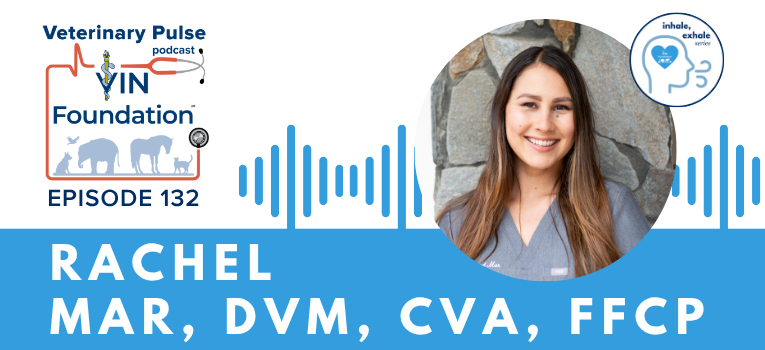
Listen in as Executive Director Jordan Benshea chats with Dr. Rachel Mar about the importance of having compassion for yourself, her path to creating Vitality Vet, and how Batman (yes Batman!) plays a role in her life.
GUEST BIO:
Dr. Rachel Mar
Dr. Rachel Mar completed her bachelor’s degree in Animal Science with a minor in photography at Cal Poly San Luis Obispo. She worked in high school ministry for one year then moved to Dublin, Ireland to obtain her degree in Veterinary Medicine from University College Dublin. Now she is an integrative veterinarian working in Santa Barbara, California. She is a Fear Free certified veterinarian and will complete her Certification in Veterinary Acupuncture (CVA) through Chi University at the end of Summer 2021. Dr. Mar is currently enrolled in the Certified Canine Rehabilitation Professional (CCRP) course through the University of Tennessee. She has a blog dedicated to improving the wellbeing of both pet parents and their pets, and also offers virtual veterinary teleadvice consults via her website www.thevitalityvet.com. Dr. Mar can also be found on Facebook and Instagram (@thevitalityvet).
LINKS AND INFORMATION:
- Cal Poly
- Veterinary Medicine at University College Dublin
- Vitality Vet on Facebook
- Vitality Vet on Instagram
- VIN Foundation Vets4Vets®
You may learn more about the VIN Foundation, on the website, or join the conversation on Facebook, Instagram, or Twitter.
If you like this podcast, we would appreciate it if you follow and share. As always, we welcome feedback. If you have an idea for a podcast episode, we’d love to hear it!
TRANSCRIPT
Intro
Rachel Mar, DVM, CVA, FFCP: Let’s be honest about what we’re going through because it’s hard. Veterinary medicine is hard whether you’re in vet school, or pre-vet, or being a vet new or for many years, it can be really challenging. I wanted to be honest about my experience with that. It’s been amazing to have other people who are already vets encourage me in it and be like, “It’s okay, your failures aren’t going to define who you are as a vet,” and be able to encourage other people who are students who’ve been like, “Thank you so much for sharing that. I’ve been really struggling with this”, or people who weren’t even in vet med who’ve been struggling. I think that’s been really encouraging. If it’s one or two people that I can impact positively, that’s all I wanted to do was to be positive on this platform.
Meet Rachel Mar, DVM, CVA, FFCP: A Journey in Veterinary Medicine
Jordan Benshea: That is Dr. Rachel Mar, a small animal practitioner and founder of Vitality Vet, and this is the VIN Foundation’s Veterinary Pulse podcast. I’m Jordan Benshea, Executive Director of the VIN Foundation. Join me and our cohost and VIN Foundation Board member, Dr. Matt Holland, as we talk with veterinary colleagues about critical topics and share stories. Stories that connect us as humans, as animals, as a veterinary community. This podcast is made possible by individuals like you who donate to the VIN Foundation. Thank you. Please check the Episode Notes for BIOS, links, and information mentioned. Hi, Rachel, thank you for joining me today.
Rachel Mar, DVM, CVA, FFCP: Hi, Jordan. Thanks so much for having me.
Jordan Benshea: Welcome. First and foremost, thanks for joining us. What is your current role right now? Where are you in the veterinary profession? I like to backtrack it, give people some backstory, and share some depth into how you got to where you are now.
Rachel Mar, DVM, CVA, FFCP: Yes, so I’m a recent veterinary grad, I graduated last May in 2020. I’m currently working at a small animal practice in Santa Barbara, California. I consider myself an integrative vet. I am nearly done with my certification in veterinary acupuncture, and then I will be starting my certification in canine rehabilitation.
Jordan Benshea: That’s wonderful. You also run a website called the Vitality Vet, which we will get into talking about.
Rachel Mar, DVM, CVA, FFCP: Yes, yes. So, people can find me at the Vitality Vet on Instagram. I do have a website that goes along with that where I blog, and I share general veterinary education as well as other mental health tidbits and advice.
Jordan Benshea: Wonderful. Okay, so let’s dive right in.
From California to Dublin: A Vet’s Educational Path
Jordan Benshea: Where were you born and raised?
Rachel Mar, DVM, CVA, FFCP: So, funny story. I was born in Virginia and lived there for maybe nine months as a toddler before my parents decided to move back to California where they’re both originally from. My dad’s family is from the Bay Area, so I spent my childhood in nearby San Francisco. My mom’s from Southern California. So, when I was entering Middle School, we moved to Southern California and that’s where I spent the rest of my young years, I guess you could say. So, I was raised all over.
Jordan Benshea: And then where did you end up going to undergrad?
Rachel Mar, DVM, CVA, FFCP: I went to undergrad at Cal Poly San Luis Obispo. I’ve lived essentially all along the coast of California and I’m a California girl at heart and yeah, I lived in what we call SLO for five years and lived this SLO life before I moved to Dublin, Ireland for vet school.
Jordan Benshea: What was your journey to veterinary school? Are you someone that always wanted to be a veterinarian, or was there a defining moment in your life when you thought, “Oh, this is it?” Or was it just from a young age? Puppies are really cute, and I want to make……….
Rachel Mar, DVM, CVA, FFCP: I think we all kind of start that way. Oh, we love animals. I want to be a vet! Yeah, but to be honest, I don’t feel like there is really one specific moment. I just remember I had pets my whole life growing up. We had an ant farm, guinea pigs, hamsters, cats, and dogs. From the day I was born, I was born into a family that was already two dogs, and they were like my siblings. I loved animals since I could remember and my I don’t know if it was my parents being like, “Oh, you love dogs, do you want to like take care of them when you’re older? You could be a vet.” I honestly can’t remember, but I do know that when I was two years old, for Christmas Santa got me a little vet kit. It was this little stuffed dog with a little like stethoscope for a kid. So basically, since I was at least two, I was playing vet and that’s what I always knew I wanted to do, and I’ve always loved animals. I just feel the passion for animals in vet med from that age.
Jordan Benshea: Wow, that’s pretty young.
Rachel Mar, DVM, CVA, FFCP: Yes, it is, and I have video proof to verify because everyone says since they’re a child, but I didn’t even really know where it started. My parents were like, “No, you were two years old in this video,”, and they have a video of me at Christmas time opening this vet kit and I was like I didn’t even want to open other presents I was so excited.
Jordan Benshea: Well, and you said you had an ant farm. I mean, I have ants in my kitchen right now, but I think in my mind of the pets that I think that kids had, we had rabbits, lizards, birds, and cats, and all that stuff, but I guess I didn’t think about an ant farm. Is it like one of those things that is plastic on both sides and there’s a little top and you watch them go through?
Rachel Mar, DVM, CVA, FFCP: Yep. I don’t know what was so trendy about it in the day. It was like the whole chia pet craze. Ant farm and it was so cool. You’d like you had to feed them a right amount, but they just make now that I think about it, that’s kind of cruel. You keep like hundreds of ants in this little plastic thing. Eventually, we let them free because we’re like we don’t need this. It was just one of the many animal creatures we could have living in the city.
Jordan Benshea: Very city friendly.
Rachel Mar, DVM, CVA, FFCP: Yes.
Jordan Benshea: So, how did you go from Cal Poly to going to veterinary school in Dublin? That’s a big shift. You and I both happen to live in the same town of Santa Barbara, but SLO or San Luis Obispo is definitely Central Coast, California and is nowhere close to the UK. So, what was that journey and how did that look like for you?
Rachel Mar, DVM, CVA, FFCP: Yeah, I honestly don’t think I was prepared for the journey to a cold country. Essentially, I went to Cal Poly Animal Science pre-vet track. I knew I wanted to go to vet school. Funny enough it came to my final year, actually, the beginning of my final year at Cal Poly and I was just so burnt out. Like college is busy enough, pre-vet on top of that, and I was doing a minor in photography. So, it was a lot of things at once. I was technically graduating a little early with all the credits I had. I was really burnt out to be honest. I had this this life moment at the young age of 21, 22. I was like, is this really what I want to do with my life? I am so tired, I’m always striving. Do I really want to go to vet school? I was involved with a Christian organization out there called Campus Crusade for Christ. I really love mentoring teenagers and specifically high school students. I ended up doing High School ministry for a year after graduating because I was like I don’t think that I really want to go to vet school. Do I really want to pay hundreds of 1,000s of dollars to do a career that is going to burn me out? I did that for a year, and it was exactly what my mind and my soul needed, to take time off. That year I still applied to schools; in case I want to do it. With a lot of peer support and even chatting to my pre-vet mentor about it. he was like, “No, you should honestly take a year off, work, take time, and really think about it,” because he agreed with what I was feeling. He’s like if you aren’t really committed, then don’t go to vet school. Eventually, by the time I was getting letters back from schools, I was thinking about it and praying. I was like, you know what I really do miss you know, that was the first year of my life I didn’t have a pet, I wasn’t involved in any of vet things, and I really missed it. I missed animals. I did everything I can to just like pet sit people’s pets for free. Whenever you sell horses and sled stuff, I’d go over and go pet them. I was like you know what, I think that’s what I’m. I have this piece of me where I feel called to that and I really think I can make it work. I knew in my mind if I was going to go to vet school, I had to be really adamant about how I was going to approach it to ensure it wasn’t going to burn me out and ensure it wasn’t [I knew it was going to be stressful], but ensure I was choosing a career and something within veterinary medicine that was giving me the space that I needed and understand my own capabilities. When it came to which school to go to, I applied to Davis. Davis was my top choice because I’m in California, it’s cheaper in-state and Davis is a great school. I also applied to Colorado, Auburn, and Dublin, Ireland. How I knew about Dublin was that the year prior, I went on a family vacation to the UK, we went to France, and we went to Ireland. I had visited the Royal Veterinary College in England and as much as I loved it, I was like I can’t live in London. I’m not a city gal. They told me, “Well, since you’re going to Dublin next, have you thought about checking out their vet school?” I was like, “they have a vet school there?” I was only in Ireland for four days but fell in love with it. It was a very relaxed culture. They love their Guinness, I love Guinness, it was perfect. Going from, I can get through vet school, they got Guinness here. That’s great. So, coming from the drought of California to beautiful green. The lifestyle was so opposite of what experiencing it here in California and in the States, in general, of very fast paced. Very much like, “Okay, I got to focus on me, I’m going to not help anyone on the side of the street. Where you go to Dublin, and Ireland in general, and if you’re lost, they’ll stop and walk with you to where you need to go. You make so many friends from random strangers and so, I really enjoyed the lifestyle. I was like, “Oh, I wouldn’t mind going here.” The other plus was they did have a sports medicine program in both equine and canine, which is the field I knew I wanted to go into in veterinary medicine. So, I applied, got in, and next thing you know I’m moving to Ireland. So long story short, not really short, but
Jordan Benshea: How was that shift for you going from undergrad at Central California, Central Coast, California to a year in ministry, to Dublin and veterinary school?
Rachel Mar, DVM, CVA, FFCP: Yeah, it was tough. I’m not going to lie. It was a hard transition, not only being out of academia for a year, and then going back to school, but also transition of I didn’t realize how hard it would be to move to a different country. I was like, “Oh, they speak English, it’s not really a transition, but just things like figuring out what phone I’m going to have and a new number. I’m not going to have all the normal toiletries that I’m used to here, medications are called different things there.
Jordan Benshea: Everything!
Rachel Mar, DVM, CVA, FFCP: Yeah. So, it was like quite a difference. Even getting groceries. I got so used to using the French words, I just need to find a zucchini and they’d be like, “Wait, what’s a zucchini?” I found out later it’s called a courgette there, and I’d be, oh, courgette! So, it got really fancy with my food names. It was quite a transition and hard. You’re moving to a different country, and you don’t know anyone. I knew very few people who moved for vet school and end up knowing people out in Ireland, and I really didn’t know anybody. It was starting a whole new life. I’ve always been adventurous and independent, so I made my way. I met some people and traveled on my own. It was an amazing experience in the end, and I really am glad that I did that. I never got to study abroad in undergrad, which is something I always wanted to do, but limited time when you’re pre-vet and taking on all these extra things.
Jordan Benshea: Yeah, I spent a semester in high school in England and it was it was very different. So, dating myself that was pre-internet, that was pre-cell phones, that was pre- a lot of things, but it was still drastically different for me. I had spent some time in Europe previously, but it was definitely different going to school there. Just the school phrases and words and everything and the food and it’s definitely a shift. I really admire you going to veterinary school because that’s so much more of a shift. Even the change between the ‘er’ and the ‘re’ and so many different words, or the ‘ou’ versus just the ‘o’ and there’s just a lot of shifts and changes that you’re learning to make, let alone the social aspects of that.
The Birth of Vitality Vet: A Mental Health Outlet
Jordan Benshea: One thing that came out of your veterinary school is that you started the Vitality Vet. Can you explain to us how that happened and what was your motivation in creating that wall in the midst of this big change and in the midst of veterinary school challenges and demands?
Rachel Mar, DVM, CVA, FFCP: Vitality Vet came out of a way for me to express myself and it was a mental health outlet. I’ve always loved writing. If I wasn’t a vet when I was younger, I want to be an English teacher and write. I loved writing and when I was most stressed, when you know I’d be lying in bed in vet school stressed on my mind, and you’re either thinking about whatever you’re studying, or life things in general, I would get my phone and I’d write notes. I write things out whether it was poetry, whether it was to get this off my mind, or whether it was a list of okay, I need to study this. I needed something to release and so out of that came a different blog. Before it was Vitality Vet, it was another blog and it was a blog where I would just write poetry, or write about things on my mind, my opinions on topics, random things like that. It wasn’t ever a thing that maybe my friends and family will read it. The other side of it was also I’m a huge foodie, and I love traveling, so it was another way for me to share my travel experiences and places that I recommended. So many people would contact me. Friends knew that I was a huge foodie and I tried almost every place in Dublin, and they’d be like, “Okay, I have a friend that’s visiting, and she has this dietary need, and we’re thinking of going to this type of place, what do you recommend?” I’d send them a list. I’d have friends visiting Ireland and wanting an idea of where to go, what I recommend, and I ended up with this list of places. So, ironically, I already had this list right now and I put up a blog. When people asked me, here’s the link, go read it, and I have all the links to where you can buy tickets. So, it was more of a fun thing, a great outlet, and something that I could release out of. As it started going, and I was getting good feedback, which I wasn’t really anticipating, I just thought it would be this weird little thing I can send people and people loved it and were like, I love reading your new like food guide. So, that’s how it started. Then it turned into Vitality Vet because during vet school, I would add certain things about pet health or pet advice in general, or things that I would’ve learned about. People also loved that, and this veterinary community grew online, which encouraged me to realize we need this online. Because, I go online, and you can have advice from a nutritionist, from a human doctor, from a dermatologist, you can find all those information. Vet med at the time, which is crazy to think, four years ago, wasn’t really a big thing online. So, I started posting more of that information and my experience in vet school and sharing a lot about not only pet wellness and pet education, but also mental health within vet med and so I think that was a lot of the motivation. I’m really passionate about veterinary medicine, but I’m also really passionate about wellness within it. I truly believed that if I was going to be a good vet, I had to really take care of myself and that’s something you’re not taught in vet school. That was something that I knew my peers struggled with, too. We would constantly talk about, how can I get through this, despite the failures, the stress of it, the inadequacy or constantly feeling, I mean, we’re all brilliant people, which is why we got into vet school, but you never felt like enough or never felt successful, always felt tired. What got me through vet school was taking care of myself and my own mental, physical, and spiritual health. I would wake up at five in the morning, go to the gym with my roommates, and we’d go to class at 7am downing our breakfast in class [we’re known as the girls who ate in class]. We had a week off right before our exams, and people would cram study for seven days. I was like, I can’t study for seven days straight, I’d go travel. I’d travel for like, four of the days and then I’d come back feeling great and refreshed and I’d study. I’d go on hikes, and people would ask, “How are you doing these things before our finals?” I’d respond that I need that break, I need that mental break. I found personally for me that when I did that, I performed better, because my life wasn’t all vet med. I guess, again, long story short, but not really short, it was accumulation of all these experiences, these thoughts, and also an outlet for me that led to the Vitality Vet. My big thing is encouraging people to live this life of vitality, and help people strive for them and their pets for mental, physical, and spiritual health, and for their mind, body and soul. I want to do that through wellness and education. That’s my passion. That’s how this started. It was a variety of things through both my passion in vet met and writing, as well as I wanted people to take care of themselves if they were going to do this career as well as, “Hey, how can we take care of our pets?”
Jordan Benshea: Yeah, there is really that piece there that it’s so often, especially in America I think, that it’s this work mentality that we have is drastically different from Europe, of course, and many places in the world. This concept that taking care of yourself and what that means and clearly, we’re seeing more discussion about it now and there’s more awareness around mental health which is really helpful. The VIN Foundation’s Vets4Vets program is this confidential support group, peer to peer support, and it’s run by veterinarians specifically for veterinarians. There’s another one for support staff as well called Support4Support. We regularly see that there are so many people struggling. Specifically, if they’re struggling in veterinary school and within the first five years out of veterinary school, they tend to be struggling throughout their career versus if they get the support and the resources they need in school and within a couple years of graduating, they tend to succeed more. That’s something that the more help that we can give colleagues to me, it just seems like a no brainer. We want our veterinarians healthy because they take better care of our animals when they’re healthy as well. It’s this circle of care for each other that improves across the board and happy vets are happy pets, right and great happy vets support happy pets. We’re all here for this love of animals and loving ourselves in the midst of that and learning how to do that is always challenging. We tend to be our worst or our hardest critics and having those resources are extremely important. It seems like Vitality Vet definitely supports those efforts and wants to improve colleagues. Even some of the stuff that you’ve talked about with Vitality Vet like acupuncture and stuff like that, those are aspects of Veterinary Medicine that improve an animal’s life, and through that also improve the pet owner’s life. Finding ways that we can support our pets and support our vets as well is extremely important.
Rachel Mar, DVM, CVA, FFCP: Yes, exactly. That’s another huge reason I’m passionate about vet med and the client education side of it. I realized it’s a common misunderstanding of ‘I love animals, I’m going to be a vet’, and then you realize, oh, wait, I have to actually interact way more with people and it’s that hard realization. The more I thought about it, the more I realized I actually do love people. People are either misunderstood, and we don’t communicate well with them as vets, or people don’t know where to go. They don’t have the resources and it’s easy to Google things these days. So, what can I do to make it easier on pet owners as well as help them care for their pet better? If you have a happy vet happy pet, but also a happy owner, you’re going to have a way healthier pet and an owner that is truly educated to know I need annual exams, annual blood work, or biannual blood work once a pet is older, and the importance of that. For them to understand we’re not trying to get money out of them or make a career, but it’s I want your pet to live a long life, a life of vitality too for your pet. It’s that whole idea of how can we, in general in vet med, make it a better environment for not only our peers and ourselves, but also owners and their pets? I imagine this Venn diagram with the three circles, and we have to be all interconnected in the middle, and if we’re not interconnected in the middle, at that point where we’re all well, then it’s not going to work out. We’re all in our own circles doing our own things, and no one’s benefiting. So yeah, I totally agree.
Jordan Benshea: It’s so true. My dog gets extremely anxious and shakes when I take her to the vet. I have a mobile vet now. I felt if I take my dog who starts shaking to the vet, and she is shaking, and the vet seeing her is not able to do as good of a job because she’s in this very uncomfortable situation, then it’s hard to get a true look at what’s going on with her because she’s shaking. The dog is not relaxed, and the vet is probably having a hard time, then what could happen is the pet owner could get frustrated because she felt like the vet’s not doing their job. It’s like this circle of if everybody comes in with all the stuff that they come in with, like stress and other patients, etc. and it’s already hard enough for colleagues in the profession that anything that we can do to make it easier is wonderful.
The Impact of Vitality Vet: Community and Connection
Jordan Benshea: What are some of the positive impacts that you’ve seen from Vitality Vet so far?
Rachel Mar, DVM, CVA, FFCP: I’ve really loved the vet community and the people that I’ve been able to connect with through not only my website, but my Instagram as well. I tried to be as raw as possible on my Instagram, and I’ve shared about my successes and my failures. I think even if there’s just that one person that will reach out to me and say, “Thank you for sharing that. I’ve been really struggling lately.” I’m very open about my own personal battle with depression, about failing the NAVLE, and things like that. It’s hard to find people where you’re really struggling online to find someone that you can connect with. It’s hard enough in person, and you go online, and you feel even more alone or even more isolated with where I’m at because Instagram’s a highlight reel for a lot of people. I try so hard to not make it that and be real about these things. There are amazing successes that we need to celebrate with each other, but also, let’s be honest about what we’re going through because it’s hard. Veterinary medicine is hard whether you’re in vet school, or pre-vet, or being a vet new or for many years, it can be really challenging. I wanted to be honest about my experience with that. It’s been amazing to have other people who are already vets encourage me in it and be like, “It’s okay, your failures aren’t going to define who you are as a vet,” and be able to encourage other people who are students who’ve been like, “Thank you so much for sharing that. I’ve been really struggling with this”, or people who weren’t even in vet med who’ve been struggling. I think that’s been really encouraging. If it’s one or two people that I can impact positively, that’s all I wanted to do was to be positive on this platform. My thought was always if I’m going to have social media, I want to be able to make a positive impact. I don’t want it to be for nothing, or make people feel bad about themselves. That defeats the purpose of this platform for me.
Jordan Benshea: There’s already enough of that going on there.
Rachel Mar, DVM, CVA, FFCP: Exactly, yeah. If there’s a comparison, all that stuff, I want people to feel better if they follow me. If they don’t, then don’t follow me, that’s fine. You don’t need to read my stuff. That’s definitely been a highlight, but also just the amazing connections and networking. Meeting, Matt online. That was more through his NAVLE support group, but also just connecting more with him once he made an Instagram meeting. I’ve had amazing opportunities recently to be a speaker at an online conference, the Dog Health Solutions summit, and I’ve met one of my close vet med friends now through an online veterinary female group. It’s just funny, because I feel like I’ve all these, quote, unquote, I mean, they are friends, but it’s people I’ve never actually met in person yet. They either don’t live where I live, or we’re just Instagram friends. It sounds so weird, but you make such great connections with these people. Yeah, it’s been a great platform to feel like I’m making a positive impact in people’s lives as well as people have positively impacted my life. It’s been an amazing way to grow community and know that I’ll always have support, whether it’s in person or not. Even I think, which is kind of sad and I do wish that veterinary medicine would change this way, but you don’t always have the support that you need in your own clinic, and in your own city within veterinary medicine. So, it’s been nice to have the Vitality Vet because I know it sounds weird, but it’s like I know I have that support online, at least from peers that I’ve met via Instagram and through the Vitality Vet.
Jordan Benshea: Yeah, I’m hoping that one of the positives that comes out of COVID is the ability to learn how to communicate and connect better over distances. We’ve for sure seen an increase in online education and curbside pickup. I love those things; I think they are a life changer.
Rachel Mar, DVM, CVA, FFCP: Yes, it’s a life changer.
Jordan Benshea: But the ability to learn online at a level that you would with the travel and everything, you just wouldn’t have been able to do that much. The ability to connect with people, and it’s been a great exercise to learn how to [I’m a big believer in clear communication and good communication] and it’s been a good exercise in us learning how to communicate in ways that we might not be as good at. We’ve had to do this distance in different levels. I’m not saying that it’s okay for necessarily for school, etc., but I mean in terms of finding ways to improve our communication skills with each other at a distance. I’m hoping that’s one benefit that’s come out of COVID. I’m also hoping and maybe this is naive of me, that there’s an increase in kindness amongst each other because usually when there are these things that we go through geographically that are challenging, [for us in our area, it was the Thomas fire, the mudslides, etc., or earthquakes, I mean, take your pick] by going through that, it’s very geographic, right? Then you talk to somebody that’s in another state, or 10 miles down the road, and it’s been a completely different experience versus COVID is something that we have all experienced. In some ways, it almost this bonding experience that I’m hoping people are able to come out with some kindness of we’ve just been through a whole lot, some of us a lot more versus others, but it’s impacted every single person, and hopefully there’s some kindness that can come out of that. That combined with the increased awareness of mental health and the increased resources of mental health, I’m hoping there’ll be some positive impact there. Maybe that’s just me looking for the light at the end of the tunnel, or an ongoing desire to see something positive, but I see that shift a little bit and I’m hoping that it continues, and people take the time to consider things as they’re getting back to stuff and work from that mentality.
Rachel Mar, DVM, CVA, FFCP: Yeah, and totally agree. I love it. I’m really hope that that’s the case. So, we’ll see. Time will tell, but there’s a lot of hope in that sense of people coming out of this better than they were going into it.
Jordan Benshea: Sure. Right.
Navigating a Veterinary Career: Challenges and Opportunities
Jordan Benshea: So, now you’re a practicing veterinarian, how is Vitality Vet playing a role in your career now?
Rachel Mar, DVM, CVA, FFCP: I guess I’ve shared a bit about it already in terms of the support in the community and the resources. I think also with the networking it has been a good way to move my career forward. As a new grad, I’ve already had people call into the clinic that I work at specifically requesting me. I’m like how did they possibly figure out who I am? I don’t know who they are. It’s because they found me through my website and knew that I am an integrative vet. People are specifically looking for acupuncture and the services that I specifically offer at my clinic. That’s been really awesome and so cool. Back in the day when there weren’t websites, and people didn’t know who you were, made it a lot harder. Now, it’s so easy. I don’t even know how people find me anymore, whether it’s LinkedIn, Facebook, or Instagram. There are all these ways that they can, which is why I have those platforms. It’s been cool that people are actually finding me through this. It’s been awesome just advancing my career and getting my name out there as a new grad. I’ve had tons of people reach out wanting telemedicine consults. I offer some telemedicine consults. I don’t diagnose or prescribe anything, because you can’t here in California, but I can at least give people some advice about what the next step is and should you be concerned about your pet. It’s been cool to be able to offer that to people, and it helps direct them to my clinic as well. So, it’s also a plus for the clinic, getting business for them. In my career to be able to be open on the platform and also stay encouraged, because if I wasn’t on Instagram, I wouldn’t be getting as much support as I would without having this platform. I’ve gotten tons of freebies, that sounds weird to say that, but it’s true, people really want your advice as a vet, and how to do something, if their product is worthwhile and if it’s going to help a pet. I think that’s been fun, too, [I don’t say yes to all of it], but some things that sound like a really great deal. I’d love to try your products. Those are always pluses with branding. All of that. It’s been mainly a positive thing. I think the hardest is 1] not being able to get to meet people in person, which hopefully the pandemic has changed that now as you were saying earlier, but 2] I think the hardest thing is definitely people reaching out for advice and I legally can’t help you with that. I think that’s been the downside is the inability to interact with people sometimes because they don’t understand the limitations we have with our licensing.
Jordan Benshea: Right. Right.
Outro
Jordan Benshea: Well, I really appreciate you taking the time to chat with us today, Rachel, and one thing that I like to ask everybody is, do you have a secret talent or something you enjoy doing that others might not know about?
Rachel Mar, DVM, CVA, FFCP: Well, I did get my minor in photography, so I had my own photography business before we went to vet school. That’s the other thing I did on the side. It’s got Rachel Jade Photography. I still dabble in that, but I guess the other secret thing is I am a huge Batman fan, and I’m a huge Batman nerd. I have one of the comic books. I’ve got like all the movies. I saw the Dark Knight Rises, I think 12 times in theater. I yeah, I love that man.
Jordan Benshea: That’s funny. Okay. Is there anything else you want to leave our audience with or a specific piece of advice before we go today?
Rachel Mar, DVM, CVA, FFCP: Wherever you’re at in your journey, you are exactly where you need to be. You are enough and don’t forget to have compassion for yourself along the way, and take care of your mind, body, and soul.
Jordan Benshea: I like it. Thank you, Rachel, thanks so much for your time.
Rachel Mar, DVM, CVA, FFCP: Thanks so much for having me, Jordan. This was great.
Jordan Benshea: Thank you for joining us for this episode of the Veterinary Pulse. Please check the Episode Notes for additional information referenced in the podcast. If you enjoyed this podcast, please follow, subscribe, and share a review. We welcome feedback and hope you will tune in again. You can find out more about the VIN Foundation, through our website, VINFoundation.org, and our social media channels. Thank you for being here. Be well.