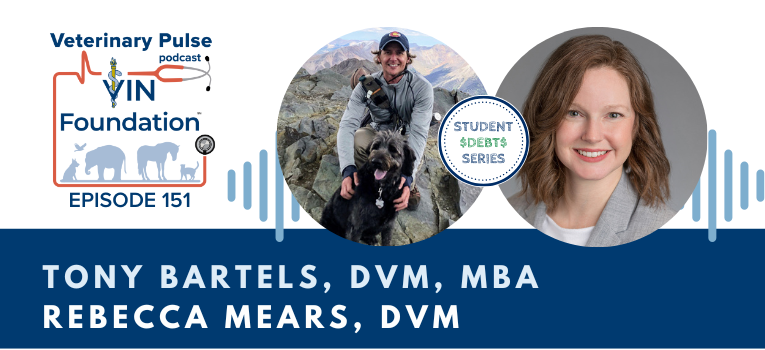
Listen in as Executive Director Jordan benShea chats with student debt expert and Board Member Dr. Tony Bartels and the newest student debt team member Dr. Rebecca Mears in this next installment of our Student Debt Series.
In this episode we’re covering the following six topics:
- Latest news for current veterinary school students
- How to help 2023 grads prepare for repayment
- What pandemic grads, classes 2020, 2021 and 2022 should be doing
- Helpful information for all other borrowers
- The latest on the Student Debt Relief before the Supreme Court
- Recertification and the important dates to be aware of now
As always, we want to hear from YOU. Please share your thoughts by sending an email or joining the conversation.
GUEST BIO:
Dr. Tony Bartels
Tony Bartels, DVM, MBA graduated in 2012 from the Colorado State University combined MBA/DVM program and is a VIN Foundation Board Member and Student Debt Expert, and an employee of the Veterinary Information Network (VIN). He and his wife, a small-animal internal medicine specialist practicing in Denver, have more than $400,000 in veterinary-school debt that they manage using federal income-driven repayment plans. By necessity (and now obsession), his professional activities include researching and speaking on veterinary-student debt, providing guidance to colleagues on loan-repayment strategies and contributing to VIN Foundation resources. Beyond debt, his professional interests include small- and exotic-animal practice. When he’s not staring holes into his colleagues’ student-loan data, Tony enjoys fly fishing, ice hockey, camping and exploring Colorado with his wife, Audra, and their two rescued canines, Addi and Maggie.
Dr. Rebecca Mears
Rebecca Mears, DVM is from Lexington, KY, where she completed her BS at University of Kentucky. She is a graduate of University of Georgia’s College of Veterinary Medicine. While in vet school, she served as the National Business Certificate Director for the Veterinary Business Management Association (VBMA) and as a board member for Vets for Pets and People. During this time she took an active role in wellbeing awareness and access within the veterinary community. Rebecca then worked as an equine general practitioner and is an active AAEP member. In her time away from veterinary medicine, she can be found hiking, baking, and hosting impromptu dance parties. She is passionate about giving back to the profession and improving the lives of veterinarians, pre-vet and vet students.
LINKS AND INFORMATION:
- VIN Foundation Student Debt Center
- Check your current student loan servicers and other loan details — VIN Foundation My Student Loans tool
- VIN Foundation WikiDebt
- VIN Foundation Webinars
- VIN Foundation Blog Recent Student Debt Blog posts:
- Common Student Loan Consolidation Questions and Answers
- Class of 2020, 2021, 2022 Income-Driven Repayment Renewal Note
- Special Cancellation of Up to $20,000 of Student Debt. Are You Eligible?
- Got Federal Student Debt? You’re Now Closer to Forgiveness Than You Think
- Student Loan Forgiveness Planning: Preparing for the Tax Bill
- Student Loan Interest Rates Increase for 2022-2023 Academic Year
- Personalized student loan help from VIN Foundation
- VIN Foundation Repay Wiser
- VIN Foundation Borrow Better
- VIN Foundation New Grad Student Loan Repayment Playbook
- Federal Student Aid Data, Consolidation, and Repayment Application
- Student Debt Relief Information
- Department of Education press release (Nov 2022)
- Department of Education press release (April 2022)
- One-time Forgiveness Count Adjustment
- Federal Student Loan Servicers
- Public Service Loan Forgiveness (PSLF)
- Stay up to date with VIN Foundation updates
Email VIN Foundation: [email protected]
Get updates to stay tuned for the VIN Foundation webinars on student debt.
If you like this podcast, we would appreciate it if you follow and share. As always, we welcome feedback. If you have an idea for a podcast episode, we’d love to hear it!
TRANSCRIPT
Intro
Tony Bartels, DVM, MBA: There’s a lot of changes, and there’s a lot of reason to review your repayment strategy. I think a lot of people, you know, and rightly so, you know, they’re just like, “well, this is just too much and there’s no reason for me to worry about all this, I’m just going to leave my loans the way they were”. And, you know, I cannot emphasize enough that there are so many benefits out there floating around on the table, that leaving your loans as is, is probably not the most beneficial strategy for you.
Meet the Host and Guests
Jordan Benshea: That is student debt expert and VIN Foundation Board Member, Dr. Tony Bartels with Dr. Rebecca Mears, and this is the VIN Foundation’s Veterinary Pulse Podcast, Special Student Debt series. I’m Jordan Benshea, Executive Director of the VIN Foundation. Join me as I talk with veterinary colleagues about critical topics, and share stories, stories that connect us as humans, as animals, as a veterinary community. This podcast is made possible by individuals like you who donate to the VIN Foundation. Thank you. Please check the episode notes for bios, links, and information mentioned. We’re back again with our VIN Foundation Board Member and student debt expert. Dr. Tony Bartels, and also joining us again is Dr. Rebecca Mears to talk about the latest in student loans. Welcome, Tony and Becca.
Tony Bartels, DVM, MBA: Thanks, Jordan. Great to be back, I guess again. It seems like we keep getting new updates almost weekly, if not sooner, so I guess we have to continue to keep doing these to make sure everybody’s aware of all the ongoing changes with student loans and repayment.
Jordan Benshea: Yeah, it seems that we’re really powerful because all we need to do is schedule a webinar or a podcast and then some sort of news will come out that will negate what we were just going to talk about.
Tony Bartels, DVM, MBA: They must be spying on us.
Jordan Benshea: So we’ll just keep doing these, we’ll just keep scheduling things, and then we’ll get news or maybe we schedule nothing and there’ll be no news.
Tony Bartels, DVM, MBA: I doubt that.
Jordan Benshea: Exactly.
Rebecca Mears, DVM: It is funny because I’m new to the team, and I keep asking Tony, I’m like does this always change this much like, I feel like every time I started to kind of understand things, I’m like, wait, nope, just kidding.
Jordan Benshea: Right? Nope. Don’t get too comfortable. Yeah. All right. Well, let’s dive right in this episode, we are going to cover six topics. We are going to talk about what you need to know for current veterinary school students. For number two, for those graduating in 2023. Number three, what we’re calling sort of the pandemic grads, those that have graduated in 2020, 2021, and 2022. All our other colleagues, those that that graduated 2019 or previously, and then we will talk about the Supreme Court case, and also about re certification. So those are the six things we’re going to cover in this episode. As always, notes and things that we mentioned will be in the episode notes, all the helpful links and information, so be sure to check those out. And let’s start with number one.
Current Veterinary School Students: What You Need to Know
Jordan Benshea: What do currently enrolled veterinary school students need to know now and what do they need to do now?
Tony Bartels, DVM, MBA: Well, the students I’d say probably have the easiest homework, if you will, from the recent changes, and that’s just to be excited that, you know.
Jordan Benshea: Just be excited.
Tony Bartels, DVM, MBA: Yeah, just be excited that no interest is accruing on your student loans, for at least, you know, I guess the first half of 2023. We’ll find out exactly how long that extension will last once we have a decision on the cancellation benefits. So in the past, the pandemic forbearance benefits really haven’t been tied to anything in particular. But now, since the cancellation benefits are kind of driving the education department guidance right now until we have a resolution on that case, we’re not going to have the end of the forbearance benefits, which is good and bad. I mean, it’d be great to know sooner rather than later if we could expect to receive some student loan cancellation benefits, but the longer it takes to work its way through the courts, the longer you’re going to receive the interest benefit, which for students is extremely valuable. The longer that interest stays off, the less interest accrues during school when you can’t really do anything about it, the less you’ll have to manage when you reach repayment.
Jordan Benshea: So for now, know that it’s important to stay up to date with the information, but this isn’t something else that you need to add to your plate that you need to worry about currently, until there’s more information.
Tony Bartels, DVM, MBA: Yeah, I would say that this is a great opportunity to really build a budget, know exactly what your living expenses are, as a student. You still want to borrow only what you need, but this also presents a unique opportunity to get your finances in order, right. So if you’ve been struggling with your living expenses and you’re trying to not borrow, or you’re actually taking on credit card debt, or you have other less flexible loans that you might consider paying off while you have access to some of these super flexible federal student loans, this is a great opportunity to do that. But you really have to have a good budget in place in order to know exactly how much you need to cover your living expenses and how much you might have extra to shore up other areas of your of your finances while you’re in school.
Jordan Benshea: Right, and that touches on our Borrow Better tools, and we’ll add a link for that in the episode notes to help current veterinary school students.
Tony Bartels, DVM, MBA: Yep, and I would also just add that we do know that interest rates for next fall are likely to be higher, it’s almost guaranteed that they’ll be higher than they were this past year. So again, that’s really good information to help you potentially borrow less of those more expensive funds in the future, while you have access to these less expensive and non-interest accruing funds now.
Graduating in 2023: Key Information and Tips
Jordan Benshea: Okay, and what about for, you know, second topic is let’s talk about fourth year veterinary students who are going to graduate in 2023. How does that information differ for them?
Tony Bartels, DVM, MBA: Yeah, well, first thing, they should rejoice as well, because they’re going to be the first graduating class that largely accrues almost no interest on their veterinary school loans for a long time. It’s been a very, very long time since we’ve had, you know, subsidized loans or loans that don’t accrue interest during veterinary school. So the norm is that interest would accrue on graduate school, professional school loans, like the loans you take for veterinary school from the time you receive them. The Pandemic Forbearance Benefit started in March of 2020, so really, this graduating class of 2023, most of them are only going to have that first semester of student loans that accrued some interest, and the rest of it has been interest free. Which, again, super exciting, because the less interest accrues, the less you have to manage, and the less it’s going to cost you in repayment. But as they approach graduation, I would highly encourage them to file a tax return, if you are going to have to enter repayment, and there’s probably going to be some, you know, something that resembles repayment in the not so distant future. So you want to make sure that you’re prepared to start repayment in the most financially beneficial way possible, and having a tax return on file, whether you need to file a tax return or not, is really helpful in getting started on repayment. So even if your parents claim you as a dependent or you didn’t have any income to report, you can still voluntarily file a tax return for the 2022 tax year. The tax filing date for that tax return is April 18, this year of 2023. So file that tax return for most of you, that’s going to be right before you graduate. So have that tax return on file, it will make getting started in repayment, particularly with an income driven plan a lot easier.
Jordan Benshea: Right, because a lot of, we do get a lot of questions about this, about “well, can I file a tax return and is that income on what I think I’m going to make once I graduate or what it currently is when you file?”, and the answer is absolutely, when you file because that’s going to be a lower Adjusted Gross Income, right, and that lower AGI is going to benefit you with that repayment plan.
Tony Bartels, DVM, MBA: Right and, you know, people do get tripped up on and a lot and, you know, if you read the application, particularly for the income driven plans carefully, it always asks you, have you filed a recent tax return, which is why you want to have that on file. And then they ask you, has your income decreased since you filed that tax return? They’re not terribly concerned if it increased, they’ll get you the next time you renew when your income increases on the subsequent years tax returns, but if you have that recent tax return that shows almost no income probably for most of you that are fourth year veterinary students, you can apply for an income driven plan and secure a very low if not zero payment for the first 12 months, regardless of what you’re doing after graduation.
Jordan Benshea: Okay, and then for a third topic, so we have the students who are current veterinary students, and including that the fourth years who are going to graduate in 2023, and then we have, you know, all the students who graduated during during the pandemic. So that would be 2020, 2021, 2022, and now addition 2023.
Pandemic Graduates: Navigating Complexities
Jordan Benshea: So what do these pandemic grads need to know?
Tony Bartels, DVM, MBA: Ooo that, this is probably the most complicated, almost the most complicated of the groups. It depends on what you’ve done with your student loans since you’ve graduated. Most of you, at least just based on the ones that I’ve seen, that have reached out for assistance, haven’t done anything because you haven’t had to do anything, right. So you graduated, you didn’t have any payments due you had your grace period, your grace period expired, your payments were still set to zero, the interest rates were still set to zero because of the Pandemic Forbearance Benefits, but that’s not ideal. Yours, thankfully, through a lot of other changes that have happened recently, you’ll still get repayment credit, which will also count towards forgiveness, regardless of what you did with your student loans since graduation, even if you’ve done nothing. But you want to start thinking about what your repayment plan is going to look like after the Pandemic Forbearance Benefits end, right. And again, probably will end sometime in 2023, it’s just a matter of well, will it be early, mid or late of 2023. But you want to choose a repayment plan and same thing kind of applies as we talked about for the 2023 graduating class, you can use a prior year’s tax return, right. So if you apply now, that would be your 2021 tax return because you don’t have a 2022 tax return yet, and for some of you that 2021 tax return will be pretty low, right? It’ll either look like it did as a fourth year veterinary student, or it’ll have your half a year’s worth of income that first year after you graduated. Or for some of you it might be that full, that first full year’s worth of income that you’ve generated during an entire working tax year. So you can use that most recently filed tax return to apply for something like an income driven plan, like Pay As You Earn, the Revised Pay As You Earn, and have that payment set for the next 12 months, including when repayment resumes after forbearance benefits.
Jordan Benshea: And we should also say that for 2023 graduates, we will be doing the new graduate playbook again, probably around May that webinar along with a checklist that will help those that are about to graduate. And we’ll put a link for that in the episode notes as well.
Tony Bartels, DVM, MBA: Yeah, and that one is going to be quite different than the previous ones. So I’ve been trying to prepare folks for the fact that, you know, normally we could send you to prior years new grad playbooks, and you could get the gist of what you should be doing to get started with payment. This year is going to be quite different, so what we’ve talked about in the past is really not going to be as applicable as the playbook that we’re going to run this year for the 2023 graduating class because there are changes beyond just the Pandemic Forbearance Benefits and the cancellation benefits that are going to require us to talk about different strategies for getting started.
Jordan Benshea: So it will be new this year, and we’ll make sure to share that link so you guys can know where to go for updates and information on that. So…
Tony Bartels, DVM, MBA: Yeah, and some of that actually relates to the recommendations for this cohort we were just talking about, right, so the pandemic graduating classes. So I get a lot of questions from those folks who graduated in 2020, 2021, 2022, that haven’t done anything with their student loans, and they reach out and they’re like, “well, should I still consolidate? I listened to the playbook, and you guys talk about consolidating all the time”, and at this point, the recommendation would be, probably not. And that’s because some of the changes that are going to take place in mid 2023 have also been extended to folks who graduated into the Pandemic Forbearance Benefits and had that forbearance in place when their graduate school student loan grace periods ended. And the way that the guidance has been released is, the interest that you may have accrued during school will not capitalize if you let your grace period expire and enter repayment. But if you consolidate, then it will take that unpaid interest and capitalize it to your principal. Capitalization is essentially taking your unpaid interest, adding it to your principal, the higher your principal balance, the more interest you accrue during repayment. The more interest you accrued during repayment, the more your pay. Right. So now we have to talk more about what do the details of your student loans look like? How much unpaid interest do you have? Do you have any loans that require you to consolidate so everything can get into the same repayment plan and qualified for forgiveness in the future if you need it? Or can we just choose a repayment plan to get you in repayment without triggering the unpaid interest capitalisation so you can save a little money during the course of your repayment.
Upcoming Webinars and Updates
Jordan Benshea: Yeah, and as we get closer, and once we know the actual date when things will start again, we’ll do what webinar as well and more podcasts to give you guys all of that information. And as long as you’re signed up to get updates, you’ll get all the information about those webinars.
Recertification Concerns for Pandemic Graduates
Rebecca Mears, DVM: One of the questions that we hear pretty commonly from those graduates that did graduate during the pandemic is about recertification for those that did graduate, consolidate, choose an income driven repayment, you know, has that changed at all Tony? Is that something that those graduates need to be worried about? Or what’s the deal with that?
Income Driven Repayment Plan Details
Tony Bartels, DVM, MBA: Yeah, for so for those of you that have chosen a repayment plan, and particularly those that have chosen an Income Driven Repayment Plan that will have a annual recertification date, meaning you have to provide new documentation of your income to have that payment continued to be calculated based on your income. As part of the Pandemic Forbearance Benefits, the renewal dates keep getting pushed into the future. Nobody is going to be required to provide any kind of income renewal documentation before July of 2023, and some of you, if you’d let’s say you graduated in 2021, consolidated, and got a payment of zero for the first 12 months, it’s likely that your renewal date would be sometime in 2024. At this point, because the way that the annual renewal window would have worked is that I graduated in 2021, I consolidated, I applied for an Income Driven Repayment Plan, my new renewal date would have been, you know, say May, June, July of 2022, which is already passed, which would get kicked into July of 2023. Or even beyond that, if your renewal date is still listed as something before July of 2023. If you do your what we call a student loan physical exam, you obtain your student aid data file uploaded into the VIN Foundation My Student Loans tool, and you look for the anniversary date for your Income Driven Repayment Plan, if it has a date from before July of 2023, then you can pretty much add a year to it until it gets beyond July of 2023. So that means those of you that graduated, consolidated, got a $0 payment for the first 12 months, likely will continue to have that $0 payment for quite some time, right, at least till July 2023, maybe until early 2024. So make sure you’re checking on that renewal date to see when you’re next due to provide documentation. And for most of you, your incomes are probably, have probably increased since you graduated, and that’s great. But your payment on your student loans won’t increase until you actually are due to provide that updated income documentation and it generates a payment that’s higher than you were paying before.
Jordan Benshea: That’s a good point, Becca. Thanks for bringing that up. And if we have colleagues who are listening who are not pandemic grads, so anyone pre like 2019 or prior that graduated from veterinary school in those years, what do they need to know?
Tony Bartels, DVM, MBA: I would say it’s similar, but we want to make sure again, you know, what repayment plan are you using, what life changes have you had since then that may necessitate a change in that repayment plan, but also checking on that renewal date to see exactly when you’re due to provide updated income information. You know, what might that updated income information be and will it generate a payment that’s higher or lower than what you’re currently paying if you’re on track to reach forgiveness? Are you planning for that forgiveness? Do you have a forgiveness planning fund? You know Just in case you have to pay a tax when you reach student loan forgiveness.
One Time Forgiveness Count Adjustment
Tony Bartels, DVM, MBA: But I’d also encourage you to look into the One Time Forgiveness Count Adjustment Benefit, and this is one that kind of flew under the radar that was announced in April of 2022, but essentially, all repayment time counts as forgiveness time. So if you have some older loans that had been in repayment, maybe before an income driven plan became available, or before you actually stumbled upon income driven repayment plans, or maybe you’ve been using an extended or graduated repayment plan for, you know, 5, 10, 15 years, all of that will count towards forgiveness qualifying time, which means if you weren’t using an income driven plan before you may have a reason to do so in the future, because you might be closer to forgiveness than you even realized. So I would be using this time to dive into the Forgiveness Count Adjustment. Again, doing that student loan physical exam, see how long some of your loans have been in repayment, and then start, you know, looking at what a forgiveness qualifying plan might look like for you in terms of how much forgiveness eligible time do you receive as part of this One Time Forgiveness Count Adjustment, that we should all get notified on, you know, as early as the end of this year, but ideally before mid of next year, and then see how much time we all have before we’re due to reach student loan forgiveness.
Jordan Benshea: Okay.
Supreme Court Case on Student Debt Relief
Jordan Benshea: And for our, we talked about the recertification, so that topic is done, but one of the other topics we wanted to cover is, you know, when is the case for the student debt relief being heard by the Supreme Court? I mean, this has been something that’s definitely been a news topic, and I think a lot of people were really excited about and applied for. So where does that stand?
Tony Bartels, DVM, MBA: So last week, they agreed to hear the case. They told the administration that they couldn’t do any cancellation benefits until the case is heard, and they’re going to hear the case sometime in February, so February of 2023. So the earliest we would get any kind of decision would be after those arguments are made during that court case in February. But most likely, that decision probably won’t come down until later in the spring of 2023 when the Supreme Court tends to release all of their decisions for the cases that their hearing for this term. So, could be as early as February we get some kind of resolution, but most likely won’t be until later in the spring of 2023.
Jordan Benshea: Okay, and what else do colleagues need to know about all of these changes?
Tony Bartels, DVM, MBA: Yeah, there’s just been a lot of changes.
Reviewing Your Repayment Strategy
Tony Bartels, DVM, MBA: There’s a lot of changes and there’s a lot of reasons to review your repayment strategy. I think a lot of people, you know and rightly so you know, they’re just like, “well, this is just too much, and there’s no reason for me to worry about all this, I’m just kind of leaving my loans the way they were”. And I, you know, I cannot emphasize enough that there are so many benefits out there floating around on the table, that leaving your loans as is, is probably not the most beneficial strategy for you. So, you know, make sure that you have a plan, that you reviewed it and that the plan during the rest of the Pandemic Forbearance Benefits make sense, as well as what you’re planning to do after the Pandemic Forbearance Benefits end.
Requesting Refunds for Payments Made During Forbearance
Tony Bartels, DVM, MBA: I will say that, we’ve talked about this a lot on previous podcasts that, you know, if you’ve been making payments during this Pandemic Forbearance Benefit period, I would highly recommend that you request a refund. So with the extension of the forbearance benefits, the time that you have to request a refund has now been extended as well. There really is no good financial reason to make payments during this forbearance benefit timeframe, you can still choose to make a big payment if it makes sense to do so before the Pandemic Forbearance Benefit end, but there’s really no benefit to making the payments, you know, over the course of this forbearance benefit period. Take that instead, take that money, put it in some kind of dedicated account that’s earning you some interest. And now interest rates on savings accounts are creeping up, right? I mean, if you go on to bankrate.com, you could get three and a half percent on a savings account these days. Keep that money in your control, earning some interest and if it makes sense for you to make a payment, do it the day before the Pandemic Forbearance Benefits end, you know, that won’t be a surprise. There’s going to be a lot of information that comes out that says this is when repayments can resume and it’s going to be a big deal when and if that ever happens again. But keep that money in your control earning some additional interest on that. And if it still makes sense for you to make that payment at that time, you could do it the day before those benefits end and it will still have the exact same impact as making payments along the way.
Jordan Benshea: And because we get this question a lot, how do they ask for a refund?
Tony Bartels, DVM, MBA: Yeah, they go directly to their loan servicer and say, “hey, I’ve been making some payments”, they should be able to tell you how many payments, but you can also see how much your payments have been in your student aid data file. If you upload that through to the VIN Foundation My Student Loans tool we’ve got an algorithm that will help identify if you’ve been making those payments and show you, you know, how many payments you’ve made towards your student loans on each loan since you’ve been in repayment. So that can be a helpful way to identify those loans that have received a payment during the pandemic forbearance period.
Rebecca Mears, DVM: We have seen a number of changes to the loan servicers during that time. What if my loan servicer who I made those payments to and I paid off my loans doesn’t exist anymore? What if they’ve gotten out of the game?
Tony Bartels, DVM, MBA: Yeah, you request a refund from the servicer you currently have right and that prior payment history should have transferred over with your loans when it moved from one servicer to another. If you have any difficulty or they give you any pushback, then you can also reach out to the Federal Student Loan Ombudsman. They’re the official referee for disputes on student loans between borrowers and loan servicers, so you can reach out to them and they should be able to help you navigate how to get that refund back.
Jordan Benshea: Yeah, and I would say just everybody makes sure that you’re, you know we’ve said this to before, but make sure your contact information is up to date with your loan servicer and they have your correct email, phone number, address, all of that information. That’s always going to be really important if they do reach out to you and for when things continue to change. And then also make sure that you’re tuning into these podcasts and signed up for updates so that when we have the information, as soon as we know about it and are able to share it, we will do so and we can share it with you to keep you updated. Anything else that Becca, Tony, you think that we want to leave our listeners with for this?
Consolidation and Forgiveness Eligibility
Tony Bartels, DVM, MBA: I would just kind of coming back to that One Time Forgiveness Count Adjustment, that it is hard to overstate how beneficial that is. And for those of you that have been in repayment for a really long time, this is like we have seen some of our colleagues that have reached out recently that have been in repayment for, you know, 15, 20, 25, 30 years, there’s a really, really good chance that your loans will be either forgiven before payment starts back up or you have a very short amount of time remaining in repayment. But also what comes with that as some of the older borrowers have some older loans that aren’t automatically eligible for those benefits. But if you consolidate, if you use a Federal Direct Consolidation Loan, you can still be eligible for this Forgiveness Count Adjustment even on prior repayment time. So all of that time you spent in repayment, even on the loans before you consolidate will be eligible towards forgiveness, even up to three years of forbearance and deferment time. So I mean, I sound like a broken record, and we have these discussions on the VIN and VIN Foundation Student Debt Message Board area, but people seem to be shocked that, you know, my internship year deferment year would count as a repayment year, and it does and it would count towards forgiveness. And some of you are either at 20 or 25 years of forgiveness qualify time already, as long as you consolidate those loans into a direct consolidation loan before May 1 of 2023. You have to do that before May 1 in order to have your prior repayment time counted as forgiveness qualified time. So there’s really no downside to doing so, I haven’t really seen any, there’s been hardly any reason not to consolidate. But if you’re confused, and you want to talk through that, then please come and visit us over on the Special Student Debt Message Board area where we provide our colleagues that personalized assistance.
Outro
Rebecca Mears, DVM: Yeah, just to echo what Tony was saying earlier, you know, with the $0 payments and 0% interest that’s been going on for the last couple of years, I feel like it’s been really easy to kind of stick your head in the sand about your student loans, right? Just not pay attention. There’s so many changes that are happening right now and just feels over your head, but there’s never really been a better time to re engage with your student loans and your repayment strategy with as many changes that are going on. There’s probably benefits out there that you can take advantage of, and you know, we’re here to help walk you through that, and better understand what those options are. So definitely join us on that Student Debt Message Board area.
Jordan Benshea: Yeah, well, you hear us say it all the time, but we are here to help. So please reach out, and we’ll put all that information in episode notes. We’re here to help you with your student loans and your student debt. And also, you know, it just can’t be said enough, people regularly say, “oh, this might be a silly question”, but there’s no silly questions. We’ve probably heard almost all of it or we’ve seen a lot of it, and we really mostly just encourage you to reach out because you’re not alone through this process. And the whole team is here to help you at every step.
Rebecca Mears, DVM: Yeah, absolutely.
Jordan Benshea: All right. Thanks, guys. Thank you, Tony. Thank you, Becca.
Tony Bartels, DVM, MBA: Absolutely.
Rebecca Mears, DVM: Thank you, Jordan.
Tony Bartels, DVM, MBA: Thank you, Jordan.
Jordan Benshea: Thank you for joining us for this episode of The Veterinary Pulse. Please check the episode notes for additional information referenced in the podcast. If you enjoyed this podcast, please follow, subscribe, and share a review. We welcome feedback and hope you will tune in again. You can find out more about the VIN Foundation, through our website, VINFoundation.org, and our social media channels. Thank you for being here. Be well.