
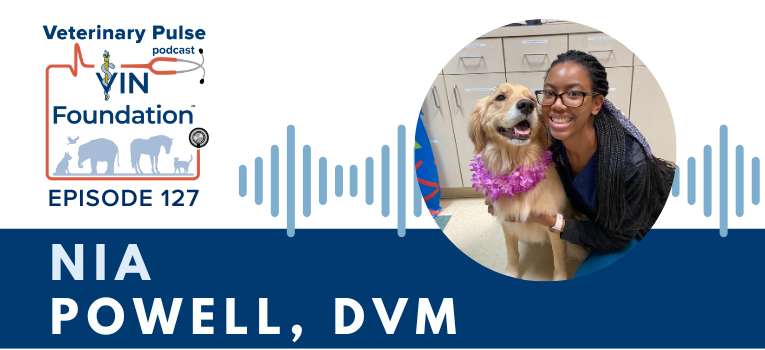
Dr. Matt Holland has a conversation with NC State College of Veterinary Medicine’s 2nd-year student Nia Powell. Nia shares her journey to veterinary medicine, her experience with racism, and how a quarter-life crisis led her to good things. With a commitment to encouraging others, Nia shares the one area she wishes she focused on more prior to entering veterinary school, and how her role as a veterinary technician provided helpful experience.
Quote mentioned by Nia Powell during the episode: “Never let the fear of striking out, keep you from playing the game.” – Babe Ruth
GUEST BIO:
Nia Powell
Nia Powell is a 2nd-year student at the NC State College of Veterinary Medicine. After growing up in Chicago, Nia attended the University of Missouri where she earned a B.S in Psychology and Spanish. Currently, Nia is interested in small animal and equine medicine. She also enjoys cardiology and internal medicine. Outside of vet med, Nia likes to travel and spend time with her family, friends, and dogs Zoe (a pomeranian mix) and Peyton (a lab mix).
LINKS AND INFORMATION:
- Nia Powell on Instagram
- NC State College of Veterinary Medicine
- VIN Foundation Cost of Education Map
- VIN Foundation Apply Smarter
- 3D Anatomy on VIN
- You will need a VIN membership to view the 3D Learning, you may sign up for a free VIN Student membership
- VIN Foundation Student Debt Center
You may learn more about the VIN Foundation, on the website, or join the conversation on Facebook, Instagram, or Twitter.
If you like this podcast, we would appreciate it if you follow and share. As always, we welcome feedback. If you have an idea for a podcast episode, we’d love to hear it!
TRANSCRIPT
Intro
Nia Powell: I tried to be that representation for other people that I didn’t have, which is why I started my Instagram page to show other students of color, hey, you can do it. Let me be that representation that you probably don’t have because I didn’t have it.
Jordan Benshea: That is Nia Powell, and this is the VIN Foundation’s Veterinary Pulse podcast. I’m Jordan Benshea, Executive Director of the VIN Foundation. Join me and our cohost and VIN Foundation board member, Dr. Matt Holland, as we talked with veterinary colleagues about critical topics and share stories. Stories that connect us as humans, as animals, as a veterinary community. This podcast is made possible by individuals like you who donate to the VIN Foundation. Thank you. Please check the Episode Notes for bios, links, and information mentioned.
Meet Nia Powell
Matt Holland, DVM: All right, well, welcome Nia. Thanks for joining us.
Nia Powell: Of course. Thanks for having me.
Matt Holland, DVM: Yeah, and congratulations on officially finishing your first year of veterinary school.
Nia Powell: Oh my gosh, thank you. It’s so weird now to tell people that I’m a second year even though I still feel like a first year, but it’s super cool to be done.
Matt Holland, DVM: Yes, I want to get to that point, but first, I would like to hear what your favorite quote is.
Nia Powell: Okay, my favorite quote is, “Don’t let the fear of striking out keep you from playing the game”. I don’t know who said it, but I stole it from A Cinderella Story, that Hilary Duff movie. Ever since I heard it in the movie, it has really stuck with me. I like it, because a lot of times the best things come out of situations that you maybe might be a little scared about, but if you keep pushing through it, great things can come out of those situations. I really try to keep that quote in the front of my mind with like most of the things I do.
Matt Holland, DVM: I believe that was originally from Babe Ruth, if I am not wrong.
Nia Powell: Oh, look at that. That’s cool.
Matt Holland, DVM: We used to ask people their favorite quote at the end of the episode. I started doing it at the beginning to see where the quote shows up in your story. So, let’s get to your story then.
Nia’s Journey to Veterinary School
Matt Holland, DVM: Where were you born and raised? How did you get to where you are now?
Nia Powell: I was born in Boston, but I only lived there for a couple years when I was small. I moved to Chicago, so I was raised there, I grew up in Chicago. I’ve always known I wanted to be a vet, so I did a lot of shadowing and things at hospitals there. I worked for a couple of vets when I was in high school. I work as a receptionist and a little bit of assistant work there, too. I went to undergrad at the University of Missouri, which is Mizzou to me and maybe anyone else in the Midwest. I went to undergrad there and I started as an animal science major, but I thought because Mizzou had a vet school that their animal science major was going to be very focused towards going to vet school. I found out really quickly that it’s actually more focused towards the Ag side of animal husbandry and things like that. So, I switched my major at the end of my sophomore year to psychology and Spanish. I had an interest in psychology and loved the psych classes that I was taking, but still followed the pre-vet track. I graduated and had a quarter-life crisis, which basically means I didn’t know what I wanted to do. I’ve always known I wanted to be a vet, but I came to this point where I wasn’t sure if I wanted to be a vet because that’s what I wanted, or if I wanted to be a vet because it’s all I’ve ever talked about, and all people expect from me. I took my gap years and I moved to Charlotte because I knew I wanted to go to NC State if I went to vet school. Being in Charlotte would allow me to be in-state and also closer as far as like moving if I ended up moving to Raleigh. I did that, and I worked as a tech full-time, and nothing will tell you whether or not vet medicine is for you besides being in a hospital 24/7 all the time, 40 plus hours a week. That experience really made me realize that I do love this profession, and I do want to go to vet school. I applied two times. The first time I had an issue with one of my credits and had to pull my application, but the second time, my credits were all done, and I got in. I applied to NC State and to Tuskegee. I got into both and decided to go to NC State. So that’s how I got here now.
Matt Holland, DVM: Awesome. I have so many questions. Okay, first of all, we have Chicago in common.
Nia Powell: I love Chicago.
Matt Holland, DVM: Yeah, me too. I went there for [oh, this is a great segue], I lived there for six years before my quarter-life crisis.
Nia Powell: We all have one!
Matt Holland, DVM: I was doing television production, like sports television production, and then decided that I wanted to go to veterinary school. Totally related.
Experiences of Racism and Diversity in Education
Matt Holland, DVM: So, I went to U of I. Those are two things I wanted to touch on in terms of comments, but questions like, you said North Carolina because you knew that it was going to be North Carolina if you applied to vet school, but then what made you decide to apply to Tuskegee later on?
Nia Powell: Yes, I went to undergrad at Mizzou, and I loved my experience at Mizzou. I wouldn’t change it for anything, but Mizzou is not the most welcoming place for people of color all the time. When I went my sophomore year, we actually had a whole race war on campus and where we were camping out on the quad and protesting, and it was just, it was a lot. The way that experience went through me, I knew that I wanted to go to a school that really embraced diversity. I knew that I needed to be around other students who looked like me and I was not getting that at Mizzou. I knew that I would get it at Tuskegee, and I knew that I would get it at NC State, well, maybe not knew, but really, really hoped I would get it at NC State. That’s what I had heard that NC State is really big on diversity and so being supportive of their diverse communities. So that’s why I applied to those two places and only those two.
Matt Holland, DVM: I know it’s not really related to the veterinary journey, but I am just so curious. Can you talk about that race war thing?
Nia Powell: Basically, my sophomore year there was an incident during our homecoming parade where the Chancellor said something. Okay, so Mizzou has like two separate homecomings, there’s general homecoming, but the black community at Mizzou, we call ourselves Black Mizzou, we do a lot of things ourselves, too. We also have our own homecoming committee that is present on campus. There was something that happened between the chancellor, and I think the students that were on the homecoming committee, and it just blew up. They wanted to get him fired. They wanted all sorts of things done, and he pretty much refused to do that, or to do any of those steps that they wanted him to do. It led to this big protest on campus, and we were protesting on the quad. There was a student doing a hunger strike, and he was like, I’m not eating until he steps down. It was a whole thing. We slept on the quad, couldn’t go to class, and there was a lot of backlash towards the students of color as far as people making threats and saying they were going to bomb the BCC, which is the Black Culture Center, and making a lot of statements that were not what I wanted to hear and not very supportive from the students, not from teachers, or anything like that. It was just a lot, and I did not feel supported. I felt very supported by my other students of color and the black faculty, but I did not feel supported by the University at all. I don’t regret it, I mean, I grew up from that experience, but I knew I needed to leave because my four years were up.
Matt Holland, DVM: Have you experienced anything similar throughout your time at NC State, or before when you were working in clinics, like any issues with overt or covert racism?
Nia Powell: When I was in undergrad, a lot of people were like are you sure you want to go to vet school? Maybe you should tech or something else, and just telling me I couldn’t do it. Overall, my advisor, at least at Mizzou, was super supportive, which is why I picked him actually. He always told me that I could go to vet school, I could be a good vet, but he was like the only person telling me that outside my family. Clearly I can, but I didn’t hear that enough from a lot of people, only literally my advisor, my family, and my friends. When I was working as a tech in Charlotte, there were some things people would say. I remember that there was one time when I was taking a dog out to a client. This was in the COVID time, so everybody was still in their car, and I was trying to explain to him about the care for his dog and he refused to talk to me. He would only talk to my receptionist who is also with me. She’s white. She kept telling him, “I’m not the nurse, you need to talk to the nurse. I don’t know any of the answers to your question.” And he just refused to talk to me, would only talk to her. It’s little things like that or people saying that their dogs don’t like black people that I hear all the time. Yeah, those kinds of things. As far as NC State, I have not felt that way. Things happen everywhere, of course, and nowhere is perfect, but I think, coming from Mizzou and going to NC State, it’s leaps and bounds better. I feel supported and we have a Diversity Committee where we work to make change and make sure that we’re being supportive of our communities of color. We have a lot of safe spaces too, which I really like. So yeah, things have been great. I would not go anywhere else.
Matt Holland, DVM: I haven’t been there, but I have also heard what you heard before you went, and confirmed since you’ve been there, that it’s a very supportive place to be for people of color.
Nia Powell: Yeah, it’s great.
Matt Holland, DVM: There is, I was going to say like a silver lining the pandemic, I’m not sure how much I like that term, because the whole thing has been a major bummer, but it’s easier to fire clients, because there’s so much business at veterinary clinics that that’s where my head went with that person who wouldn’t talk to you. I’d be like, alright, go find another clinic then.
Nia Powell: Yeah, right. They didn’t do anything. My hospital was like, “Oh, that happened? Sorry to hear that.” But it would have been nice if they would have fired him, or at least been like, “Hey, you should talk to our nurse, and it’s fine, and don’t be weird.”
Matt Holland, DVM: With an experience like that, is that like, okay, I still want to go to vet school despite the fact that happened, or I’m wanting to go to school because of the fact that happened, or neither? Is it just like, whatever, people suck?
Nia Powell: I think it’s a mix of the two. At the beginning, it was discouraging, it was really, really discouraging when people would say that kind of stuff, or I would have those experiences. And the black vet community is not large, so I didn’t feel like I ever had the representation that I needed, or people I could even go to be like, hey, this happened. Please tell me I can do it. I didn’t have that, and I didn’t see a lot of people like me who I could even really visualize outside of, literally, the Animal Planet TV shows, the Vet Life and Critter Fixers. That changed a lot for me when I was growing up, because I would see them like, oh, hey, there’s black people and people of color in this profession who are doing it, like doing the thing. So, a little of both. Once I got older, I turned the haters into motivators as the kids say, right? I would take those experiences and be like, Okay, well, people suck, but it’s fine and you can still do and don’t let them knock you off the path that you know you need to be on. There’s also something motivating about seeing other students of color who are younger than me and knowing I can do it, and you can do it. So, I tried to be that representation for other people that I didn’t have, which is why I started my Instagram page to show other students of color, hey, you can do it. Let me be that representation that you probably don’t have because I didn’t have it. And so, a mix of the two.
Matt Holland, DVM: I can’t remember if that’s where I first met you, because you brought up the TV shows and I immediately flashback to the event on BlackDVMnetwork where you’re like, “sorry, guys, I’ve got to go like my TV show’s on.” I was like
Nia Powell: I don’t play with my TV shows at all. That’s how I get through vet school. It’s how I get through life. I don’t miss the Bachelor. I don’t miss This Is Us. I may have three exams and the Bachelor is two and a half hours on a good night and I will watch it. My exam will wait. Oh, yeah.
Matt Holland, DVM: I love that.
Nia Powell: Thank you.
Matt Holland, DVM: For everyone listening, this is how you create boundaries.
Nia Powell: It is.
Matt Holland, DVM: I know. I know. I don’t mean to be laughing at you. I remember being that serious.
Nia Powell: Oh, it doesn’t bother me.
Matt Holland, DVM: I was like, whoa, this is serious.
Nia Powell: I don’t play. I set alarms. My friends know, my classmates know. Eight o’clock on Wednesday, don’t call me, Vet’s Life is on and I’m watching it for the full two hours. Computer closed. Cell phone off. I might do laundry because I’m always behind on it, but I’m not doing schoolwork and I’m not answering your phone call. So, yeah.
Challenges and Realities of Vet School
Matt Holland, DVM: Okay, so now that you have finished one year, how do they compare to your expectations? That can be two questions because one, when you were growing up, and two versus the pandemic.
Nia Powell: It was a lot harder than I expected. People have been telling me since I was five that vet school is hard, vet school is hard. That’s hard. When I got to college people would tell me it’s like drinking from a firehose. I heard all of the things. I knew it was going to be hard, and week one, oh my gosh, I knew it was going to be hard, but it was hard. It was really, really hard. It’s a hard you don’t understand until you’re in it, I think. So even though people told me, and I tried my best to prepare. I color coded in my planner, I color coded in my notes, I did all the things that I thought I needed to do to prepare, and there just was no preparation that was enough. So, it was a lot harder. I also liked it more than I thought I would as weird as that sounds. Vets and doctors and students and all sorts of people told me how much you’re going to hate vet school and how much it stinks and how they would never do it again. But I really liked it despite having a lot of hard days and a lot of exams that I maybe wasn’t completely prepared for and things like that. I really liked being in vet school, I love all the things I get to do. I love wearing my vet school t shirt and letting everybody know I am in vet school. I love every moment of it, even though it’s definitely the hardest thing I’ve ever experienced. Compared to expectations, it was a lot harder. With the pandemic, I don’t know anything any different. This is the only way I know vet school, of course, doing it from my bed and a little bit in class and with the 25 people who I do know. I don’t know how it really compares. I miss the social interaction a lot. People always told me going in when I’d asked for vet school tips, just bond with your classmates, be with your classmates, study with your classmates, and get really close to your anatomy lab group. I feel like I’ve missed all of that just with the pandemic, because we can’t be in groups. NC State did it where we are split up into four cohorts. Our groups are 23 ish students, and we can be with them. Then two cohorts will go in a day. So, I kind of know some of the people in the other cohort, so maybe 40 ish, but the kids who are on the other day, I’ve never seen them. I know them through zoom. That part has been really hard. I didn’t expect that with the pandemic you really don’t get any of that social interaction and I miss it a lot. Otherwise, it’s going well. I really liked the way that NC State handled it as far as still being able to come in for some things. We get to come in for our labs and we get to come in for our TAU [Teaching Animal Unit], which is our farm class. I like that we still get to come in for those and I don’t feel like I’ve missed out on those, but I feel like I’ve missed out on a lot of things as far as not being able to connect with my classmates. It’s not really knowing how to sit in a lecture hall all day. I haven’t had to do that yet. So, a little nervous for next year, but I’m going to roll with it. See how it goes.
Matt Holland, DVM: The not sitting in lecture hall for the whole day, my advice there would be just don’t.
Nia Powell: Yeah, that’s what I think I’m going to do and just continue to watch lecture capture. I want to be in a lecture hall one time, just so I can sit in the back with my blanket and say I did it, but other than that, I continue to be in my bed.
Matt Holland, DVM: What you said about it being a lot harder than you expected even though you heard how hard it was going to be, that totally resonated with me. I don’t know if this is why it was hard for you, but for me, it wasn’t like any of the individual concepts were that hard to grasp, it was just so much. I would feel like I studied all night and then I look at all this stuff I had left to study in order to check all the boxes for the exam, and I was like, literally there is no way I’m going to get through this. I was like, all right.
Nia Powell: That’s it because the material isn’t hard. I can memorize bones, I can learn how kidneys function, but two days, you have to know all of this in two days, because tomorrow we’re going on to something completely different and we’re not going to review. There are no review days. I made that mistake first semester. I thought the exam is next week, we’re done. So, we’re going to review the next few days. No, no, no, no, no. You go on to the next chapter and you’re just expected to still know it. That was crazy. I had the same thing where the night or a couple nights before the exam, I’m like, well, I’ve looked through osteology, I know a little bit of the nerves, oh, wait, radiology! Still haven’t touched it, but that’s on the test, too. We’re going to look at it before the test at some point and hope for the best. So that was definitely the hardest part.
Matt Holland, DVM: Okay, so besides the pandemic or any of the other stuff we’ve already gone over, is there anything that totally caught you off guard?
Nia Powell: Outside of anatomy, not really. I think just the amount of material was really the most surprising thing. Other than that, I really like it and I think it matches what I expected. But anatomy man, they hand you a humerus, and I’m thinking going in you just have to know humerus and maybe those bumps on the top. No, no, no, no, no, all the bumps on the side, all the bumps on the top, where it connects, where the vein connects, where the nerve connects. I think that was maybe what I didn’t expect, the amount of depth that you really have to know. We’re doctors and I know that we have to know a lot of depth, but every bump on the humerus was not what I thought we were going to be doing going in, and every single nerve and where it connects. I guess maybe the amount of depth that you go into, and how quickly they want you to learn it. That would be the craziest part for me.
Matt Holland, DVM: Alright, so that is why after we met on Instagram, you said, “the 3D anatomy saved my life” and now hearing you say, “oh, wow, it really did.”
Nia Powell: Oh, it did. I didn’t even know that it existed until I posted about it on Instagram, and was saying there’s no way I’m going to know all these nerves and somebody DMed me and was like, have you tried the VIN anatomy tools? What is that? I found it and yes definitely use it if you’re going into anatomy. Use it. It’s free and it’s helpful.
Matt Holland, DVM: I didn’t have that in vet school. It didn’t exist.
Nia Powell: Sorry.
Matt Holland, DVM: When I first learned about it let’s just say salty,
Nia Powell: I would have been, too. Yeah.
Matt Holland, DVM: To keep it PG.
Nia Powell: Yeah. I, too, would have been salty.
Matt Holland, DVM: I’m thinking of what you said about you knew it would be a good idea to go to NC State for cost, too.
Advice for Pre-Vet Students
Matt Holland, DVM: What were you thinking about in terms of cost? What resources were you using at that point? If a pre-vet is out there listening, what things should be on their radar?
Nia Powell: I don’t think I did as much research going into vet school as I wish I did. In the moment, I felt like I was doing a lot and I looked at the cost really, really heavy. I made a spreadsheet of all the ones that I was interested in and put the cost on there. The AVMA has a price comparison tool, and you all have one, too. I would definitely use those to see if I’m in-state in this state, what states are in my price range, and what’s super expensive and what’s not. I think that some of those numbers could be surprising, so definitely look at those. I knew NC State was going to be really cost efficient for me. I moved here, of course to get in-state which made it even better, but even as an out-of-state student from Chicago, it wasn’t out of my budget or out of my price range, and it was one of the more cost-efficient schools, which is why I picked it.
Matt Holland, DVM: Yes, the VIN Foundation has a cost of education map, and I really hate to be that guy who is like, correct me on this so folks aren’t confused, but I think the other one you’re thinking of is the AAVMC.
Nia Powell: Oh, might be them, yeah.
Matt Holland, DVM: I think so, but now I might be the one who needs correcting.
Nia Powell: I don’t know honestly.
Matt Holland, DVM: I think it’s that, we will fact check, but I just don’t want to get any little pre-vets confused.
Nia Powell: Okay, yeah. One of those, I’m not sure I could be completely wrong, in which case, fix it, but one of those have a price thing similar to yours, that’s a map that I used. Look at that. I wish I would have looked at curriculum more. Now that I’m in vet school, I realize that curriculum is completely different depending on what school you go to. I think that maybe my pre-vet brain just assumed that vet schools are pretty much the same, but it’s very different. I really like NC State’s curriculum and how we do things, but it is different among schools. That would be my advice, for sure, for pre-vets but also something I wish I maybe would have done a little bit more of. I’m happy where I am, but I got lucky, and I could have really not been happy. So, look at those things.
Matt Holland, DVM: Okay, that is an interesting point. I don’t think I’ve heard anyone say that. Do you mean curriculum like what you learn or curriculum like when you learn it?
Nia Powell: A mix of the two. I knew going in that there’s two in two, where you do two years of didactic two years of clinical versus like three in one or some variation of that. I knew that going in because Mizzou is two and two and I learned most my things through their vet school, whereas NC State is three in one. But outside of that, what you learned and how you learn it. I talked to a girl who goes to Florida, and she was telling me that their clinical year you do your first two years, I think its first two years of classroom, and then you go to a clinic for a year and do clinical rotations for a year. Then you go back to the classroom, and then you go back to clinics again to finish out. So, you have like a didactic block in between your clinics, which is totally different. I didn’t even know that existed. But also, what you learn. NC State doesn’t have any sort of like biochemistry or organic chemistry, where you’re drawing shapes of anything, but I have a friend who goes to Mizzou, and she had to do more biochemistry stuff. Biochemistry was not my thing. I barely got into vet school because of biochemistry, so there’s no way I would have wanted to do that in vet school and NC State doesn’t do that. But some schools do.
Matt Holland, DVM: I’m shuttering just thinking about doing more of that. No, so this is like a totally, it’s because I’m thinking in my head, well, you pretty much learn all the same stuff because you have to take the same NAVLE. At Illinois our first day of vet school was in the clinics.
Nia Powell: Really?
Matt Holland, DVM: Yeah, they had just started it, our class was the second class to go through this curriculum. They wanted to make it more integrative and like you’re doing. It’s not quite two in two, but it is like a little bit of clinics along the way. So, we had eight weeks of clinics, which was our first eight weeks of vet school and then in our second year our second eight weeks was in the clinics. We were split up into like eight-week quarters. In our third year, after a third quarter, we went straight into the clinics, like in the middle of March. We ended up with 24 extra weeks, which almost is another entire year, but it’s not two plus two, it’s like all along the way. Yeah, it’s different everywhere. So good looking it up before you go.
Nia Powell: Yeah, I had no idea. I just liked NC State and went with it, but it would have been smart to look into some of those things.
Matt Holland, DVM: Yeah, I just went with Illinois, because it was the insane cost of education. I was like this is my state and I have a job. If I don’t get in, I’ll just apply next year. This is if I go to vet school, it’s going to be at Illinois. But yeah, everyone’s coming from a different situation.
Nia Powell: Yeah, for sure.
Matt Holland, DVM: All right. So again, geared toward the pre vets, knowing what you know now, is there anything you’d go back and do differently?
Nia Powell: I don’t know how many times I can say anatomy on here before y’all kick me off, but that’s what I would look at. Look, I wish I would have taken anatomy as an undergrad. It was offered at Mizzou, and I didn’t take it, but I wish I would have because I think it would have helped. I felt behind in my anatomy class, because most of my classmates, at least that I had talked to had taken some form of anatomy and at least were kind of familiar. My memory is not amazing, so I don’t know how much it really would have helped me or if I would have remembered any of it, but I think having a little bit of base knowledge would have been nice going in. I also wish I would have looked at schools more. I love NC State and even if I could go back, I’d probably only apply to NC State because I loved it a lot. But I wish I would have checked all those boxes to make sure before coming here that this was for sure the place I wanted to go and where I wanted to be. I didn’t do any of that I just kind of got lucky. So those I think would be my advice. Also, if you can tech at some point, because I know a lot of people who don’t have a whole lot of technical experience and I think being a tech has made me really appreciate my techs not only as a vet student, but it also has given me a lot of hands-on skills as far as being able to draw blood and place catheters and do those things. And it has made me 500% sure that I want to do this because again, nothing will tell you whether or not you want to be in vet med besides being at a clinic 40 hours a week, all day every day. I think those would be my big three.
Matt Holland, DVM: Okay, yeah, I like that, and I totally agree on the anatomy part too. I really wish I would have taken even like a human anatomy course at a community college. Like something because I always felt behind there. Another thing in terms of what’s different at each school besides the curriculum is grading. At Illinois, we had like all year, you’d just get one grade for the semester or for the quarter.
Nia Powell: You get one grade?
Matt Holland, DVM: Yes, and all your grades are lumped. So, what I’m getting at is I did not do well in anatomy. If that had been separated out into its own grade, I might not have passed first year, but it was put together with other stuff that I did well enough in to averaged out to a fine grade. That’s part of why I didn’t really like give anatomy my all was because I was like, alright let’s just strategically thinking it doesn’t seem like I’m picking this up and the math says that I don’t necessarily have to in order to do what I want, which is to make it the second year. That could have been a different kick, if it had been its own grade, I probably spent more time on it. Anyway, I know every school grades differently too. Some do pass/fail, some do a single, some have an exam for each subject. Like we had every quarter you’ve got your quizzes every Friday, and then every fourth Friday, it’s like all your exams.
Nia Powell: Interesting!
Matt Holland, DVM: Asking the admissions offices those questions, I totally recommend that.
Nia Powell: Yes, I definitely agree. I remember as a pre-vet sitting in our pre-vet club. It’s in this big lecture hall in Mizzou’s vet school and so every time you would go in there, there’s this huge calendar that they would roll in other classrooms. It’s a calendar of all your exams and quizzes that you have coming up for the month. I remember sitting there and looking at their schedule. Monday, Tuesday, Wednesday, Thursday, you have an exam all the time. There’s always an exam, and it freaks me out to know that as a pre-vet student that you really are taking exams every single day. But at NC State, at least right now the way things were with COVID I don’t know if it would look more like that on a normal year, but we didn’t have it like that. So, you’re saying you had exams every Friday. Ours were kind of random, but we only had maybe a couple of them a month. You didn’t have them every day or anything. We have quizzes, several quizzes a week, but as far as big exams that I’m staying up all night on energy drinks for, we only had those a couple times a month. Way less crazy than what I was expecting. As far as grades, definitely a touchy subject for me right now because we just found out we’re going back to grades and that’s not what I want. But we were pass/fail for this past semester or past year, actually, both semesters and so they made that executive decision for everybody to do pass/fail. So, I definitely had a better quality of life because I wasn’t worried about my anatomy grade. Similarly, to you, not my strongest class, not my strongest class, not my strongest class. So, if I had to worry about that grade, I would have been in my bed in the books all day every day. Being pass/fail really allowed me to take that load off and breathe a little bit more and to enjoy my life a lot more. I knew I needed to know the material. I knew I needed to pass the exam, but I wasn’t worried about getting an A versus an A minus versus a B versus a C, like as long as you pass and you know the material, that was enough. That’s really what I needed, especially for the first year, but next year we’re going back to grades and so I’m crying a lot on the inside, but we’re going to hope for the best.
Matt Holland, DVM: I’m sorry for your loss.
Nia Powell: Thank you. I’m also sorry for my loss.
Matt Holland, DVM: Well, you know what the papers would say.
Nia Powell: Yeah, it doesn’t matter. It doesn’t even matter, just a different degree. It’s fine.
Matt Holland, DVM: It doesn’t even matter in giant quotes with papers.
Nia Powell: It doesn’t even matter. I’m going to put that on my wall next to my desk when I’m about four trying to learn pharmacology, it doesn’t even matter. Just pass and know the stuff for your patient. But it doesn’t matter. It really doesn’t.
Matt Holland, DVM: I’m glad you brought up the pre-vet club because it reminded me, I wanted to mention earlier the Apply Smarter page on the VIN Foundation website. We talk to pre-vet clubs quite frequently about the whole Apply Smarter toolkit and so for any pre-vet students or any pre-vet student clubs that is what we have designed for you. We hope you take advantage of it.
Hopes for the Veterinary Profession
Matt Holland, DVM: Alright, so nearing the homestretch here, what is one change you’d like to see in the profession? Or it can be multiple.
Nia Powell: Okay, of course, I’d love to see more diversity. It’s so important to have representation in this field and there’s not any, and the lack of representation almost kept me out of this field. That’s definitely something I would like to see. On top of that, I’d like to see better overall quality of life for vets and vet professionals, like staff, technicians, nurses, receptionists, and kennel people. I don’t care, I just wanted a better quality of life for everybody. I think that we need to set more boundaries. I don’t think we should be skipping lunch. I can think of all the times when I was a tech that I wouldn’t get lunch because my doctor ran over in surgery, or an emergency came in. That’s just not sustainable. I’d like to us to get paid the same as normal human doctors. I mean we work just as hard, why would we be making so much less? I want us to charge what we’re worth. I want us to have a better quality of life, so when pre-vets come to us and ask, “How do you like being a vet? I want to go to vet school.”, instead of hearing this is the worst profession ever, you should do anything but go into vet school, you’re dumb for going into vet school. All things I’ve heard from vets. People can say I really love this career, and I love this profession and you should totally do it. I want that shift to happen, so people hate their lives less as veterinary professionals, but instead really love the job because this really is a great field and I think that there’s some changes that need to be done so that we’re happier in it and can show that to people.
Matt Holland, DVM: I love that. I was waiting for you to say something, because I wasn’t sure if you were finished. When we release podcasts, we have these like audio teasers, and I have a hunch part of that is going to be an audio teaser of this episode. The first thing you mentioned that diversity in the profession, the Bureau of Labor Statistics, and this is from 2019, so I guess it’s not like exactly reflective of today, but it’s pretty close, it says when it divides out the workforce by ethnicity and race, it rounds down to 0.0% black veterinarians. That’s how underrepresented people of color are in the profession.
Nia Powell: I wish that surprised me, but it doesn’t even a little.
Matt Holland, DVM: I know. Yeah, it’s shocking, but not surprising, I guess.
Nia Powell: Yeah, exactly.
Final Thoughts and Gratitude
Matt Holland, DVM: Alright, and so if you, and this could be more than one, but if you can leave the audience with anything, what would it be?
Nia Powell: I think for the pre-vet community, I would tell them not to get discouraged and to keep pushing. If you want to be in this field, be in this field and make it happen. Between my grades not being 4.0 as an undergrad, and people telling me that veterinarian medicine sucks and not to go into it, and the lack of diversity, there’s so many things and so many barriers you have to overcome, but had I let any of those keep me out of this field, I don’t know where I would have been. I’m so happy that that didn’t happen and that I’m here. So, I would just tell pre-vet students, especially, if this is what you want, go for it and don’t let anybody tell you otherwise, because it really is a great field. If this field is meant for you, you’re going to love it, I sure do. So, that’s what I would talk about. So that’s what I would tell pre-vets, anyway.
Matt Holland, DVM: All right. Anything you would tell your colleagues, your vet student colleagues, or your people who have paved the way for you?
Nia Powell: Oh my gosh, yes, for other people in vet school, I would say hey, we made it through this year and if we can do it through COVID we can get through anything like this. We made it through this dumpster fire that was vet school in the middle of a panorama and so we did that and so we can do the rest of it and just keep pushing for them too. As far as for vets, maybe, be easy on us. I’m scared and I don’t know things, so be nice to us please. Vote for everyone who paved the way through for me, thank you! And everyone who encouraged me to be here, all the vets of color who encouraged me to be here and who I could look up to, just thanks because it was hard out here. I’m really thankful that I’m here and I would not have been without seeing all of them and talking to other vets.
Matt Holland, DVM: Yeah, I love that. I’m just going to say that blanket statement to everyone. Everyone should be nice to everyone, period paragraph.
Nia Powell: Yeah, 100%.
Matt Holland, DVM: All right. Well, that sounds like a good way to finish the conversation.
Nia Powell: Be nice to each other. Thank you.
Matt Holland, DVM: Alright, thanks for talking with me.
Nia Powell: Yeah, no problem. Thank you for having me.
Outro
Jordan Benshea: Thank you for joining us for this episode of the Veterinary Pulse. Please check the Episode Notes for additional information referenced in the podcast. If you enjoyed this podcast, please follow, subscribe, and share a review. We welcome feedback and hope you will tune in again. You can find out more about the VIN Foundation, through our website, VINFoundation.org, and our social media channels. Thank you for being here. Be well.