
RAP UPDATE ALERT:
Final borrowing and repayment rules were published in the Federal Register on May 1, 2026.
There is one major unexpected change to repayment rules in this final version:
Payments made in the new Repayment Assistance Plan (RAP) will NOT count towards legacy income-driven repayment (IDR) plan forgiveness (IBR, PAYE, or ICR). However, as expected, payments made in IBR, PAYE, or ICR will count towards RAP forgiveness.
What is IDR plan forgiveness? IDR plans require you to make a minimum monthly payment calculated from your income. You update your income information and have your payment recalculated at least annually. You will either reach a zero balance or reach the maximum number of years allowed in your IDR plan (20-30 years, depending on your IDR eligibility). If you reach the maximum number of years for your IDR plan and still have a balance, the remaining balance is forgiven. Forgiven debt is normally treated as taxable income, so you will likely incur a federal (and possibly state) tax on your forgiven balance.
It’s been a confusing year in student loan repayment, to say the least. We continue to see changes even as we approach the end of 2025.
We have two ongoing points of frustration and one suggestion to round out 2025.
- IBR application issues: Partial Financial Hardship update
- SAVE may be ending sooner rather than later.
- Now is the best time to review your student loan repayment options
Removal of the IBR Partial Financial Hardship test
Legislation from this past summer updated the Income-Based Repayment (IBR) plan to remove the partial financial hardship requirement but maintained the monthly payment cap. That means anyone can use IBR, and their payment will never be more than a standard 10-year plan payment, no matter their income or remaining student loan balance.
The IBR update is helpful for those otherwise stuck in the SAVE forbearance and those with lower student debt-to-income ratios who are nearing the forgiveness finish line. Generally speaking, when your student debt-to-income ratio (DIR) is one or less, you would not likely pass the partial financial hardship test, or be able to use IBR.
While the IBR update took effect when the new law was signed on July 4, 2025, the Department of Education’s application system has been slow to reflect the change.
According to the Monday, December 22nd update provided by the Department of Education, “The One Big Beautiful Bill Act (OBBBA) allows borrowers who don’t have partial financial hardship to enroll in the Income-Based Repayment (IBR) Plan. On Dec. 22, 2025, we updated our systems, including Loan Simulator, to implement this change. Borrowers who previously could not enroll in the IBR Plan because they lacked partial financial hardship will now see IBR as an option when using [the Department of Education] Loan Simulator, and they can enroll in the IBR Plan using the online income-driven repayment (IDR) plan application. As more information becomes available, we will update this page.”
Anyone who is not seeing IBR as an option when they apply for an income-driven plan should call their loan servicer and reference this recent announcement to help get their loans into the IBR plan.
SAVE Ending Soon?
Hopefully, we’ll see that system update completed soon because we just learned that the SAVE forbearance could be ending sooner rather than later. Litigation around the SAVE repayment plan reached a potential settlement that will require borrowers in the SAVE forbearance to choose another repayment option. Per the Department of Education, “While the settlement agreement is still pending court approval, we encourage borrowers to … explore other available repayment plans.”
The timeline for ending SAVE or choosing another plan is not yet available. In the meantime, anyone in the SAVE forbearance should get prepared for another repayment plan.
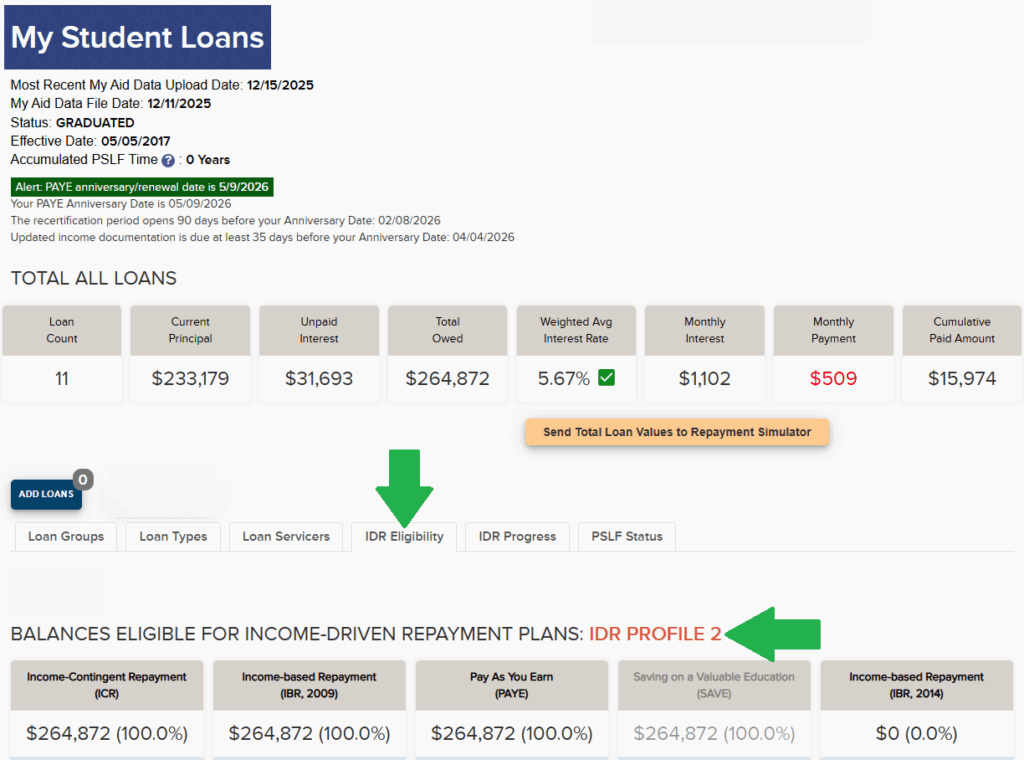
“What repayment plan do I use after SAVE?” has been the most common student loan question of 2025. To see your next best available income-driven repayment (IDR) option, upload your federal student aid data file into the VIN Foundation My Student Loans tool and check your “IDR Profile” in the IDR Eligibility tab.
WikiDebt: What is your IDR Profile?
Your IDR eligibility is determined by your loan types and borrowing history. With ambiguous criteria and changing rules, one of the most difficult aspects of federal student loan repayment is knowing which repayment options are available for your loans. The VIN Foundation My Student Loans tool attempts to clarify the confusion and provide a simplified description of your IDR eligibility via the IDR Profile.
There are six different VIN Foundation IDR Profiles:
- IDR Profile 1: Eligible for ICR, PAYE, SAVE, and IBR 2014, and RAP (once available)
- IDR Profile 2: Eligible for ICR, IBR 2009, PAYE, SAVE, and RAP (once available)
- IDR Profile 3: Eligible for ICR, IBR 2009, SAVE, and RAP (once available)
- IDR Profile 4: Eligible for IBR 2009 only
- IDR Profile 5: Eligible for ICR only
- IDR Profile 6: Eligible for RAP only
See the WikiDebt IDR Profiles page for more detail.
The most common IDR Profiles we see for veterinarians are 1, 2, or 3. Here are short-term repayment guidelines for your IDR Profile:
- IDR Profile 1 or 2: Choose PAYE
- IDR Profile 3: Remain in SAVE Forbearance, or choose IBR or ICR, whichever payment is lowest.
Now is the best time to review your student loan repayment options
Whether you are applying for your first or a new student loan repayment plan, the end of the calendar year is one of the best times to evaluate your options.
Choosing a new income-driven repayment plan requires you to submit income documentation.
If your income has decreased since the last time you provided income information, you should apply to have your payment reduced in your current income-driven plan.
The period immediately before filing your next tax return gives you the most choices to minimize your monthly student loan payment.
You can use either the adjusted gross income (AGI) from your most recently filed tax return (i.e., 2024), your 2025 end-of-year income information (i.e., W-2), your first paystub in 2026, or potentially wait until after you file your 2025 tax return. Use the income information that will result in the lowest minimum monthly payment for your circumstances.
For example, let’s say your income in 2025 decreased compared to your income in 2024. You can use a recent paystub or your 2025 W-2 as income documentation for your income-driven repayment plan application.
On the flip side, if your income increased in 2025, then you may want to apply using your previous tax return, before you file your 2025 tax return.
What if you got married in 2025, and this will be the first time you need to decide whether to file taxes jointly or separately? Consider getting your 2025 tax return filed before you apply for your income-driven plan to make it easier to reflect your current marital and tax filing status.
Preparing for more changes in 2026
The new Repayment Assistance Plan (RAP) is coming by July 1, 2026. You can explore how RAP looks for you in the VIN Foundation Student Loan Repayment Simulator. With the SAVE forbearance potentially ending before RAP is available, you may need a bridge to get you to RAP. Choose PAYE if you are eligible, ICR if it is the lowest monthly payment for you, or IBR if neither PAYE nor ICR is the best option for you. If you are in IBR or plan to use IBR before switching to RAP, please note that your unpaid interest will capitalize (get added to your principal) when you leave IBR. Generally speaking, avoid unpaid interest capitalization when possible.
Need student loan help?
Have more questions? Post a comment below or email [email protected].
We’re here to help!

Dr. Tony Bartels graduated in 2012 from the Colorado State University combined MBA/DVM program and is an employee of the Veterinary Information Network (VIN) and a VIN Foundation Board member. He and his wife have more than $400,000 in veterinary-school debt that they manage using federal income-driven repayment plans. By necessity (and now obsession), his professional activities include researching and speaking on veterinary-student debt, providing guidance to colleagues on loan-repayment strategies and contributing to VIN Foundation initiatives.
11 thoughts on “Federal Student Loan Repayment: 2025 Year-End Wrap and Preparing for 2026”
I plan to leave SAVE and enter old IBR. I’m trying to determine the best of these options for me: ” You can use either the adjusted gross income (AGI) from your most recently filed tax return (i.e., 2024), your 2025 end-of-year income information (i.e., W-2), your first paystub in 2026, or potentially wait until after you file your 2025 tax return. Use the income information that will result in the lowest minimum monthly payment for your circumstances.”
What is the difference between using your 2025 W2 and your 2025 tax return? Which numbers are they looking at? (Other options are worse for me- Married and filed jointly in 2024, salary increased in 2026).
Hi Carrie,
Thanks for posting!
>>>What is the difference between using your 2025 W2 and your 2025 tax return?<<<
It really depends on how complicated your taxes are. However, if your taxes are relatively simple, then your 2025 W-2 wages (Box 1) will be pretty close to your 2025 tax return Adjusted Gross Income (AGI). The major difference is the timing. Your W-2 wages for 2025 are available now. You tax return is not due until April 15th, 2026. So you won’t be able to use your 2025 tax return AGI until you file your tax return and it is available via the IRS Data Retrieval Tool in studentaid.gov.
If you have a recertification date coming up soon or you need to choose another plan before your tax return is filed, or your income decreased in 2025 and your payment would be lower, then you can use your W-2 as income documentation of your income-driven plan application.
>>>Which numbers are they looking at? (Other options are worse for me- Married and filed jointly in 2024, salary increased in 2026).<<<
They will look at whatever you provide them. If you use the electronic application and have them pull in your most recent tax return information, then they are using your 2024 tax return AGI. If you filed jointly, then your 2024 tax return AGI includes your and your spouse’s income.
If your income increased in 2026, then wait until you have to use your 2026 as your income documentation. That won’t be until you file your 2026 tax return in early 2027. In the meantime, as we covered in the blog post, you can use your 2024 tax return AGI, your 2025 W-2 wages, or your 2025 tax return after you file it.
Clear as mud? 🙂
It says we need to ‘upload your federal student aid data file’ – I have looked around on Nelnet and cannot find anything. Is there an actual file I should look for or do I manually input all my loan information?
Hi Christine,
Thanks for posting! My apologies for the confusion. Your federal student aid data file is found in your studentaid.gov account. I normally link directly to studentaid.gov when I say that and didn’t in this post. I have updated that text to link to studentaid.gov now. You will also see a short video tutorial on the VIN Foundation My Student Loans tool that will show you how to find your federal student aid data file in your studentaid.gov account.
I hope that helps! Please submit a secure VIN Foundation Student Debt & Income Signalment form if you would like some help working through your student loans over on the special student debt messsage board area we have for veterinarians and veterinary students.
PAYE allowed lowest payment terms for 20 years and then forgiveness, but also caused incredible accrual of unpaid interest. Now to be forced to a 25 year plan as of 7/1/26; sounds like the government set me up to pile up interest with the assumption it would be forgiven but is now forcing me to repay it anyway. Doesn’t anyone think this unethical ?
Hi Bryan,
Thanks for posting! My apologies for the delayed reply. It’s been bonkers on the student debt front with all of the recent and upcoming changes. Needless to say, we’re a bit behind on replies.
Correct – PAYE and IBR 2014 allow for the lowest payments and 20 years of payments to reach student loan forgiveness. The downside of PAYE and IBR, as you pointed out, is that you can have a payment that is lower than your monthly interest accrual (aka negative amortization) where your unpaid interest balance grows, the “pile up” of interest that you mentioned.
In a recent student aid file that I see for you in the VIN Foundation My Student Loans tool, you’re in what we call “IDR Profile 2.” That means PAYE is your only 20-year forgiveness pathway, and as you point out, that is going to be eliminated. However, you can continue to use PAYE until July 1, 2028 — so another two years — before you will be forced into another plan. Those in IDR Profile 2 will have to move to either IBR 2009 (25 years to reach forgiveness) or the new Repayment Assistance Plan (RAP, 30 years to reach forgiveness). RAP is due to be available by July 1, 2026.
I don’t disagree with your sentiment. The folks who are in IDR Profile 2 are getting screwed the worst by these recent repayment updates. Being forced into a plan that is at least 5 years longer is not right, particularly after you have borrowed and begun repayment under a different set of terms. I would suggest that you write your federal congressional representatives (House member and both Senators) to convey the impacts and your frustration with the changes. Just like we saw these rules change for the worse recently, we can also see them change for the better in the future. But only if enough folks share their experience.
In the meantime, continue to use the plans that are most beneficial for you. If you’re projected to reach forgiveness even after PAYE is ended, then choose the least costly pathway to get there. Will you end up paying more of that interest than you expected to get forgiven? Probably. You can put a more specific number on that cost using the VIN Foundation Student Loan Repayment Simulator. Good news — you still have some forgiveness options rather than none. And if you end up paying your balance to zero before you reach forgiveness, great! Either way, you’re done with your student loans.
If you would like a deeper dive into your loans and repayment options, complete a secure Student Debt & Income Signalment form. From there, we can start a dedicated anonymous thread for you and discuss your repayment strategy more specifically and help you navigate those coming changes.
What do you think — sound like a plan?
I’m in a similar situation trying to figure out the timing for switching from SAVE to old IBR. The strategy of using whichever income documentation gives you the lowest payment makes sense, but I’m curious how quickly the recalculation happens once you submit? Also, did the article mention anything about whether choosing your first 2026 paystub locks you into that income level for the full year, or can you recertify sooner if needed?
Thank you for your post!
Regarding timing for switching from the SAVE Forbearance, you can remain in the forbearance with no payment due for as long as they will let you. However, once you’re notified by your loan servicer, you will have 90 days to select a new repayment option, or they will put you in another plan. If your next best option is IBR 2009, then you can apply anytime between now and when you are removed from the SAVE Forbearance.
Once you apply, your application is usually processed within 30-60 days. Once your application is processed, you will receive a new 12-month payment schedule. You will make that payment for 12 months until you’re due to provide updated income information 35 days before your next “Anniversary Date.”
IF your income decreases for any reason during that 12-month repayment period and you can get a lower calculated payment than you currently have, you can apply to have your payment recalculated. As long as it will result in a lower payment than you have now, they will adjust your payment downward. And that will start a new 12-month payment schedule. You are not “locked in” to a payment that is too high. You are, however, “locked in” for at least 12 months for a payment that is too low (i.e., in the case where your income increases).
Hope that helps!
It looks like Carrie’s question got cut off at the end, but she’s bringing up a really common dilemma about switching from SAVE to the old IBR plan. Trying to figure out whether to use the 2024 AGI, a 2025 W-2, or just wait to file 2025 taxes to get the lowest payment is incredibly confusing. I’d love to hear your advice on how to compare those options since timing the transition is so tricky.
Thanks for posting! Carrie’s question doesn’t look cut off to me? But I’m happy to expand a bit on the dilemma you raised on switching and what income documentation to use. It all comes down to timing. Generally, we don’t have this kind of ambiguity around when we apply or recertify for an income-driven repayment plan. However, since the system has been in disarray for several years now, it’s going to take some time to get back to something that looks more “regular.”
First, no one has to leave SAVE yet. While SAVE has officially been ended, the forbearance is still in place. You will not be required to choose another option until you receive notice from your loan servicer that you are required to choose another plan. Once you receive that notice, you have 90 days to select another plan. Few have received those notices, most have not.
When you choose to leave SAVE will determine which income information you will use if you’re applying for another income-driven repayment plan. If you leave now and you filed a 2025 tax return, then your choices are to use the Adjusted Gross Income (AGI) from your 2025 tax return OR something more recent (like a paystub that is no more than 90 days old). Use the income documentation that will give you the lowest minimum monthly payment available for your income-driven repayment eligibility.
You would only be able to use your 2024 AGI if you have not yet filed a 2025 tax return. You can try to use a 2025 W2, but that is more than 90 days old at this point. So they may not accept it.
If you haven’t filed your 2025 tax return, but you know your 2025 tax return will be lower than your 2025 tax return, then you can definitely wait until that 2025 tax return is filed. Again, you don’t have to leave the SAVE forbearance if you don’t want to — not until 90 days after you receive your official notice from your loan servicer. The Dept of ED has sent out a number of notices about leaving SAVE, but that is NOT the official notice. The official notice will be from your loan servicer that will state the 90 day deadline date that you have to choose another plan.
What do you think – clear as mud? 🙂
It looks like Carrie’s question cut off, but she’s hitting on a really tricky part of switching from SAVE to old IBR. Trying to compare your 2024 AGI against a 2026 paystub is tough because alternative documentation like paystubs usually uses gross income instead of adjusted gross, which might accidentally bump up the payment. Personally, I’m trying to decide if it’s safer to just wait until my 2025 taxes are filed to get the most accurate, lowest rate.