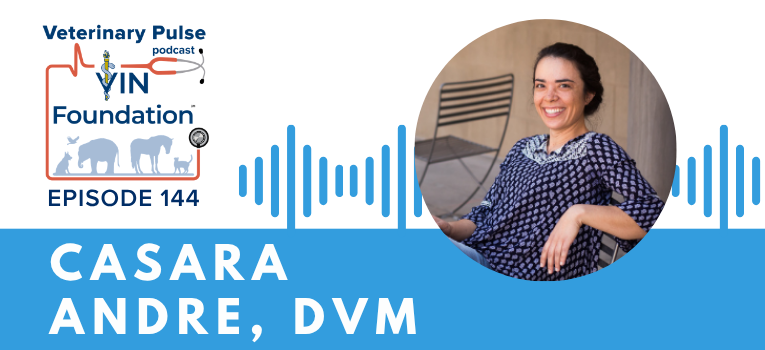
Listen in as VIN Foundation Executive Director Jordan benShea has a conversation with Dr. Casara Andre about her first-hand boots-on-the-ground experience as the volunteer branch director of the Front Range Veterinary Medical Reserve Corps (FRvMRC) and how her heart cat brought her to the veterinary profession. Join us as we learn about her story from a forensics anthropologist passion to volunteer work and her successful experience as an entrepreneur. With helpful life lessons and fascinating stories, this episode offers a wonderful opportunity to explore a different veterinary career path full of passion.
*Episode note… this episode was originally recorded in February 2022 but due to some technical issues was published on April 20, 2022.”
GUEST BIO:
Dr. Casara Andre
Casara Andre, DVM, is a Healer consistently motivated by her desire to help all mammals of all species (human and veterinary) repair and sustain their health and wellbeing. A veterinarian by education and training, Dr. Andre’s day-to-day mission is creating a safe-haven and incubator-for-ideas opportunities within medical communities. By leveraging the power of cooperation, creating a supportive community, and encouraging creative solutions, she works to support entrepreneurship among Healers that have a vision for positive change in the world. Dr. Andre currently serves the geographic regions east of the Continental Divide as the volunteer branch director of the Front Range Veterinary Medical Reserve Corps (FRvMRC). The FRvMRC is a group of medical and non-medical volunteers working to support a disaster prepared and resilient veterinary community and provide animal-related expertise to non-veterinary disaster response organizations.
LINKS AND INFORMATION:
- Front Range Veterinary Medical Reserve Corps (FRVMRC)
- Get in touch with FRvMRC
- Massey Veterinary School
- Virginia-Maryland Veterinary School
- Veterinary Cannabis
- Cultivate Wellbeing
You may learn more about the VIN Foundation, on the website, or join the conversation on Facebook, Instagram, or Twitter.
TRANSCRIPT
Intro
Casara Andre, DVM: Most of us as veterinary professionals may have heard the don’t self-deploy as the only intersection that we hear about with disasters. If you haven’t heard that, essentially what it means is don’t go in on your own. Don’t decide that you’re going to go into an incident area to do something because you think that you need to. This can be really hard for us as veterinary professionals because we are geared to help. We know how to help but this don’t self-deploy is a really important piece of keeping everybody safe and letting all those communication pathways and the other organizations that are working, do their job. Instead, get involved with the team early.
Meet Casara Andre, DVM
Jordan Benshea: That is Dr. Casara Andre, the Veterinary Medical Director of the Rocky Mountain Medical Reserve Corps, and the branch director of the Front Range Veterinary Medical Reserve Corps. This is the VIN Foundation’s Veterinary Pulse podcast. I’m Jordan Benshea, VIN Foundation’s executive director. Join me and our cohost and VIN Foundation board member, Dr. Matt Holland, as we talk with veterinary colleagues about critical topics and share stories. Stories that connect us as humans, as animals, as a veterinary community. This podcast is made possible by individual donors like you who donate to the VIN Foundation. Thank you. Please check the Episode notes for bios, links, and information mentioned. Welcome, Casara. Thank you so much for joining us.
Casara Andre, DVM: Thanks so much, Jordan. I’m excited to be here, but also talk about this particular topic.
Jordan Benshea: Yeah, I’m really excited to have you here as well. Dr. Casara Andre is with the Medical Reserve Corps, and she has just such an interesting perspective on the profession and is so boots on the ground doing so much to help colleagues and the animals that we all love. I’m excited to get into this conversation.
Dr. Andre’s Journey to Veterinary Medicine
Jordan Benshea: Where I love to start is tell us about your journey to veterinary medicine. Was there an ‘aha’ moment where you knew this was the right profession for you? Were you one of those five year olds who just thought I love puppies, and I’m doing it? How did it come about for you?
Casara Andre, DVM: I was definitely not one of those five to six year olds who this is what I’m doing, this is my life, I know I’m on the right path. I was studying to be a forensic anthropologist through most of school.
Jordan Benshea: Ooh, very interesting!
Casara Andre, DVM: It was just a love and a passion of mine in so many regards. My, ‘I need to take this path’ was when my own cat needed something. She was really struggling with some IBD, some behavioral issues, and I didn’t feel like I had enough information to be able to do the treatment that I needed to for her. To understand what the veterinarian was saying was going on and needed to happen. She was definitely my heart cat, so it was a decision of I really need to figure out what this means and what I’m supposed to be doing for her. I will say that that little kitty, Maddie was her name, has for the majority of my professional life, been the steerer, the guide.
Jordan Benshea: Sort of your true north there.
Casara Andre, DVM: Absolutely. When I decided to do acupuncture, when I decided to do rehab, and I decided to do cannabis stuff, it was because she needed something. I think most anyone associated with the veterinary profession has a story like that of one animal that has just changed their lives.
Jordan Benshea: When was that? What rough age were you when that happened with Maddie?
Casara Andre, DVM: I was about probably 17 or so. I started college really young, so I’d already been in college for a couple of years. It was just about time for me to declare my major, decide which direction I was going to go, and really could make that moment a right, I’m headed down the medicine route. What do I need to do? Let’s get it done.
Jordan Benshea: Wow, yeah, they’re the animals that just capture our hearts. Amazing.
Casara Andre, DVM: It is absolutely incredible.
Jordan Benshea: Yeah, my dog is my first and only dog and she is my heart dog. I mean, I love my chickens and I love my bees, but she is my heart dog. Where did you end up going to veterinary school and how was that experience for you?
Casara Andre, DVM: I went to my first year in veterinary school in New Zealand at Massey University. I had just a few credits left on my undergraduate degree and decided to do a year of vet school in the southern hemisphere because there semesters flip flop so I could do those rather than finishing my bachelor’s, so I don’t have a bachelor’s and then just went straight into vet school. I did the first year in New Zealand, then came back to the states, and went to school in Virginia, so Virginia Maryland regional College.
Jordan Benshea: Wow, that’s so cool. You are the first story that we’ve talked to about somebody that didn’t finish the bachelor’s and then go on to the veterinary. I love how you’ve taken that different path because it shows people. I think so often we are so focused on it has to be this, it has to be this, it has to be this, but really, there are so many options out there.
Casara Andre, DVM: Especially in veterinary medicine. We just are in a world where anything you can dream up, there’s something out there.
Jordan Benshea: That’s amazing.
Casara Andre, DVM: Yes.
Jordan Benshea: That’s amazing, and I hope that our listeners or somebody that might be thinking about the veterinary profession can listen and think oh, wow, that’s like an option. I didn’t even know that was an option. Right? We so often get so stuck in that. You went to Massey for a year, and then Virginia, Maryland. What was your first job out of veterinary school?
Military Service and Veterinary Medicine
Casara Andre, DVM: Well, while I was in vet school here in the US, I commissioned with the military, so I was an officer for the Army as a veterinarian. That was my first job. I was an officer for the military as a veterinarian.
Jordan Benshea: Wow. Okay. How did you get from an officer in the army to where you are now? If you can, share with us and our listeners your current role.
Casara Andre, DVM: Absolutely. For me, military was such a life shaping, profession shaping experience. There are so many important pieces of my leadership style, things that I choose, path that I put my current businesses on that are directly informed because of some of the stuff I learned in the military, but it also really grew my love of working dogs, so military working dogs, patrol dogs. It’s hard to not to be around working animals and not develop this passion for them, their handlers, all across the board. I transitioned from the active side of military to reserve, which was when I moved to Colorado. I taught for the ROTC group for a while, leadership, organizational skills, and really having an opportunity to fill in some gaps, I’d say of what I had found missing while I was working for the military. I had my vet school training, knew what I needed to about general practice and surgery, but when you’re working with working animals, it’s sport medicine just like on the human side. I realized there was a piece of my medicine that was missing. I needed something that was easier or softer, I guess, then a nonsteroidal, we didn’t need surgery, you know, we know these dogs in and out. I was really wanting to be interested in acupuncture, rehab, massage, I wasn’t yet working with cannabis, but that was a piece of I really need something for these patients that I don’t feel like I have. When I moved to Colorado to the reserve side, I had a lot more time to explore what I wanted to, and even though I’ve resigned my commission now, that’s still the path that I’m on. So, integrative holistic modalities, I have a couple of veterinary based businesses that are based out of Colorado, but we consult globally, particularly on cannabis education, and things like that.
Jordan Benshea: This is so interesting.
Casara Andre, DVM: I would say the experience of being part of a team, having really strong leadership around you, and learning what that means it’s a part of everything that I do still.
Jordan Benshea: Well, and I can imagine that probably those skills that you learned in the military, as you can hear my dog barking in the background…
Casara Andre, DVM: It’ll let up in a minute, enjoyed it.
Jordan Benshea: Okay, that’s the great thing about working in the veterinary profession, everybody’s going to have some sort of animal sound in the background. I can imagine that working in the military probably taught you a lot of really beneficial skills, processes, and systems that are helpful in your business and your career today, because I feel like those sorts of practical skills, it doesn’t seem to me that they’re teaching those in veterinary school. I think that it’s very helpful when you’re running any type of business and when you’re also dealing with people, right?
Casara Andre, DVM: Absolutely. Absolutely, I agree 100%, and it was from both directions. I saw a lot of things that I learned I didn’t want to do. You learned from the bad experiences just as much as the good. It’s on you to decide what you’re going to compost it into, what are you going to take out with you, and I have definitely brought a lot of pieces out. I will say that there aren’t a lot of things that were harder than creating a convoy plan and getting your soldiers like, I’ve done this before, I got this.
Jordan Benshea: It’s all relative.
Casara Andre, DVM: It also teaches you a degree of an emotional resiliency that I think is important in any career, but particularly veterinary field. I had some really not fun commanders that I learned to navigate. When I got out and started doing some private practice and beginning my own businesses, there were quite a few times when I would just think to myself, you know, this situation is not as scary as my last career, so, I’m good.
Jordan Benshea: I’m good. This is fine. It’s this range of possibilities that we have, and then it’s just relative of oh, compared to that, I’m good. It’s okay.
Current Roles and Responsibilities
Jordan Benshea: What is your current role in the veterinary profession now?
Casara Andre, DVM: I am the director of a couple of companies, so the ones that are my own, we run Cultivate Wellbeing, which is a coworking community. Essentially, we support entrepreneurship among healers, and because I’m a veterinarian, we have a lot of strong intersections in veterinary medicine, but that could be across the board. We have a massage school that I wrote the curriculum for and I’m the current director. We have a consulting practice for safe and effective use of cannabis in animals, and that’s a really fun one to work with. Cannabis is definitely a global phenomenon, so it’s fun to really work with colleagues from across the globe. We have started a nonprofit, Care for the Healer in 2020. There was a lot of just need that has been coming up that we wanted to deal with. Also in 2020, which is the one who relates most of this conversation, I’m the director of the Front Range Veterinary Medical Reserve Corps. That is a volunteer position, and essentially, we are one of two veterinary reserve corps in the state of Colorado. Our unit deals with everything that’s to the east of the continental divide. That’s the area that we serve.
Jordan Benshea: That sounds like quite a big job for a volunteer position.
Casara Andre, DVM: It’s a lot for a volunteer position.
Jordan Benshea: I mean, that’s not like I serve on a nonprofit board, and I attend a meeting once a month. That seems much more hands on, and probably most specifically with the Marshall fire that just happen.
Casara Andre, DVM: Yes, absolutely. We are a unit that has been around for a while, but not too active or too functional, really, until we decided to reinitiate or get ourselves restarted in 2020. So technically, we’re an older unit, but in terms of processes we already have, the team that’s built, we’re pretty new, and we’re pretty young. Yes, the Marshal fire was out of the blue, unexpected, a lot to dump on any team, particularly one that is finding its feet and getting the processes in place and figuring out we’re a volunteer base. It was more than a full time job for the past month, absolutely.
Jordan Benshea: Most people in 2020, were working on sourdough starters, and refining their Netflix list and you started multiple, multiple organizations and a nonprofit and became in this director role. I want to touch on the Marshal fire, but I want to go back for a little bit and maybe help our audience because I was ignorant to this.
Understanding the Medical Reserve Corps
Jordan Benshea: Can you explain what the Medical Reserve Corps is and how that works?
Casara Andre, DVM: Yes. The Medical Reserve Corps is a national system, so essentially a national group of volunteers, but importantly, organized locally. Now, our unit has both medical volunteers and non-medical from the support side, logistics side, and that’s an important component to have both pieces. What we essentially do is connect all the grassroots local resources to those who might need it. So, in an incident where state, federal respond, they’re not going to know who all the equine vets are in the area. They’re not going to know I can get hay over here; I can board horses here. We know what’s available locally and make sure that we connect them to the right places, piece in some of the disaster incidences.
Jordan Benshea: For some reason, I’ve been under the impression, and this can be completely incorrect, that anybody that’s in the reserve corps is former military. Is that correct or not?
Casara Andre, DVM: No. I do find quite a few of our team have military backgrounds. I think it’s a format and a style that lets us have some common communication patterns, common technology, and common ideas. It’s really useful when your team has the same ideas of, we need a logistics officer, we needed an operations officer, we need an equipment officer and that kind of makes things fall into place a little bit easier, but a lot of our members have no military background and are members of the community, veterinary or otherwise. Animal lovers, we have a ton of those. It’s just all pitching in because of that community base. What are we doing for our community is prepare, so in advance of a disaster, respond in the case of a disaster depending on what needs to happen, and that changes in every situation, but then also the resiliency piece, and that’s a big part that’s come up for Marshall fire. Outside of the incident, past the incident, what are the effects? What are the sequela of what happened? How do you make sure your community recovers and is prepared for the next one? So that resiliency angle is an important piece of what we’re trying to do?
Jordan Benshea: That’s really interesting.
The Importance of Communication in Disaster Response
Jordan Benshea: So, it sounds like the resiliency plus the community communications play a really important role.
Casara Andre, DVM: Yes, yes, absolutely. I think anyone listening who is already part of the veterinary community knows that we have our own jargon. We have our own way of thinking about ourselves, our industry, our patients, and our clients. That communication between the different groups, between the different sets of jargon, is important. Anytime you’re trying to coordinate multiple people, you need to be speaking the same language, but particularly in light of a disaster, like Marshall fire when everyone’s looking for information. What should I do? How can I help? What comes next? Being able to have clear lines of communication, that everyone knows where to find them, and we’re all speaking the same language is essential for success of any mission no matter what you’re trying to do?
Jordan Benshea: Yeah, I am obsessed with clear communication, because I am such a staunch believer that miscommunication, the smallest thing does everything from end relationships to start wars. I was talking to somebody recently, and they were saying, “Okay, well, I’m going to tell this person that we’re going to go a different route.” I said, you know, instead of saying a different route, people innately don’t like change, so their defenses come out, and I thought, what if we said, “I think of an approach that might be most helpful to our community is this, this, this” and it is a different route, but how you word those little things, right? I’m always checking myself day in and day out professionally, personally, in my relationships and all of them, how am I communicating because that is so vitally important. Especially, I think that we’ve seen, with COVID, with the pandemic, communications all over the map from all directions. I know how vitally important that is. I live in an area that’s had some extreme disasters in the last few years, and that lack of clear communication also impacts how the community reacts, the stress levels, what they do, it can potentially save or cause lives, so I think that’s so important. I’m glad that that’s something that you’re focused on because it’s so important. It’s also probably not easy, right? People using like you mentioned terminology, that is something that is so important.
Addressing Misconceptions about the Medical Reserve Corps
Jordan Benshea: So, along with terminology and clear communications, what are some misconceptions you hear about the Medical Reserve Corps?
Casara Andre, DVM: I would say that the biggest misconception we’re dealing with currently, which is informed slightly by how new of a restart we are, about how we have a lot of work to do to become embedded in our community, and it’s a piece that we’re excited to have an opportunity to work on. So, probably the biggest thing we’re dealing with now is the concept that the Medical Reserve Corps activates for disaster right then, and not recognizing the work that goes into building the team so that you have trained with your colleagues, so that you have the certifications you need to go into a disaster incident area to keep yourself safe, to keep your colleagues safe, and do whatever your professional role is. So, I think that it’s just very easy anytime there’s something that’s emotionally traumatic for us, all to go into react mode and it’s been effective. We’re really good at that. We are good on the ER floor, knowing what needs to be done, and being able to respond, but when you do that as a team and you try to also interact with other organizations and groups that may have different communications or different goals or just be working from a different angle, if you haven’t trained with that team ahead of time that’s when it can get a little bit dangerous and confusing. So that long term commitment, yes, but just interest in what’s going on from a disaster preparedness perspective is probably the biggest misconception that we find and are actively trying to change. It’s about getting involved with the team now so that you know who you’re working with, who you’re going to deploy with, and then that you know what your actual job is going to be once you’re on the ground.
The Importance of Proactive Disaster Preparedness
Jordan Benshea: Yeah, I think that we as a country from a US perspective are very reactive. The idea of being proactive is not so interesting to the majority of people. We can look at that from a health perspective, we can look at that in a lot of different ways, but I can imagine that probably those misconceptions come because it’s just, oh, you’re there, and then you just react. To your point, there’s a lot of pro-action that needs to go into that so that the reaction is really on point and actually helpful. Right?
Casara Andre, DVM: It can be really hard when you’re reacting to a lot, and I think that that has come up so much over the past two years. Everyone’s life is so full, not just from work, or just from family, but then pandemic on top of that. There’s so much information to process. You have to actively fight to make room in your mind to just have a little bit of space to think about what’s coming next. What can I change in 10 seconds that’s going to make my next 10 days significantly better? But it’s hard. It takes a lot of energy, and it takes a lot of teamwork to put that thought in ahead of time.
Jordan Benshea: Right, right.
Insights from the Marshall Fire Incident
Jordan Benshea: We touched on this a little bit, but we initially connected based on the Marshall fire. Speaking of misconceptions, I live in an area where there are a lot of fires, so I think that because we have these news cycles which are just so bombarding, there used to be a news crawl on the bottom of CNN. I don’t know who gets information there now, that’s like old already. Can you give us an update on the Marshall fire? For those listeners that might not know about it, can you give a little summary about what the Marshall fire was and where the situation stands today?
Casara Andre, DVM: Yes, the Marshall fire occurred in Boulder County of Colorado, for those of you who aren’t too familiar with the specific geographic area. It was a wildfire, essentially, at a time when there were some very, very high winds, I think up to 100 mile an hour winds. It’s still under investigation what the actual cause was, but the most common thought is that a downed power line just hit a spark. It’s been really dry this year and the winds. What we really saw was a huge wildfire, but in the middle of a very urban area, and this is something that took everybody by surprise. I’ve heard this from every disaster response group when we sit in their meetings, like everyone says the same thing. You don’t expect fires to really jump highways. Usually, those are effective fire breaks. In Colorado, we’re more used to fires on the western slope or in a pastureland, so for it to be right in the middle of a very, very urban area was shocking, but it also meant that who needed to be evacuated [for us listening to this and talking about this], the population density of the animals in that area is different than we would see in other wildfires. So, there was a lot of fast factors, it was very, very fast moving, destroyed so many homes in a very, very short period of time. All those things make the Marshall fire unique, but at the same time, Boulder County has unfortunately, or fortunately, known how to respond to disasters a lot. We had the floods a couple of years ago, and there’s definitely fires frequently, so in terms of responding to the incident, the county, state, federal, I think I have not heard anyone who wanted for better there. I think everyone did a spectacular job. As an MRC, we were not even a necessary piece. Boulder County had the resources they need needed to be able to handle the incident itself. Our unit has been more involved in listening to, assessing, and trying to brainstorm on the consequences to the community. What now happens to those families who are displaced? Where do their pets go for medical care? How do we do a census of the animals that were lost, found, recovered. That’s information that we as practitioners need to know, not just as animal lovers and part of a community, but this type of incident is not going to go away. We’re going to see more and more types of fire, floods, that are in very, very urban areas, so as medical practitioners there’s some data that we’re trying to gather now rather quickly so that we don’t lose it because we want to know. What were the medical injuries? What’s the consequence of medical need that was going to take be taken care of and now the family had to move and now it’s not taken care of? All those pieces for behavioral health. We want to know those answers to it. From the Marshall fire incident itself, that’s really beginning to be closed down. State and federal are still present there but evacuation orders have been lifted, families are able to go back if they have a house left still, but there’s long term support from the community that is important now, because there’s so much that’s changed and in so many people’s lives. The community being present for them, it’s this long term recovery piece that I think a lot of people don’t think about, but it’s so simple to make sure those humans and their animals continue to be okay.
Jordan Benshea: What was the date of the Marshall fire?
Casara Andre, DVM: January 30th – 31st, so New Year’s Eve was really the peak of
Jordan Benshea: December 31. Okay,
Casara Andre, DVM: Yes, sorry. Yes. Last week has been a little bit crazy in my mind! Yes, so essentially New Year’s Eve.
Jordan Benshea: Okay. It seems like what you’ve said is that everything went as well as it could based on the situation. Do you see any room for improvement in communication during a disaster such as the Marshall fire?
Casara Andre, DVM: Absolutely. We are consistently hearing in our debriefs and after action reviews with our team and the community, that people were not finding the information they needed. Not knowing where to go, how to assess the information to know whether it was accurate or not, and what that meant for them. Can I go help? What should I do? Should I leave? Should I stay? Some of those questions, so yes, absolutely. We also as a team and a community, we’ve been talking about what can we do preemptively? We want to be able to effectively respond to the disaster itself, but part of our role as the MRC is to prepare, and to make sure that there are not lives lost, animal lives lost, so we’re beginning to think about evacuation networks. Can we establish groups within neighborhoods that if you’re not home, someone’s still going to come get your animal. There are so many things that I think are possible for us to make significant changes, but it takes a lot of brainstorming. It will have to come up with unique solutions, so it takes some dedicated brainstormers. Alright, I’m here to problem solve, what can we do? Because we’re going to need an out of the box solution.
Opportunities to Get Involved with the Medical Reserve Corps
Jordan Benshea: If colleagues want to learn more about the Medical Reserve Corps, or how they can get involved from the veterinary aspect, we’re going to put all of that in the Episode Notes. I think we’re going to also share some links about the Marshall fire in case somebody wants to learn more about that. If somebody wants to get involved, though, are there opportunities? Are there opportunities outside of Colorado? If there is a veterinary colleague that thinks, oh, that’d be cool [in all their spare time, but might think that that might be something that they might want to do, or maybe they’re selling a practice and looking for a way to stay engaged, what sort of opportunities are there across the country or internationally?
Casara Andre, DVM: Nationally, across the US, there are multiple MRC groups. Now they all look a little bit different because it is meant to be a reflection of the local grassroots piece, so sometimes you’ll find the MRC under a humane society or a different nonprofit. You may need to look a little bit around in your state to be able to figure out how to connect there, but most states have at least one MRC. They may not have a veterinary MRC, but they will have ways that those grassroots resources and supplies can get connected. In Colorado, we are still in the process of making sure we are easily accessible to the community and kind of struggling with that newness versus information that needs to be readily available. For our volunteers, we start everyone off with just an interest survey. Why do you want to be interested? There are so many roles to fill. You could be a veterinarian that says, “I don’t want to volunteer as a veterinarian. I do that in my life, and I don’t actually want to do it here” and can be a logistics officer to help us do the planning of how we get animals from one point to the other and make sure that we have supplies when we need to. So, it is possible for everyone to be involved in the capacity that they want to, and we’ll say that the MRC is not for everybody. Boots on ground is not for everyone. That’s some pretty traumatic stuff that you may be exposed to, and that needs to be thought about really carefully from a mental health, emotional health perspective. Debriefing from that, making sure you’re taking care of yourself, but just from a communication standpoint, social media, logistics, all of those, there’s so much need for the community just to lean in. We start with an interest survey, and I’ve given you the link for that one. Hopefully, people will find this of interest and want to reach out and say hi. We essentially ask everyone to onboard with a state database. It does a background check needed for training. Once you’re onboarded in those basic requirements, then we have some veterinary specific training that we ask our volunteers to go through. How do I handle a large animal in the field, small animal in the field? Field euthanasia is a big thing that we talk about, personal go-bag making sure that you’re safe to go out in the field, your professional go-bag making sure you have the tools that you need while you are out in the field, debriefs, priority triage, how you will do all those pieces. Field medicine is different than clinic medicine, but it’s very, very fun. So, there’s room for everyone!
Jordan Benshea: I imagine it’s probably really rewarding as well.
Casara Andre, DVM: Yes, yes.
Jordan Benshea: Oh, well, I so appreciate your time, Casara. Is there anything else that you want to leave our audience with today?
Casara Andre, DVM: I think I would say to close that most of us as veterinary professionals may have heard the don’t self-deploy as the only intersection that we hear about with disasters. If you haven’t heard that, essentially what it means is don’t go in on your own. Don’t decide that you’re going to go into an incident area to do something because you think that you need to. This can be really hard for us as veterinary professionals because we are geared to help. We know how to help but this don’t self-deploy is a really important piece of keeping everybody safe and letting all those communication pathways and the other organizations that are working, do their job. Instead, get involved with the team early. Start now if there’s an incident so that you’re training with your team, you have the credentials that you need to be able to do boots on ground if you want to, to be able to go out and save an animal that needs you to be present, so prepare in advance. That’s been a little bit of a theme throughout this entire conversation. Think ahead of time about what you might want to do and make sure that you have that training in advance. We do that for everything. We wouldn’t do surgery without making sure we were qualified first or knew what was going on. Disaster is the same thing. It requires a set of skills, a set of training, so don’t self-deploy is definitely a thing, but there are a lot of ways for people to get involved as long as you start early before the actual incident comes up.
Jordan Benshea: That’s a great answer. Hopefully with the information I’ll provide in the Episode Notes, people will be able to explore if that’s something that interests them.
Casara Andre, DVM: Absolutely.
Final Thoughts and Personal Insights
Jordan Benshea: One of my favorite questions that I love to ask at the end is do you have a secret talent or something that you enjoy doing that others might not know about? It clearly sounds like you’re extremely busy, but there are additional things.
Casara Andre, DVM: Well, I will say that, yes, I am busy, but I can’t imagine doing anything else. I absolutely love every aspect of my professional life, and as we said in the beginning, there are so many things that you can do in veterinary medicine. Sky’s the limit. If you can dream it up, there’s a need for it. I would say that probably the thing most people don’t know about me is that I am a synaesthete, which may be something that a lot of people haven’t encountered. It essentially means that some of my senses are mixed. Synesthesia is actually really common. The most common one that you’ll hear about is visual synesthesia, if you hear the number seven, you’ll see a purple seven, so some of those senses get mixed in the background. I’m a kinesthetic synaesthete, so a lot of my interactions with the world have a physical sensation to me, but it also makes me really good at seeing analogies in between things. It’s something that I love about myself but has been merged really intimately with some of what I do in a professional context.
Jordan Benshea: That’s so interesting and a first time, I’m used to like knitting, or like karaoke. I love that! That is so cool.
Casara Andre, DVM: I’ll leave that. As my like thing that I like to do, I love to do archery. That’s really fun.
Jordan Benshea: So, you love to do archery?
Casara Andre, DVM: Yeah.
Jordan Benshea: Okay, another totally cool thing that’s awesome! Casara, you are so fascinating as a person and thank you so much for everything that you’re doing for our animals, for the profession, and for the community. I think that we’re definitely better off with you in it. Thank you so much for your service and giving back and supporting so much. We’re very grateful. Thanks for coming on here and spending your time. You know, I think time is one of the most valuable things we have, so thank you for choosing to spend it with us here.
Casara Andre, DVM: Absolutely. So much fun from my side to be able to talk about, and I will say that all the ways that I’ve served and continue to serve have been an honor. I love our veterinary community, and I wouldn’t pick to do anything else.
Jordan Benshea: That’s wonderful. I love it. I love hearing how when people love, love, love what they do.
Casara Andre, DVM: Absolutely
Jordan Benshea: Because I feel that way and I just feel so grateful every day, so thank you.
Casara Andre, DVM: That’s wonderful.
Jordan Benshea: Thank you so much, Casara!
Outro
Jordan Benshea: Thank you for joining us for this episode of the Veterinary Pulse. Please check the Episode Notes for additional information referenced in the podcast. If you enjoyed this podcast, please follow, subscribe, and share a review. We welcome feedback and hope you will tune in again. You can find out more about the VIN Foundation through our website, VINFoundation.org, and our social media channels. Thank you for being here. Be well.