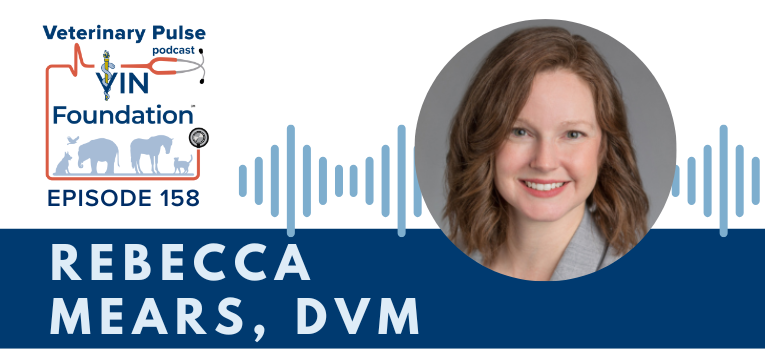
Listen in as Dr. Rebecca Mears from the VIN Foundation Student Debt Education Team shares her unorthodox path to veterinary medicine, the trends she is seeing in her work with veterinary students and student debt. Find out how a horse jockey and dinosaur fit into her story. As she says in the beginning, this episode is a fun ride!
GUEST BIO:
Dr. Rebecca Mears
Rebecca Mears, DVM is from Lexington, KY, where she completed her BS at University of Kentucky. She is a graduate of University of Georgia’s College of Veterinary Medicine. Rebecca has worked as an equine general practitioner and is an active AAEP member. She has been involved in the Veterinary Business Management Association (VBMA) since vet school and now as a co-advisor for the National VBMA. In her work with VIN and the VIN Foundation she has a primary focus on student debt education and is a member of the VIN Student Team. She is passionate about giving back to the profession and improving the lives of veterinarians, pre-vet and vet students. In her time away from veterinary medicine, she can be found hiking, baking, and hosting impromptu dance parties.
LINKS AND INFORMATION:
- VIN Foundation Student Debt Center
- VIN Students
- VBMA
- Vets for Pets and People
- Check your current student loan servicers and other loan details — VIN Foundation My Student Loans tool
- VIN Foundation Student Loan Repayment Simulator
- VIN Foundation WikiDebt
- VIN Foundation Webinars
- VIN Foundation get updates
- VIN Foundation GIVE page to support these programs & tools
If you like this podcast, we would appreciate it if you follow and share. As always, we welcome feedback. If you have an idea for a podcast episode, we’d love to hear it!
TRANSCRIPT
Intro
Rebecca Mears, DVM: Feel like as a nontraditional vet student that has kind of had some different life experiences and things like that, then going into vet school, I feel like you just look at it as a very different experience. That’s not that it’s any better or worse or anything like that than somebody who goes straight through all of academia into vet school, but I do think it is a little bit different of a perspective.
Jordan Benshea: That is Dr. Rebecca Mears, a veterinarian and so much more, and this is the VIN Foundation’s Veterinary Pulse Podcast. I’m Jordan Benshea, VIN Foundation’s Executive Director. Join me as we talk with veterinary colleagues about critical topics and share stories, stories that connect us as humans, as animals, as a veterinary community. This podcast is made possible by individuals like you who donate to the VIN Foundation. Thank you. Please check the episodes notes for bios, links, and information mentioned. Welcome, Becca. Thank you for joining us today.
Rebecca Mears, DVM: You’re so welcome. I’m really excited to be here, Jordan.
Jordan Benshea: We normally have you with Dr. Tony Bartels doing student debt updates, but I figured it was well beyond time to introduce our audience to you and share your story.
Rebecca Mears, DVM: Oh, absolutely, and buckle up audience because it’s going to be a ride.
Jordan Benshea: Oh, fun for sure.
Rebecca Mears, DVM: We aim to have an entertaining podcast here at the Veterinary Pulse.
Jordan Benshea: Yeah, we do. So you know how we start these.
Becca’s Journey to Veterinary Medicine
Jordan Benshea: Let’s start with your story, and let’s start with your journey to veterinary medicine. Was there an aha moment for you where you knew it was the profession for you, or you knew that you wanted to practice it?
Rebecca Mears, DVM: There was an aha moment, but it was definitely later in life. I did not grow up wanting to be a veterinarian. I grew up as a horse girl through and through, and everybody would always ask, do you want to go to vet school? Oh, you’re going to be a veterinarian one day, and I was adamant that I would not become a veterinarian. So that was definitely a different story than many of my colleagues and classmates during vet school and things.
Jordan Benshea: So did you go kicking and screaming? How did you get from I definitely do not want to be a veterinarian with everybody suggesting it to me to going to veterinary school?
Rebecca Mears, DVM: Yeah, so when I was the average age of most people deciding to be a veterinarian, I decided that I wanted to be a jockey. I wanted to ride racehorses, and so that was my goal as a kid. That’s actually what brought me to Kentucky where I am living again, and that’s where I did my undergrad degree. But what I did is I kind of did that on a roundabout way and ended up spending two years doing jockey school and then galloping race horses for a while, and then eventually went back to finish my bachelor’s degree. I started my bachelor’s degree in equine science, not really knowing what I wanted to do, just that I really liked horses and wanted to have a career with them. When I started to look around at what jobs I might like to have, I was really attracted to regulatory medicine and thoroughbred horse racing because my time from galloping, being a groomer, and a hot walker, I just really liked that aspect of the industry. So protecting the equine athlete and making sure the rules are being followed and everything like that. So when I started looking at those jobs, all of the people who are always like, yeah. I could do that, like that would be a cool job to have. They were all veterinarians.
Jordan Benshea: Oh, really?
Rebecca Mears, DVM: Yeah, it was just a moment of, like, well, there’s your aha moment, we’re going to go to vet school.
Jordan Benshea: So kicking and screaming with every path that you could do but that.
Rebecca Mears, DVM: I mean, really, it kind of it was very interesting, and it was so funny because for so long I used to always tell people like, oh, yeah, you know, I wanted to be a jockey when I, ever since I was a kid, and I finally got to Gallop Race horses. I didn’t ride races, but I got to follow my childhood dream to so far into that industry and everything, and who gets to say that? Then I went to vet school, and I was like, oh, everybody says that here. That’s not a cool story anymore, Rebecca, that’s like, that is veterinary medicine.
Jordan Benshea: Okay, so you decide that you do want to be a veterinarian, and that does somehow align with your passion for horses because it has all these other opportunities.
Vet School Experience and Challenges
Jordan Benshea: So what vet school did you go to, and what was that experience like for you?
Rebecca Mears, DVM: Yeah, so I ended up going to University of Georgia, and the reason I did so is the time that I was applying to vet schools, I was a Delaware resident. Delaware doesn’t have a vet school of their own, but they do have contract seats where you can pay in-state tuition. At the time. I don’t know if it’s still the case now, but at the time it was at University of Georgia and Oklahoma State University. So I, unfortunately, because of my very unique path through undergrad that may or may not have taken almost a decade, some of my prereqs were expiring for Oklahoma State, so I set my sights on University of Georgia. Again, everything with me is an adventure, and so I applied for a spot and was accepted, but I was number three on the list for contract seats, and only the first two get contracts.
Jordan Benshea: No.
Rebecca Mears, DVM: Yeah, so they gave me an at-large seat where I would pay out of state tuition, but I unfortunately have student loans from undergrad already, and so for me, it was really important that I pay that discounted tuition rate. So I told them, I was like, I’ll stay on the waitlist for the in-state spot, but I’m not coming for out-of-state tuition. So I applied again the next year, my mentor at the time thought I was crazy. He was like, if you turn them down, they’re not going to take you again the next year. Luckily, for some reason, they did.
Jordan Benshea: Oh, wow. Yeah.
Rebecca Mears, DVM: So that year, I was able to get in state tuition.
Jordan Benshea: So what did you do for that year in between?
Rebecca Mears, DVM: So that year, I spent working with that mentor veterinarian in central Kentucky. So he was a solo equine practitioner in central Kentucky. We did a lot of repro work, sport horse work, or just like a variety of things. We pretty much did any stage of the thoroughbred racehorse except for racing. We didn’t really do too much track work itself, but, yeah, it was I mean, it was a great experience. It really ramped up my hours for my experience hours going into my next vet school application cycle. But then I think also spending that year working, I always joke, like, less than four feet away from a solo equine practitioner in central Kentucky for that time, that’s a lot of honesty. You really see what it is like to be a veterinarian and what the challenges are and what the great parts of being a veterinarian are. So I think that was just a really great experience for me because, I mean, he used to ask me all the time, he’s like, oh, don’t you want to don’t you want to like ride along with somebody else who who doesn’t have the experience that I’ve had and stuff like that because it can be challenging. I was like, no, because I want somebody who’s going to be honest with me about what veterinary medicine is. It doesn’t help me to prepare for my future career at all if I just get the sugar coated version of everything. So it was great experience, I can’t say that I regret a single second of it.
Jordan Benshea: How did you find, with that sort of life experience under your belt and veterinary experience under your belt, how did you find that impacted your veterinary school experience versus your classmates?
Rebecca Mears, DVM: I always joke that I entered vet school already bitter and jaded, I felt like I had been practicing for 20 years already, and I was like, ugh no. I think it helped me a lot because I was able to kind of, I don’t know, I just feel like as a nontraditional vet student that has kind of had some different life experiences and things like that, then going into vet school, I feel like you just look at it as a very different experience. That’s not that it’s any better or worse or anything like that than somebody who goes straight through all of academia into vet school, but I do think it is a little bit different of a perspective. So I felt like my time in vet school I was one, a lot of the time I was very focused on how to deal with people, how to deal with clients specifically. Like, I wanted to know those things because I knew I would learn the medicine, like, that’s what that school teaches you. That school teaches you the medicine, but I knew that there was so much more to being a good practitioner, to being a great practitioner, so for me, that was really important. Then I think also I had a slightly different perspective on, like, what do I need to take from my medical learning, from my didactic courses, from my clinical year, what do I need to take from that because I’ve already seen very, very closely what the day to day life of an equine veterinarian was.
Jordan Benshea: Yeah, because that’s a different approach. I mean, it’s a different approach than what we regularly hear, which is I had an aha moment, I knew from when I was kid that I wanted to be a vet, boom, boom, boom, in school, out of school, and then sort of hit with different realities that you’re not focusing, that most are not focused on when they’re trying to get into veterinary school, nor are they focused on when they’re in school because they’re just working to survive school.
Rebecca Mears, DVM: Absolutely, and I think through that, I really found there were a couple of things that helped me through vet school that weren’t related to the traditional, like, learning and medicine and everything else that you typically think of with vet school.
The Importance of Counseling and Support
Rebecca Mears, DVM: So counseling was a huge part of that, because vet school’s hard. It’s really hard, and it’s not just the material that you’re learning. They always, I’ve always heard the comparison that learning in vet school is like trying to drink from a fire hose. There’s just so much material being thrown at you. That’s not just a learning issue, but that’s also like a time management, management, emotional intelligence, resiliency, like, there’s so much more that’s involved in getting through vet school than just being able to sit in your classes, master the material, take the test, and move on.
Jordan Benshea: Right.
Rebecca Mears, DVM: So I think that is something that I have seen more and more schools adapting, but we were lucky enough that when I was at University of Georgia, we had two embedded counselors there. One who was at UGA, which is a split campus, so there was one embedded counselor at each of the two campuses. So I, pretty early on in my vet school time, established a relationship with one of those two counselors and was seeing her pretty regularly. It would wax and wane as life waxed and wane, and those clinical rotations started, like, some of them were really hard to go see the counselor. But I, that was really important to me, and I felt like that really made a big difference for me during vet school and being able to, like, just survive what is, that experience.
Jordan Benshea: Do you feel that you were unique in taking advantage of that resource?
Rebecca Mears, DVM: You know, that’s a great question, and I think it is funny because, so when I started at UGA there was one embedded counselor and they added the second within, like, my first year and a half there. I noticed a change in the trend of people being, one, willing enough to talk to a counselor, and then two, being willing enough to announce that’s something they did, because it’s not something we really think about running around, especially if that’s cool and being like, oh, yeah, I’m seeing the counselor. But I did see that change throughout my time there and that more and more people, like, it became a conversational thing, like, oh, yeah, I’ve got to go because I’ve got an appointment with whoever it may be. But I definitely like, especially my first year, there was a lot of resistance I saw on my classmates in order to take advantage of those things.
Jordan Benshea: What other resources did you find were helpful for you in veterinary school?
VBMA and Professional Development
Rebecca Mears, DVM: One of the big ones that I am still involved in and really, really absolutely love and recommend to all veterinary students, is the VBMA, the Veterinary Business Management Association. Everything’s a story with me, so I apologize if everybody’s not into stories listening to this.
Jordan Benshea: Becca, you’re here to share your story, so I feel like this is the right platform for your stories.
Rebecca Mears, DVM: We’ll just have a fireside chat.
Jordan Benshea: Exactly, Becca’s fireside chat.
Rebecca Mears, DVM: So I, my first year of vet school, it was the first semester and I was in line to get lunch for another club meeting, and there was the first VBMA meeting coming up of that semester. I remember talking to one of my friends and being like, “oh, I wonder what do vet students really know about business, like, I just really don’t know that that’s a worthwhile thing to do”, and one of the girls behind me in line was actually a chapter officer for that VBMA chapter, and she’s like, “hey, like, I couldn’t help but overhear, it actually is a really great opportunity, you should check it out, just come to the first meeting, if it’s not your thing that’s fine, but I really think that, like, you will see that it is, it’s more than you think it is, and it’s not just business, it’s really, like, professional development, and we can benefit anybody no matter what you want to do within veterinary medicine”. So I went to that first meeting, and then, like, I never left VBMA.
Jordan Benshea: We should also say, Becca, what is your current role in VBMA?
Rebecca Mears, DVM: Yeah, so one of the things I do now is I’m a national co adviser for the national VBMA, and so I’m still able to give back to that organization because, really, I mean, it did, it gave me so much throughout, not only vet school, but now into my career. It’s hands down one of the best things that I did for myself and my career throughout vet school, was joining and being active in VBMA.
Jordan Benshea: Why do you think it was so beneficial in veterinary school? I mean, some audience members might be listening and think, well, I don’t even have enough time to study the medical aspects of veterinary school, I definitely don’t have time to focus on the business ones.
Rebecca Mears, DVM: No, and I think that’s something we hear a lot. I think that’s something, especially now, I hear from students a lot, is I think there has been a lot of focus on setting boundaries, which I think is awesome and I’m really glad to see that. I do think there’s a fine line between, be involved, like, do things, like, get those other experiences, and I do think VBMA is a great experience. So the reason I think that that was so helpful is, one, that was a large part of what I had been looking for, like, I knew that veterinary medicine was so much more than just the medicine. It is a people profession, at the end of the day, it really is, but dealing with people is hard. Dealing with people can be a big challenge sometimes, and so I think that was one of the things that I took from VBMA is a lot of that professional development, working in teams, things like that. But then so much more, I mean, the way the VBMA curriculum is set up with their business certificate program is really designed to give veterinary students, you’re not going to be an expert in anything, but give you a good knowledge about different areas that will help impact your career and honestly your personal life as well as you move forward from vet school. So it just, I can’t say enough good things about it.
Jordan Benshea: Well, it’s wonderful that you found something, that you found your groove in coming from that sort of an unorthodox journey to veterinary school, and then finding something probable. I mean, I would imagine that your extra experience early on, that extra year that you took before going plus your your jockey time, obviously,
Rebecca Mears, DVM: Very vital to the experience.
Jordan Benshea: Very vital. But it gave you some insight into different areas that you wouldn’t have thought as necessary, if you didn’t have them. This is an example of an experience that really has supported you in all different areas because there’s a lot that we can learn from business that can be applicable in our personal lives. I mean, it’s dealing with people is dealing with people personally, professionally. Any insight that we can get in that is helpful.
Rebecca Mears, DVM: Oh, yeah, absolutely. I mean, I think even, like extroverts, like even extroverts, people who love people, which I am clearly not one of by the way I say the word extrovert. Like even for extroverts, it’s harder to deal with people sometimes, and especially as you move forward in your career as a veterinarian that can be really challenging. It doesn’t even have to be necessarily in clinical practice, but clinical practice is a great example. Many of our veterinary school graduates don’t necessarily have a ton of experience dealing with people, and then you graduate, you walk across that stage, and you’re a leader in the clinic that you go to. It’s like day one, you have people looking to you for answers, not just your clients, but your support staff and everything else, and with that sometimes comes its own difficulties. I don’t know how to tell everybody this, but sometimes veterinary clinics can have a little bit of trauma or maybe even a little bit of conflict, and as a leader in that clinic as a veterinarian, sometimes you have to figure out how to navigate that. If you have two technicians that don’t get along and those are your two technicians for the day, then like you’ve got to figure out how to make that team work. And I think that’s something that vet schools don’t necessarily always prepare us for, but is a really big, important part of being a veterinarian. Like we were saying, it goes beyond being a veterinarian, like, that’s a great skill to have as a person.
Jordan Benshea: Okay, so you’re in a veterinary school, you’re taking advantage of these resources and these opportunities, what happens when you get out of veterinary school?
Graduating During COVID-19
Jordan Benshea: What’s your first job?
Rebecca Mears, DVM: That’s a great question because I graduated during COVID. So I’m a 2020 graduate, and I wanted to go into
Jordan Benshea: So it was right after, I mean, when everyone was still in lockdown.
Rebecca Mears, DVM: Oh, yeah, we were in lockdown, oh, yeah. We actually, they canceled clinics, like, we were kicked out of the hospital. So it was, I mean, that was a unique experience. Luckily, I was able to do some of my rotations virtually. At that point, for our program we had done enough of our clinical time that we had, like, satisfied all the requirements that we needed to and everything else. But, I mean, to this day, like, equine ophthalmology was one of the rotations that I missed, and to this day, every time I have to do an eye exam, I’m like, oh man, it would have been really nice if I had that rotation.
Jordan Benshea: Dang COVID.
Rebecca Mears, DVM: Yeah, and I hear that from, like, classmates too when I catch up with them and they’re like, oh, yeah, just, you know, every time I have to do this, I’m just like, oh, that was that rotation I missed. It’s not, our rotations at UGA were three weeks, it’s not that having three weeks of equine ophthalmology would have made me an expert in it, but it is that comfort idea, if only I had had this experience. But yeah, so, I mean, it was a difficult time. I wanted to go into equine medicine, I knew that’s what I wanted to do after vet school, but I wasn’t sold on doing an internship. For so many equine veterinary focused veterinary students, that’s kinda what you hear you’re supposed to do for so long, is that you go to vet school and then you do your equine internship like that’s the path, and then you can go find a job. That wasn’t really what I wanted to do, the way that I learn, the way that I wanted my life to go, the way that I know about like the things I know about, like, my mental health and me as a person, that just wasn’t a good fit for me. So I was looking to go straight into general practice, and at least at that time, it’s a little bit better now, but at least at that time those jobs were kind of hard to find because most people wanted an internship trained veterinarian. So I was traveling, applying for jobs, interviewing and everything, and then COVID happened. If there was one thing that went away real fast, it was job opportunities for new graduates to go into equine practice, we saw that everywhere.
Jordan Benshea: So you don’t feel like it was unique to equine?
Rebecca Mears, DVM: I mean, it was unique in that nobody wanted to hire for those positions anymore, or at least in my experience it seemed that way, versus what I saw in my small animal colleagues is maybe, like, a delayed start date or just kind of like a, hey, we’re trying to figure things out right now. I did hear about some people who had, if they hadn’t signed their contract yet, that the clinic was trying to negotiate a lower salary because, I mean at that time, that’s when everything was shut down. Nobody had any idea.
Impact of COVID on Veterinary Medicine
Rebecca Mears, DVM: We didn’t know at the time that the result of COVID in veterinary medicine would be this huge. Nobody knew that. Yeah. So, I mean, it was, at that time, people could barely even get into their clinics and stuff like that. So it was an interesting experience.
Jordan Benshea: So why do you think equine was so hesitant? Do you think that’s the proximity of people working together? Or I mean, that doesn’t really make sense because in practices you’ve got the same thing.
Rebecca Mears, DVM: I think because when you’re looking at a practice already that is willing to kind of go outside the norm and hire a fresh, brand new, new grad as an equine practitioner, those opportunities are already few and far between. Then when you put into place, like, nobody knows what’s going to happen with their business, like, the last thing that those practices want to do is add on an associate. So it’s not like they were like, oh, we don’t want a new grad, but we’ll take somebody else, like, by large and far, a lot of those places were just like, yeah, we’re not going to hire anybody right now.
Jordan Benshea: Right, everybody was sort of in lockdown with what they did with business because they didn’t want to extend expenses and then not be able to cover it.
Rebecca Mears, DVM: Yeah, absolutely.
Challenges for New Graduates During Lockdown
Jordan Benshea: Okay, so you’ve graduated, it’s in the middle of lockdown for COVID.
Rebecca Mears, DVM: Yeah, and all my job interviews dried up, nobody wants to talk to me anymore. That was comforting.
Jordan Benshea: Oh my gosh.
Finding Mentorship and Early Career Experiences
Rebecca Mears, DVM: So I was very lucky in that the mentor that I had mentioned before was still a solo practitioner in central Kentucky, and he was actually looking to move his practice outside of Kentucky, and he was like, I could use some help because I have a lot of business stuff I need to focus on, and I know what I’m going to get from you, my clients know you, I know you, we had a really great relationship. And so he was like, I can’t promise you anything long term, but, like, come up here and I’ll mentor you and we’ll do some work together, and then we’ll just kinda take it from there, so that’s what I did. It really was, I mean, it was a great experience because, again, like I said, I knew that person and I knew that person very, very well, and so I knew the level of mentorship that I would receive. That level of mentorship that I received was what I wish anybody would get in veterinary medicine. I mean, I could literally be across town, and I was like, I don’t know what I’m looking at, can you come check this out? And he would drop what he was doing, get in the truck and come. So, I mean, that was just, I mean, it was really like, I cannot give him enough credit for being just a fabulous mentor and friend to me. Just that was, it was really like the, as weird as it is to say, like the best start to my career that I could have received. So, yes, I was there for a little while and then was, as things started to level out and we realized how busy we were going to be post of the initial shutdown and everything like that, then jobs started opening up and I was able to find a clinic that was looking for an associate, and I made my way to a new clinic.
Transition to VIN and Current Role
Jordan Benshea: Wow, so you made your way to a new clinic, and then last year sometime, you made your way to VIN. So what’s your current role in the veterinary profession?
Rebecca Mears, DVM: Yeah, a strange switch huh? So I now work for VIN, and I do a lot of crossover work with the VIN Foundation as well, and so what I do…
Jordan Benshea: Which we’re super grateful for.
Rebecca Mears, DVM: Thank you, and so what I do there is largely a big one of my biggest sections of my multiple hats that I wear at VIN, is student debt education and member payment help for veterinarians and vet students.
Jordan Benshea: Yeah, and the VIN Foundation Student Debt resources, I mean, you and Tony tag team that, and you guys do an amazing job, and we’re so, so, so grateful. And then you also work with VIN students, right?
Rebecca Mears, DVM: Yes. I’m a member of the VIN student team as well, and so I do a variety of things for the VIN student team, including I am a co mentor for our VIN student champions program. So many of the vet schools have a VIN student champion who, they’re awesome students, I’m so excited to work with them, and they’re great individuals and they just help share their love of VIN with their classmates.
Trends Among Veterinary Students
Jordan Benshea: What are some trends that you’re seeing with veterinary students?
Rebecca Mears, DVM: Oh, good question. Trends that I see in vet students? We kinda touched on the biggest one that I’m seeing a little bit earlier of students sort of trying to navigate that balance between setting boundaries and prioritizing their own wellness, but also not shutting yourself off from opportunities. So something I’ve heard from many of the vet school clubs and the officers that I work with and things like that in a variety of different capacities, just that a lot of the vet students aren’t looking to be involved in clubs. That’s just so startling to me because those were some of my best experiences in vet school. The ability to get in for wet labs and, like, get those hands on opportunities that everybody just wants so much when you’re in vet school, like, all you want to do is do something other than sit in front of your computer or a textbook.
Jordan Benshea: So why do you think there’s that decrease of interest?
Rebecca Mears, DVM: I think some of it is that balance of trying to, do I prioritize my wellness and setting these boundaries and not straying from those? And I think, I hate to blame everything on Covid, but I do think that Covid was really hard. When I was in school in the club activities that we would do and things, there were so many lunches and wet labs and everything that we could do just kind of like in person while you were already at school for the day and where that changed by so much virtual learning. I think that’s just been really hard to recover from. I think you’ve also lost that sort of pass down of recommendations from older students. So like your third and fourth year students that are meeting these incoming first years or second years, and they’re like, well, what should I do while I’m in that school? Well, maybe those third and fourth years didn’t have all of those opportunities and so they don’t realize that maybe recommending those things would be, because it’s like, well, I didn’t do that and I don’t know. So I think that is a really big challenge that we’re sort of looking at for vet students right now.
Jordan Benshea: What’s interesting is the idea of mental wellness and setting boundaries, it’s also possible that joining some of these clubs or getting more involved and engaged could actually be really helpful for the mental wellness, right? I mean, I know that there has been studies that have come out since COVID saying that loneliness and people that spend a lot of time alone, that can actually have a really poor impact on your emotional, mental, and physical health.
Rebecca Mears, DVM: Absolutely, I definitely I noticed that myself, and I tell people this all the time, and I’m like, there’s a very big chance that I would have quit that school after first year if it weren’t for VBMA. I loved what I did with VBMA, and at that time I had been elected to be a local chapter officer, and I was getting more involved with that. So for me, like, I just wanted to carry through with that. I was also involved with another program at UGA that’s called Vets for Pets and People. So I was a board member for them all throughout that school, and that’s a program that partners with the local domestic violence shelter in order to foster and provide medical care of the pets that are seeking to escape from domestic violence. So just a great program. It’s absolutely amazing. It’s so wonderful and just, like, such a great community outreach program, and I wanted to stay involved with those things. I think that was that was a challenge of me not growing up wanting to be a veterinarian. I didn’t have that tie that some people did to going to vet school and being a veterinarian. And so one again, that school’s hard. There’s a lot of great opportunities and there’s a lot of fun, but not all the time. So when I got to the end of the first year and I was like, man, like, is this what I want to do? I’m really like those two things hardcore, like, kept me going throughout vet school. And I just, it also helped me balance my time because I wanted to make time for all of those things. And so through that I was like, okay, well, I’ll study here and then I’m going to go to this meeting and then I got to talk to this person and I’ll study here. It just helped to keep me going throughout that school.
Jordan Benshea: It’s so interesting.
Student Debt and Financial Resources
Jordan Benshea: So what are some trends that you’re seeing with student debt?
Rebecca Mears, DVM: So many trends. I say that because short…
Jordan Benshea: So many changes. So much news. So much nonstop.
Rebecca Mears, DVM: We’ve had some…
Jordan Benshea: I mean, if our audience is unaware, there have just been, I mean the onslaught of student debt changes and news and updates and the back and forth and the moving of the dates since COVID has been
Rebecca Mears, DVM: And some of the things are announced very quietly if at all, so it’s like just discover it and you’re like, oh, okay, that’s. But that’s why VIN Foundation is here to help.
Jordan Benshea: Yeah. That’s why we’re here to help.
Rebecca Mears, DVM: We do those things and help break it down in this podcast for you.
Jordan Benshea: I mean, if nothing else, it’s just severe job security for Becca and Tony.
Rebecca Mears, DVM: Yeah. Absolutely. Well, it is but you mentioned earlier that I started this role last year, and it’s true, I did. It’s been just over a year now, and when I first started, I mean, it felt like every 30 days there were new rules. Like, it was just, I mean and I remember telling Paul and Tony and just being like, look, I promise I’m trying, it’s just it’s really hard to learn these things when every 30 days, it’s like, nope, everything you just had, forget it.
Jordan Benshea: Gone.
Rebecca Mears, DVM: Yeah.
Jordan Benshea: Yep.
Rebecca Mears, DVM: So I mean, that’s why I love what I get to do. It’s because I, doing this, recognize how challenging it is to keep up with these things and understand it and because you go to vet school to learn medicine, you learn to be a veterinarian, you don’t learn to be a student debt expert, except for a couple of us. And so I just think that’s such a great thing that we offer and that is there for our professional community to be able to help navigate those situations. Again, let’s not like, finances are not fun sometimes. Like, there’s just like few people in the world that think they’re fun. But the large majority of us are, like, not really what I want to sit down and do on my Friday evening. It’s just, again, that’s like a huge, it’s, we know it’s a huge stressor in the profession, and I just think being able to help people navigate that, it’s just it brings me joy, which seems weird to say.
Jordan Benshea: What are some of your favorite student debt resources?
Rebecca Mears, DVM: The VIN Foundation Student Debt Center, and I’m not even saying that through, like, any
Jordan Benshea: I promise we’re not paying her to say that.
Rebecca Mears, DVM: Yeah. No one’s paying me to say that, truthfully. It’s not even that. I remember my first year of vet school, going to a VBMA meeting, and it was Tony giving the Climbing Mt Debt lecture, and I was just like, this is legit. Like, I distinctly remember sitting in the class. Like, I can tell you that I was on the right side of the room. Like, I mean, I could it was a moment for me.
Jordan Benshea: Here’s your aha moment.
Rebecca Mears, DVM: That was the moment. So that was just, like, open the doors for me for the resources that are available through the Student Debt Center through the foundation, and those tools are just so incredibly helpful. I know so many people focus on the loan repayment simulator, but it’s more than that. There’s so much more. I mean, it’s the blog posts and the podcasts and our WikiDebt, which is like a encyclopedia of student debt things you need to know, and breaking down all of those confusing terms and things. There’s a My Student Loans tool, which helps you to learn so much more about the specific loans that you have. Like, it really is just a wealth of resources. And again, not to plug, nobody’s telling me to do this, but they’re free. Who doesn’t like free stuff? I love free stuff to this day.
Jordan Benshea: Okay, is there anything else you wanna leave our audience with?
Personal Insights and Final Thoughts
Jordan Benshea: I think that your story has been, I really appreciate you taking the time to share it with us, and we’ve been trying to record this podcast for truly months.
Rebecca Mears, DVM: It’s been a while.
Jordan Benshea: It’s been a while, but it just seemed like, we wanted to have your story shared, and I think that you bring so much insight in this. I love these more, you know, all the stories are vitally important in their own way, and I also think that this unorthodox approach that you had, is really insightful as well. Just showing people that it doesn’t need to be this aha moment from childhood, and there can be other things that happen, and there’s different paths and whatever your path is, that’s what’s right for you. So I love hearing and sharing with our audience how you’ve found your way within veterinary medicine and all these different aspects of it, anything else you can share?
Rebecca Mears, DVM: I feel like I embody that, like, path to success, and it’s not like a line on a graph. It’s like that weird, like, squiggly. I feel like that’s
Jordan Benshea: Like progress is not linear.
Rebecca Mears, DVM: Yeah. I feel like that’s my life story. Like, one day when I write my autobiography, we’ll just include that image on the cover.
Jordan Benshea: Okay, so last question that I’m sure that you know that I ask people all the time, which is, do you have a secret talent or something that you enjoy doing that others might not know about?
Rebecca Mears, DVM: Oh, I did know it was coming, and I still don’t know that I’m prepared for it. A secret talent or something that people may not know about me? Okay, I got it. This isn’t actually, like, completely unknown, I also can’t believe that I’m sharing here. So one night after the kids went to bed, my nieces and nephews, my sister and brother-in-law and I decided that we would just get wild and measure wingspan versus height, like your arms from fingertip to fingertip versus your height, because in most people, it’s like about equal, except my arms are quite a bit shorter than my height. I got pretty short arms, which was really fun being an equine veterinarian and having to palpate things. And so all of my nieces and nephews now call me Becca-saurus. That is like my family nickname now is Becca-saurus, and I get a ton of dinosaur gifts from my nieces and nephews frequently.
Jordan Benshea: Who would’ve known?
Rebecca Mears, DVM: Who would have known, I know. Now everybody’s going to look at me.
Jordan Benshea: Secret talent as a dinosaur.
Rebecca Mears, DVM: I’ll know people who have listened to the podcast now because they’re going to, like, eye up my arms and be like
Jordan Benshea: I mean, obviously, we’re putting in, like, a dinosaur emoticon when we share this.
Rebecca Mears, DVM: Absolutely, because they got to listen to the end to get that.
Jordan Benshea: Becca, thank you so much for taking the time to share with us today, and as always, we’ll put everything in the episode notes, links, and information. Thank you, Becca. I really appreciate your time.
Rebecca Mears, DVM: Thank you, Jordan. I really appreciate it, and thanks everybody for hanging in on the ride.
Outro
Jordan Benshea: Thank you for joining us for this episode of the Veterinary Pulse. Please check the episode notes for additional information referenced in the podcast. If you enjoyed this podcast, please follow, subscribe, and share a review. We welcome feedback and hope you will tune in again. You can find out more about the VIN Foundation through our website, vinfoundation.org, and our social media channels. Thank you for being here. Be well.