2026 New Graduate Student Loan Playbook Webinar: 4/22 5pm PT
“How worried should I be as a first-year veterinary student about my student loans?”
The first cohort of veterinary students subject to the new federal student loan limits has started veterinary school.
One of the best questions I have received this year from a first-year veterinary student was, “How worried should I be as a first-year veterinary student about my student loans?”
The answer depends on where you fall in three main categories —
- How much do you need to borrow?
- How much will you need in private student loans to complete veterinary school?
- What are the terms of your private student loans?
We’ve learned a lot these past few months, whether you are a first-year veterinary student or a returning veterinary student who is eligible to continue borrowing under the old federal student loan limits.
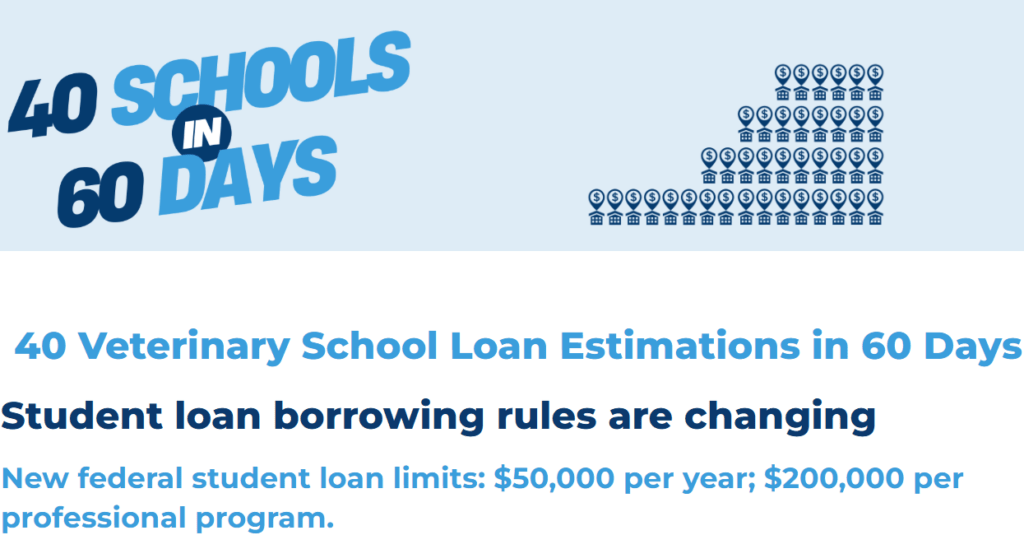
The One Big Beautiful Bill signed into law July 4, 2025, established new rules for anyone using federal student loans for professional programs, like veterinary school. Those new rules took effect July 1, 2026. Students who started a new professional program or who received their first federal Direct Loan for their current veterinary program are limited to a maximum of $50,000 of Direct Unsubsidized Loans only, with a $200,000 program maximum. Nearly every veterinary school seat costs more than $50,000, including tuition, fees, and living expenses.
Before the new rules, students could apply for federal Direct Grad PLUS Loans to receive additional funding needed beyond Direct Unsubsidized Loans up to the school’s “Cost of Attendance,” the published tuition, fees, and living expenses for each school. The new rules eliminated Direct Grad PLUS loans, requiring students to seek other funding sources to cover costs above the new federal limit.
How do new student loan limits overlap with borrowing needs at each veterinary school?
To see how much funding beyond the new limits is required to cover the Cost of Attendance per school, check out the VIN Foundation 40 in 60 Project
How much do you need to borrow?
New veterinary students most commonly cover additional costs with personal funds, scholarships, other federal loan types (like Health Professions Student Loans or Loans for Disadvantaged Students where eligible), or private student loans.
Unfortunately, scholarships, adequate personal funds, and other federal loan types are inconsistently available, and private student loans fill the gap for most.
Private student loans are credit-based, meaning the lender checks the student’s credit score and credit history. Most veterinary students do not have sufficient credit scores or histories to receive private loans on their own, requiring a creditworthy co-signer. The interest rate and terms of the private loan offer depend on the student’s and/or co-signer’s creditworthiness.
Students who can get through veterinary school using only federal student loans (Direct Loans, Health Professions Student Loans, and Loans for Disadvantaged Students) can worry less. Federal student loans are still the most flexible (but really annoying debt) you’ll ever have. They don’t require credit checks, and the terms and conditions are the same for every borrower. They have repayment benefits like income-driven plans and Public Service Loan Forgiveness that can make managing repayment and eliminating the loans easier, no matter what you choose to do as a veterinarian.
Private student loans do not have the same flexibility. Private student loan repayment is set by the balance, interest rate, and duration of repayment. While some may have lower interest rates than federal student loans and longer grace periods before you need to make payments, there is no consideration for your income in the minimum monthly payment. If you don’t earn enough to make your private student loan minimum payment, you likely will need to add another job or find another position in veterinary medicine that will.
Navigating private student loans
The more you need or take in private student loans (principal), the more you should worry. A higher private student loan need increases the risk that you may not be able to secure the funding necessary to finish your veterinary education. If you can secure the private loans you need, the higher your private student loan balance, the more interest accrues. More interest means a higher minimum payment (possibly during and) after school. The higher your monthly private student loan payment, the more challenging it will be to navigate the income ups and downs that we often see for new veterinarians getting started in their careers.
Diving deeper, the level of worry changes based on the terms and conditions of your private loans:
- Variable-rate versus fixed-rate: Some students report receiving variable-rate private loans. Variable-rate loans change as conditions in the macroeconomic environment change — things that are outside of your control. Prevailing interest rates are increasing lately. You do not want to have variable-rate loans while interest rates are increasing and you have several years until you reach repayment. Opt for fixed-rate loans instead, even if the rate is higher.
- The higher the interest, the higher the payment: The higher the interest rate, the more interest accrues, and the higher the monthly payment. Credit scores and credit history are important factors in your private student loan interest rate. If you cannot get a lower, fixed interest rate using your own credit history, you will need a creditworthy co-signer. Shop around for the lowest fixed-rate loan you can find with a favorable repayment duration.
- A shorter term isn’t better: The shorter the repayment term, the higher the monthly payment. While you may eliminate your loans sooner and pay less interest over time with a shorter term, you increase the risk that you will have a hard time making your monthly student loan payment. Opt for the longest repayment term available to keep your minimum monthly payment as low as possible. After you graduate and have a more consistent income, you can accelerate the payoff or explore refinance options for your private loans.
For veterinary students using private loans this year, we have seen interest rates fixed at less than 3%, but also as high as 17%. We’ve seen variable interest rate loans above 10%, and repayment terms that range from 5 years to 20 years. We’ve seen loans that require interest payments monthly during school as well as loans that require no or a very low minimum payment during school.
This year’s incoming veterinary students did their best with little guidance this year.
How to reduce your borrowing risk?
- Always (yes, we mean in every situation) max out federal student loans first — even if you get a lower interest rate on a private loan, your federal student loans are preferred due to their unique repayment flexibility and benefits (income-driven repayment, PSLF, discharge provisions, to name a few.
- Know the interest rates and terms that fellow students are receiving for private loans. How do your interest rate(s) and terms stack up? How can you improve your future private student loan terms?
- Do you have a creditworthy co-signer available? How about a backup co-signer just in case? Is there a provision that allows you to release your co-signer after you graduate?
- Have you shopped various lenders for the best interest rate and terms?
- Fixed interest rates are preferred to variable interest rates, particularly in a rising interest rate environment (like we’re in right now).
- Longer repayment terms are preferred to shorter repayment terms, particularly as you’re just getting started in your veterinary career. You want a lower minimum monthly payment to start. That typically comes with a longer repayment term.
Expert tip: Seek out a longer repayment term over a lower interest rate. You can always refinance your private loans later after you have sufficient cash flow to meet your various student loan payments.
- What is your minimum payment due during school? Does your private student loan provider allow a deferment option? If you need more private loans during school and they also require a minimum monthly payment, how will that impact your in-school budget?
- What is the grace period for your private loan(s)?
- When will your first regular monthly payment be due? How much will your total private student loan payment(s) be?
Need student loan help?
Have more questions? Post a comment below or email [email protected].
We’re here to help!

Dr. Tony Bartels graduated in 2012 from the Colorado State University combined MBA/DVM program and is an employee of the Veterinary Information Network (VIN) and a VIN Foundation Board member. He and his wife have more than $400,000 in veterinary-school debt that they manage using federal income-driven repayment plans. By necessity (and now obsession), his professional activities include researching and speaking on veterinary-student debt, providing guidance to colleagues on loan-repayment strategies and contributing to VIN Foundation initiatives.